What is a cell?
NCERT Class 11 Biology Chapter 8 Section 8.1
Quick answer
The cell is the fundamental structural and functional unit of cellular life: one cell performs essential functions in a unicellular organism, while multicellular organisms depend on cooperating cells. Specialised cells need not live independently. Leeuwenhoek first described living cells, and Robert Brown described the nucleus.
With your textbook
NCERT Biology (Class 11), Chapter 8 “Cell: The Unit of Life”, Section 8.1 “What is a Cell?”, page 87.
Open the official NCERT chapter (PDF, 7.0 MB, ncert.nic.in) (opens in a new tab)
Checked against the 2026-27 reprint on .
What is a cell?
The cell
Hence, cell is the fundamental structural and functional unit of all living organisms.
NCERT Biology (Class 11), Section 8.1, page 87
- Cellular organisation is a fundamental feature of living organisms: the cell is their basic unit (page 87). Cells can also die, so merely finding cell walls or dead cells does not prove that a specimen is alive.
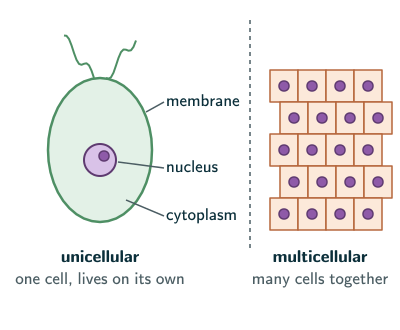
- All cellular organisms are made of cells. NCERT treats acellular viruses separately in Chapter 2. Unicellular organisms are a single cell; multicellular organisms, like us, are made of many cells (page 87).
In plain words: the cell is the smallest complete unit of cellular life. A free-living unicellular organism carries out its essential functions within one cell, given suitable surroundings; an isolated organelle cannot do this. This does not mean every cell can live alone: specialised cells in a multicellular body depend on other cells, and parasitic organisms may depend on hosts. That is why the cellular organisation of living things is one of the features that define life.
Why the cell is the unit of life
NCERT’s argument has two steps (page 87):
- Unicellular organisms are capable of (i) independent existence and (ii) performing the essential functions of life.
- Anything less than a complete structure of a cell does not ensure independent living.
So the cell is the fundamental structural and functional unit of all living organisms.
How cells were discovered
- Antonie van Leeuwenhoek first saw and described a live cell. NCERT prints his name “Antonie Von Leeuwenhoek”; the Dutch spelling is van.
- Robert Brown later discovered the nucleus.
- The invention of the microscope, and its improvement up to the electron microscope, revealed progressively finer structural details of the cell (page 87).
Beyond the NCERT text, as documented in the University of Glasgow’s account of Hooke’s Micrographia: the word “cell” was first used by Robert Hooke in 1665 for the tiny compartments he saw in a thin slice of cork; those were the walls of dead cells, which is why Leeuwenhoek is credited with the first live cell. NCERT dates Robert Brown’s description of the nucleus to 1831 (Section 8.5.10, page 100).
Solved examples
Example 1: Why the cell?
Why does NCERT call the cell the fundamental structural and functional unit of life?
Answer: because unicellular organisms, single cells, can exist independently and perform all the essential functions of life, while anything less than a complete cell cannot live independently (NCERT page 87).
Example 2: Who discovered what?
Match: (a) first saw and described a live cell; (b) discovered the nucleus.
Answer: (a) Antonie van Leeuwenhoek; (b) Robert Brown (NCERT page 87).
Example 3: Unicellular or multicellular?
How is a unicellular organism different from a multicellular one?
Answer: a unicellular organism is a single cell that carries out all the functions of life; a multicellular organism is made of many cells (NCERT page 87).
Example 4: Hooke or Leeuwenhoek?
Robert Hooke named the cell, so why is Leeuwenhoek credited with the first live cell?
Answer: Hooke saw the empty walls of dead cork cells; Leeuwenhoek saw and described living cells (NCERT page 87; the Hooke detail is beyond the NCERT text).
Common mistakes to avoid
Common mistake
Saying Robert Brown discovered the cell
Robert Brown discovered the nucleus (NCERT page 87). Leeuwenhoek first saw and described a live cell; the word “cell” goes back to Robert Hooke (1665, beyond the NCERT text).
Common mistake
Calling a cell part a unit of life
An organelle, such as a nucleus or a mitochondrion, cannot live on its own; only a complete cell can.
Common mistake
Thinking the light microscope showed everything
The structural details of the cell were revealed only as microscopes improved, up to the electron microscope.
Quick revision summary
- Cells are the basic units of cellular life; dead cells alone are not evidence that an organism is alive.
- Unicellular organisms: one cell performs essential life functions in suitable conditions; multicellular organisms: many interdependent cells.
- Anything less than a complete cell cannot live independently, so the cell is the fundamental structural and functional unit of life.
- Leeuwenhoek first saw and described a live cell; Robert Brown discovered the nucleus; the electron microscope revealed fine structure.
Formula sheet
- cell: fundamental structural and functional unit of life
- unicellular: one cell performs essential life functions
- multicellular: many cells
- Leeuwenhoek: first live cell; Robert Brown: nucleus
Questions students ask
What is the difference between unicellular and multicellular organisms?
Unicellular organisms consist of a single cell, which is capable of independent existence and of performing the essential functions of life, while multicellular organisms, like us, are composed of many cells (NCERT page 87). Bacteria, Amoeba and yeast are unicellular; humans, frogs and flowering plants are multicellular. In sexual reproduction, a multicellular organism develops from a single-celled zygote and grows by cell division.
What is division of labour in multicellular organisms?
Division of labour in multicellular organisms means that different cells, and the tissues and organs they form, are specialised for different functions and work together, so no single cell has to carry out every function of life, as the one cell of a unicellular organism must. NCERT notes that the shape of a cell may vary with the function it performs, as in the long, branched nerve cells (page 89). The division grows with the level of organisation: NCERT Chapter 4 finds only some division of labour among the loosely aggregated cells of sponges, while in coelenterates cells doing the same function form tissues.
Are all unicellular organisms prokaryotic?
Not all unicellular organisms are prokaryotic: bacteria are unicellular prokaryotes, but protists such as Amoeba, Euglena and Paramoecium, and fungi such as yeast, are unicellular eukaryotes, with a membrane-bound nucleus. NCERT Chapter 2 gives a broad single-celled description of Protista but explicitly places yeasts in Fungi; “unicellular eukaryote” alone therefore does not establish kingdom membership, and Chapter 8 says the eukaryotes include all the protists, plants, animals and fungi (page 91). Being a single cell says nothing about the kind of cell: a prokaryotic cell has the bacterial or archaeal organisation without a membrane-bound nucleus. A specialised eukaryotic cell that loses its nucleus does not become prokaryotic.
Is Cell: The Unit of Life in the NEET 2026 syllabus?
Cell: The Unit of Life is in the NEET (UG) 2026 Biology syllabus: Unit 3, Cell Structure and Function, opens with “Cell theory and cell as the basic unit of life; Structure of prokaryotic and eukaryotic cell; Plant cell and animal cell”. That point goes on to the cell envelope, the organelles from the endomembrane system to microbodies, the cytoskeleton, cilia, flagella and centrioles (“ultra structure and function”) and the nucleus, all in NCERT Class 11 Biology, Chapter 8. The unit’s other two points, biomolecules and cell division, are NCERT Chapters 9 and 10.
Practice questions
Try each question first, then open the answer to check your working.
-
Q1. What two abilities of unicellular organisms does NCERT name?
Show answerHide answer
Independent existence, and performing the essential functions of life (NCERT page 87).
-
Q2. Which advance in microscopy revealed finer internal cell structure?
Show answerHide answer
The microscope, improved up to the electron microscope (NCERT page 87).
-
Q3. NCERT Exercise 1 (page 103): which is not correct? (a) Robert Brown discovered the cell. (b) Schleiden and Schwann formulated the cell theory. (c) Virchow explained that cells are formed from pre-existing cells. (d) A unicellular organism carries out its life activities within a single cell.
Show answerHide answer
(a): Robert Brown discovered the nucleus, not the cell (NCERT page 87); (b), (c) and (d) are correct (NCERT pages 87–88).
-
Q4. Can a nucleus taken out of a cell live on its own?
Show answerHide answer
No: anything less than a complete structure of a cell does not ensure independent living (NCERT page 87).