Cell theory
NCERT Class 11 Biology Chapter 8 Section 8.2
Quick answer
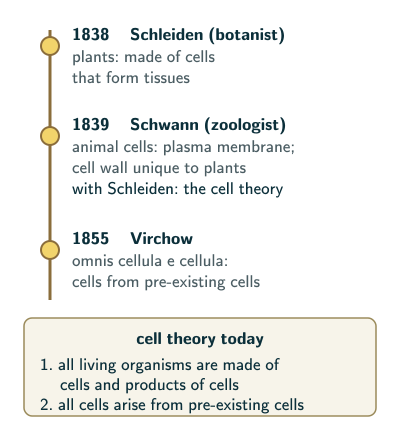
Schleiden (1838) found that plants are made of cells, and Schwann (1839) that animal cells have a thin outer layer, today called the plasma membrane; together they formulated the cell theory, that animals and plants are made of cells and products of cells. It did not explain how new cells form, until Virchow (1855) showed that cells arise from pre-existing cells. Today the theory says all living organisms are made of cells and products of cells, and all cells arise from pre-existing cells.
With your textbook
NCERT Biology (Class 11), Chapter 8 “Cell: The Unit of Life”, Section 8.2 “Cell Theory”, pages 87–88.
Open the official NCERT chapter (PDF, 7.0 MB, ncert.nic.in) (opens in a new tab)
Checked against the 2026-27 reprint on .
What is the cell theory?
The cell theory
Schleiden and Schwann together formulated the cell theory.
NCERT Biology (Class 11), Section 8.2, page 88
Rudolf Virchow (1855) added that new cells come from pre-existing cells and gave the theory its final shape. The cell theory, as understood today (NCERT page 88):
- All living organisms are composed of cells and products of cells.
- All cells arise from pre-existing cells.
In plain words: every living thing is built of cells (and of what cells make, such as bone matrix or a cell wall), and every cell comes from a cell that already existed. This describes how cells arise in present-day reproduction; it does not explain the origin of the first cells. The theory explains why the cell is the unit of life. The first tenet goes back to Schwann’s hypothesis (1839); the second is Virchow’s addition (1855).
Schleiden and Schwann
- In 1838, Matthias Schleiden, a German botanist, examined a large number of plants and observed that all plants are composed of different kinds of cells, which form the tissues of the plant (page 87).
- At about the same time, Theodor Schwann (1839), a German zoologist, studied different types of animal cells and reported that cells had a thin outer layer, today known as the plasma membrane. Based on his studies of plant tissues, he also concluded that the presence of a cell wall distinguishes plant cells from the animal cells he studied (page 88). This historical plant–animal comparison does not mean only plants have walls: NCERT also describes fungal and bacterial walls.
- On this basis Schwann proposed the hypothesis that the bodies of animals and plants are composed of cells and products of cells. Schleiden and Schwann together formulated the cell theory (page 88).
NCERT spells his first name “Theodore”; the usual spelling is Theodor.
Virchow’s addition
This theory however, did not explain as to how new cells were formed.
NCERT Biology (Class 11), Section 8.2, page 88
In NCERT’s historical account, Rudolf Virchow (1855) explained that cells divide and that new cells are formed from pre-existing cells: omnis cellula e cellula, which NCERT prints as “Omnis cellula-e cellula” (page 88). He modified the hypothesis of Schleiden and Schwann and gave the cell theory its final shape.
Solved examples
Example 1: The two tenets
State the cell theory as it is understood today.
Answer: (i) all living organisms are composed of cells and products of cells; (ii) all cells arise from pre-existing cells (NCERT page 88).
Example 2: What was missing?
What did the cell theory of Schleiden and Schwann fail to explain, and who supplied it?
Answer: how new cells are formed; Rudolf Virchow (1855) explained that cells divide and new cells form from pre-existing cells (NCERT page 88).
Example 3: Match the scientist
Match: (a) all plants are made of cells forming tissues; (b) a thin outer layer, the plasma membrane, in animal cells; (c) omnis cellula e cellula.
Answer: (a) Schleiden, 1838; (b) Schwann, 1839; (c) Virchow, 1855 (NCERT pages 87–88).
Example 4: “Products of cells”
Why does the cell theory say “cells and products of cells”, not just “cells”?
Answer: because bodies also contain material that cells make but that is not itself cellular; Schwann’s hypothesis already spoke of cells and products of cells (NCERT page 88). Examples: the cell wall, which NCERT calls a non-living rigid structure (Section 8.5.2, page 94), and, beyond the NCERT text, the matrix of bone.
Common mistakes to avoid
Common mistake
Crediting Virchow with formulating the cell theory
Schleiden and Schwann formulated it; Virchow added that cells arise from pre-existing cells and gave it its final shape.
Common mistake
Swapping botanist and zoologist
Schleiden was the botanist (plants); Schwann the zoologist (animals).
Common mistake
Dropping “products of cells”
The first tenet is that organisms are composed of cells and products of cells.
Common mistake
Forgetting that viruses are not cells
Viruses have no cell structure, so the cell theory does not cover them; NCERT says they are not considered truly ‘living’ if living means having a cell structure (Section 2.6, page 19). Questions sometimes describe acellular viruses as an exception; more precisely, they lie outside cellular life rather than contradicting cell division.
Quick revision summary
- Schleiden (1838, botanist): all plants are composed of different kinds of cells forming tissues.
- Schwann (1839, zoologist): animal cells have a thin outer layer (plasma membrane); a cell wall distinguishes plants from animals in his comparison; animals and plants are composed of cells and products of cells.
- Schleiden and Schwann together formulated the cell theory, which did not explain how new cells form.
- Virchow (1855): cells divide and new cells form from pre-existing cells (omnis cellula e cellula); he gave the theory its final shape.
- Today: all living organisms are composed of cells and products of cells; all cells arise from pre-existing cells.
Formula sheet
- 1838 Schleiden: plants made of cells
- 1839 Schwann: plasma membrane; plant–animal wall comparison
- 1855 Virchow: omnis cellula e cellula
- tenet 1: organisms made of cells and products of cells
- tenet 2: all cells arise from pre-existing cells
Questions students ask
Who proposed the cell theory, and when?
The cell theory was proposed by Matthias Schleiden, a German botanist, and Theodor Schwann, a German zoologist: NCERT says they together formulated it, after Schleiden found in 1838 that all plants are composed of cells and Schwann studied animal cells in 1839. Rudolf Virchow (1855) did not formulate it; he modified it, adding that new cells are formed from pre-existing cells, and gave it its final shape. Robert Brown, who discovered the nucleus, and Leeuwenhoek, who first saw a live cell, had no part in proposing it.
What is the difference between the classical and the modern cell theory?
The classical cell theory of Schleiden and Schwann (1838–1839) held that the bodies of animals and plants are composed of cells and products of cells, but it did not explain how new cells were formed. The modern cell theory, which NCERT calls the cell theory “as understood today”, extends this to all living organisms and adds Virchow’s point (1855) that all cells arise from pre-existing cells, omnis cellula e cellula (NCERT prints “Omnis cellula-e cellula”). Beyond the NCERT text, the Latin means ‘every cell from a cell’, and some books add further tenets, such as that cells pass on hereditary information (DNA) when they divide.
What are the exceptions and limitations of the cell theory?
The main exception to the cell theory is viruses: NCERT calls them non-cellular organisms with an inert crystalline structure outside the living cell, not truly ‘living’ if living means having a cell structure (Chapter 2, page 19). The main limitation of the original theory of Schleiden and Schwann was that it did not explain how new cells were formed, which Virchow (1855) supplied. Beyond the NCERT Class 11 text, the theory also cannot explain how the first cell arose: NCERT Class 12 (Evolution) notes that proving life comes only from pre-existing life “did not answer how the first life form came on earth”.
Was Schwann a British or a German zoologist?
Theodor Schwann was a German zoologist: the current NCERT reprint (2026–27) calls him “a German Zoologist”, and Matthias Schleiden “a German botanist” (Section 8.2, pages 87–88). Older NCERT reprints, such as 2021–22, printed “a British Zoologist”, an error still found in some notes and question banks. Beyond the NCERT text, Schwann was born in Neuss, in today’s Germany, and did his studies of animal cells in Berlin; a question on his nationality expects German.
How does the cell theory reject spontaneous generation?
The cell theory rejects spontaneous generation through its second tenet, that all cells arise from pre-existing cells (Virchow, 1855), in present-day cell reproduction. It does not rule out the ancient chemical origin of the first life. Spontaneous generation was the old belief that life came out of decaying and rotting matter like straw and mud; NCERT Class 12 (Evolution) credits Louis Pasteur with showing, by careful experiments with pre-sterilised flasks, that life comes only from pre-existing life. Pasteur’s experiments tested contamination and growth in those conditions; neither account supplies a mechanism for the first cell’s origin.
Practice questions
Try each question first, then open the answer to check your working.
-
Q1. NCERT Exercise 2 (page 103): new cells generate from (a) bacterial fermentation, (b) regeneration of old cells, (c) pre-existing cells, (d) abiotic materials. Which is right?
Show answerHide answer
(c): all cells arise from pre-existing cells, Virchow’s omnis cellula e cellula (NCERT page 88).
-
Q2. What did Schwann conclude about the cell wall?
Show answerHide answer
In his plant–animal comparison, that a cell wall characterises plant cells (NCERT page 88). Fungi and many prokaryotes also have walls, so this is not a universal claim that walls occur only in plants.
-
Q3. What does “omnis cellula e cellula” mean?
Show answerHide answer
All cells arise from pre-existing cells (NCERT page 88).
-
Q4. Who gave the cell theory its final shape?
Show answerHide answer
Rudolf Virchow (NCERT page 88).