An overview of the cell
NCERT Class 11 Biology Chapter 8 Section 8.3
Quick answer
Typical eukaryotic cells have a membrane-bound nucleus and organelles such as ER and Golgi; prokaryotes lack this organisation, while both types use ribosomes. Specialised eukaryotic cells can lose their nuclei. NCERT gives mycoplasmas at 0.3 µm, human red cells at about 7 µm and the ostrich ovum as the largest isolated single cell.
With your textbook
NCERT Biology (Class 11), Chapter 8 “Cell: The Unit of Life”, Section 8.3 “An Overview of Cell”, pages 88–89.
Open the official NCERT chapter (PDF, 7.0 MB, ncert.nic.in) (opens in a new tab)
Checked against the 2026-27 reprint on .
An overview of the cell
Prokaryotic and eukaryotic cells
Cells that have membrane bound nuclei are called eukaryotic whereas cells that lack a membrane bound nucleus are prokaryotic.
NCERT Biology (Class 11), Section 8.3, page 88
- In both kinds of cell, a semi-fluid matrix, the cytoplasm, fills the volume of the cell (page 88).
- Eukaryotic cells also have other membrane-bound organelles; prokaryotic cells lack them. Ribosomes, which have no membrane, occur in both prokaryotic and eukaryotic cells (page 88). These are general cell plans; mature specialised cells may lose components.
In plain words: every cell is a bag of cytoplasm wrapped in a membrane. The typical distinction is whether the DNA sits inside its own membrane-bound nucleus (eukaryotic) or lies free in the cytoplasm (prokaryotic, as in bacteria). This classifies cellular organisation, not just the presence of a nucleus in one mature cell: specialised mammalian red cells remain eukaryotic after losing their nuclei.
Onion cells and cheek cells
NCERT recalls two cells seen under the microscope (page 88):
- The onion cell, a typical plant cell, has a distinct cell wall as its outer boundary, and just within it the cell membrane.
- The human cheek cell has an outer membrane as the boundary of the cell; it has no cell wall.
- Inside each is a dense, membrane-bound nucleus. The nucleus contains the chromosomes, which in turn contain the genetic material, DNA.
Cytoplasm and organelles
The cytoplasm is the main arena of cellular activities in both the plant and animal cells.
NCERT Biology (Class 11), Section 8.3, page 88
Various chemical reactions take place in the cytoplasm to keep the cell in the “living state” (page 88).
| Prokaryotic cell | Eukaryotic cell |
|---|---|
| no nuclear membrane | nucleus with a membrane |
| no membrane-bound organelles | membrane-bound organelles |
| ribosomes | ribosomes |
- Membrane-bound organelles of eukaryotic cells, besides the nucleus, include the endoplasmic reticulum (ER), the Golgi complex, lysosomes, mitochondria, microbodies and vacuoles (page 88). NCERT’s list gives examples: plant cells also have chloroplasts, which are double membrane bound (Section 8.5.5, page 98).
- Ribosomes are non-membrane-bound organelles found in both eukaryotic and prokaryotic cells. Inside a cell they occur in the cytoplasm, within two organelles, chloroplasts (in plants) and mitochondria, and on the rough ER (page 88). NCERT adds later that the outer membrane of the nuclear envelope also bears ribosomes (Section 8.5.10, page 100), and that ribosomes are 70S in prokaryotes, mitochondria and chloroplasts but 80S in the eukaryotic cytoplasm (pages 91, 97–98). Beyond NCERT, Sharma and colleagues’ 2003 cryo-EM study shows mammalian mitochondrial ribosomes are 55S; the textbook’s mitochondrial 70S value is a simplified generalisation.
- Centrosome: animal cells have another non-membrane-bound organelle, the centrosome, which helps in cell division (page 88). NCERT adds later that a centrosome usually contains two cylindrical structures called centrioles (Section 8.5.9, page 99), and that centrioles are absent in almost all plant cells (Section 8.5, page 91).
Size of cells
Cells differ greatly in size, shape and activities (page 88):
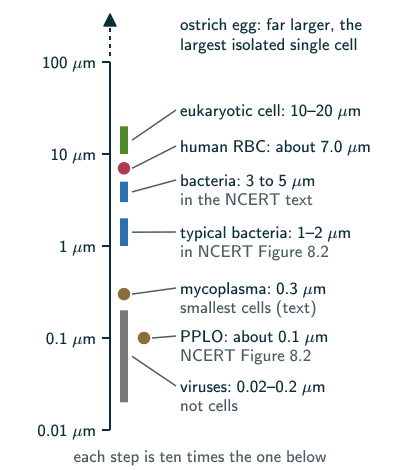
- Mycoplasmas, the smallest cells, are only 0.3 µm in length (page 88); they are the one prokaryote NCERT names with no cell wall (Section 8.4, page 90).
- Bacteria could be 3 to 5 µm (page 89). NCERT’s Figure 8.2 (page 90) labels “typical bacteria” 1–2 µm. Both numbers are NCERT’s: prokaryotes “may vary greatly in shape and size” (Section 8.4, page 89).
- The largest isolated single cell is the egg of an ostrich (page 89).
- Among multicellular organisms, human red blood cells are about 7.0 µm in diameter (page 89).
- Nerve cells are some of the longest cells (page 89).
NCERT’s Figure 8.2 also shows a typical eukaryotic cell as 10–20 µm, PPLO as about 0.1 µm, and viruses as 0.02–0.2 µm (page 90). NCERT lists “mycoplasma and PPLO” side by side among prokaryotes (Section 8.4, page 89), so a question on the smallest cells may use either name. Beyond the NCERT text: PPLO (pleuropneumonia-like organisms) is an older name for mycoplasmas, so the 0.3 µm of the text and the 0.1 µm of the figure describe the same group, whose cells differ in size; viruses are not cells at all.
Beyond the NCERT text, as outlined by Penn State Extension in Hen Reproduction: in a bird’s egg, the single cell is the ovum, the yolk with its thin membrane and the small germinal disc on it. The white, the shell membranes and the shell are added by the oviduct after the ovum leaves the ovary, and are not part of the cell. If the egg is fertilised, the cell starts dividing before the egg is laid.
Shape of cells
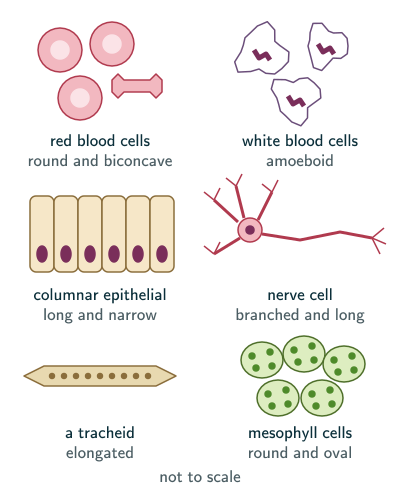
Cells also vary greatly in shape. They may be disc-like, polygonal, columnar, cuboid, thread-like, or even irregular (page 89).
The shape of the cell may vary with the function they perform.
NCERT Biology (Class 11), Section 8.3, page 89
NCERT’s Figure 8.1 (page 89) shows six examples: red blood cells (round and biconcave), white blood cells (amoeboid), columnar epithelial cells (long and narrow), a nerve cell (branched and long), a tracheid (elongated) and mesophyll cells (round and oval).
Solved examples
Example 1: Onion cell or cheek cell?
What forms the outer boundary of an onion cell, and of a human cheek cell?
Answer: the onion cell has a cell wall as its outer boundary, with the cell membrane just within it; the cheek cell has only an outer membrane (NCERT page 88).
Example 2: Which kind of cell?
A self-reproducing bacterial cell has ribosomes but no membrane-bound nucleus or eukaryotic membrane-bound organelles. Is it prokaryotic or eukaryotic?
Answer: prokaryotic: it lacks a membrane-bound nucleus, and ribosomes, which have no membrane, occur in both major cell types (NCERT page 88).
Example 3: Where are ribosomes?
List the places where ribosomes are found in a plant cell.
Answer: in the cytoplasm, within the chloroplasts and the mitochondria, and on the rough ER (NCERT page 88); NCERT later adds the outer membrane of the nuclear envelope (Section 8.5.10, page 100).
Example 4: Order by size
Arrange in increasing size: a human red blood cell, a mycoplasma, a typical eukaryotic cell, a bacterium of 3 to 5 µm.
Answer: mycoplasma (0.3 µm) < bacterium (3 to 5 µm) < human red blood cell (about 7.0 µm) < typical eukaryotic cell (10–20 µm) (NCERT pages 88–90).
Example 5: How many times larger?
About how many times the length of a mycoplasma is the diameter of a human red blood cell?
Answer: 7.0 µm ÷ 0.3 µm ≈ 23, so about 23 times (sizes from NCERT pages 88–89).
Common mistakes to avoid
Common mistake
Calling ribosomes membrane-bound, or absent in prokaryotes
Ribosomes have no membrane and occur in both prokaryotic and eukaryotic cells (NCERT page 88).
Common mistake
Saying plant cells have no cell membrane
A plant cell has a cell membrane just within its cell wall (NCERT page 88).
Common mistake
Thinking every eukaryotic cell has a nucleus
Some mature cells lose it: NCERT names the erythrocytes of many mammals and the sieve tube cells of vascular plants (Section 8.5.10, page 100). A mature human red blood cell has no nucleus, yet it is a eukaryotic cell.
Common mistake
Calling a virus the smallest cell
Viruses are not cells. The smallest cells are the mycoplasmas (NCERT page 88); NCERT does not count viruses as truly living, as they have no cell structure (Chapter 2, page 19).
Quick revision summary
- Eukaryotic cells have a membrane-bound nucleus; prokaryotic cells do not. Both have cytoplasm, the main arena of cellular activities.
- Onion cell: cell wall outside, cell membrane within; cheek cell: outer membrane only; the nucleus holds chromosomes with DNA.
- Membrane-bound organelles (eukaryotes only) include the ER, Golgi complex, lysosomes, mitochondria, microbodies, vacuoles and, in plants, chloroplasts. Ribosomes, with no membrane, occur in both major cell types; the centrosome is in animal cells.
- Sizes: mycoplasma 0.3 µm (smallest); bacteria 3 to 5 µm; human RBC about 7.0 µm; nerve cells among the longest; the ostrich egg the largest isolated single cell.
- Shapes: disc-like, polygonal, columnar, cuboid, thread-like or irregular; shape may vary with function.
Formula sheet
- eukaryotic: membrane-bound nucleus and organelles
- prokaryotic: no membrane-bound nucleus or organelles
- ribosomes: no membrane; present in both major cell types
- smallest cells: mycoplasmas, 0.3 µm
- largest isolated single cell: ostrich egg
- human RBC: about 7.0 µm across
Questions students ask
What is the difference between prokaryotic and eukaryotic cells?
The main difference between prokaryotic and eukaryotic cells is the nucleus: NCERT says cells that have membrane bound nuclei are called eukaryotic whereas cells that lack a membrane bound nucleus are prokaryotic, whose genetic material is not enclosed in a nuclear membrane. A mature mammalian red cell is an exception to the nucleus-present shortcut; it remains eukaryotic. Only eukaryotic cells have other membrane-bound organelles, such as the ER, Golgi complex and mitochondria; both have ribosomes, but these are 70S in prokaryotes and 80S in the eukaryotic cytoplasm. Prokaryotes, such as bacteria, blue-green algae and mycoplasma, are generally smaller and multiply faster; protists, plants, animals and fungi are eukaryotes.
What do prokaryotic and eukaryotic cells have in common?
The typical prokaryotic and eukaryotic cell plans both have a plasma membrane, cytoplasm, ribosomes and DNA as their genetic material: NCERT says that in both a semi-fluid matrix, the cytoplasm, occupies the volume of the cell, and that ribosomes, which have no membrane, occur in both groups. The prokaryotic plasma membrane is structurally similar to that of eukaryotes, and in both kinds of cell ribosomes are the site of protein synthesis (NCERT pages 88–91). Most prokaryotes have a cell wall outside the membrane, as plant and fungal cells do, though wall chemistry differs; animal cells have none. Mycoplasmas are NCERT’s wall-less example. Beyond NCERT, Ruepp and colleagues’ 2000 genome study describes wall-less archaea of the genus Thermoplasma too.
What is the difference between membrane-bound and non-membrane-bound organelles?
Membrane-bound organelles are enclosed by one or two membranes and are found only in eukaryotic cells, while non-membrane-bound organelles have no membrane of their own. In NCERT, the nucleus, mitochondria and chloroplasts are bounded by two membranes, lysosomes and vacuoles (the tonoplast) by a single membrane, and the ER, Golgi complex and microbodies are also membrane-bound. Ribosomes are non-membrane-bound and occur in both prokaryotic and eukaryotic cells, and the centrosome of animal cells and the nucleolus inside the nucleus also have no membrane (NCERT pages 88 and 100).
Which is the smallest cell and which is the largest cell?
According to NCERT, the smallest cells are mycoplasmas, only 0.3 µm in length, and the largest isolated single cell is the egg of an ostrich; nerve cells are some of the longest cells (pages 88–89). NCERT’s Figure 8.2 also shows PPLO at about 0.1 µm and viruses at 0.02–0.2 µm, but viruses are not cells. Beyond the NCERT text, PPLO is an older name for mycoplasmas, and in the ostrich egg only the yolk with its thin membrane is the cell: the white and the shell are added around it in the oviduct.
Practice questions
Try each question first, then open the answer to check your working.
-
Q1. Name the non-membrane-bound organelle that animal cells have and that helps in cell division.
Show answerHide answer
The centrosome (NCERT page 88).
-
Q2. Which cells does NCERT call some of the longest cells?
Show answerHide answer
Nerve cells are some of the longest cells (NCERT page 89).
-
Q3. What does the nucleus contain?
Show answerHide answer
The chromosomes, which in turn contain the genetic material, DNA (NCERT page 88).
-
Q4. Give the shape NCERT’s Figure 8.1 gives for white blood cells, and for a tracheid.
Show answerHide answer
White blood cells: amoeboid; a tracheid: elongated (NCERT page 89).