Viruses, viroids, prions and lichens
NCERT Class 11 Biology Chapter 2 Section 2.6
Quick answer
NCERT discusses acellular viruses, viroids and prions separately from its five cellular kingdoms. Viruses have an RNA or DNA genome and depend on host cells for replication; viroids are uncoated RNA agents, while prions are infectious misfolded proteins. Lichens are fungal–photosynthetic associations whose partners retain their taxonomic placements; sensitive lichen species can indicate pollution, but tolerance varies.
With your textbook
NCERT Biology (Class 11), Chapter 2 “Biological Classification”, Section 2.6 “Viruses, Viroids, Prions and Lichens”, pages 19–21.
Open the official NCERT chapter (PDF, 3.3 MB, ncert.nic.in) (opens in a new tab)
Checked against the 2026-27 reprint on .
Why these four stand outside the five kingdoms
Viruses, viroids, prions and lichens
In the five kingdom classification of Whittaker there is no mention of lichens and some acellular organisms like viruses, viroids and prions.
NCERT Biology (Class 11), Section 2.6, page 19
- Viruses: non-cellular nucleoproteins that replicate only inside a living host cell.
- Viroids: free RNA without a protein coat.
- Prions: infectious agents made of abnormally folded protein.
- Lichens: associations of a fungus with a photosynthetic partner, described by NCERT as an alga.
In plain words: Whittaker’s kingdoms classify cellular organisms, so agents with no cells (viruses, viroids, prions) have no place in them, and lichens, partnerships of two organisms, are not mentioned. NCERT introduces them briefly at the end of Chapter 2. A lichen is not an acellular agent or a separate kingdom: its partners retain their respective taxonomic placements.
Viruses
Viruses did not find a place in classification since they are not considered truly ‘living’, if we understand living as those organisms that have a cell structure.
NCERT Biology (Class 11), Section 2.6, page 19
The viruses are non-cellular organisms that are characterised by having an inert crystalline structure outside the living cell.
NCERT Biology (Class 11), Section 2.6, page 19
Once they infect a cell, they take over the machinery of the host cell to replicate themselves, killing the host.
NCERT Biology (Class 11), Section 2.6, page 20
Beyond NCERT’s summary: infection does not always kill the host cell, and extracellular virus particles are not all literal crystals. Medical Microbiology on NCBI Bookshelf describes persistent infections in which viral material remains in living cells. Crystallisation is a laboratory observation for viruses such as tobacco mosaic virus.
Discovery (page 20). The word virus means venom or poisonous fluid.
- Dmitri Ivanowsky (1892) recognised certain microbes as the cause of the mosaic disease of tobacco; they were found to be smaller than bacteria because they passed through bacteria-proof filters.
- M.W. Beijerinck (1898) showed that the extract of infected tobacco plants could infect healthy plants, named the new pathogen “virus” and called the fluid Contagium vivum fluidum (infectious living fluid).
- W.M. Stanley (1935) showed that viruses could be crystallised, and that the crystals consist largely of proteins.
Structure and genetic material (page 20). Viruses are inert outside their specific host cell and are obligate parasites. Besides protein, a virus contains genetic material, either RNA or DNA:
No virus contains both RNA and DNA. A virus is a nucleoprotein and the genetic material is infectious.
NCERT Biology (Class 11), Section 2.6, page 20
In general, viruses that infect plants have single stranded RNA and viruses that infect animals have either single or double stranded RNA or double stranded DNA.
NCERT Biology (Class 11), Section 2.6, page 20
Here RNA or DNA refers to the genome, not every molecule present or every stage of infection. NCERT Class 12 describes HIV using an RNA genome to make a DNA intermediate; that does not make it a virus with two genome types. Bacterial viruses, or bacteriophages, are usually double-stranded DNA viruses in NCERT’s summary. The protein coat, the capsid, is made of small subunits called capsomeres, arranged in helical or polyhedral geometric forms, and it protects the nucleic acid (page 20).
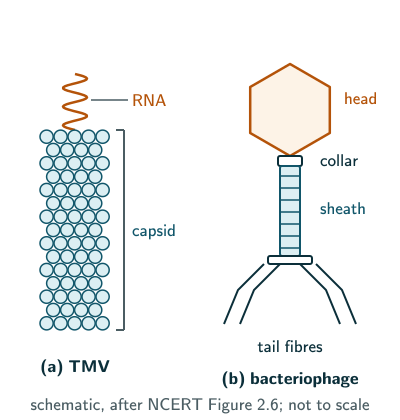
Diseases (pages 20–21). NCERT lists mumps, smallpox, herpes, influenza and AIDS as human viral diseases. Beyond NCERT: smallpox is a historical example, not a currently common disease; WHO declared it eradicated in 1980. In plants, the symptoms can be mosaic formation, leaf rolling and curling, yellowing and vein clearing, dwarfing and stunted growth.
Viroids
In 1971, T.O. Diener discovered an infectious agent smaller than viruses that caused potato spindle tuber disease (page 21).
It was found to be a free RNA; it lacked the protein coat that is found in viruses, hence the name viroid.
NCERT Biology (Class 11), Section 2.6, page 21
The RNA of the viroid was of low molecular weight.
Prions
Prions are infectious agents involving abnormally folded protein. NCERT gives bovine spongiform encephalopathy (BSE, mad cow disease) in cattle and “Creutzfeldt–Jacob disease (CJD)” in humans (page 21). Beyond NCERT: the standard spelling is Creutzfeldt–Jakob disease. CDC distinguishes classic CJD from variant CJD (vCJD), the disease linked to BSE exposure; they are not interchangeable. Prions are defined by their protein nature and ability to propagate misfolding, not a fixed size comparable to all viruses.
Lichens
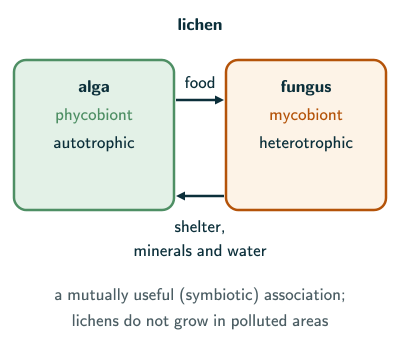
Lichens are symbiotic, that is mutually useful, associations between algae and fungi (page 21).
The algal component is known as phycobiont and fungal component as mycobiont, which are autotrophic and heterotrophic, respectively.
NCERT Biology (Class 11), Section 2.6, page 21
The alga prepares food for the fungus, and the fungus provides shelter and absorbs mineral nutrients and water for its partner. The association is so close that a lichen looks like a single organism. NCERT calls lichens pollution indicators and says they do not grow in polluted areas (page 21). Beyond that simplified statement, USDA Forest Service studies distinguish pollution-sensitive and pollution-tolerant species: the presence of a lichen alone does not prove clean air. The Forest Service also describes photosynthetic partners as green algae, cyanobacteria or both.
Solved examples
Example 1: Viroids against viruses (NCERT Exercise Q5)
How are viroids different from viruses?
Answer: a viroid is a free RNA with no protein coat, of low molecular weight, and smaller than a virus; a virus has a protein coat (capsid) around its RNA or DNA (NCERT pages 20–21).
Example 2: Phycobiont and mycobiont (NCERT Exercise Q8)
What do the terms phycobiont and mycobiont signify?
Answer: the algal and the fungal partner of a lichen; the phycobiont is autotrophic and prepares food, the mycobiont is heterotrophic and provides shelter and absorbs mineral nutrients and water (NCERT page 21).
Example 3: A brief account of viruses (NCERT Exercise Q11)
Give a brief account of viruses with respect to their structure and nature of genetic material, and name four viral diseases mentioned by NCERT.
Answer: viruses are non-cellular nucleoproteins: a protein capsid of capsomeres, arranged in helical or polyhedral forms, protects a genome made of either RNA or DNA. Plant viruses generally have single-stranded RNA; animal viruses single- or double-stranded RNA or double-stranded DNA; bacteriophages usually double-stranded DNA. Diseases: mumps, smallpox, herpes and influenza (also AIDS) (NCERT page 20). Smallpox is now eradicated, as explained above.
Example 4: Living or non-living? (NCERT Exercise Q12)
NCERT asks the class to discuss: are viruses living or non-living?
Answer: non-living side: they have no cell structure, so they are not truly living if living means having a cell structure; outside a host cell they are inert, and they can be crystallised. Living side: inside a host cell they take over its machinery and replicate, and their genetic material is infectious. NCERT leaves the verdict open (pages 19–20); beyond the NCERT text, viruses are often described as on the borderline between living and non-living (see what is living?).
Example 5: Who discovered what?
Match Ivanowsky, Beijerinck, Stanley and Diener with their discoveries.
Answer: Ivanowsky (1892): microbes causing tobacco mosaic, smaller than bacteria; Beijerinck (1898): the infectious extract, Contagium vivum fluidum; Stanley (1935): viruses crystallised, crystals largely protein; Diener (1971): viroids (potato spindle tuber disease) (NCERT pages 20–21).
Example 6: Lichens and pollution
Why are lichens useful to environmental scientists?
Answer: changes in sensitive lichen species and community composition can indicate air pollution. NCERT’s statement that they do not grow in polluted areas (page 21) is a simplification: some species tolerate pollution, so one lichen is not proof of clean air.
Common mistakes to avoid
Common mistake
Confusing genome type with replication intermediates
A viral genome is classified as RNA or DNA. An RNA virus such as HIV can nevertheless make a DNA intermediate during replication; the genome rule does not prohibit every occurrence of the other nucleic acid.
Common mistake
Calling viroids small viruses
Viroids lack the protein coat that viruses have; they are free RNA.
Common mistake
Calling prions viruses
Prions are infectious protein agents; they have no nucleic-acid genome. Size is not the defining distinction from viruses.
Common mistake
Swapping phycobiont and mycobiont
The phycobiont is the alga (autotrophic); the mycobiont is the fungus (heterotrophic).
Quick revision summary
- Whittaker’s five kingdoms make no mention of lichens or of acellular viruses, viroids and prions.
- Viruses: acellular, dependent on host cells for replication; a capsid protects an RNA or DNA genome. NCERT’s crystallisation description is not a claim that every extracellular particle is a crystal.
- History: Ivanowsky (1892), Beijerinck (1898, Contagium vivum fluidum), Stanley (1935, crystallised).
- Viroids (Diener, 1971): free low-molecular-weight RNA without a protein coat; potato spindle tuber disease.
- Prions: infectious misfolded-protein agents; BSE in cattle and CJD in humans. BSE is linked specifically to variant CJD, which differs from classic CJD.
- Lichens: alga (phycobiont, autotrophic) and fungus (mycobiont, heterotrophic) in a mutually useful association; good pollution indicators.
Formula sheet
- virus: protein capsid + an RNA or DNA genome
- plant viruses: usually ssRNA; bacteriophages: usually dsDNA
- viroid: free RNA, no protein coat
- prion: abnormally folded protein
- lichen: phycobiont (alga) + mycobiont (fungus)
Questions students ask
What is the difference between viroids and prions?
A viroid is a free RNA without the protein coat of a virus, while a prion is an infectious agent consisting of abnormally folded protein. Viroids are smaller than viruses and were discovered by T.O. Diener in 1971 as the cause of potato spindle tuber disease; prions can transmit neurological disease, such as bovine spongiform encephalopathy (mad cow disease) in cattle and Creutzfeldt–Jakob disease (CJD) in humans. A virus has both parts: a protein capsid around RNA or DNA.
What is the difference between a virus and a bacterium?
A bacterium is a prokaryotic cell of NCERT’s Kingdom Monera, typically multiplying by fission; many live independently but some are obligate intracellular parasites, while a virus is non-cellular: a nucleoprotein, with a protein capsid around RNA or DNA, that is inert outside a host cell and replicates only inside one, as an obligate parasite. Most bacteria have a cell wall (Mycoplasma has none), and many are free-living decomposers; every virus depends on a host. Many familiar viruses are smaller than bacteria, as illustrated by the historical tobacco-mosaic filtration experiment; size alone is not a reliable universal test.
What is the difference between lichens and mycorrhiza?
Lichens and mycorrhiza are both mutually useful associations of fungi, but in a lichen the fungus (mycobiont) partners an alga (phycobiont), so closely that they look like one organism, while in mycorrhiza a fungus is associated with the roots of a higher plant. NCERT Class 12 Biology (Organisms and Populations) says that in mycorrhizae the fungi help the plant absorb essential nutrients from the soil, and the plant gives the fungi energy-yielding carbohydrates; its chapter Microbes in Human Welfare names phosphorus as one of them. NCERT lists both among the ways fungi live, and a lichen is not itself a separate kingdom: its partners retain their taxonomic placements.
What is the difference between lichens and mosses?
A moss is a plant, a bryophyte of Kingdom Plantae whose main body is the haploid gametophyte, while a lichen is not a single organism but a close, mutually useful association of an alga and a fungus, which Whittaker’s five kingdoms do not mention. They are easily confused because both grow on bare rock: NCERT Chapter 3 notes that mosses along with lichens are the first organisms to colonise rocks, decomposing them so that higher plants can grow. This role is described under importance of bryophytes.
Practice questions
Try each question first, then open the answer to check your working.
-
Q1. What did Ivanowsky observe about the agent of tobacco mosaic disease?
Show answerHide answer
It passed through bacteria-proof filters, so it was found to be smaller than bacteria (NCERT page 20).
-
Q2. What is a capsid made of, and in what forms are its subunits arranged?
Show answerHide answer
Small subunits called capsomeres, arranged in helical or polyhedral geometric forms (NCERT page 20).
-
Q3. Name the cattle prion disease and distinguish its BSE-linked human counterpart from classic CJD.
Show answerHide answer
Bovine spongiform encephalopathy (BSE, mad cow disease) is the cattle disease. Variant Creutzfeldt–Jakob disease (vCJD) is linked to BSE exposure and differs from classic CJD. NCERT page 21 names CJD broadly and spells it Creutzfeldt–Jacob; CDC supplies the modern distinction.
-
Q4. Give four symptoms of viral infection in plants.
Show answerHide answer
Any four of: mosaic formation, leaf rolling, leaf curling, yellowing, vein clearing, dwarfing, stunted growth (NCERT pages 20–21).