Bryophytes
NCERT Class 11 Biology Chapter 3 Section 3.2
Quick answer
NCERT discusses liverworts and mosses as bryophytes, called amphibians of the plant kingdom because they live on land but need water for fertilisation. Their dominant haploid gametophyte bears sex organs, while the zygote develops into an attached diploid sporophyte that produces haploid spores by meiosis. Moss gametophytes pass through a protonema before the leafy stage, while some liverworts reproduce vegetatively using gemmae.
With your textbook
NCERT Biology (Class 11), Chapter 3 “Plant Kingdom”, Section 3.2 “Bryophytes”, pages 28–30.
Open the official NCERT chapter (PDF, 5.2 MB, ncert.nic.in) (opens in a new tab)
Checked against the 2026-27 reprint on .
What are bryophytes?
Bryophytes
Bryophytes are also called amphibians of the plant kingdom because these plants can live in soil but are dependent on water for sexual reproduction.
NCERT Biology (Class 11), Section 3.2, page 29
- They include the mosses and liverworts, found commonly in moist, shaded areas in the hills (page 28).
- They usually occur in damp, humid and shaded localities, and they play an important role in plant succession on bare rocks and soil (page 29).
- The main plant body is the haploid gametophyte; the sporophyte grows on it and depends on it.
In plain words: bryophytes are small land plants that still need water to reproduce, because their male gametes swim to the egg. The green plant you see is haploid and makes gametes; the diploid sporophyte stays attached to it and depends on it; a stalked capsule is the familiar moss form.
The plant body
The plant body of bryophytes is more differentiated than that of algae (page 29). It is thallus-like, prostrate or erect, and attached to the substratum by unicellular or multicellular rhizoids. Bryophytes lack true roots, stem or leaves, although they may have root-like, leaf-like or stem-like structures. They also have no vascular tissue: NCERT calls the pteridophytes the first terrestrial plants to possess vascular tissues, xylem and phloem (Section 3.3, page 30).
The main plant body of the bryophyte is haploid.
NCERT Biology (Class 11), Section 3.2, page 29
Because it produces gametes, this plant body is called a gametophyte (page 29).
Sexual reproduction and the dependent sporophyte
The sex organs of bryophytes are multicellular (page 29).
- Antheridium (male sex organ): produces biflagellate antherozoids.
- Archegonium (female sex organ): flask-shaped; produces a single egg.
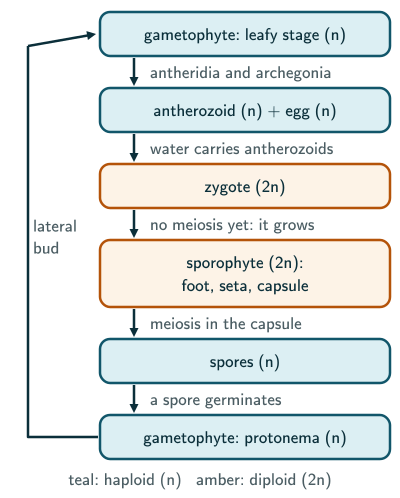
The antherozoids are released into water, where they come in contact with the archegonium, and an antherozoid fuses with the egg to produce the zygote. Zygotes do not undergo reduction division immediately; each produces a multicellular body called a sporophyte (page 29).
The sporophyte is not free-living but attached to the photosynthetic gametophyte and derives nourishment from it.
NCERT Biology (Class 11), Section 3.2, page 29
Some cells of the sporophyte undergo reduction division (meiosis) to produce haploid spores, and these spores germinate to produce the gametophyte (page 29). In a moss, the spore first gives the protonema, and the leafy stage grows from it (page 30).
Economic and ecological importance
Bryophytes in general are of little economic importance (page 29), but:
- some mosses provide food for mammals, birds and other animals;
- species of Sphagnum, a moss, provide peat, long used as fuel, and are used as packing material for the trans-shipment of living material because of their capacity to hold water;
- since mosses form dense mats on the soil, they reduce the impact of falling rain and prevent soil erosion.
Mosses along with lichens are the first organisms to colonise rocks and hence, are of great ecological importance.
NCERT Biology (Class 11), Section 3.2, page 29
They decompose rocks, making the substrate suitable for the growth of higher plants (page 29).
NCERT’s sentence on food reads “food for herbaceous mammals” (page 29). Beyond the NCERT text: this is an error for herbivorous mammals, since herbaceous describes soft, non-woody plants and plant-eating animals are herbivorous. If a question copies NCERT’s wording, read it as plant-eating mammals.
Beyond the NCERT Biology text: peat is burnt as a fuel; the enthalpy change when one mole (or a unit amount) of a substance burns completely in oxygen is its enthalpy of combustion, negative because heat is given out.
Liverworts
Liverworts usually grow in moist, shady habitats such as the banks of streams, marshy ground, damp soil, the bark of trees and deep in the woods (page 29).
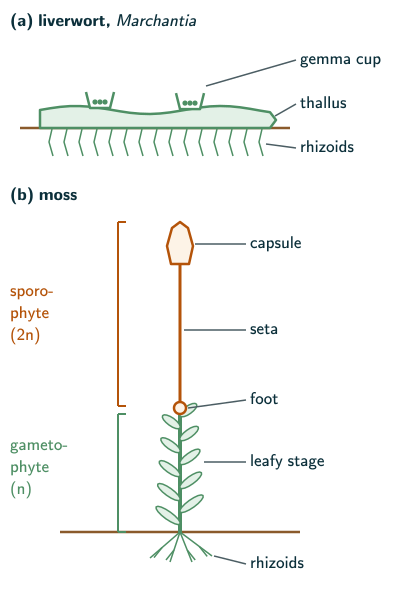
- Body: thalloid, as in Marchantia. The thallus is dorsiventral and closely appressed to the substrate. The leafy members have tiny leaf-like appendages in two rows on the stem-like structures.
- Asexual reproduction: by fragmentation of the thalli, or by gemmae (singular gemma).
- Sexual reproduction: male and female sex organs are produced either on the same thallus or on different thalli (pages 29–30).
- Sporophyte: differentiated into a foot, seta and capsule. After meiosis, spores are produced within the capsule, and they germinate to form free-living gametophytes (page 30).
Gemmae are green, multicellular, asexual buds, which develop in small receptacles called gemma cups located on the thalli.
NCERT Biology (Class 11), Section 3.2.1, page 29
The gemmae become detached from the parent body and germinate to form new individuals (page 29). In Marchantia, NCERT Figure 3.2 (page 28) draws separate female and male thalli: archegonia on archegoniophores, antheridia on antheridiophores.
Beyond the NCERT text: the foot–seta–capsule sporophyte is the general pattern; in Riccia, a liverwort, the sporophyte is only a capsule, and many botanists treat hornworts as a third group of bryophytes besides liverworts and mosses.
Mosses
The predominant stage of the life cycle of a moss is the gametophyte, which has two stages (page 30).
- Protonema: the first stage, which develops directly from a spore. It is creeping, green, branched and frequently filamentous.
- Leafy stage: develops from the secondary protonema as a lateral bud. It has upright, slender axes bearing spirally arranged leaves, is attached to the soil by multicellular, branched rhizoids, and bears the sex organs.
NCERT does not define the secondary protonema; remember its two roles on page 30: the leafy stage grows from it as a lateral bud, and mosses reproduce vegetatively by budding in it.
Vegetative reproduction is by fragmentation and budding in the secondary protonema. In sexual reproduction, the antheridia and archegonia are produced at the apex of the leafy shoots. After fertilisation, the zygote develops into a sporophyte of foot, seta and capsule; the capsule contains spores, formed after meiosis, and mosses have an elaborate mechanism of spore dispersal (page 30). Common examples are Funaria, Polytrichum and Sphagnum.
The sporophyte in mosses is more elaborate than that in liverworts.
NCERT Biology (Class 11), Section 3.2.2, page 30
Solved examples
Example 1: Amphibians of the plant kingdom
Why are bryophytes called amphibians of the plant kingdom?
Answer: they can live in soil, but they depend on water for sexual reproduction: the antherozoids are released into water and reach the archegonium through it (NCERT page 29).
Example 2: Where meiosis happens (NCERT Exercise Q2, liverwort and moss)
When and where does reduction division take place in the life cycle of a liverwort and a moss?
Answer: not in the zygote, which does not undergo reduction division immediately. It happens later, in the sporophyte: some of its cells undergo meiosis to produce haploid spores, within the capsule (NCERT pages 29–30). The other plants in this question are answered on the pteridophyte, gymnosperm and angiosperm pages.
Example 3: Ploidy (NCERT Exercise Q4, bryophyte items)
Give the ploidy of: a protonemal cell of a moss; a leaf cell of a moss; a gemma cell in Marchantia; the ovum of a liverwort.
Answer: all four are haploid (n), because each is part of the gametophyte or one of its gametes; the main plant body of a bryophyte is haploid (NCERT page 29).
Example 4: Liverworts and mosses (NCERT Exercise Q9(ii))
Differentiate between liverworts and mosses.
Answer: from NCERT pages 29–30:
- Body: a liverwort is thalloid and dorsiventral (or has leaf-like appendages in two rows); a moss has upright, slender axes with spirally arranged leaves.
- First stage: mosses have a protonema stage before the leafy stage; NCERT describes none for liverworts.
- Asexual reproduction: liverworts by fragmentation or gemmae in gemma cups; mosses by fragmentation and budding in the secondary protonema.
- Sporophyte: NCERT gives foot, seta and capsule as the general pattern, with a more elaborate dispersal mechanism in mosses; the Riccia exception is noted above.
- Sex organs: liverworts on the same or different thalli; mosses at the apex of the leafy shoots.
- Rhizoids: mosses, multicellular and branched (page 30); beyond the NCERT text, liverwort rhizoids are unicellular.
- Examples: Marchantia; Funaria, Polytrichum, Sphagnum.
Example 5: Three terms (NCERT Exercise Q8(i)–(iii))
Explain protonema, antheridium and archegonium with examples.
Answer: the protonema is the first stage of a moss gametophyte, creeping, green, branched and often filamentous, developing directly from a spore (as in Funaria). The antheridium is the male sex organ, producing biflagellate antherozoids; the archegonium is the flask-shaped female sex organ, producing a single egg. Examples: in Funaria both are produced at the apex of the leafy shoots, and in Marchantia on the thalli (NCERT pages 29–30); fern prothalli also bear both (page 32).
Example 6: Groups with archegonia (NCERT Exercise Q3)
Name three groups of plants that bear archegonia, and briefly describe the life cycle of one.
Answer: bryophytes, pteridophytes and gymnosperms (NCERT pages 29, 32 and 33). In a moss, the haploid leafy gametophyte bears antheridia and archegonia; an antherozoid reaches the egg through water, and the zygote (2n) grows into a sporophyte (foot, seta, capsule) attached to the gametophyte. Meiosis in the capsule gives haploid spores; a spore forms the protonema, from which the leafy stage grows as a lateral bud.
Common mistakes to avoid
Common mistake
Calling the green moss plant a sporophyte
The leafy moss plant is the gametophyte and is haploid; the sporophyte is the stalked capsule growing on it.
Common mistake
Saying the zygote undergoes meiosis
Bryophyte zygotes do not undergo reduction division immediately: they first grow into a sporophyte, and meiosis happens in its cells (NCERT page 29).
Common mistake
Calling the sporophyte free-living
The sporophyte stays attached to the photosynthetic gametophyte and derives nourishment from it.
Common mistake
Calling gemmae spores or gametes
Gemmae are green, multicellular, asexual buds that detach and grow into new plants.
Common mistake
Giving bryophytes xylem and phloem
Bryophytes have no vascular tissue; pteridophytes are the first land plants with xylem and phloem (NCERT page 30).
Common mistake
Calling rhizoids roots
Bryophytes lack true roots, stem and leaves; rhizoids attach the plant to the substratum but are not true roots with xylem and phloem.
Quick revision summary
- Bryophytes (liverworts and mosses) live in damp, shaded places and need water for fertilisation: the amphibians of the plant kingdom.
- The body is thallus-like, with rhizoids but no true roots, stem or leaves; the main plant body is the haploid gametophyte.
- Antheridia make biflagellate antherozoids; the flask-shaped archegonium makes one egg; fertilisation needs water.
- The zygote grows into a sporophyte (foot, seta, capsule) that depends on the gametophyte; meiosis gives haploid spores.
- Importance: food for animals; Sphagnum gives peat (fuel) and packing material (holds water); with lichens, the first colonisers of rocks; mats prevent soil erosion.
- Liverworts: dorsiventral thallus (Marchantia); gemmae in gemma cups; sex organs on the same or different thalli.
- Mosses: protonema, then the leafy stage; sex organs at the shoot apex; a more elaborate sporophyte (Funaria, Polytrichum, Sphagnum).
Formula sheet
- bryophytes: amphibians of the plant kingdom (water needed for fertilisation)
- main plant body: gametophyte (n); sporophyte (2n) attached to it and fed by it
- antheridium: biflagellate antherozoids; archegonium: flask-shaped, one egg
- zygote (2n) → sporophyte (foot, seta, capsule) → meiosis → spores (n)
- liverworts: dorsiventral thallus; gemmae in gemma cups
- mosses: spore → protonema → leafy stage (lateral bud)
Questions students ask
What is the difference between algae and bryophytes?
Bryophytes differ from algae in having a more differentiated plant body: it is thallus-like, prostrate or erect, attached by rhizoids and may have root-like, leaf-like or stem-like structures, while an alga is a simple thallus. Most algae live in water, whereas bryophytes live on land in damp, shaded places, though they still need water for sexual reproduction. Bryophytes have multicellular sex organs, including the flask-shaped archegonium, which algae do not have, and their zygote does not undergo reduction division immediately but grows into a multicellular sporophyte that stays attached to the gametophyte.
Why are bryophytes small?
Bryophytes generally stay small because they lack the lignified xylem and extensive root systems that support tall vascular plants. Water relations and the need for water during fertilisation also influence their habitats. Beyond NCERT: this does not mean all transport is limited to slow movement from one living cell to the next. Experimental microscopy and tracer work on feather mosses, reported in Annals of Botany, shows internal conducting pathways, including hydroids in some mosses; these are not true xylem. NCERT itself does not explain their small size.
Why are bryophytes, not pteridophytes, called amphibians of the plant kingdom?
Only the bryophytes are called the amphibians of the plant kingdom, although pteridophytes also need water to carry their antherozoids to the archegonium. NCERT gives the name to bryophytes because these plants can live in soil but are dependent on water for sexual reproduction. Pteridophytes are better fitted for land: NCERT calls them the first terrestrial plants to possess vascular tissues, and their main plant body is a sporophyte with true root, stem and leaves.
Why are liverworts called liverworts?
Liverworts get their name from the Old English liferwyrt, ‘liver plant’ (wort meant a plant or herb), because the lobed thallus of some species, such as Marchantia, was thought to look like a liver. Under the old doctrine of signatures, this shape was taken as a sign that the plant could treat liver ailments, a belief with no scientific basis. The name says nothing about classification: liverworts and mosses are the two groups into which NCERT divides the bryophytes.
Practice questions
Try each question first, then open the answer to check your working.
-
Q1. Name the three parts in NCERT’s general description of a bryophyte sporophyte.
Show answerHide answer
Foot, seta and capsule (NCERT page 30).
-
Q2. What are the two stages of a moss gametophyte, and which one bears the sex organs?
Show answerHide answer
The protonema and the leafy stage; the leafy stage bears the sex organs (NCERT page 30).
-
Q3. Why is Sphagnum used as packing material for sending living material?
Show answerHide answer
Because of its capacity to hold water (NCERT page 29).
-
Q4. How do mosses help prevent soil erosion?
Show answerHide answer
They form dense mats on the soil, which reduce the impact of falling rain (NCERT page 29).