Angiosperms
NCERT Class 11 Biology Chapter 3 Section 3.5
Quick answer
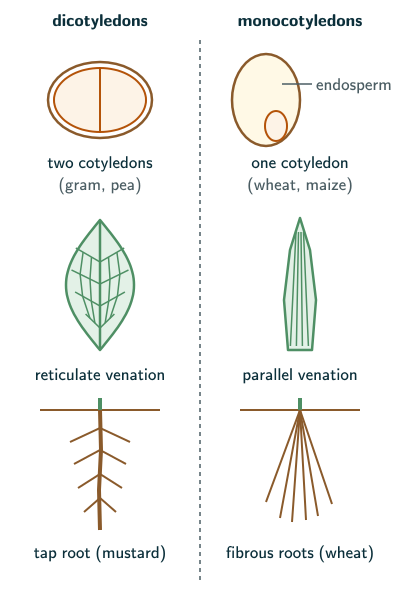
Angiosperms are the flowering plants: their pollen grains and ovules develop in flowers, and their seeds are enclosed in fruits, unlike the naked seeds of gymnosperms. They form an exceptionally large group, from the smallest flowering plant to trees over 100 metres tall, and are divided into dicotyledons and monocotyledons. Dicotyledons have two cotyledons, generally reticulate venation and tap roots; monocotyledons have one cotyledon, mostly parallel venation and fibrous roots.
With your textbook
NCERT Biology (Class 11), Chapter 3 “Plant Kingdom”, Section 3.5 “Angiosperms”, page 34.
Open the official NCERT chapter (PDF, 5.2 MB, ncert.nic.in) (opens in a new tab)
Checked against the 2026-27 reprint on .
What are angiosperms?
Angiosperms
In angiosperms, the seeds are enclosed in fruits.
NCERT Biology (Class 11), Section 3.5, page 34
- Angiosperms are the flowering plants: their pollen grains and ovules develop in specialised structures called flowers.
- They are divided into two classes, the dicotyledons and the monocotyledons.
In plain words: angiosperms are the seed plants with flowers and fruits. A gymnosperm’s ovules are borne exposed on megasporophylls and its seeds are naked (page 33); an angiosperm’s ovules lie inside the ovary of a flower, and after fertilisation the ovules develop into seeds and the ovary matures into a fruit (NCERT Chapter 5, pages 65–66).
The angiosperms are an exceptionally large group of plants occurring in wide range of habitats.
NCERT Biology (Class 11), Section 3.5, page 34
- Size: from the smallest, Wolffia, to tall trees of Eucalyptus, over 100 metres (page 34).
- Uses: they provide food, fodder, fuel, medicines and several other commercially important products (page 34).
Beyond the NCERT Biology text: a Wolffia plant is about a millimetre across or less, so a Eucalyptus over 100 metres tall is roughly 105 times as tall as a Wolffia is wide, five orders of magnitude larger.
Dicotyledons and monocotyledons
NCERT’s Plant Kingdom chapter names the two classes but does not compare them (page 34). The differences below are from NCERT Chapter 5, Morphology of Flowering Plants:
- Cotyledons: the embryo has two cotyledons in dicotyledons, as in gram and pea, and one in monocotyledons, as in wheat and maize (Chapter 5, page 66).
- Leaf venation: leaves of dicotyledonous plants generally have reticulate venation, the veinlets forming a network; parallel venation is the characteristic of most monocotyledons (Chapter 5, page 60).
- Leaf base: in monocotyledons, the leaf base expands into a sheath covering the stem partially or wholly (Chapter 5, page 60).
- Roots: in most dicotyledonous plants the radicle elongates into a primary root that forms a tap root system, as in mustard; in monocotyledonous plants the primary root is short-lived and is replaced by many roots from the base of the stem, a fibrous root system, as in wheat (Chapter 5, pages 57–58).
- Seeds: bean, gram and pea seeds have no endosperm when mature, but castor seeds are endospermic; monocotyledonous seeds are generally endospermic, though some, as in orchids, are not (Chapter 5, page 66). In maize the endosperm is bulky and the embryo small (page 67).
Beyond the NCERT text: the floral parts of most dicotyledons are in fours or fives, and those of most monocotyledons in threes. NCERT Chapter 5 defines trimerous, tetramerous and pentamerous flowers (page 62) without linking them to the two classes.
Exercise questions on removed content
The 2026–27 Plant Kingdom chapter no longer describes reproduction in angiosperms or the types of plant life cycles, but three of its exercises still ask about them (pages 35–36). NCERT Class 12 Biology, Chapter 1, Sexual Reproduction in Flowering Plants, covers the first two; the third is beyond both books.
Example 1: Reduction division in an angiosperm (NCERT Exercise Q2, angiosperm part)
When and where does reduction division take place in the life cycle of an angiosperm?
Answer: in the flower of the sporophyte, before the gametophytes form. In the anther, each pollen mother cell undergoes meiosis to form a tetrad of microspores, which develop into pollen grains (microsporogenesis; NCERT Class 12 Biology, Section 1.2, page 6). In the ovule, the megaspore mother cell in the nucellus divides meiotically to produce four megaspores (megasporogenesis; Class 12, pages 9–10).
Example 2: Two ploidies (NCERT Exercise Q4, angiosperm items)
Give the ploidy of the primary endosperm nucleus in a dicot and of a meristem cell of a monocot.
Answer: the primary endosperm nucleus is triploid (3n): one male gamete fuses with the two polar nuclei, three haploid nuclei in all, in triple fusion (NCERT Class 12 Biology, Section 1.3, page 18). A meristem cell of a monocot belongs to the plant body, the diploid sporophyte, so it is diploid (2n). Syngamy, which gives the diploid zygote, and triple fusion together make up double fertilisation, an event unique to flowering plants (page 18).
Example 3: Diplontic (NCERT Exercise Q8(iv))
Explain the term diplontic with an example.
Answer: beyond the 2026–27 NCERT text, which keeps this exercise (page 36) but no longer defines the term. The usual textbook answer (our reasoning from NCERT pages 33 and 36): a diplontic life cycle is one in which the diploid sporophyte is the dominant, independent, photosynthetic phase and the haploid gametophytes are much reduced and depend on it. Beyond the NCERT text, Wikipedia’s article “Biological life cycle” uses “diplontic” more strictly, for a cycle in which only the gametes are haploid, and calls a cycle with both multicellular diploid and haploid stages haplodiplontic (facts in our words); for this NCERT exercise, give the textbook answer. Seed plants follow this pattern: in Pinus the pollen grain has only a limited number of cells and the multicellular female gametophyte stays within the ovule (NCERT page 33); in angiosperms the pollen grain has two or three cells and the embryo sac seven (NCERT Class 12 Biology, pages 7 and 11).
Solved examples
Example 4: Two kinds of seed plants (NCERT Exercise Q6)
Both gymnosperms and angiosperms bear seeds. Why are they classified separately?
Answer: in gymnosperms the ovules are not enclosed by any ovary wall, so the seeds are naked (page 32). In angiosperms the pollen grains and ovules develop in flowers, and the seeds are enclosed in fruits (page 34): the ovary matures into the fruit (NCERT Chapter 5, page 65).
Example 5: Which class?
A plant has leaves with parallel venation and a fibrous root system. To which class of angiosperms does it most likely belong?
Answer: the monocotyledons: parallel venation is characteristic of most monocotyledons, and they have fibrous roots, as in wheat (NCERT Chapter 5, pages 58 and 60).
Example 6: Endosperm in dicot seeds
Are all dicot seeds non-endospermic?
Answer: no. Bean, gram and pea seeds are non-endospermous, but castor seeds are endospermic (NCERT Chapter 5, page 66).
Common mistakes to avoid
Common mistake
Calling angiosperm seeds naked
Naked seeds belong to gymnosperms. Angiosperm seeds are enclosed in fruits.
Common mistake
Saying every monocot leaf has parallel venation
NCERT says parallel venation is the characteristic of most monocotyledons, and that dicotyledons generally have reticulate venation (Chapter 5, page 60): these are tendencies, not rules. Beyond the NCERT text: Smilax, a monocot, has reticulate venation, and Calophyllum, a dicot, has parallel venation.
Common mistake
Calling the primary endosperm nucleus diploid
It forms from three haploid nuclei, so it is triploid (3n); the zygote is diploid (NCERT Class 12 Biology, page 18).
Quick revision summary
- Angiosperms are the flowering plants: pollen grains and ovules develop in flowers, and seeds are enclosed in fruits.
- They form an exceptionally large group in a wide range of habitats, from the smallest, Wolffia, to Eucalyptus trees over 100 metres tall, and give food, fodder, fuel and medicines.
- Two classes: dicotyledons (two cotyledons, generally reticulate venation, tap roots) and monocotyledons (one cotyledon, mostly parallel venation, fibrous roots), as NCERT Chapter 5 describes.
- From NCERT Class 12 Biology, Chapter 1: in angiosperms, meiosis occurs in the anther (pollen mother cells) and the ovule (megaspore mother cell); the primary endosperm nucleus is triploid.
Formula sheet
- angiosperms: ovules in flowers; seeds enclosed in fruits
- gymnosperms: ovules exposed; seeds naked
- dicotyledons: two cotyledons; usually reticulate venation and tap roots
- monocotyledons: one cotyledon; usually parallel venation and fibrous roots
- primary endosperm nucleus: 3n (triple fusion); zygote: 2n
Questions students ask
Are angiosperms in the NEET 2026 syllabus?
Angiosperms are in the NEET (UG) 2026 Biology syllabus as flowering plants, but not in Unit 1, Diversity in Living World, whose major plant groups are only ‘Algae, Bryophytes, Pteridophytes, Gymnosperms’. Flowering plants are studied mainly in Unit 2, Structural Organisation in Animals and Plants (the morphology and anatomy of root, stem, leaf, inflorescence, flower, fruit and seed, and five families), and in Unit 6, Reproduction (sexual reproduction in flowering plants, including double fertilisation). NCERT Section 3.5 is a short Class 11 introduction to the group.
What is the difference between flowering and non-flowering plants?
Flowering plants, the angiosperms, develop their pollen grains and ovules in flowers and enclose their seeds in fruits, as in mango and wheat, while non-flowering plants bear no flowers or fruits. Among non-flowering plants, algae, bryophytes and pteridophytes reproduce by spores and form no seeds, as in Chlamydomonas, mosses and ferns, while gymnosperms such as Pinus and Cycas bear seeds, but naked ones. So every flowering plant is a seed plant, but not every seed plant is a flowering plant.
Why are angiosperms not called archegoniates?
Angiosperms are not archegoniates because they bear no archegonia: their female gametophyte is the embryo sac inside the ovule, typically 8-nucleate but 7-celled, in which the egg lies in an egg apparatus with two synergids. The archegoniates are the bryophytes, pteridophytes and gymnosperms, the three groups that bear archegonia in NCERT’s Plant Kingdom chapter; even in gymnosperms the female gametophyte bears two or more archegonia. The embryo sac is described in NCERT Class 12 Biology, Chapter 1.
Why are angiosperms so successful?
Angiosperms are today’s most successful plants: NCERT calls them an exceptionally large group occurring in a wide range of habitats, and the reasons usually given for their success lie in their reproduction. Flowers often attract insects and other animals that carry pollen between plants, fruits protect the seeds and help to disperse them, and double fertilisation couples embryo formation with initiation of the nutritive endosperm. This can reduce investment in nutritive tissue before fertilisation, as the endosperm develops only after triple fusion (reasoned from NCERT Class 12 Biology, Chapter 1, page 18). These reasons go beyond the NCERT Class 11 text.
Practice questions
Try each question first, then open the answer to check your working.
-
Q1. Where do the pollen grains and ovules of angiosperms develop?
Show answerHide answer
In specialised structures called flowers (NCERT page 34).
-
Q2. Name two products that angiosperms provide, according to NCERT.
Show answerHide answer
Any two of food, fodder, fuel and medicines (NCERT page 34).
-
Q3. How many cotyledons do the embryos of gram and of maize have?
Show answerHide answer
Gram has two (a dicotyledon) and maize one (a monocotyledon) (NCERT Chapter 5, page 66).
-
Q4. Which kind of root system does mustard have, and which does wheat have?
Show answerHide answer
Mustard has a tap root system and wheat a fibrous root system (NCERT Chapter 5, page 58).