Double fertilisation
NCERT Class 12 Biology Chapter 1 Section 1.3
Quick answer
In the typical angiosperm embryo sac, one sperm fertilises the egg to form a diploid zygote and the other fuses with the two polar nuclei to form a triploid primary endosperm nucleus. These two fusion events produce the embryo and its nutritive endosperm.
With your textbook
NCERT Biology (Class 12), Chapter 1 “Sexual Reproduction in Flowering Plants”, Section 1.3 “Double Fertilisation”, page 18.
Open the official NCERT chapter (PDF, 36.8 MB, ncert.nic.in) (opens in a new tab)
Checked against the 2026-27 reprint on .
What is double fertilisation?
Double fertilisation
Since two types of fusions, syngamy and triple fusion take place in an embryo sac the phenomenon is termed double fertilisation, an event unique to flowering plants.
NCERT Biology (Class 12), Section 1.3, page 18
- Syngamy: one male gamete fuses with the nucleus of the egg cell, giving the diploid zygote (page 18).
- Triple fusion: the other male gamete fuses with the two polar nuclei of the central cell, giving the triploid primary endosperm nucleus (PEN) (page 18).
The explanation and chromosome counts below use NCERT’s typical Polygonum-type embryo sac in a diploid plant. Other embryo-sac types can give different endosperm ploidies.
In plain words: a pollen tube brings two male gametes into the embryo sac, and both are used. One fertilises the egg and starts the next generation, the embryo; the other joins the two polar nuclei and starts the food store for that embryo, the endosperm.
Where the two male gametes go
After the pollen tube has grown through the style and entered the ovule, it enters one of the synergids through the filiform apparatus (page 17). Then (page 18):
- the pollen tube releases the two male gametes into the cytoplasm of the synergid;
- one male gamete moves towards the egg cell and fuses with its nucleus;
- the other male gamete moves towards the two polar nuclei in the central cell and fuses with them.
NCERT calls the combination of embryo-forming and endosperm-forming fertilisation unique to flowering plants (page 18); give this in an NCERT-based answer. Beyond the NCERT text: two fertilisation events also occur in some Ephedra and Gnetum, but they do not produce angiosperm-type triploid endosperm (Friedman, Science, 1990; Friedman and Carmichael, International Journal of Plant Sciences, 1996). Compare gymnosperm reproduction.
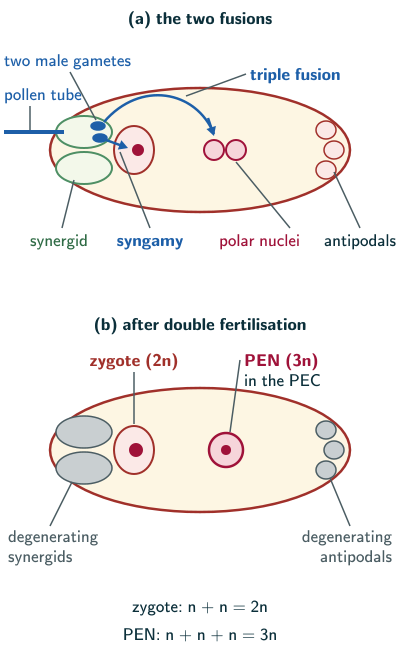
Syngamy
One male gamete fuses with the nucleus of the egg cell, which completes syngamy. This forms a diploid cell, the zygote (page 18).
- male gamete (n) + egg (n) → zygote (2n)
- The zygote develops into the embryo (page 18).
Triple fusion and the primary endosperm nucleus
The other male gamete fuses with the two polar nuclei in the central cell to give a triploid primary endosperm nucleus (PEN) (page 18).
As this involves the fusion of three haploid nuclei it is termed triple fusion.
NCERT Biology (Class 12), Section 1.3, page 18
- male gamete (n) + two polar nuclei (n + n) → PEN (3n)
- After triple fusion, the central cell becomes the primary endosperm cell (PEC), which develops into the endosperm (page 18).
- In NCERT Figure 1.13 (a) (page 18), the synergids and the antipodal cells left in the fertilised embryo sac are labelled as degenerating.
In short (NCERT page 18):
- Syngamy: 1 male gamete + egg → zygote (2n) → embryo.
- Triple fusion: 1 male gamete + 2 polar nuclei → PEN (3n) → endosperm.
Five haploid nuclear contributions take part in the typical pattern: two sperm nuclei, one egg nucleus and two polar nuclei (reasoned from NCERT page 18). The polar nuclei may have already fused into a diploid secondary nucleus before the second sperm arrives; the resulting PEN is still 3n.
Solved examples
Example 1: Triple fusion (NCERT Exercise 11)
What is triple fusion? Where and how does it take place? Name the nuclei involved.
Answer: triple fusion is the fusion of one male gamete with the two polar nuclei, three haploid nuclei in all. It takes place in the central cell of the embryo sac: after the pollen tube discharges the two male gametes into a synergid, one of them moves to the two polar nuclei and fuses with them. The nuclei involved are one male gamete nucleus and the two polar nuclei; the product is the triploid primary endosperm nucleus (NCERT page 18).
Example 2: Chromosome numbers in one plant
A flowering plant has 2n = 16 in its leaf cells. How many chromosomes are there in (a) its male gamete, (b) its egg cell, (c) its zygote, (d) its primary endosperm nucleus, (e) a cell of its nucellus?
Answer: (a) 8 and (b) 8: gametes are haploid. (c) 8 + 8 = 16: the zygote is diploid. (d) 8 + 8 + 8 = 24: the PEN is triploid. (e) 16: the nucellus is part of the diploid ovule (NCERT pages 10 and 18).
Example 3: Why “double”
A student says double fertilisation means that two eggs are fertilised in each embryo sac. Correct the statement.
Answer: the typical embryo sac described here has one egg. “Double” refers to two fusions by the two male gametes of one pollen tube: syngamy with the egg, and triple fusion with the two polar nuclei (NCERT pages 11 and 18).
Common mistakes to avoid
Common mistake
Calling the primary endosperm nucleus diploid
The PEN comes from three haploid nuclei (one male gamete and two polar nuclei), so it is triploid (3n); the zygote is diploid (NCERT page 18).
Common mistake
Counting three male gametes in triple fusion
Triple fusion has one male gamete; the other two nuclei are the polar nuclei of the central cell (NCERT page 18).
Common mistake
Saying the male gametes are released into the egg
The pollen tube releases the two male gametes into the cytoplasm of a synergid; from there one moves to the egg and the other to the central cell (NCERT page 18).
Common mistake
Thinking every seed plant has a triploid endosperm
The typical angiosperm PEN is triploid. Gymnosperm seed nutrition generally comes from the haploid female gametophyte, formed before fertilisation. The extra fertilisation reported in some gnetophytes does not make angiosperm-type triploid endosperm; see the qualification above.
Quick revision summary
- The pollen tube enters a synergid and releases two male gametes.
- Syngamy: one male gamete fuses with the egg nucleus, giving the diploid zygote, which develops into the embryo.
- Triple fusion: the other male gamete fuses with the two polar nuclei, giving the triploid primary endosperm nucleus; the central cell becomes the primary endosperm cell and develops into the endosperm.
- The egg-plus-central-cell fertilisations give embryo and endosperm, the characteristic angiosperm pattern of double fertilisation.
Formula sheet
- syngamy: male gamete (n) + egg (n) → zygote (2n)
- triple fusion: male gamete (n) + 2 polar nuclei (n + n) → PEN (3n)
- double fertilisation = syngamy + triple fusion
- zygote → embryo; PEC → endosperm
Questions students ask
What is the difference between syngamy and triple fusion?
Syngamy and triple fusion are the two fusions of double fertilisation, one for each of the two male gametes that a pollen tube brings into the embryo sac (NCERT page 18). In syngamy a male gamete fuses with the nucleus of the egg cell, two haploid nuclei in all, and the product is the diploid zygote; in triple fusion the other male gamete fuses with the two polar nuclei of the central cell, three haploid nuclei, and the product is the triploid primary endosperm nucleus (page 18). The zygote develops into the embryo, whereas triple fusion gives rise to the endosperm, the food tissue of the developing seed (pages 18–19).
What is the difference between fertilisation and double fertilisation?
Fertilisation in the ordinary sense is a single fusion of a male and a female gamete that forms a diploid zygote, as in humans, where NCERT calls “the process of fusion of a sperm with an ovum” fertilisation (NCERT Chapter 2, page 35; see human fertilisation). Double fertilisation, in flowering plants, is that fusion, called syngamy, plus a second one in the same embryo sac, triple fusion, which forms no embryo but the triploid primary endosperm nucleus from which the endosperm grows (NCERT page 18). So syngamy alone is fertilisation in the usual sense; only the two fusions together make double fertilisation.
Why is double fertilisation important?
Double fertilisation is important because it starts both new parts of the seed together: syngamy gives the zygote, which develops into the embryo, and triple fusion gives the primary endosperm nucleus, whose tissue fills with reserve food that nourishes the developing embryo (NCERT pages 18–19). In NCERT’s typical sexual pathway the endosperm therefore forms only in an ovule that has been fertilised (our reasoning from page 18), and in seeds where it persists it is used up during germination (page 19).
Is double fertilisation found only in flowering plants?
Double fertilisation as NCERT describes it, syngamy together with triple fusion, is found only in flowering plants: NCERT calls it “an event unique to flowering plants” (page 18). A gymnosperm’s pollen tube discharges its male gametes near the archegonia of the female gametophyte (NCERT Class 11, Chapter 3, page 33; see gymnosperm fertilisation), and, by our reasoning, there are no polar nuclei for a second male gamete to join. Beyond the NCERT text, a 1990 study found a regular second fusion in Ephedra, a non-flowering seed plant, but there the second sperm nucleus joins the egg’s ventral canal nucleus (Friedman, Science, 1990).
Practice questions
Try each question first, then open the answer to check your working.
-
Q1. Into which cell does the pollen tube release the two male gametes?
Show answerHide answer
Into the cytoplasm of one of the synergids (NCERT page 18).
-
Q2. What does the central cell become after triple fusion, and what does it develop into?
Show answerHide answer
The primary endosperm cell (PEC), which develops into the endosperm (NCERT page 18).
-
Q3. In a plant with 2n = 20, how many chromosomes are there in the primary endosperm nucleus?
Show answerHide answer
30: the PEN is triploid, 3 × 10 (NCERT page 18).