Fertilisation and implantation
NCERT Class 12 Biology Chapter 2 Section 2.5
Quick answer
Fertilisation usually occurs in the ampulla when viable sperm and an oocyte overlap. A sperm’s contact with the zona pellucida induces changes that block other sperms, and the secondary oocyte completes meiosis II; the haploid nuclei then fuse into a diploid zygote. Cleavage produces a morula and blastocyst; after hatching, the blastocyst attaches to and invades the uterine endometrium during implantation.
With your textbook
NCERT Biology (Class 12), Chapter 2 “Human Reproduction”, Section 2.5 “Fertilisation and Implantation”, pages 35–37.
Open the official NCERT chapter (PDF, 64.5 MB, ncert.nic.in) (opens in a new tab)
Checked against the 2026-27 reprint on .
What are fertilisation and implantation?
Fertilisation and implantation
The process of fusion of a sperm with an ovum is called fertilisation.
NCERT Biology (Class 12), Section 2.5, page 35
- Fertilisation takes place in the ampullary region of the fallopian tube and gives a diploid zygote (pages 35–36).
- Implantation is the embedding of the blastocyst in the endometrium of the uterus; it leads to pregnancy (page 37).
In plain words: the sperms and the egg must meet in the ampulla at the right time. One sperm gets in, the egg finishes its meiosis, and the two nuclei fuse. The zygote divides as it travels down the tube, reaches the uterus as a hollow ball of cells, the blastocyst, and sinks into the uterine lining.
Insemination and the journey to the ampulla
- During copulation (coitus), semen is released by the penis into the vagina: this is insemination (page 35).
- The motile sperms swim rapidly, pass through the cervix, enter the uterus and finally reach the ampullary region of the fallopian tube (page 35).
- The ovum released by the ovary is also carried to the ampullary region, where fertilisation takes place (page 35).
Fertilisation can only occur if the ovum and sperms are transported simultaneously to the ampullary region.
NCERT Biology (Class 12), Section 2.5, page 35
This is why not all copulations lead to fertilisation and pregnancy (page 35). “Simultaneously” here does not mean arriving at the same instant: the two must still be alive in the tube at the same time (our reasoning). Beyond the NCERT text: sperm also need capacitation; only after some hours in the uterus and oviduct do they become able to fertilise (Wikipedia, “Capacitation”, facts in our words).
Fertilisation and the zona pellucida
- A sperm comes in contact with the zona pellucida layer of the ovum and induces changes in the membrane that block the entry of additional sperms, so only one sperm can fertilise an ovum (page 35).
- The secretions of the acrosome help the sperm enter the cytoplasm of the ovum through the zona pellucida and the plasma membrane (pages 35–36).
- This induces the completion of the meiotic division of the secondary oocyte. The second meiotic division is also unequal: it gives a second polar body and a haploid ovum (ootid) (page 36).
- The haploid nucleus of the sperm and that of the ovum “fuse together to form a diploid zygote” (page 36). Beyond the NCERT text: in mammals the two pronuclei approach, then their envelopes break down as the first mitotic division begins, so the two haploid sets first share one nucleus only in the two-cell embryo; NCERT’s “fuse” is a shorthand for this joining (NCBI Bookshelf, Fertilization). NCERT asks how many chromosomes the zygote has: 23 + 23 = 46 (reasoned from NCERT page 31, where the diploid spermatogonium has 46 chromosomes and the haploid secondary spermatocytes 23).
Beyond the NCERT text: the acrosome’s secretions are set free in the acrosome reaction, when the sperm reaches the zona pellucida: the acrosome opens to the outside as the membrane round it merges with the cell membrane of the sperm head. Later the sperm’s own membrane merges with the egg’s plasma membrane (Wikipedia, “Acrosome reaction”, facts in our words). During fertilisation the egg also releases the contents of its cortical granules, which change the coat round the egg so that no more sperm can get in, a lasting block to polyspermy (Wikipedia, “Cortical reaction”, facts in our words). In an NCERT-based answer, give NCERT’s account above.
The sex of the baby is decided by the sperm
NCERT explains that the sex of the baby is decided at fertilisation itself, through the typical XX/XY mechanism of sex determination (page 36):
- The chromosome pattern of the human female is XX and that of the male is XY.
- So all ova carry the sex chromosome X, while sperms carry either X or Y: 50 per cent carry X and 50 per cent carry Y.
- A zygote with XX develops into a female baby, and one with XY into a male.
- Beyond the NCERT text: the Y chromosome acts through a gene, SRY, whose protein starts the development of testes in the fetus; changes in this gene are one cause of differences in sex development, so XX and XY are the usual pattern, not an exceptionless rule (MedlinePlus Genetics, SRY gene).
That is why, scientifically it is correct to say that the sex of the baby is determined by the father and not by the mother!
NCERT Biology (Class 12), Section 2.5, page 36
Which kind of sperm fertilises the ovum is a matter of chance: neither parent chooses it, so neither should be blamed for a child’s sex (reasoned from NCERT page 36, where half the sperms carry X and half Y).
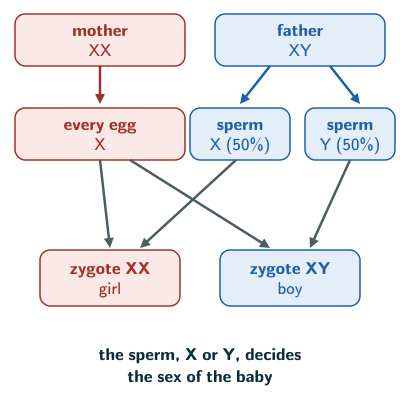
NCERT slip (page 36): the sentence ends “(you will learn more about the chromosomal patterns in Chapter 5)”. In the 2026–27 book, sex determination is Section 4.6 of Chapter 4, Principles of Inheritance and Variation; Chapter 5 is Molecular Basis of Inheritance. Look for it in Chapter 4.
Cleavage: morula and blastocyst
- Mitotic division starts as the zygote moves through the isthmus of the oviduct towards the uterus; this is cleavage, and it forms 2, 4, 8, 16 daughter cells called blastomeres (page 36).
- The embryo with 8 to 16 blastomeres is a morula (pages 36–37).
- The morula continues to divide and transforms into a blastocyst as it moves further into the uterus (page 37).
- In the blastocyst, the blastomeres are arranged into an outer layer, the trophoblast, and an inner group of cells attached to the trophoblast, the inner cell mass (page 37).
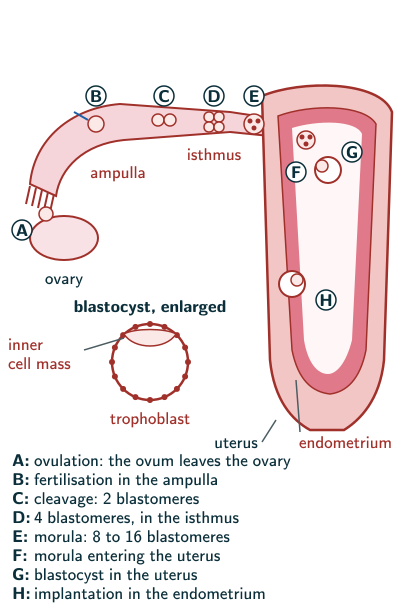
Implantation
- The trophoblast layer gets attached to the endometrium, and the inner cell mass gets differentiated as the embryo (page 37).
- After attachment, the uterine cells divide rapidly and cover the blastocyst, so the blastocyst becomes embedded in the endometrium of the uterus (page 37). Beyond the NCERT text: before it can attach, the blastocyst hatches out of the zona pellucida, and its trophoblast cells then invade the endometrium (Wikipedia, “Blastocyst” and “Implantation (embryology)”, facts in our words).
This is called implantation and it leads to pregnancy.
NCERT Biology (Class 12), Section 2.5, page 37
Solved examples
Example 1: Why daughters are not the mother’s doing (NCERT Exercise 19)
In our society, women are often blamed for giving birth to daughters. Explain why this is not correct.
Answer: every ovum carries an X chromosome. Half of the father’s sperms carry X and half carry Y. If an X-bearing sperm fertilises the ovum, the zygote is XX and develops into a girl; if a Y-bearing sperm does, it is XY and develops into a boy. So the sex of the baby is decided by the sperm, at fertilisation, and not by the mother’s ovum, which is always X (NCERT page 36). Which sperm wins is a matter of chance, so neither parent should be blamed (our reasoning).
Example 2: Eggs and twins (NCERT Exercise 20)
How many eggs are released by a human ovary in a month? How many eggs would have been released if the mother gave birth to identical twins? Would the answer change for fraternal twins?
Answer: one ovum is released in the middle of each menstrual cycle, of about 28/29 days (NCERT pages 33–34). NCERT does not explain twins; beyond the NCERT text, MedlinePlus Genetics (National Library of Medicine) says identical (monozygotic) twins come from one egg fertilised by one sperm, the zygote splitting into two early in development, and fraternal (dizygotic) twins come from two eggs, each fertilised by a different sperm, in the same menstrual cycle. So identical twins need one egg; fraternal twins need two.
Example 3: Six puppies (NCERT Exercise 21)
How many eggs do you think were released by the ovary of a female dog that gave birth to 6 puppies?
Answer: at least 6, one fertilised egg for each puppy, if no two of them are identical twins (our reasoning, using the twin rule of Example 2). If some puppies came from a split zygote, fewer eggs would be needed.
Example 4: Counting blastomeres
After how many rounds of cleavage does the zygote first become a morula, and how many cells does the embryo have then?
Answer: each round of mitotic cleavage doubles the cell number: 1 → 2 → 4 → 8. After 3 rounds there are 8 blastomeres, the smallest morula; a fourth round gives 16, the largest morula, since NCERT’s morula has 8 to 16 blastomeres (NCERT pages 36–37).
Common mistakes to avoid
Common mistake
Placing fertilisation in the uterus
Fertilisation takes place in the ampullary region of the fallopian tube; the uterus is where the blastocyst implants (NCERT pages 35 and 37).
Common mistake
Saying the inner cell mass attaches to the endometrium
The trophoblast attaches to the endometrium; the inner cell mass becomes the embryo (NCERT page 37).
Common mistake
Saying the ovum completes meiosis at ovulation
The secondary oocyte completes its second meiotic division only after a sperm enters it (NCERT page 36).
Quick revision summary
- Insemination puts semen into the vagina; sperms pass through the cervix and uterus to the ampulla, where the ovum is also carried; both must be transported there simultaneously, which is why not all copulations lead to fertilisation.
- One sperm touches the zona pellucida and blocks other sperms; acrosome secretions help it enter; the secondary oocyte completes an unequal meiosis II (second polar body, ootid); the nuclei fuse into a diploid zygote.
- All ova carry X; sperms carry X or Y in equal numbers; XX gives a girl and XY a boy, so the father’s sperm decides the sex.
- Cleavage in the isthmus: 2, 4, 8, 16 blastomeres; morula (8 to 16); blastocyst in the uterus with trophoblast and inner cell mass.
- The trophoblast attaches to the endometrium, the uterine cells cover the blastocyst, and implantation leads to pregnancy.
Formula sheet
- fertilisation: in the ampulla; one sperm per ovum
- ovum (n, X) + sperm (n, X or Y) → zygote (2n, XX or XY)
- XX → female; XY → male
- zygote → 2 → 4 → 8–16 (morula) → blastocyst
- blastocyst: trophoblast + inner cell mass
- trophoblast attaches to the endometrium; blastocyst embeds: implantation, then pregnancy
Questions students ask
Are fertilisation, conception and implantation the same thing?
Fertilisation and implantation are two separate events: NCERT defines fertilisation as the fusion of a sperm with an ovum (page 35), while implantation comes later, when the dividing embryo, having moved down the oviduct, becomes embedded in the endometrium of the uterus, and it is implantation that NCERT says “leads to pregnancy” (page 37). Beyond the NCERT text, MeSH lists conception as another name for fertilisation, a word NCERT’s Chapter 2 does not use. NCERT’s Chapter 3 uses it more loosely, pairing it with pregnancy in “conception/pregnancy” (page 46).
How many days after fertilisation does implantation happen?
Beyond the NCERT text, which gives no timing, implantation happens roughly 5 to 12 days after fertilisation: NICHD puts the embryo’s first attachment to the uterine wall at about day 5 or 6 after ovulation, and its firmer implantation over days 6 to 12. An egg usually stays open to fertilisation for only 8 to 12 hours after ovulation (NICHD), so, by our reasoning, the counts from fertilisation are less than a day shorter. The days before implantation are taken up by cleavage, as the zygote travels through the isthmus of the oviduct to the uterus (NCERT pages 36–37).
What is the difference between a morula and a blastocyst?
A morula is the earlier stage of the human embryo and a blastocyst the later, organised one: NCERT calls the embryo with 8 to 16 blastomeres a morula, formed by cleavage as the zygote moves through the isthmus of the oviduct, and says the morula goes on dividing and transforms into a blastocyst as it moves further into the uterus (NCERT pages 36–37). In the blastocyst the blastomeres are arranged into two distinct parts, an outer layer and an inner cell mass attached to it (page 37). Beyond the NCERT text, MeSH puts the morula at about 16 tightly packed cells and the blastocyst at more than a hundred cells around a fluid-filled cavity.
Is a blastocyst the same as a blastula?
A blastocyst is the mammalian counterpart of a blastula, not the same structure: beyond the NCERT text, MeSH keeps the name blastula for the post-morula stage of animals other than mammals and uses blastocyst for mammals. Each is a hollow ball of cells with fluid inside, but in the blastula a layer of cells, the blastoderm, simply encloses the cavity (MeSH), while the human blastocyst also holds an inner cell mass attached to its outer layer (NCERT page 37). NCERT uses only the word blastocyst for the human embryo.
How many chromosomes does each cell of a human morula have?
Each blastomere of a human morula has 46 chromosomes, the diploid (2n) number of the zygote it came from: NCERT calls cleavage a mitotic division (page 36), and mitosis gives daughter cells with the parent cell’s chromosome number (mitosis and ploidy). The zygote’s 46 come from two haploid sets that combine at fertilisation, 23 from the sperm and 23 from the ovum (NCERT page 36; page 31 gives 46 for the diploid spermatogonium and 23 for the haploid secondary spermatocyte). By the same reasoning, the cells of the blastocyst, in its outer layer and its inner cell mass alike, are diploid.
Are fertilisation and implantation in the NEET (UG) 2026 syllabus?
Fertilisation and implantation are in the NEET (UG) 2026 syllabus: Unit 6, Reproduction, lists under Human Reproduction “Fertilisation, embryo development upto blastocyst formation, implantation”. That matches NCERT Class 12 Biology Section 2.5 (pages 35–37), which this page covers. The syllabus’s next entry, “Pregnancy and placenta formation (Elementary idea)”, takes over after implantation; this chapter’s pregnancy and embryonic development page covers it.
Practice questions
Try each question first, then open the answer to check your working.
-
Q1. Fertilisation takes place in ______. Zygote divides to form ______ which is implanted in the uterus. (NCERT Exercise 1 i and j)
Show answerHide answer
The ampullary region of the fallopian tube; the blastocyst (NCERT pages 35 and 37).
-
Q2. What prevents more than one sperm from fertilising an ovum?
Show answerHide answer
The sperm that touches the zona pellucida induces changes in the membrane that block the entry of additional sperms (NCERT page 35). Beyond the NCERT text: the egg’s cortical granules add a lasting block (Wikipedia, “Cortical reaction”, facts in our words; see above).
-
Q3. What is the outer layer of the blastocyst called, and what does it do at implantation?
Show answerHide answer
The trophoblast; it gets attached to the endometrium of the uterus (NCERT page 37).