Pregnancy and embryonic development
NCERT Class 12 Biology Chapter 2 Section 2.6
Quick answer
The placenta forms from fetal and maternal tissues, exchanges substances between separate blood circulations and produces hormones supporting pregnancy. The embryonic epiblast gives rise to ectoderm, mesoderm and endoderm during gastrulation. Clinical pregnancy dating counts about 40 weeks from the last menstrual period; NCERT’s developmental milestones are approximate.
With your textbook
NCERT Biology (Class 12), Chapter 2 “Human Reproduction”, Section 2.6 “Pregnancy and Embryonic Development”, pages 37–38.
Open the official NCERT chapter (PDF, 64.5 MB, ncert.nic.in) (opens in a new tab)
Checked against the 2026-27 reprint on .
What happens in pregnancy?
Pregnancy and the placenta
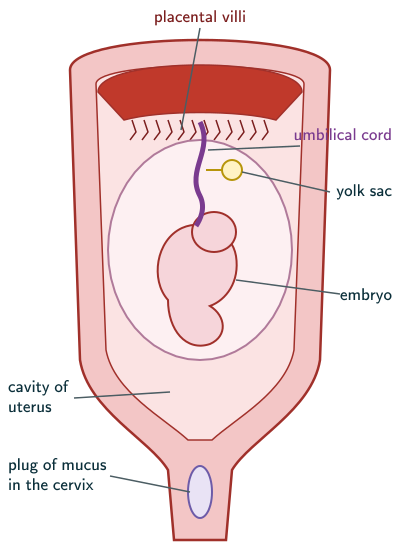
- After implantation, finger-like projections called chorionic villi appear on the trophoblast; they are surrounded by uterine tissue and maternal blood (page 37).
- The chorionic villi and the uterine tissue become interdigitated and together form the placenta (page 37).
The chorionic villi and uterine tissue become interdigitated with each other and jointly form a structural and functional unit between developing embryo (foetus) and maternal body called placenta
NCERT Biology (Class 12), Section 2.6, page 37
In plain words: once the blastocyst has sunk into the uterine lining, the embryo and the mother build a shared organ, the placenta, through which the embryo is fed and its wastes are removed, and which also makes hormones. Meanwhile the embryo forms its three germ layers and, month by month, its organs.
Chorionic villi and the placenta
The placenta has fetal and maternal components. Maternal and fetal blood normally remain in separate circulations; substances cross placental tissues rather than the two blood supplies simply mixing. The placenta does three jobs (page 37):
- Exchange: it supplies oxygen and nutrients to the embryo and removes carbon dioxide and excretory or waste materials produced by the embryo.
- Connection: it is connected to the embryo through the umbilical cord, which helps transport substances to and from the embryo.
- Hormones: it acts as an endocrine tissue (next section).
Placental hormones
- The placenta produces several hormones: human chorionic gonadotropin (hCG), human placental lactogen (hPL), estrogens, progestogens, etc. (page 37).
- NCERT mentions relaxin from the ovary in later pregnancy (page 37). This is not its exclusive timing: circulating relaxin is present earlier in pregnancy and has also been detected in nonpregnant menstrual cycles; the ovarian hormones are introduced in Class 11.
Let us remember that hCG, hPL and relaxin are produced in women only during pregnancy.
NCERT Biology (Class 12), Section 2.6, page 37
Qualification: these are important pregnancy-associated hormones, but the word “only” is too absolute for hCG and relaxin. Small amounts of hCG can arise outside pregnancy, including pituitary production; primary research has detected relaxin in nonpregnant cycles (Wreje and colleagues, 1995).
- Maternal estrogens, progestogens, cortisol and prolactin rise with pregnancy, but their patterns and magnitudes differ. Total thyroxine increases partly because thyroid-binding proteins increase; free thyroxine does not simply rise several-fold throughout normal pregnancy. This qualifies NCERT’s broad sentence (page 37; American Thyroid Association pregnancy guideline).
Germ layers and stem cells
- NCERT summarises the inner cell mass as forming ectoderm, endoderm and then an intervening mesoderm (pages 37–38). Beyond the NCERT text, an embryological clarification: the initial two layers are epiblast and hypoblast, not the definitive ectoderm and endoderm. During gastrulation, epiblast cells give rise to all three definitive germ layers: ectoderm, mesoderm and endoderm (NCBI Bookshelf, Embryology, Gastrulation).
- These three layers give rise to all the tissues (organs) in adults (page 38); humans are therefore triploblastic, as Class 11 classifies animals.
It needs to be mentioned here that the inner cell mass contains certain cells called stem cells which have the potency to give rise to all the tissues and organs.
NCERT Biology (Class 12), Section 2.6, page 38
These inner-cell-mass-derived stem cells are pluripotent: they can form the body’s cell types, but this does not mean a single such cell normally makes an entire embryo plus its supporting placenta.
Development of the foetus month by month
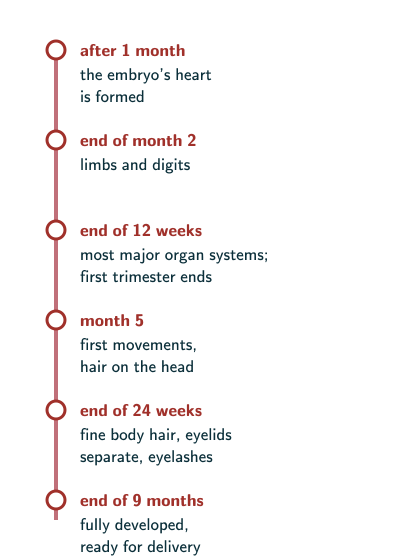
NCERT describes pregnancy as about 9 months (page 38). Clinical gestational age is counted from the first day of the last menstrual period: about 40 weeks, roughly two weeks longer than age since fertilisation. NCERT’s following milestones are approximate textbook landmarks, not a precise clinical dating chart:
- After one month: early cardiac development is underway; this does not mean the heart is fully mature.
- End of the second month: the foetus develops limbs and digits.
- End of 12 weeks (first trimester): most of the major organ systems are formed; for example, the limbs and external genital organs are well developed.
- Fifth month: fetal movements may first be felt by the mother, and NCERT notes hair on the head. Movement itself starts earlier; NHS gives about 16–24 gestational weeks for first felt movement.
- About 24 weeks (NCERT’s landmark): the body is covered with fine hair, the eyelids separate, and eyelashes are formed.
- End of nine months: the foetus is fully developed and ready for delivery.
Beyond the NCERT text: clinical trimester boundaries differ from NCERT’s shorthand. ACOG uses the first trimester through 13 weeks 6 days, the second from 14 through 27 weeks 6 days, and the third from 28 weeks. Early cardiac activity is detected by ultrasound. NCERT’s stethoscope sentence comes straight after its one-month heart sentence (page 38), but it must not be read as saying that the heart sound can be heard at one month.
NCERT asks how many months pregnancy lasts in dogs, elephants and cats (page 38). For comparison, MSD Veterinary Manual’s gestation table gives dogs about 62–64 days from ovulation and cats about 65 days, roughly two months each. San Diego Zoo lists elephants at 20–22 months. These are species-level approximations, not fixed durations for every pregnancy.
Solved examples
Example 1: Placenta as a gland
Name the hormones the placenta produces, and the pregnancy hormone that NCERT says comes from the ovary.
Answer: the placenta produces hCG, hPL, estrogens and progestogens (NCERT page 37). NCERT names the ovary as the source of relaxin (page 37); its production is not confined to late pregnancy, and neither hCG nor relaxin is absolutely pregnancy-exclusive.
Example 2: Weeks and months
A pregnancy is in its 30th week. Which trimester is it in, and which of NCERT’s milestones has the foetus passed?
Answer: using clinical gestational age, the third trimester begins at 28 weeks, so week 30 is in the third trimester. NCERT lists these approximate earlier landmarks: heart (1 month), limbs and digits (2 months), most organ systems (12 weeks), first felt movements and head hair (month 5), fine body hair, separated eyelids and eyelashes (24 weeks).
Example 3: From inner cell mass to organs
What do the inner cell mass and the trophoblast each give after implantation?
Answer: the trophoblast puts out the chorionic villi, which with the uterine tissue form the placenta (NCERT page 37). The inner cell mass becomes the embryo: NCERT says it differentiates into an outer ectoderm and an inner endoderm, with a mesoderm soon appearing between them; these three layers give rise to all the tissues (organs), and the inner cell mass contains stem cells able to give rise to all the tissues and organs (NCERT pages 37–38). Beyond the NCERT text: all three definitive germ layers arise from the epiblast during gastrulation (NCBI Bookshelf, Embryology, Gastrulation).
Common mistakes to avoid
Common mistake
Listing relaxin among NCERT’s placental hormones
NCERT names hCG, hPL, estrogens and progestogens as placental hormones and says relaxin is secreted by the ovary in the later phase of pregnancy (NCERT page 37); identify the ovary when asked specifically for the source named by NCERT, while recognising the timing qualification above.
Common mistake
Calling the first two layers the definitive ectoderm and endoderm
In an NCERT answer, give NCERT’s order: the inner cell mass differentiates into an outer ectoderm and an inner endoderm, and a mesoderm soon appears between them (NCERT pages 37–38). Beyond the NCERT text: the first two layers are epiblast and hypoblast, and all three definitive germ layers arise from the epiblast during gastrulation (NCBI Bookshelf, Embryology, Gastrulation).
Common mistake
Placing the heart’s formation late
NCERT’s one-month heart landmark refers to early development, not a completed adult-like heart; limbs and digits are listed by the end of the second month (page 38).
Quick revision summary
- After implantation, chorionic villi of the trophoblast interdigitate with uterine tissue to form the placenta.
- The placenta supplies oxygen and nutrients, removes carbon dioxide and wastes, joins the embryo through the umbilical cord and secretes hCG, hPL, estrogens and progestogens; the ovary is an important source of relaxin, including earlier pregnancy.
- hCG, hPL and relaxin are pregnancy-associated, but hCG and relaxin are not exclusive to pregnancy; total and free thyroxine must be distinguished.
- The inner cell mass gives epiblast and hypoblast; the epiblast then produces all three definitive germ layers.
- Approximate NCERT milestones: early heart development at 1 month; limbs and digits by 2 months; organ systems by 12 weeks; first felt movements and head hair in month 5; fine hair, eyelids, eyelashes by 24 weeks; delivery at 9 months.
Formula sheet
- chorionic villi + uterine tissue = placenta
- placental hormones: hCG, hPL, estrogens, progestogens
- relaxin: ovarian source in NCERT; not exclusive to late pregnancy
- inner cell mass → epiblast/hypoblast; epiblast → three definitive germ layers
- clinical trimesters: through 13w6d; 14–27w6d; 28 weeks onward
Questions students ask
What does hCG do in pregnancy?
hCG, human chorionic gonadotropin, is a placental hormone that, beyond the NCERT text, keeps the corpus luteum active in pregnancy: NCERT names hCG first among the placenta’s hormones (page 37), and MeSH describes hCG as a close match to the pituitary’s LH in structure and action, with a part in sustaining the corpus luteum. That matters because, in the luteal phase, the corpus luteum secretes the progesterone that maintains the endometrium (NCERT page 35). NICHD adds that hCG is released once implantation takes place and that a pregnancy test works by detecting it.
Which organs come from the ectoderm, mesoderm and endoderm?
Beyond the NCERT text, the ectoderm forms the epidermis of the skin and the nervous system, the mesoderm the muscles, skeleton, heart, blood vessels, blood and kidneys, and the endoderm the lining of the gut and airways with the gland cells of the liver, pancreas and thyroid (Wikipedia, “Germ layer”); NCERT itself says only that the three layers give rise to all tissues (organs) in adults (page 38). In MeSH, the brain and spinal cord arise from the ectodermal neural tube, and much of the skeleton and muscle, with the dermis, from the mesodermal somites. Class 11 NCERT adds a mesoderm example, the notochord (page 39).
What is the difference between an embryo and a foetus?
An embryo and a foetus are the same developing human at two ages: beyond the NCERT text, MeSH draws the line at eight weeks after conception, calling the young an embryo for about its first two months in the uterus and a foetus from then until birth. NCERT’s month-by-month account mostly fits, speaking of the embryo at one month of pregnancy and of the foetus from the end of the second month on (page 38). NCERT also uses the two words together, calling the placenta a unit between the “developing embryo (foetus)” and the mother’s body (page 37).
What do hPL and relaxin do in pregnancy?
Beyond the NCERT text, which names hPL and relaxin but gives no job for either (page 37), MeSH says hPL acts partly like growth hormone and partly like prolactin and works against insulin, while relaxin loosens the pubic symphysis and opens the cervix in some animal species. Human placental lactogen, also named chorionic somatomammotropin, is made from soon after implantation in rising amounts, reaching 1 g or more a day late in pregnancy (MeSH). Relaxin is found in the corpus luteum of pregnancy, and MeSH leaves its role in pregnant women open.
Practice questions
Try each question first, then open the answer to check your working.
-
Q1. What connects the placenta to the embryo, and what does it do?
Show answerHide answer
The umbilical cord, which helps transport substances to and from the embryo (NCERT page 37).
-
Q2. By which month are the limbs and digits of the foetus formed?
Show answerHide answer
By the end of the second month of pregnancy (NCERT page 38).
-
Q3. The structure that provides a vascular connection between the foetus and the uterus is called the ______. (NCERT Exercise 1 k)
Show answerHide answer
Placenta (NCERT page 37).