Parturition and lactation
NCERT Class 12 Biology Chapter 2 Section 2.7
Quick answer
Parturition is childbirth through uterine contractions coordinated by maternal, fetal and placental signals. Cervical stretch and posterior-pituitary oxytocin support a positive-feedback loop during labour. Lactation is milk production, supported by prolactin; oxytocin causes milk ejection, and colostrum supplies maternal antibodies for passive protection.
With your textbook
NCERT Biology (Class 12), Chapter 2 “Human Reproduction”, Section 2.7 “Parturition and Lactation”, page 38.
Open the official NCERT chapter (PDF, 64.5 MB, ncert.nic.in) (opens in a new tab)
Checked against the 2026-27 reprint on .
What are parturition and lactation?
Parturition and lactation
This process of delivery of the foetus (childbirth) is called parturition.
NCERT Biology (Class 12), Section 2.7, page 38
- Parturition is the expulsion (delivery) of the foetus by vigorous contraction of the uterus at the end of pregnancy; it is induced by a complex neuroendocrine mechanism (page 38).
- Lactation is the production of milk by the mammary glands, which differentiate during pregnancy and start producing milk towards its end (page 38).
In plain words: maternal, fetal and placental signals interact as labour begins, the uterus starts contracting, and a hormone from the mother’s pituitary makes the contractions stronger and stronger until the baby is born. The mother’s breasts are ready to feed the newborn, and the first milk carries antibodies.
The gestation period
The average duration of human pregnancy, about 9 months, is called the gestation period (page 38).
The foetal ejection reflex and oxytocin
NCERT’s simplified sequence (page 38) is part of a complex maternal–fetal–placental process; it is not a complete account of the onset of human labour:
- The signals for parturition come from the fully developed foetus and the placenta; they induce mild uterine contractions, the foetal ejection reflex.
- This triggers the release of oxytocin from the maternal pituitary. It is the posterior pituitary that stores and releases oxytocin, which is synthesised by the hypothalamus (NCERT Class 11 Biology, Chapter 19, page 241).
- Oxytocin acts on the uterine muscle and causes stronger uterine contractions, which in turn stimulate further secretion of oxytocin.
- This stimulatory reflex between uterine contraction and oxytocin secretion continues, giving stronger and stronger contractions.
- The baby is expelled out of the uterus through the birth canal; soon after, the placenta is also expelled.
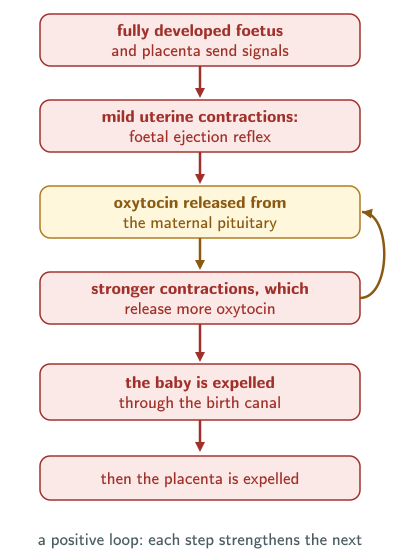
The muscle that does this work is the myometrium, the middle layer of the uterine wall, which shows strong contraction during delivery (NCERT Section 2.2, page 30). The oxytocin of the posterior pituitary is introduced in Class 11.
NCERT asks what doctors inject to induce delivery (page 38). Oxytocin is used by clinicians to induce or augment labour under monitoring because it stimulates uterine contraction.
NCERT’s Summary names three hormones in the neuroendocrine mechanism, cortisol, estrogens and oxytocin (page 39); the section itself describes only oxytocin’s part.
Lactation and colostrum
- The mammary glands differentiate during pregnancy and start producing milk towards the end of pregnancy; this is lactation, which helps the mother feed the newborn (page 38).
- From Class 11: prolactin regulates the growth of the mammary glands and the formation of milk in them, and oxytocin, besides contracting the uterus, causes milk ejection from the mammary gland (NCERT Class 11 Biology, Chapter 19, pages 241–242).
The milk produced during the initial few days of lactation is called colostrum which contains several antibodies absolutely essential to develop resistance for the new-born babies.
NCERT Biology (Class 12), Section 2.7, page 38
The antibodies, especially secretory IgA, provide passive protection at mucosal surfaces; they do not require the newborn to manufacture those maternal antibodies. NCERT’s emphasis on their value should not imply that an infant without colostrum has no immune protection.
Milk secretion begins during pregnancy, but abundant milk production increases after delivery, when placental progesterone and estrogen fall. Prolactin supports production; oxytocin contracts myoepithelial cells for milk ejection (WHO, The Physiological Basis of Breastfeeding).
- Breast-feeding during the initial period of infant growth is recommended by doctors for bringing up a healthy baby (page 38).
- The milk is made in the alveoli of the mammary lobes and flows through branching ducts to the nipple. NCERT labels tubules, ducts and an ampulla; the mammary-gland lesson explains why modern imaging qualifies the older ampulla model.
Solved examples
Example 1: Parturition and its hormones (NCERT Exercise 18)
What is parturition? Which hormones are involved in its induction?
Answer: parturition is the delivery of the fully developed foetus by vigorous contractions of the uterus at the end of pregnancy (NCERT page 38). It is induced by a complex neuroendocrine mechanism: signals from the foetus and placenta set off the foetal ejection reflex, which triggers oxytocin release from the maternal pituitary, and oxytocin drives stronger contractions (page 38). NCERT’s Summary lists cortisol, estrogens and oxytocin as the hormones involved (page 39).
Example 2: Why the contractions grow
Explain why uterine contractions during labour get stronger and stronger instead of settling down.
Answer: contractions cause oxytocin to be secreted, and oxytocin causes stronger contractions, which cause still more oxytocin: each step strengthens the next. NCERT calls this the stimulatory reflex between uterine contraction and oxytocin secretion (page 38); it continues until the baby is expelled.
Example 3: Colostrum
Why is colostrum important for a newborn?
Answer: colostrum, the milk of the first few days of lactation, contains several antibodies that provide passive immune protection, especially secretory IgA at mucosal surfaces (NCERT page 38, mechanism clarified). This is why breast-feeding in the initial period of infant growth is recommended.
Common mistakes to avoid
Common mistake
Saying the mother’s brain starts labour on its own
NCERT emphasises fetal and placental signals (page 38), while maternal tissues and neural feedback also participate. Beyond the NCERT text: pressure of the foetus on the cervix and vaginal walls triggers more oxytocin release during the positive-feedback loop (Walter, Abele and Plappert, Frontiers in Endocrinology, 2021; CC BY 4.0); labour is not explained by one organ alone.
Common mistake
Calling colostrum ordinary milk
Colostrum is the milk of the first few days of lactation, and it contains several antibodies (NCERT page 38).
Quick revision summary
- Gestation period: the average duration of human pregnancy, about 9 months.
- Parturition: delivery of the foetus by vigorous uterine contractions, induced by a complex neuroendocrine mechanism.
- Foetus and placenta signal → mild contractions (foetal ejection reflex) → oxytocin from the maternal pituitary → stronger contractions → more oxytocin → expulsion of the baby, then of the placenta.
- NCERT’s Summary names cortisol, estrogens and oxytocin.
- Lactation: milk production by the mammary glands from the end of pregnancy; colostrum of the first days carries antibodies; breast-feeding is recommended.
Formula sheet
- gestation period: about 9 months
- foetal ejection reflex → oxytocin release → stronger contractions → more oxytocin
- parturition hormones (NCERT Summary): cortisol, estrogens, oxytocin
- colostrum: first milk, rich in antibodies
Questions students ask
What is the difference between parturition and lactation?
Parturition and lactation differ in organ, product, hormone and timing: parturition is the delivery of the foetus (childbirth) by vigorous contraction of the uterus at the end of pregnancy, while lactation is the production of milk by the mammary glands to feed the newborn (NCERT page 38). Oxytocin drives the contractions of parturition (page 38), while prolactin regulates the formation of milk (NCERT Class 11, page 241). Parturition ends with the delivery, but NCERT’s Summary says the mother goes on feeding the baby milk during the initial few months of growth (page 39).
How is colostrum different from the breast milk that comes later?
Beyond the NCERT text, colostrum differs from the breast milk that comes later in colour, amount and timing: the US Office on Women’s Health guide calls it a deep-yellow first milk that a newborn takes only in small amounts per feed, and says it gives way to whiter, thinner mature milk by day three to five after birth. NCERT’s Chapter 7 likewise calls colostrum the yellowish fluid of the initial days of lactation (page 136); mature milk, the guide adds, still carries antibodies.
How many weeks does a human pregnancy last?
Beyond the NCERT text, which gives a gestation period of about 9 months (page 38), NICHD puts a normal human pregnancy at about 40 weeks, or 9.2 months, counted from the last menstrual period to delivery. That count starts before conception: in clinical practice, MeSH notes, the age of a pregnancy is often reckoned from the start of the last period, which falls about 2 weeks ahead of ovulation and fertilisation. By our reasoning, then, a baby born after 40 weeks of pregnancy has developed for about 38 weeks since fertilisation, as the month-by-month development section also explains.
Is parturition the same as labour?
Parturition and labour overlap but are not quite the same: parturition is the whole process of delivery of the foetus (childbirth), as NCERT defines it (page 38), while labour, beyond the NCERT text, is the run of repeated uterine contractions, with the cervix opening steadily wider, that ends in delivery (MeSH, “Labor, Obstetric”). MeSH lists birth and childbirth, not labour, as other names for parturition. So labour is the means by which parturition happens: the vigorous contraction of the uterus at the end of pregnancy that NCERT describes (page 38).
Practice questions
Try each question first, then open the answer to check your working.
-
Q1. Where do the signals for parturition originate?
Show answerHide answer
From the fully developed foetus and the placenta (NCERT page 38).
-
Q2. Which gland releases oxytocin during parturition, and on what does the hormone act?
Show answerHide answer
The maternal pituitary releases oxytocin, which acts on the uterine muscle (NCERT page 38). Specifically, it is the posterior pituitary that stores and releases oxytocin made by the hypothalamus (NCERT Class 11 Biology, Chapter 19, page 241).
-
Q3. What is the milk of the first few days of lactation called, and what does it contain?
Show answerHide answer
Colostrum; it contains several antibodies that provide passive protection for the newborn (NCERT page 38).