Immunity
NCERT Class 12 Biology Chapter 7 Section 7.2
Quick answer
Innate immunity provides rapid barriers and general defences, while adaptive immunity uses antigen-specific B- and T-cell responses and memory. Active immunity develops through the person’s own response; passive immunity transfers ready-made antibodies for temporary protection.
With your textbook
NCERT Biology (Class 12), Chapter 7 “Human Health and Disease”, Section 7.2 “Immunity”, pages 134–138.
Open the official NCERT chapter (PDF, 4.5 MB, ncert.nic.in) (opens in a new tab)
Checked against the 2026-27 reprint on .
What is immunity?
Immunity
- Every day we are exposed to a large number of infectious agents, but only a few exposures result in disease, because the body can defend itself against most foreign agents (page 134).
This overall ability of the host to fight the disease-causing organisms, conferred by the immune system is called immunity.
NCERT Biology (Class 12), Section 7.2, page 134
In plain words: the body has two lines of defence. The innate system responds rapidly using barriers and recognition of broad molecular patterns. The second learns: it recognises a particular germ, makes weapons aimed at it, and remembers it, so a second attack is beaten faster. Vaccines work by teaching this second line in advance.
Immunity is of two types: innate immunity and acquired immunity (page 134).
| Innate immunity | Acquired immunity |
|---|---|
| non-specific | pathogen-specific |
| present at birth | develops after antigen exposure, including vaccination |
| barriers plus internal cellular/chemical defences | memory: a faster, stronger second response |
(NCERT pages 134–135.)
Innate immunity: four barriers
Innate immunity is a non-specific defence present at the time of birth. It works through four types of barriers to the entry of foreign agents (pages 134–135):
- Physical barriers: the skin is the main barrier to the entry of micro-organisms; the mucus coating of the epithelium lining the respiratory, gastrointestinal and urogenital tracts traps microbes.
- Physiological barriers: acid in the stomach, saliva in the mouth and tears from the eyes prevent microbial growth.
- Cellular barriers: certain leukocytes (WBC), namely polymorphonuclear leukocytes (PMNL, the neutrophils), monocytes and natural killer cells (a type of lymphocyte) in the blood, and macrophages in the tissues; neutrophils, monocytes and macrophages can phagocytose microbes, while NK cells primarily kill infected or abnormal host cells rather than acting as phagocytes (page 135).
- Cytokine barriers: virus-infected cells secrete proteins called interferons, which induce antiviral defences in nearby cells, limiting viral spread rather than guaranteeing that no infection occurs.
Reading note (page 135): NCERT lists natural killer cells with the cells that phagocytose. Beyond the NCERT text, the National Cancer Institute (US, public domain) describes a natural killer cell as an immune cell with granules holding enzymes that “can kill tumor cells or cells infected with a virus”. In an exam, count NK cells among the cellular barriers of innate immunity, as NCERT does.
Acquired immunity and its memory
- Acquired immunity is pathogen-specific and is characterised by memory (page 135).
- On the first encounter with a pathogen the body produces a primary response of low intensity. A later encounter with the same pathogen brings a highly intensified secondary or anamnestic response, because the body appears to remember the first encounter (page 135).
- Both responses are carried out by two special types of lymphocytes in the blood: B-lymphocytes and T-lymphocytes, which circulate and also act in lymphoid tissues (page 135).
Antibodies and the two kinds of acquired response
- The B-lymphocytes produce an army of proteins, the antibodies, into the blood to fight pathogens. T-cells do not secrete antibodies but help B-cells to produce them (page 135).
- The basic antibody unit has four peptide chains: two small light chains and two longer heavy chains, so an antibody is written H2L2. Different types are produced, among them IgA, IgM, IgE and IgG (page 135).
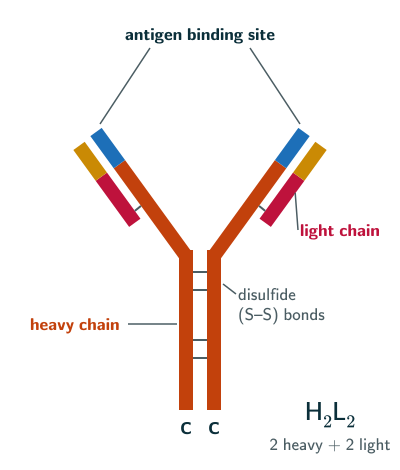
- Because the antibodies are found in the blood, the antibody-mediated response is called the humoral immune response (page 135).
- The second type is the cell-mediated immune response, or cell-mediated immunity (CMI), which the T-lymphocytes mediate (page 135).
Graft rejection
- When organs such as the heart, liver or kidney fail, transplantation may be the only remedy, but a graft cannot be taken from just any source: an animal, another primate or any human. An incompatible graft risks rejection; suitability depends on the tissue, donor and clinical setting (pages 135–136).
- Matching requirements vary by transplant. For many solid-organ transplants, blood-group compatibility and tissue assessment help reduce risk, and long-term immunosuppressants are usually required; this is not a universal rule for every graft. Corneal transplantation replaces corneal tissue, not a routinely functioning whole eye (page 136).
- The body can tell ‘self’ from ‘nonself’, and cell-mediated responses are important in graft rejection; antibodies can also contribute (page 136).
Active and passive immunity
- Active immunity: when a host is exposed to antigens, living or dead microbes or other proteins, it produces its own antibodies. A primary active response is relatively slow and takes time to give its full response. It is induced by deliberate injection of microbes during immunisation, or by natural infection (page 136).
- Passive immunity: ready-made antibodies are given directly to protect the body (page 136). Examples:
- colostrum, the yellowish fluid a mother secretes in the first days of lactation, rich in antibodies (IgA) that protect the infant;
- mainly IgG antibodies that pass from the mother to the foetus through the placenta during pregnancy.
| Active immunity | Passive immunity |
|---|---|
| the body makes its own antibodies | ready-made antibodies are given |
| slow to develop | immediate |
| vaccination; natural infection | colostrum; placenta; antitoxin |
| can create long-lived memory | temporary protection; transferred antibodies do not create the recipient’s own memory |
(NCERT page 136; “immediate” is our reading of NCERT’s contrast.)
Vaccination and immunisation
The principle of immunisation or vaccination is based on the property of ‘memory’ of the immune system.
NCERT Biology (Class 12), Section 7.2.4, page 136
- NCERT describes a vaccine as a preparation of antigenic proteins of a pathogen, or of an inactivated or weakened pathogen. The antibodies it raises neutralise the pathogen during a real infection, and it also generates memory B and T-cells, which recognise the pathogen quickly later and respond more rapidly; B-derived plasma cells make antibodies, while T-cells act through cellular mechanisms. Modern vaccines also include nucleic-acid and vector platforms; vaccination reduces risk but does not guarantee sterilising or lifelong protection (page 136).
- Passive immunisation: where a quick response is needed, as in tetanus, preformed antibodies or an antitoxin (a preparation of antibodies to the toxin) are injected. Antivenom, when clinically indicated for a venomous snakebite, contains antibodies against venom; not every snakebite requires it (page 136).
- Recombinant DNA technology produces antigenic polypeptides of a pathogen in bacteria or yeast, allowing large-scale production of vaccines, as with the hepatitis B vaccine produced from yeast (page 136).
Allergies and auto-immunity
- Allergy is the exaggerated response of the immune system to certain antigens in the environment. The substances to which such a response is produced are allergens, and the antibodies produced to these are of IgE type. Common allergens: mites in dust, pollen and animal dander (page 137).
- Symptoms: sneezing, watery eyes, running nose and difficulty in breathing. Allergy is due to the release of chemicals like histamine and serotonin from the mast cells (page 137).
- To find the cause of an allergy, the patient is exposed to or injected with very small doses of possible allergens, and the reactions are studied (page 137).
- NCERT: “The use of drugs like anti-histamine, adrenalin and steroids quickly reduce the symptoms of allergy” (page 137). Beyond the NCERT text: a serious allergic reaction, anaphylaxis, can begin very quickly and may be life-threatening, so it needs emergency help (MedlinePlus, “Anaphylaxis”, a US National Library of Medicine health-topic page, public domain).
- NCERT: modern-day life style has resulted in lowering of immunity and more sensitivity to allergens; more and more children in metro cities of India suffer from allergies and asthma, which could be because of the protected environment provided early in life (page 137). This possible explanation does not justify deliberate infection or abandoning hygiene (our reading).
- Auto-immunity: acquired immunity rests on the ability to tell foreign organisms from self-cells. Sometimes, for genetic and other unknown reasons, the body attacks self-cells, damaging the body: an auto-immune disease, such as rheumatoid arthritis (page 137).
Reading note (pages 136–137): NCERT’s ‘suppresants’ (in ‘immuno–suppresants’, split over two lines) and ‘dissappeared’ are misprints of immunosuppressants and disappeared.
The immune system and the lymphoid organs
- The human immune system consists of lymphoid organs, tissues, cells and soluble molecules such as antibodies. It recognises foreign antigens, responds to them and remembers them, and it plays a part in allergies, auto-immune diseases and organ transplantation (page 137).
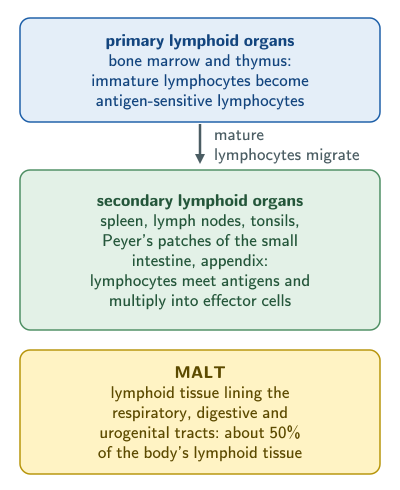
- Lymphoid organs are where lymphocytes originate, mature or proliferate. The primary lymphoid organs, bone marrow and thymus, are where immature lymphocytes become antigen-sensitive. After maturing, lymphocytes migrate to the secondary lymphoid organs, the spleen, lymph nodes, tonsils, Peyer’s patches of the small intestine and the appendix, where they meet antigens and proliferate into effector cells (pages 137–138).
- Bone marrow is the main lymphoid organ, where all blood cells, including lymphocytes, are produced. The thymus is a lobed organ near the heart, beneath the breastbone; it is prominent in childhood and undergoes age-related involution. NCERT’s claim that it is already very small by puberty is misleading: anatomical size generally grows through childhood, with fatty replacement increasingly evident after puberty. T-cell precursors arise in bone marrow and mature in the thymus; human B-cells mature mainly in bone marrow (page 138).
Reading note (page 138): distinguish the origin of T-cell precursors (bone marrow) from their maturation site (thymus); do not answer that T-cells mature equally in both.
- The spleen, a large bean-shaped organ, contains mainly lymphocytes and phagocytes; it filters the blood by trapping blood-borne micro-organisms and removes ageing RBCs and stores blood cells; NCERT’s “large reservoir of erythrocytes” should not imply that humans have the same specialised RBC storage capacity as diving mammals. Lymph nodes trap micro-organisms and antigens in the lymph and tissue fluid, and the trapped antigens activate the lymphocytes there (page 138).
- MALT (mucosa-associated lymphoid tissue) lies in the lining of the respiratory, digestive and urogenital tracts and makes up about 50 per cent of the body’s lymphoid tissue (page 138).
Solved examples
Example 1: Why the second infection is milder
A child has measles once and does not fall ill when exposed again years later. Explain.
Answer: acquired immunity has memory. The first encounter produced a low-intensity primary response; the second encounter brings a highly intensified secondary (anamnestic) response, which can prevent disease or reduce severity; the extent and duration of protection vary (NCERT page 135).
Example 2: Active or passive?
Classify: (a) a polio vaccine; (b) antibodies a baby receives in colostrum; (c) an injection of antitoxin after a deep wound; (d) recovery from a natural infection.
Answer: (a) active (the body makes its own antibodies after immunisation); (b) passive (ready-made IgA); (c) passive (preformed antibodies, as for tetanus); (d) active (natural infection) (NCERT page 136).
Example 3: Why organs are matched
Why are tissue matching and blood group matching needed before a kidney transplant?
Answer: the body tells ‘self’ from ‘nonself’, and the cell-mediated immune response rejects a graft from an unmatched source; matching lowers the risk, and long-term immunosuppression is generally required for a kidney graft (NCERT pages 135–136).
Common mistakes to avoid
Common mistake
Saying T-cells secrete antibodies
B-lymphocytes produce antibodies; T-cells do not secrete them but help B-cells to produce them, and they mediate cell-mediated immunity (NCERT page 135).
Common mistake
Calling vaccination passive immunity
A vaccine makes the body produce its own antibodies and memory cells: active immunity. Injecting preformed antibodies, as for tetanus or snakebite, is passive immunisation (NCERT page 136).
Common mistake
Linking allergy to IgG
NCERT: the antibodies produced to allergens are of IgE type (page 137).
Quick revision summary
- Immunity: the host’s ability, conferred by the immune system, to fight pathogens. Innate (non-specific, from birth): physical, physiological, cellular and cytokine (interferon) barriers.
- Acquired (specific, with memory): primary response of low intensity; secondary (anamnestic) response highly intensified; B- and T-lymphocytes.
- Antibodies from B-cells: H2L2; IgA, IgM, IgE, IgG; humoral response. T-cells: cell-mediated immunity, graft rejection.
- Active immunity: own antibodies, slow (vaccination, infection). Passive: ready-made antibodies (colostrum IgA, placenta, antitoxin, snake antivenom). Vaccines rely on memory; recombinant hepatitis B vaccine from yeast.
- Allergy: IgE antibodies; histamine and serotonin from mast cells; anti-histamine, adrenalin and steroids reduce symptoms (NCERT). Auto-immunity: rheumatoid arthritis.
- Lymphoid organs: primary (bone marrow, thymus); secondary (spleen, lymph nodes, tonsils, Peyer’s patches, appendix); MALT about 50 per cent.
Formula sheet
- basic antibody unit: HL (2 heavy, 2 light chains)
- innate: non-specific; acquired: specific, memory
- humoral: B-cells, antibodies; CMI: T-cells
- active: own antibodies; passive: ready-made
- allergy: IgE antibodies; histamine and serotonin from mast cells
- primary lymphoid organs: bone marrow, thymus
Questions students ask
What is the difference between an antigen and an antibody?
An antigen is what the immune system reacts to, and an antibody is a protein made in reply: NCERT says that when a host is exposed to antigens, “which may be in the form of living or dead microbes or other proteins”, antibodies are produced in the host body (page 136), and that the B-lymphocytes make them (page 135). Beyond the NCERT text, MeSH (US National Library of Medicine) defines antigens as “substances that are recognized by the immune system and induce an immune reaction”, and says antibodies “interact only with the antigen (or a very similar shape) that induced their synthesis”. So each antibody is matched to the antigen that called it up (our reading).
Are antibodies and immunoglobulins the same?
Beyond the NCERT text, every antibody is an immunoglobulin, but not every immunoglobulin is a free antibody: MeSH (US National Library of Medicine) describes immunoglobulins made by B-lymphocytes in two kinds of form, secreted forms, which are the antibodies, and forms that sit across the cell membrane and act as the B-cell’s receptors for antigen. The Ig that begins each antibody name in NCERT, IgA, IgM, IgE and IgG (page 135), stands for immunoglobulin, as MeSH’s headings Immunoglobulin A, M, E and G show.
What are the different types of antibodies?
NCERT names IgA, IgM, IgE and IgG as some of the types of antibodies produced in our body (page 135), and beyond the NCERT text MeSH (US National Library of Medicine) adds a fifth class, IgD, sorting all five by their heavy chains. In MeSH, IgG is “the major immunoglobulin isotype class in normal human serum”; secretory IgA is “the main immunoglobulin in secretions”; IgM, a large molecule, was first called a macroglobulin because of its high molecular weight; IgE is “associated with mast cells” and, when overproduced, with allergic hypersensitivity; and IgD is “found on the membrane of many circulating B lymphocytes”.
What is the difference between an antibody and an antibiotic?
An antibody is a protein made by the body’s own B-lymphocytes in response to pathogens (NCERT page 135), whereas an antibiotic is a chemical made by microbes: NCERT’s Chapter 8 defines antibiotics as “chemical substances, which are produced by some microbes and can kill or retard the growth of other (disease-causing) microbes” (page 152). Ready-made antibodies can even be given as protection, in passive immunity (page 136), while an antibiotic acts on the microbes and leaves no immune memory (our reasoning). Beyond the NCERT text, MeSH (US National Library of Medicine) files antibiotics under anti-bacterial agents, substances that “inhibit the growth or reproduction of bacteria”.
Are vaccination and immunisation the same thing?
Vaccination is one way of immunising, so the two overlap without being the same: NCERT bases “immunisation or vaccination” on the immune system’s ‘memory’ (page 136), yet it also calls giving preformed antibodies passive immunisation, which uses no vaccine (page 136). Beyond the NCERT text, MeSH (US National Library of Medicine) defines vaccination as the “administration of vaccines to stimulate the host’s immune response”, with active immunisation as another name for it, and treats immunisation as the wider term: active when antigens are given, passive when immune sera are given.
Practice questions
Try each question first, then open the answer to check your working.
-
Q1. Name the four types of barriers of innate immunity, with one example each.
Show answerHide answer
Physical (skin), physiological (stomach acid), cellular (neutrophils or macrophages) and cytokine (interferons) (NCERT pages 134–135).
-
Q2. Which type of antibody is found in colostrum?
Show answerHide answer
IgA (NCERT page 136).
-
Q3. Which immune response is responsible for graft rejection?
Show answerHide answer
T-cell-mediated responses are important (NCERT page 136); antibody-mediated rejection can also occur.