Blood: plasma, cells, blood groups, clotting
NCERT Class 11 Biology Chapter 15 Section 15.1
Quick answer
Blood consists of plasma and formed elements: red cells transport gases, white cells support defence and platelets help clotting. ABO and RhD antigens affect red-cell compatibility, while maternal anti-D can cause foetal haemolysis. During clotting, thrombin converts soluble fibrinogen into fibrin.
With your textbook
NCERT Biology (Class 11), Chapter 15 “Body Fluids and Circulation”, Section 15.1 “Blood”, pages 193–196.
Open the official NCERT chapter (PDF, 3.1 MB, ncert.nic.in) (opens in a new tab)
Checked against the 2026-27 reprint on .
Blood
Blood
Blood is a special connective tissue consisting of a fluid matrix, plasma, and formed elements.
NCERT Biology (Class 11), Section 15.1, page 193
Blood is the body fluid most higher organisms, including humans, use to carry nutrients, O and other essential substances to the cells and to take wastes away (NCERT page 193). It counts as a connective tissue: cells in a matrix, here a fluid one.
In plain words: blood is a delivery service in liquid form. The yellowish plasma is the road and the cargo hold, carrying dissolved food, salts and proteins; the red cells are oxygen trucks, the white cells are the security guards, and the platelets are the repair crew that seals a leak.
Plasma
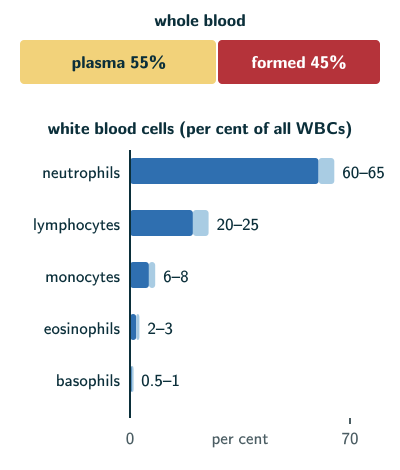
- Plasma is a straw-coloured, viscous fluid making up nearly 55 per cent of blood. It is 90–92 per cent water, and proteins make up 6–8 per cent of it (NCERT page 193).
- The major plasma proteins and their roles (pages 193–194):
- fibrinogen: needed for clotting (coagulation) of blood;
- globulins: NCERT emphasises defence; immunoglobulins are antibodies, while other globulins transport substances;
- albumins: help in osmotic balance.
- Plasma also has small amounts of minerals such as Na, Ca, Mg, HCO and Cl, and glucose, amino acids and lipids, which are always in transit in the body (page 194).
- Many clotting proteins circulate as inactive precursors. NCERT says, “Plasma without the clotting factors is called serum” (page 194). More precisely, serum is the fluid left after blood clots: fibrinogen is consumed in forming fibrin, but this does not mean every coagulation-related substance disappears (NCI SEER, “Glossary for Registrars”). Calcium ions, for example, are not inactive enzymes.
Formed elements
Erythrocytes, leucocytes and platelets together are the formed elements; they make up nearly 45 per cent of blood (NCERT page 194, Figure 15.1).
Erythrocytes, leucocytes and platelets
Erythrocytes (red blood cells, RBCs) (NCERT page 194):
- the most abundant cells in blood: a healthy adult man has on average 5 million to 5.5 million RBCs per mm of blood;
- formed in the red bone marrow in adults;
- without a nucleus in most mammals, and biconcave;
- contain haemoglobin, a red, iron-containing complex protein; a healthy person has 12–16 g of haemoglobin per 100 mL of blood, and it plays a significant role in transporting respiratory gases (see the structure of haemoglobin);
- live 120 days on average, after which they are destroyed in the spleen, the “graveyard of RBCs”.
Leucocytes (white blood cells, WBCs) are colourless (no haemoglobin), nucleated, generally short-lived, and fewer: on average 6000–8000 per mm (page 194). There are two main kinds:
Granulocytes are the neutrophils, eosinophils and basophils; agranulocytes are the lymphocytes and monocytes (page 194).
| WBC | Share | Role (NCERT) |
|---|---|---|
| neutrophils | 60–65% | phagocytic |
| eosinophils | 2–3% | resist infection; allergy |
| basophils | 0.5–1% | histamine, heparin; inflammation |
| lymphocytes (B, T) | 20–25% | immune responses |
| monocytes | 6–8% | phagocytic |
(NCERT pages 194–195.) Neutrophils are the most abundant WBCs and basophils the least (page 194).
Platelets (thrombocytes) are cell fragments produced from megakaryocytes, special cells in the bone marrow. They release substances most of which are involved in clotting; a fall in their number can cause clotting disorders and excessive loss of blood (NCERT page 195).
NCERT prints this platelet count with its commas in the wrong places (page 195). Read it as 150 000–350 000 platelets per mm (1.5 lakh to 3.5 lakh).
These counts and haemoglobin values are NCERT teaching figures, not universal clinical reference intervals; values vary with age, sex and laboratory methods.
Blood groups
Human blood, though it looks similar, differs in certain ways. Of the many groupings, the ABO and Rh groupings are widely used all over the world (NCERT page 195).
ABO grouping
- ABO grouping is based on the presence or absence of two surface antigens, A and B, on the RBCs. The plasma of different people contains two natural antibodies (NCERT page 195).
| Group | Antigens on RBCs | Antibodies in plasma |
|---|---|---|
| A | A | anti-B |
| B | B | anti-A |
| AB | A, B | neither anti-A nor anti-B |
| O | neither A nor B | anti-A and anti-B |
For red-cell transfusion considering ABO alone, who can receive from whom: A from A and O; B from B and O; AB from AB, A, B and O; O only from O (NCERT Table 15.1, page 195).
- Before a transfusion, the donor’s blood must be carefully matched with the recipient’s, to avoid severe clumping (destruction of RBCs) (page 195).
- NCERT calls O the universal donor and AB the universal recipient (page 195). This shorthand applies to red cells and the ABO system, not unrestricted whole-blood transfusion. With RhD included, O negative red cells have the widest ABO/RhD donor compatibility, and AB positive people can receive red cells from all eight ABO/RhD groups. Other antigens and compatibility testing still matter. Plasma compatibility is reversed: AB plasma has neither anti-A nor anti-B and is the universal ABO plasma donor (American Red Cross, “Blood Types”).
Rh grouping and erythroblastosis foetalis
- In NCERT’s simplified scheme, the Rh antigen is present in “nearly 80 per cent” of humans (page 196). In current terminology, routine Rh positive/negative status refers mainly to the D antigen; the Rh system includes other antigens, and RhD frequencies vary between populations (Dean, Blood Groups and Red Cell Antigens, “The Rh blood group”).
- NCERT: “An Rh-ve person, if exposed to Rh+ve blood, will form specific antibodies against the Rh antigens. Therefore, Rh group should also be matched before transfusions” (page 196). Beyond the NCERT text, exposure does not always sensitise: an RhD-negative person exposed to RhD-positive red cells may become sensitised, forming anti-D antibodies (Dean, Blood Groups and Red Cell Antigens, “The Rh blood group”). This is why RhD matters in transfusion and pregnancy.
- NCERT’s classic pregnancy sequence is an unsensitised RhD-negative mother carrying an RhD-positive foetus:
- Maternal and foetal blood normally circulate separately. Small amounts of foetal blood can nevertheless enter the maternal circulation during pregnancy or delivery.
- Exposure may stimulate maternal anti-D antibodies. If sensitisation first occurs at delivery, that first baby is usually unaffected.
- Maternal IgG anti-D crosses the placenta and can destroy an RhD-positive foetus’s RBCs in a subsequent pregnancy, causing haemolytic disease of the foetus and newborn, historically called erythroblastosis foetalis. Severe disease can cause anaemia, jaundice after birth or death.
- A first pregnancy is not guaranteed to be safe: sensitisation can already exist after an earlier pregnancy or transfusion, or occur during the current pregnancy. An Rh mismatch alone does not establish disease (NHS, “Rhesus disease”).
- NCERT names anti-Rh antibodies immediately after the first delivery as prevention (page 196). Modern prevention uses anti-D immunoglobulin in eligible, unsensitised RhD-negative mothers, including antenatal prophylaxis, relevant sensitising events and after an RhD-positive birth. It prevents sensitisation; it does not reverse established immune anti-D (Newcastle Hospitals, “Antenatal / Postnatal Suitability”).
Coagulation of blood
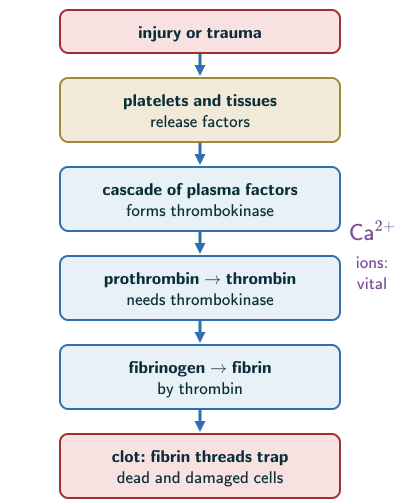
- Blood clots in response to an injury or trauma; this prevents excessive loss of blood (NCERT page 196).
- The clot (coagulum; NCERT prints “coagulam”) is mainly a network of threads called fibrin, which traps blood cells and platelets, including intact cells, not only dead or damaged formed elements (page 196).
- The chain of events (page 196):
- An injury stimulates platelets to release certain factors; factors released by the injured tissues can also start coagulation.
- A cascade of linked enzymic reactions among inactive plasma factors forms the enzyme complex thrombokinase.
- Thrombokinase is needed to convert inactive prothrombin into thrombin.
- Thrombin cleaves soluble fibrinogen into fibrin; fibrinogen is a substrate, not an inactive enzyme.
- Calcium ions play a very important role in clotting (page 196).
Solved examples
Example 1: Match the columns (NCERT Exercise 3)
Match Column I with Column II: (a) Eosinophils, (b) RBC, (c) AB Group, (d) Platelets, (e) Systole with (i) Coagulation, (ii) Universal Recipient, (iii) Resist Infections, (iv) Contraction of Heart, (v) Gas transport.
Answer: (a)–(iii), (b)–(v), (c)–(ii), (d)–(i), (e)–(iv) (NCERT pages 194–196 and 199). “Universal recipient” here means ABO-compatible red cells.
Example 2: The formed elements (NCERT Exercise 1)
Name the components of the formed elements in the blood and mention one major function of each.
Answer: erythrocytes (RBCs), which carry respiratory gases using haemoglobin; leucocytes (WBCs), which defend the body, for example neutrophils and monocytes by phagocytosis and lymphocytes by immune responses; and platelets, which release factors for blood clotting (NCERT pages 194–195).
Example 3: Plasma proteins (NCERT Exercise 2)
What is the importance of plasma proteins?
Answer: fibrinogen is needed for the clotting of blood; globulins are mainly involved in the defence mechanisms of the body; albumins help in osmotic balance (NCERT pages 193–194).
Example 4: Blood as a connective tissue (NCERT Exercise 4)
Why do we consider blood as a connective tissue?
Answer: NCERT calls blood a special connective tissue made of a fluid matrix, the plasma, and formed elements (page 193). Like other connective tissues, it has cells (the formed elements) in a matrix, here a fluid one, the plasma; the chapter’s Summary calls it “a fluid connective tissue” (page 203). It connects all parts of the body by carrying substances to and from the cells (page 193).
Example 5: Can this transfusion be given?
Considering ABO, can a person of group B receive red cells from a donor of group AB?
Answer: no. Group B plasma has anti-A antibodies, and AB red cells carry the A antigen, so the donor cells would clump. By NCERT Table 15.1, group B can receive only from B and O (page 195).
Example 6: Counting neutrophils
A blood sample has 7000 WBCs per mm. Using NCERT’s share for neutrophils, how many neutrophils are there per mm?
Answer: 60–65 per cent of 7000 = 0.60 × 7000 to 0.65 × 7000 = 4200–4550 per mm (shares from NCERT page 194).
Common mistakes to avoid
Common mistake
Confusing plasma and serum
NCERT uses “plasma without the clotting factors” (page 194). More precisely, serum is fluid separated after clotting, with fibrinogen depleted; it is not simply plasma with all proteins removed.
Common mistake
Swapping universal donor and recipient
For ABO red-cell compatibility, O is the universal donor and AB the universal recipient. Include RhD and these become O negative and AB positive respectively. Plasma follows a different rule, and compatibility testing still matters.
Common mistake
Assuming a first Rh-positive pregnancy cannot be affected
NCERT describes sensitisation at a first delivery and risk in later pregnancies. Earlier sensitisation or exposure during pregnancy can also occur; “first baby usually unaffected” is not an absolute rule.
Common mistake
Saying the spleen makes RBCs
RBCs are formed in the red bone marrow in adults and destroyed in the spleen after about 120 days (NCERT page 194).
Common mistake
Calling neutrophils the most abundant blood cells
Neutrophils are the most abundant white cells (60–65 per cent of WBCs), but RBCs are the most abundant of all the cells in blood. With about 5 million RBCs and 6000–8000 WBCs per mm, there are roughly 700 RBCs for every WBC: 5 000 000 ÷ 7000 ≈ 714 (NCERT page 194).
Quick revision summary
- Blood is a special connective tissue: plasma (about 55 per cent) and formed elements (about 45 per cent).
- Plasma: 90–92 per cent water, 6–8 per cent proteins (fibrinogen for clotting, globulins for defence, albumins for osmotic balance); serum is fluid left after clotting, with fibrinogen depleted.
- RBCs: 5–5.5 million per mm, no nucleus, biconcave, 12–16 g haemoglobin per 100 mL, life 120 days. WBCs: 6000–8000 per mm; neutrophils most, basophils least. Platelets: 150 000–350 000 per mm, from megakaryocytes, for clotting.
- ABO groups depend on A and B antigens. For red cells, O negative has widest ABO/RhD donor compatibility and AB positive the widest recipient compatibility. Maternal anti-D can harm an RhD-positive foetus; incompatibility alone is not disease.
- Clotting: platelet and tissue factors → thrombokinase → prothrombin to thrombin → fibrinogen to fibrin; calcium ions are essential.
Formula sheet
- blood = plasma (about 55%) + formed elements (about 45%)
- RBC 5–5.5 million per mm; WBC 6000–8000 per mm; platelets 150 000–350 000 per mm
- haemoglobin 12–16 g per 100 mL; RBC life 120 days
- red cells, ABO/RhD: O negative universal donor; AB positive universal recipient
- prothrombin → thrombin; fibrinogen → fibrin (thrombokinase, calcium ions)
Questions students ask
Why is group O the universal donor, yet a group O person can receive only O blood?
For red-cell transfusion, O cells carry neither A nor B, but O plasma contains anti-A and anti-B. An O recipient therefore receives ABO-compatible red cells only from O donors (NCERT Table 15.1). With RhD included, O negative red cells have the widest compatibility and AB positive people the widest red-cell recipient compatibility. These labels do not guarantee compatibility with every other blood-group antigen. AB is the universal ABO plasma donor, because plasma compatibility depends on the donor’s antibodies (American Red Cross, “Blood Types”).
What is the difference between plasma and serum, and why does serum not clot?
Plasma and serum differ in the clotting factors: plasma is the straw-coloured fluid matrix of blood with fibrinogen and the other clotting factors still in it, while serum is separated after blood clots. NCERT calls it plasma without clotting factors (pages 193–194); the precise distinction is depletion of fibrinogen during clotting, not absence of every factor (NCI SEER glossary). Serum cannot clot again because its fibrinogen has already been turned into the fibrin threads of a clot and removed with it (NCERT page 196 for the conversion). Beyond the NCERT text, the two are also prepared differently: plasma is what remains when blood kept from clotting is spun to remove its cells, and serum is the clear fluid left after blood has clotted (MeSH, US National Library of Medicine, “Plasma” and “Serum”).
Which vitamin is needed for blood clotting?
Vitamin K is the vitamin needed for normal blood clotting: beyond the NCERT text, it is a fat-soluble cofactor required for clotting, and green leafy vegetables are a good source of it (MeSH, US National Library of Medicine, “Vitamin K”). NCERT’s Chapter 15 names no vitamin; the mineral it stresses is calcium, as calcium ions play a very important role in clotting (page 196). Beyond the NCERT text, calcium ions are part of the enzyme complex that turns prothrombin into thrombin, the complex NCERT calls thrombokinase (MeSH, “Prothrombin”; NCERT page 196).
What is the difference between ABO and Rh blood grouping?
ABO grouping depends on two antigens, A and B, on the red blood cells, while routine Rh positive/negative status mainly records the D antigen. NCERT gives nearly 80 per cent Rh positive as its teaching figure; actual frequencies vary by population. The Rh system includes further antigens (Dean, “The Rh blood group”). Their antibodies differ too: the anti-A and anti-B antibodies of the ABO system are natural and already present in the plasma (page 195), but an Rh−ve person forms antibodies against the Rh antigen only after being exposed to Rh+ve blood (page 196). Each person has one group in each system, so the four ABO groups and the two Rh groups combine into eight, such as A Rh+ve and O Rh−ve, and both are matched before a transfusion (pages 195–196).
Can Rh incompatibility arise in pregnancy if the mother is Rh positive?
NCERT’s classic anti-D example involves an RhD-negative mother and an RhD-positive foetus. However, RhD-positive status does not rule out all haemolytic disease: the Rh system also includes C, c, E and e, and maternal antibodies to other Rh or other blood-group antigens can affect a foetus. Thus “Rh positive” should not be taken to mean “no possible blood-group incompatibility” (Dean, Blood Groups and Red Cell Antigens, “The Rh blood group”).
Practice questions
Try each question first, then open the answer to check your working.
-
Q1. Which WBCs secrete histamine, serotonin and heparin?
Show answerHide answer
Basophils (NCERT page 194).
-
Q2. Where are RBCs destroyed after their life span?
Show answerHide answer
In the spleen, the graveyard of RBCs, after about 120 days (NCERT page 194).
-
Q3. Which enzyme converts fibrinogen into fibrin?
Show answerHide answer
Thrombin (NCERT page 196).