Regulation of cardiac activity
NCERT Class 11 Biology Chapter 15 Section 15.5
Quick answer
The human heart is myogenic: its nodal tissue generates the rhythm without a nerve impulse for every beat. Autonomic signals and adrenal hormones modify its rate and force; cardiac output depends on both heart rate and stroke volume.
With your textbook
NCERT Biology (Class 11), Chapter 15 “Body Fluids and Circulation”, Section 15.5 “Regulation of Cardiac Activity”, page 202.
Open the official NCERT chapter (PDF, 3.1 MB, ncert.nic.in) (opens in a new tab)
Checked against the 2026-27 reprint on .
Regulation of cardiac activity
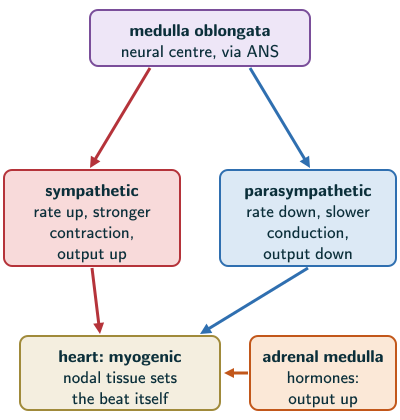
Myogenic heart
The heart starts its own beat. NCERT explains why it is called myogenic (Section 15.5, page 202):
Normal activities of the heart are regulated intrinsically, i.e., auto regulated by specialised muscles (nodal tissue), hence the heart is called myogenic.
NCERT Biology (Class 11), Section 15.5, page 202
In plain words: the heartbeat comes from inside the heart. Its own nodal tissue fires every beat; the brain and hormones only turn the speed and force up or down, much as a driver works the accelerator and brake of an engine that is already running.
Myogenic heart
- The nodal tissue (SAN, AVN, AV bundle and Purkinje fibres) is a specialised cardiac musculature that can generate action potentials without any external stimuli: it is autoexcitable (NCERT Section 15.3.1, page 199).
- The SAN generates the most action potentials, 70–75 a minute, and so sets the rhythm as the pacemaker (page 199). The heart wall itself is cardiac muscle, which is involuntary.
- Nerves and hormones do not start the beat; they moderate it. NCERT’s summary puts it this way:
Though the heart is autoexcitable, its functions can be moderated by neural and hormonal mechanisms.
NCERT Biology (Class 11), Chapter 15, Summary, page 204
Beyond the NCERT text, the resting rate is already held down by the nerves: human pacemaker cells on their own have an intrinsic rate of about 100 beats a minute, and steady parasympathetic activity brings the resting rate down to about 70 (Choi and colleagues, GeroScience, 2021). For exams, keep NCERT’s figures: the SAN generates 70–75 action potentials a minute, and the heart normally beats 70–75 times a minute (page 199). The figure of about 100 is the rate the SAN would set with no nerves acting; NCERT does not give it.
Beyond the NCERT text, the opposite kind of heart is neurogenic: each beat is set off by nerve cells, not by the heart muscle itself. A classic example is the adult horseshoe crab Limulus polyphemus; vertebrates and many invertebrates have myogenic hearts (Kodirov and colleagues, “Limulus and heart rhythm”, Journal of Experimental Zoology Part A, 2019). The human heart, like every vertebrate heart, is myogenic.
Sympathetic and parasympathetic control
- A special neural centre in the medulla oblongata can moderate cardiac function through the autonomic nervous system (ANS) (NCERT page 202). NCERT prints the name as “medulla oblangata” on this page; the correct spelling is medulla oblongata, which NCERT itself uses in Chapter 18 (Section 18.4.3, page 236).
- The medulla holds more than one control centre: it “contains centres which control respiration, cardiovascular reflexes and gastric secretions” (NCERT Section 18.4.3, page 236). The respiratory rhythm centre is one of them.
- The ANS carries impulses from the brain and spinal cord to the involuntary organs and smooth muscles, and it has two parts, the sympathetic and the parasympathetic (NCERT Section 18.2, page 231). Both reach the heart:
- Sympathetic signals increase the rate of heart beat, the strength of ventricular contraction and thereby the cardiac output (NCERT page 202).
- Parasympathetic signals decrease the rate of heart beat, the speed of conduction of the action potential and thereby the cardiac output (page 202).
| Usual effect | Heart rate | Output |
|---|---|---|
| sympathetic | up | up |
| parasympathetic | down | down |
Beyond the NCERT text, the two sets of nerves work through different chemical messengers (Choi and colleagues, GeroScience, 2021):
- Sympathetic: the nerve endings at the pacemaker release noradrenaline, which speeds it up.
- Parasympathetic: the impulses travel in the vagus nerve, which arises in the medulla oblongata, and the nerve endings release acetylcholine, which slows the pacemaker.
Adrenal medullary hormones
- Adrenal medullary hormones can also increase the cardiac output (NCERT page 202).
- NCERT names them in Chapter 19: the adrenal medulla secretes adrenaline (epinephrine) and noradrenaline (norepinephrine), together called catecholamines. They are secreted rapidly in response to stress and in emergencies, so they are called emergency hormones, or hormones of fight or flight, and both have direct cardiac effects that increase pacemaker activity and contraction strength (Section 19.2.7, page 244).
- Why output rises: cardiac output = stroke volume × heart rate (NCERT page 200). Increasing heart rate raises output if stroke volume is maintained. Stronger contraction often raises stroke volume, but filling and the pressure against which blood is ejected also matter. An excessively fast rate can reduce filling and stroke volume, so faster does not always mean greater output (Casabianca and Becker, “Cardiovascular Monitoring: Physiological and Technical Considerations”, Anesthesia Progress, 2009).
- Two different medullas: the medulla oblongata is part of the hindbrain (NCERT page 236); the adrenal medulla is the central tissue of the adrenal gland above each kidney (page 244).
Solved examples
Example 1: The myogenic heart (NCERT Exercise 9)
Why do we call our heart myogenic?
Answer: because its normal activities are regulated from within, by its own specialised muscles, the nodal tissue (NCERT page 202). The nodal musculature can generate action potentials without any external stimulus (it is autoexcitable), and the SAN sets the rhythm (page 199). The beat starts in the heart muscle itself, not in a nerve.
Example 2: Sympathetic stimulation and output
At rest, a person’s heart rate is 72 a minute and the stroke volume 70 mL (NCERT’s averages, page 200). Sympathetic signals raise the rate to 120 a minute and the stroke volume to 90 mL (illustrative numbers). Find the cardiac output before and after.
Answer: cardiac output = stroke volume × heart rate (NCERT page 200). Before: 70 × 72 = 5040 mL a minute, close to NCERT’s average of 5000 mL. After: 90 × 120 = 10 800 mL a minute, a little over twice as much. Both changes are sympathetic effects named by NCERT: a faster rate and a stronger ventricular contraction (page 202).
Example 3: Parasympathetic stimulation and output
Parasympathetic signals lower the same heart’s rate from 72 to 60 a minute, with the stroke volume unchanged at 70 mL (illustrative numbers). Find the new cardiac output.
Answer: 70 × 60 = 4200 mL a minute, which is 840 mL less than 5040 mL. A slower rate lowers the output (NCERT page 202).
Example 4: A sudden fright
A loud bang startles you. Name two ways your body raises its cardiac output within moments.
Answer: (1) the neural centre in the medulla oblongata sends signals through the sympathetic nerves, raising the heart rate and the strength of ventricular contraction (NCERT page 202); (2) the adrenal medulla rapidly secretes adrenaline and noradrenaline, the emergency hormones, which increase the heart beat and the strength of contraction (page 244).
Example 5: Without its nerves
If all the nerves to the heart were cut, would it stop beating?
Answer: no, provided its tissue remains viable and receives adequate oxygen and nutrients. The nodal tissue is autoexcitable and generates action potentials without any external stimuli (NCERT page 199); the nerves only moderate its beat (page 202). Beyond the NCERT text, without nervous input the pacemaker would run at its intrinsic rate of about 100 a minute, faster than the resting rate, because the steady parasympathetic slowing would be gone (Choi and colleagues, GeroScience, 2021).
Common mistakes to avoid
Common mistake
Saying the brain starts each heartbeat
The heart is myogenic: its nodal tissue starts every beat. The neural centre in the medulla oblongata only moderates the beat (NCERT page 202).
Common mistake
Swapping the two divisions of the ANS
Sympathetic signals speed the heart and raise output; parasympathetic signals slow the heart, slow conduction and lower output (NCERT page 202).
Common mistake
Confusing the two medullas
The cardiac control centre is in the medulla oblongata of the brain; the hormones that raise output come from the adrenal medulla of the adrenal gland (NCERT pages 202, 236 and 244).
Quick revision summary
- The heart is myogenic: its nodal tissue is autoexcitable, and the SAN sets the rhythm.
- A neural centre in the medulla oblongata moderates the heart through the ANS.
- Sympathetic signals increase the heart rate, the strength of ventricular contraction and the cardiac output.
- Parasympathetic signals decrease the heart rate, the speed of conduction and the cardiac output.
- Adrenal medullary hormones (adrenaline and noradrenaline) also increase the cardiac output.
Formula sheet
- cardiac output = stroke volume × heart rate
- sympathetic: heart rate ↑, contraction strength ↑, cardiac output ↑
- parasympathetic: heart rate ↓, conduction speed ↓, cardiac output ↓
- adrenal medullary hormones: cardiac output ↑
Questions students ask
What is the difference between a myogenic and a neurogenic heart?
A myogenic heart starts each beat in its own muscle, while a neurogenic heart beats only when impulses reach it from nerve cells; NCERT calls the human heart myogenic, as its own nodal tissue regulates it (page 202). Beyond the NCERT text, a classic neurogenic case is the adult horseshoe crab Limulus polyphemus, whose heartbeat is still myogenic in the embryo, while vertebrates and many invertebrates have myogenic hearts (Kodirov and colleagues, Journal of Experimental Zoology Part A, 2019). In the crab Cancer borealis, a cardiac ganglion of nine nerve cells starts each heartbeat (Rue and colleagues, Journal of Comparative Neurology, 2022).
What is the difference between heart rate and pulse rate?
Heart rate is the number of times the ventricles contract in a minute, while pulse rate is the number of pressure waves felt in an artery in a minute; each contraction of the left ventricle sends one such wave along the arteries, so the two numbers normally match (beyond the NCERT text; MeSH, US National Library of Medicine, “Heart Rate” and “Pulse”). NCERT counts the heart rate from an ECG, by counting the QRS complexes in a given time (page 201); feeling the pulse at the wrist normally counts the resulting arterial waves. In some arrhythmias a weak ventricular contraction produces no palpable peripheral pulse, so pulse rate can be lower than the ventricular rate (Leier and Chatterjee, “The Physical Examination in Heart Failure—Part I”, 2007).
Why does the heart beat faster during exercise?
The heart beats faster during exercise because working muscles need more oxygen: NCERT notes that exercise raises the energy demand of the muscles, and the extra oxygen calls for faster breathing, a faster heart beat and more blood flow (NCERT Chapter 18, page 230). The myogenic origin of the rhythm does not make its rate fixed. During exercise, reduced parasympathetic braking and increased sympathetic drive raise pacemaker rate; circulating hormones also contribute (NCERT Chapter 15, page 202; Choi and colleagues, GeroScience, 2021). When the exercise stops, the heart, like the lungs, gradually returns to its normal activity (Chapter 18, page 230).
What are bradycardia and tachycardia?
Bradycardia is a resting heart rate slower than normal, usually taken as below 60 beats a minute in adults, and tachycardia one faster than 100, terms beyond the NCERT text; most adults rest between 60 and 100, and some young or physically fit people normally rest at slower rates (NHLBI, “Arrhythmias: Types”). Some definitions put the bradycardia limit lower, usually below 50 beats a minute (MeSH, US National Library of Medicine, “Bradycardia”). For exams, keep NCERT’s figure: the heart normally beats 70–75 times a minute, an average of 72 (page 199).
Practice questions
Try each question first, then open the answer to check your working.
-
Q1. Which division of the autonomic nervous system slows the heart?
Show answerHide answer
The parasympathetic division: it decreases the heart rate, the speed of conduction of the action potential and the cardiac output (NCERT page 202).
-
Q2. Where is the neural centre that moderates the heart?
Show answerHide answer
In the medulla oblongata (NCERT page 202).
-
Q3. Name the two adrenal medullary hormones that increase the heart beat.
Show answerHide answer
Adrenaline (epinephrine) and noradrenaline (norepinephrine) (NCERT page 244).