Double circulation
NCERT Class 11 Biology Chapter 15 Section 15.4
Quick answer
Double circulation sends blood through the heart twice per complete circuit: right ventricle to lungs to left atrium, then left ventricle to body tissues to right atrium. The four-chambered heart separates the main streams and supports different pulmonary and systemic pressures.
With your textbook
NCERT Biology (Class 11), Chapter 15 “Body Fluids and Circulation”, Section 15.4 “Double Circulation”, pages 201–202.
Open the official NCERT chapter (PDF, 3.1 MB, ncert.nic.in) (opens in a new tab)
Checked against the 2026-27 reprint on .
Double circulation
Double circulation
In birds and mammals, oxygenated and deoxygenated blood received by the left and right atria pass to the ventricles of the same sides and are pumped out without mixing; two separate circulatory pathways are present, so these animals have double circulation (NCERT Section 15.3, page 197). In humans the two pathways are the pulmonary and the systemic circulation:
We have a complete double circulation, i.e., two circulatory pathways, namely, pulmonary and systemic are present.
NCERT Biology (Class 11), Chapter 15, Summary, page 204
In plain words: blood passes through the heart twice on every round trip. The right side pumps it on a short loop through the lungs to pick up oxygen; the left side then pumps it on the long loop round the body. The normal four-chambered heart keeps the main oxygen-rich and oxygen-poor streams separate, while allowing the lung circuit to operate at lower pressure than the body circuit.
Structure of arteries and veins
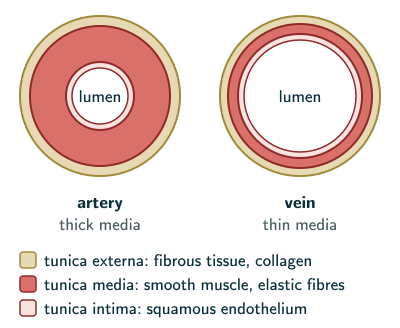
Blood flows strictly by a fixed route through the blood vessels, the arteries and veins. Each has three layers (NCERT Section 15.4, page 201):
| Layer | Made of |
|---|---|
| tunica intima (inner) | squamous endothelium |
| tunica media (middle) | smooth muscle, elastic fibres |
| tunica externa (outer) | fibrous connective tissue, collagen |
- The tunica media is comparatively thin in the veins (page 201).
- The inner lining is a squamous epithelium (endothelium).
Pulmonary and systemic circulation
- Pulmonary circulation: the right ventricle pumps deoxygenated blood into the pulmonary artery, which carries it to the lungs; oxygenated blood returns by the pulmonary veins to the left atrium (NCERT page 201).
- Systemic circulation: the left ventricle pumps oxygenated blood into the aorta, which carries it through a network of arteries, arterioles and capillaries to the tissues; deoxygenated blood is collected by venules, veins and the vena cava and emptied into the right atrium (page 201).
- The systemic circulation provides nutrients, O and other essential substances to the tissues and takes CO and other harmful substances away for elimination (page 201).
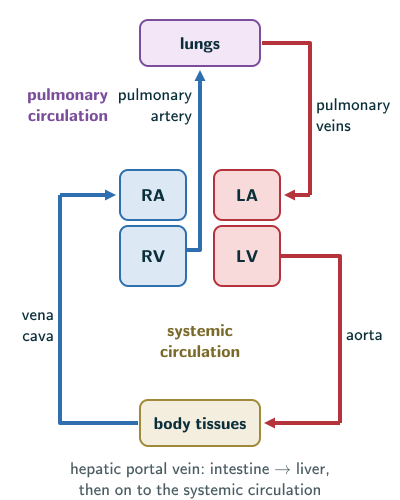
Note the names: the pulmonary artery carries deoxygenated blood and the pulmonary veins oxygenated blood. Arteries carry blood away from the heart and veins towards it, whatever its oxygen content (from NCERT’s routes, page 201).
Hepatic portal and coronary systems
- Hepatic portal system: a unique vascular connection between the digestive tract and the liver. The hepatic portal vein carries blood from the intestine to the liver before returning through hepatic veins to the general venous circulation (NCERT pages 201–202 describe the intestine-to-liver route). The hepatic portal system is part of systemic circulation, not a separate circuit outside it.
- Coronary system: a special system of blood vessels exclusively for the circulation of blood to and from the cardiac musculature (page 202). Coronary artery disease affects the vessels that supply blood to the heart muscle (page 203).
Solved examples
Example 1: Double circulation (NCERT Exercise 6)
What is meant by double circulation? What is its significance?
Answer: in double circulation, the blood passes through the heart twice in one complete circuit, along two separate pathways: the pulmonary circulation (right ventricle → lungs → left atrium) and the systemic circulation (left ventricle → body → right atrium) (NCERT pages 201 and 204). Its significance: oxygenated and deoxygenated blood are pumped out without mixing (page 197), maintaining the main oxygen-rich and oxygen-poor streams separately. Complete separation does not mean arterial blood must be 100 per cent oxygen-saturated; lung gas exchange still determines oxygen loading.
Example 2: Trace a red blood cell
Trace the path of a red blood cell from the right atrium back to the right atrium.
Answer: right atrium → (tricuspid valve) → right ventricle → pulmonary artery → lungs → pulmonary veins → left atrium → (bicuspid valve) → left ventricle → aorta → arteries, arterioles, capillaries in the tissues → venules, veins → vena cava → right atrium (NCERT pages 198 and 201).
Example 3: Which vessel?
Name the vessel that (a) carries oxygenated blood to the left atrium, (b) carries blood from the intestine to the liver, (c) supplies the heart muscle itself.
Answer: (a) the pulmonary veins; (b) the hepatic portal vein; (c) the vessels of the coronary system (NCERT pages 201–202).
Example 4: Artery or vein?
A vessel has a thick middle layer of smooth muscle and elastic fibres. Is it more likely an artery or a vein?
Answer: an artery: the tunica media is comparatively thin in the veins (NCERT page 201).
Common mistakes to avoid
Common mistake
Saying every artery carries oxygenated blood
The pulmonary artery carries deoxygenated blood from the right ventricle to the lungs, and the pulmonary veins carry oxygenated blood to the left atrium (NCERT page 201).
Common mistake
Sending the hepatic portal vein to the heart
The hepatic portal vein carries blood from the intestine to the liver, before returning to the heart through the hepatic veins. This portal route is itself part of systemic circulation (NCERT page 202 for the intestine-to-liver route).
Common mistake
Giving veins the thicker middle layer
The tunica media is comparatively thin in the veins (NCERT page 201).
Quick revision summary
- Arteries and veins have three layers: tunica intima (squamous endothelium), tunica media (smooth muscle, elastic fibres; thinner in veins) and tunica externa (fibrous tissue with collagen).
- Pulmonary circulation: right ventricle → pulmonary artery → lungs → pulmonary veins → left atrium.
- Systemic circulation: left ventricle → aorta → arteries, arterioles, capillaries → venules, veins, vena cava → right atrium; it delivers nutrients and O and removes CO.
- The hepatic portal vein carries blood from the intestine to the liver; the coronary system serves the heart muscle.
Formula sheet
- pulmonary: RV → pulmonary artery → lungs → pulmonary veins → LA
- systemic: LV → aorta → tissues → vena cava → RA
- vessel wall: tunica intima, tunica media, tunica externa
- hepatic portal vein: intestine → liver
Questions students ask
Why do veins have valves but arteries do not?
Many veins, especially in the limbs, have valves because the blood in them flows at a lower pressure than in the arteries and could slip backwards, a point beyond the NCERT text (NCI SEER Training Modules, “Classification & Structure of Blood Vessels”). Venous valves are flaps in many medium and large veins that let blood flow only towards the heart, which matters most in the arms and legs, against gravity (same source; MeSH, “Venous Valves”). Not all veins have valves. Arteries have no comparable series of venous valves along their length: the only valves on the arterial side are the semilunar valves where the ventricles open into the pulmonary artery and the aorta (NCERT pages 198–199).
What is the difference between single and double circulation?
Single circulation, as in fishes, sends blood through the heart once on each round of the body, while double circulation, as in birds and mammals, sends it through twice. The fish’s 2-chambered heart pumps out deoxygenated blood, which is oxygenated by the gills and supplied to the body parts, from where it returns to the heart (NCERT page 197). In birds and mammals the two ventricles pump oxygenated and deoxygenated blood out without any mixing (page 197). Amphibians and most reptiles have an incomplete double circulation, as their single ventricle mixes the two (page 197).
Why does blood from the intestine pass through the liver before reaching the heart?
Blood from the intestine passes through the liver first because the hepatic portal vein links intestinal capillaries to liver sinusoids before blood returns to the heart (NCERT page 202); beyond the NCERT text, this lets the liver handle what was absorbed before the rest of the body receives it. The blood carries simple sugars, amino acids, glycerol and some vitamins and salts, which the liver stores, processes and releases to the body when needed (NIDDK, “Your Digestive System & How It Works”), and the liver also helps the body remove poisons (MedlinePlus, “Liver Diseases”). Most absorbed long-chain dietary fat is packaged into chylomicrons and takes the lymph route; shorter-chain fatty acids can enter portal blood directly (Feingold, Endotext, “Introduction to Lipids and Lipoproteins”; StatPearls, “Biochemistry, Lipid Metabolism”).
What is the difference between the hepatic portal system and the renal portal system?
The hepatic portal system links the intestine with the liver, while the renal portal system links the lower parts of the body with the kidneys: NCERT describes both as special venous connections in the frog (Chapter 7, page 82), but for humans it describes only the hepatic portal system (Chapter 15, page 202). Beyond the NCERT text, mammals lost the renal portal system in evolution, so humans do not have one (Boaz and Chevalier, Evolution, Medicine, and Public Health, 2025). In any portal system, blood passes through two capillary beds before it returns to the general circulation (MeSH, “Portal System”).
Practice questions
Try each question first, then open the answer to check your working.
-
Q1. Which layer of the vessel wall is comparatively thin in veins?
Show answerHide answer
The tunica media (NCERT page 201).
-
Q2. Into which chamber does the vena cava empty deoxygenated blood?
Show answerHide answer
The right atrium (NCERT page 201).
-
Q3. What is the coronary system?
Show answerHide answer
A special system of blood vessels exclusively for the circulation of blood to and from the cardiac musculature (NCERT page 202).