Frog
NCERT Class 11 Biology Chapter 7 Section 7.2
Quick answer
The morphology and anatomy of the frog cover its external features and its internal organs: the frog is a cold-blooded amphibian whose body is head and trunk, with moist skin, a nictitating membrane, a tympanum and webbed hind feet, and males have vocal sacs and copulatory pads. It breathes through the skin in water and through the buccal cavity, skin and lungs on land, has a three-chambered heart and nucleated RBCs, and is ureotelic. Fertilisation is external and development passes through a tadpole.
With your textbook
NCERT Biology (Class 11), Chapter 7 “Structural Organisation in Animals”, Section 7.2 “Frogs”, pages 80–84.
Open the official NCERT chapter (PDF, 1.0 MB, ncert.nic.in) (opens in a new tab)
Checked against the 2026-27 reprint on .
The frog
Frogs
Frogs can live both on land and in freshwater and belong to class Amphibia of phylum Chordata.
NCERT Biology (Class 11), Section 7.2, page 80
- NCERT names Rana tigrina, the Indian bullfrog, as the most common species of frog found in India (pages 80 and 84). Beyond the NCERT text: it is now usually placed in the genus Hoplobatrachus, as Hoplobatrachus tigerinus; Wikipedia’s article on it lists Rana tigrina among its older names (facts in our words). In an NCERT-based answer, write Rana tigrina.
- Frogs are cold-blooded (poikilotherms): their body temperature varies with the temperature of the surroundings (page 80).
In plain words: NCERT uses the frog as its example of a vertebrate, to show how organs and organ systems work together in one animal. Frogs belong to the chordates, class Amphibia: animals that live both in water and on land.
Camouflage, aestivation and hibernation
- Frogs can change colour to hide from their enemies: this is camouflage (page 80).
- In peak summer and in winter they shelter in deep burrows: summer sleep is aestivation, winter sleep is hibernation (page 80).
NCERT adds that this protective coloration “is called mimicry” (page 80). That is not right: changing colour to blend with the surroundings is camouflage, or protective coloration. Beyond the NCERT text: mimicry is one species coming to resemble another species.
Morphology
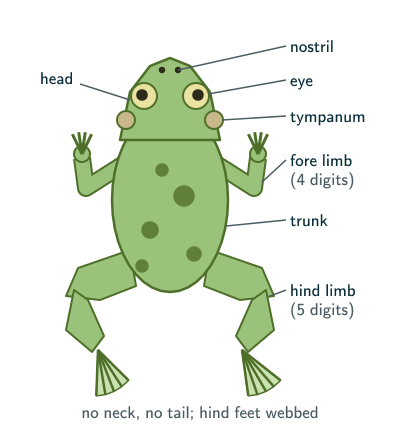
- The skin is smooth and slippery because of mucus, and always kept moist. The dorsal side is generally olive green with dark irregular spots; the ventral side is uniformly pale yellow (page 80).
- The skin has mucous glands and is highly vascularised, which helps the frog respire through it in water and on land (page 84).
- The frog never drinks water; it absorbs water through its skin (page 80).
- The body is divisible into head and trunk; there is no neck and no tail (page 80).
- Above the mouth is a pair of nostrils. The eyes bulge and are covered by a nictitating membrane, which protects them in water. On either side of the eyes, a membranous tympanum (ear) receives sound (page 80).
- The fore limbs end in four digits; the larger, more muscular hind limbs end in five. The feet have webbed digits for swimming. The limbs help in swimming, walking, leaping and burrowing (pages 80–81).
Sexual dimorphism
Frogs exhibit sexual dimorphism.
NCERT Biology (Class 11), Section 7.2.1, page 81
Male frogs have sound-producing vocal sacs and a copulatory pad on the first digit of each fore limb; female frogs have neither (page 81).
Anatomy and the digestive system
The body cavity of the frog holds the digestive, circulatory, respiratory, nervous, excretory and reproductive systems (page 81).
The alimentary canal is short because frogs are carnivores and hence the length of intestine is reduced.
NCERT Biology (Class 11), Section 7.2.2, page 81
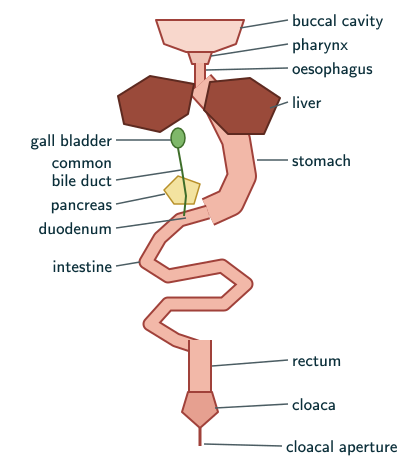
- Alimentary canal: the mouth opens into the buccal cavity, which leads through the pharynx into the short oesophagus, then the stomach, the intestine and the rectum, opening outside by the cloaca (page 81).
- Digestive glands: the liver secretes bile, stored in the gall bladder; the pancreas produces pancreatic juice containing digestive enzymes (pages 81–82).
- Food is captured by the bilobed tongue. In the stomach, HCl and gastric juices act on it, and the partly digested food (chyme) passes to the duodenum. The duodenum receives bile and pancreatic juice through a common bile duct: bile emulsifies fat, and pancreatic juices digest carbohydrates and proteins. Final digestion takes place in the intestine (page 82).
- Digested food is absorbed through the villi and microvilli of the intestine; undigested waste passes through the rectum and out through the cloaca (page 82). Beyond the NCERT text: villi are finger-like projections of the intestinal lining; microvilli are microscopic projections of the cell membrane of each lining cell, not folds of the wall.
Cutaneous and pulmonary respiration
- In water, the skin is the respiratory organ (cutaneous respiration): dissolved oxygen is exchanged through the skin by diffusion (page 82).
- On land, the buccal cavity, the skin and the lungs act as respiratory organs. Breathing by the lungs is pulmonary respiration. The lungs are a pair of elongated, pink, sac-like structures in the upper trunk (thorax); air enters through the nostrils into the buccal cavity and then the lungs (page 82).
- During aestivation and hibernation, gaseous exchange takes place through the skin (page 82).
Circulatory and lymphatic systems
- The blood vascular system is a well-developed closed type, of heart, blood vessels and blood; frogs also have a lymphatic system of lymph, lymph channels and lymph nodes (page 82).
- The heart, in the upper body cavity, has three chambers, two atria and one ventricle, and is covered by the pericardium. A triangular sinus venosus joins the right atrium and receives blood from the venae cavae; the ventricle opens into a sac-like conus arteriosus (page 82).
- Special venous connections link the liver and intestine (the hepatic portal system) and the kidney and the lower body (the renal portal system) (page 82).
- Blood is plasma and cells: RBCs (erythrocytes), WBCs (leucocytes) and platelets. The frog’s RBCs are nucleated and contain haemoglobin. Lymph lacks some proteins and RBCs (page 82).
- Beyond the NCERT text: Wikipedia’s article “Platelet” notes that platelets, cell fragments without a nucleus, are found only in mammals; in other vertebrates, amphibians among them, the clotting cells are thrombocytes, whole cells with a nucleus (facts in our words). In an NCERT-based answer, write platelets, as NCERT page 82 does.
NCERT’s chapter Summary calls the frog’s circulation “closed with single circulation” (page 84). Its own Chapter 15 says otherwise: in amphibians the left atrium receives oxygenated blood and the right atrium deoxygenated blood, which mix in the single ventricle, an incomplete double circulation (Chapter 15, page 197). Write incomplete double circulation in answers.
Excretory system
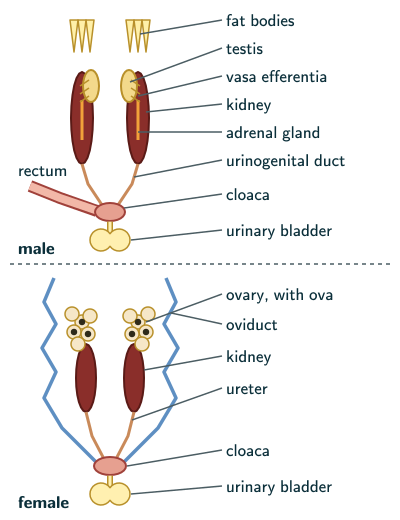
- A pair of kidneys, the ureters, the urinary bladder and the cloaca carry out excretion. The kidneys are compact, dark red and bean-like, a little posterior in the body cavity on either side of the vertebral column; each is made of many uriniferous tubules, or nephrons (page 82).
- In males the ureters act as urinogenital ducts opening into the cloaca; in females the ureters and oviducts open separately into the cloaca. The thin-walled urinary bladder, ventral to the rectum, also opens into the cloaca (pages 82–83).
The frog excretes urea and thus is a ureotelic animal.
NCERT Biology (Class 11), Section 7.2.2, page 83
Nervous system and endocrine glands
- Control and coordination are by the neural system and the endocrine glands. The prominent endocrine glands are the pituitary, thyroid, parathyroid, thymus, pineal body, pancreatic islets, adrenals and gonads (page 83).
- The nervous system has a central part (brain and spinal cord), a peripheral part (cranial and spinal nerves) and an autonomic part (sympathetic and parasympathetic). Ten pairs of cranial nerves arise from the brain, which is enclosed in a bony cranium (page 83).
- The brain has a fore-brain (olfactory lobes, paired cerebral hemispheres and the unpaired diencephalon), a mid-brain (a pair of optic lobes) and a hind-brain (cerebellum and medulla oblongata). The medulla passes out through the foramen magnum into the spinal cord, inside the vertebral column (page 83).
Sense organs
- Touch (sensory papillae), taste (taste buds), smell (nasal epithelium), vision (eyes) and hearing (tympanum with internal ears). The eyes and internal ears are well organised; the rest are cellular aggregations round nerve endings (page 83).
- The eyes are a pair of simple eyes in the orbits of the skull. There is no external ear; only the tympanum shows outside. The ear serves both hearing and balance (page 83).
Male and female reproductive systems
- Male: a pair of yellowish, ovoid testes, attached to the upper part of the kidneys by a double fold of peritoneum, the mesorchium. Ten to twelve vasa efferentia arise from the testes, enter the kidneys and open into Bidder’s canal, which joins the urinogenital duct that opens into the cloaca (pages 83–84).
- The cloaca is a small median chamber that passes faecal matter, urine and sperms to the outside (page 84).
- Female: a pair of ovaries near the kidneys, with no functional connection to them; a pair of oviducts opens into the cloaca separately. A mature female can lay 2500 to 3000 ova at a time (page 84).
- Beyond the NCERT text: the yellow, finger-like fat bodies at the front end of the gonads (labelled in NCERT Figures 7.2 and 7.3) store food reserves, used during hibernation and before breeding.
- Fertilisation is external, in water; development includes a larval stage, the tadpole, which metamorphoses into the adult (page 84).
Frogs are useful to people: they eat insects and protect crops, and they are an important link in food chains and food webs; in some countries their muscular legs are eaten (page 84).
Solved examples
Example 1: The digestive system (NCERT Exercise Q1)
Draw a neat diagram of the digestive system of a frog.
Answer: draw and label the mouth and buccal cavity, the pharynx, the short oesophagus, the stomach, the duodenum, the coiled intestine, the wide rectum, the cloaca and the cloacal aperture. Add the liver lobes with the gall bladder between them, the pancreas in the loop between the stomach and the duodenum, and the common bile duct that brings bile and pancreatic juice into the duodenum (NCERT pages 81–82). Title it “Digestive system of frog”. The digestive-system figure above shows the labels.
Example 2: The ureters (NCERT Exercise Q2)
Mention the function of the ureters in the frog.
Answer: the ureters carry urine from the kidneys to the cloaca. In the male they also carry sperms, so they act as urinogenital ducts; in the female they carry only urine, as the oviducts open into the cloaca separately (NCERT pages 82–83).
Example 3: Telling male from female
How can a male frog be told from a female?
Answer: the male has vocal sacs and a copulatory pad on the first digit of each fore limb, which the female lacks (NCERT page 81).
Example 4: Breathing in water and on land
Which organs does a frog breathe with in water, and on land?
Answer: in water, the skin (cutaneous respiration); on land, the buccal cavity, the skin and the lungs (pulmonary respiration by the lungs) (NCERT page 82).
Example 5: The frog’s heart
Name the chambers and the attached structures of the frog’s heart.
Answer: two atria and one ventricle, covered by the pericardium; the sinus venosus joins the right atrium, and the ventricle opens into the conus arteriosus (NCERT page 82).
Common mistakes to avoid
Common mistake
Calling colour change mimicry
Changing colour to blend into the surroundings is camouflage. NCERT’s next sentence calls this protective coloration “mimicry” (page 80), but mimicry means resembling another species. If both words are options, choose camouflage; know that NCERT’s own wording is “mimicry”.
Common mistake
Calling frog RBCs non-nucleated
The frog’s RBCs are nucleated (NCERT page 82); mature mammalian RBCs lack a nucleus (NCERT Chapter 15, page 194, says “most of the mammals”).
Common mistake
Calling the frog ammonotelic
The frog excretes urea: it is ureotelic (NCERT page 83). The tadpole lives in water, and NCERT Chapter 16 (page 205) lists aquatic amphibians as ammonotelic and many terrestrial amphibians as ureotelic, so expect the tadpole to excrete mainly ammonia and the adult urea (reasoned from NCERT Chapter 16, page 205).
Quick revision summary
- Frog: class Amphibia, phylum Chordata; Rana tigrina in NCERT; cold-blooded; camouflage; aestivation in summer, hibernation in winter.
- Morphology: moist, mucus-covered skin; head and trunk, no neck or tail; nostrils, bulging eyes with nictitating membrane, tympanum; fore limbs 4 digits, hind limbs 5 webbed digits; males with vocal sacs and copulatory pads.
- Digestion: short canal (carnivore), bilobed tongue, stomach, duodenum with a common bile duct from the liver (gall bladder) and pancreas, intestine, rectum, cloaca.
- Respiration: cutaneous in water; buccal, cutaneous and pulmonary on land.
- Circulation: closed, incomplete double circulation (NCERT Chapter 15, page 197); three-chambered heart with sinus venosus and conus arteriosus; hepatic and renal portal systems; nucleated RBCs; lymphatic system.
- Excretion: kidneys of uriniferous tubules, ureotelic; males with urinogenital ducts.
- Control: central, peripheral and autonomic nervous systems; ten pairs of cranial nerves; endocrine glands; no external ear.
- Reproduction: testes with mesorchium, 10–12 vasa efferentia and Bidder’s canal; ovaries and oviducts; 2500–3000 ova; external fertilisation; tadpole and metamorphosis.
Formula sheet
- frog heart: 2 atria, 1 ventricle; sinus venosus, conus arteriosus
- circulation: closed, incomplete double (blood mixes in the one ventricle)
- respiration: cutaneous in water; buccal, skin, lungs on land
- excretion: ureotelic; male ureters are urinogenital ducts
- brain: fore-brain, mid-brain (optic lobes), hind-brain
- cranial nerves: 10 pairs
- reproduction: external fertilisation; tadpole; 2500–3000 ova
Questions students ask
How is a frog’s heart different from a human heart?
A frog’s heart has three chambers, two atria and one ventricle, while a human heart has four, two atria and two ventricles (NCERT Chapter 15, pages 197–198). In the frog, oxygenated blood from the lungs enters the left atrium and deoxygenated blood from the body the right atrium, and the two get mixed in the single ventricle, which pumps out mixed blood: an incomplete double circulation (page 197). In humans the two ventricles keep oxygenated and deoxygenated blood apart, a complete double circulation.
Is the frog’s heart myogenic or neurogenic?
The frog’s heart is myogenic: each beat starts in the heart muscle itself, so a frog’s heart removed from the body keeps beating for a while, whereas a neurogenic heart needs impulses from nerve cells to start each beat. Beyond the NCERT text, the frog’s pacemaker is the sinus venosus, as the classic Stannius ligature experiments on frog hearts showed. In a myogenic heart, nerves only adjust the beat: NCERT calls the human heart myogenic because it is auto-regulated by specialised muscles, the nodal tissue, and says sympathetic signals speed it up and parasympathetic signals slow it down (NCERT Chapter 15, page 202).
What is the difference between aestivation and hibernation in frogs?
Aestivation is the frog’s summer sleep and hibernation its winter sleep: frogs are not seen in peak summer and winter because they shelter in deep burrows, from extreme heat during aestivation and from extreme cold during hibernation (NCERT Section 7.2, page 80). Both are periods of inactivity that let a cold-blooded animal, whose body temperature follows that of its surroundings, avoid the extremes. Beyond the NCERT text, the frog’s body processes slow down in both, and it lives on its stored food reserves.
What is the difference between a frog and a toad?
Frogs and toads both belong to the order Anura of class Amphibia, and the difference between them is informal: ‘toad’ is used mainly for the true toads, family Bufonidae, such as Bufo, which NCERT lists as the toad among its amphibians. A typical frog such as Rana has smooth, moist, slippery skin and long, muscular hind limbs with webbed feet for leaping and swimming, while, beyond the NCERT text, a true toad usually has dry, warty skin, a pair of large parotoid (poison) glands behind the eyes and shorter legs. Frogs usually lay their eggs in clusters and toads in long strings, and toads cope better with dry land, but these are general tendencies with exceptions.
What is the classification of Rana tigrina?
NCERT places Rana tigrina, the Indian bullfrog, in class Amphibia of phylum Chordata, and calls it the most common species of frog found in India (Section 7.2, page 80, and Summary, page 84). In the traditional classification that NCERT’s name follows, it is kingdom Animalia, phylum Chordata, subphylum Vertebrata, class Amphibia, order Anura (frogs and toads), family Ranidae, genus Rana. Beyond the NCERT text, zoologists now name it Hoplobatrachus tigerinus, in the family Dicroglossidae (Wikipedia, “Hoplobatrachus tigerinus”, facts in our words); use Rana tigrina when a question follows NCERT, and do not mix the modern genus and family into the old classification.
Is the frog in the NEET (UG) 2026 syllabus?
Yes, the frog is in the NEET (UG) 2026 syllabus: Unit 2, Structural Organisation in Animals and Plants, lists the morphology, anatomy and functions of its digestive, circulatory, respiratory, nervous and reproductive systems, as a “Brief account only”. The matching NCERT text is Section 7.2 of Class 11 Biology, Chapter 7, which also covers the frog’s excretory system, sense organs and endocrine glands, so learn the whole section.
Practice questions
Try each question first, then open the answer to check your working.
-
Q1. What protects a frog’s eyes in water?
Show answerHide answer
The nictitating membrane (NCERT page 80).
-
Q2. Which parts make up the frog’s hind-brain?
Show answerHide answer
The cerebellum and the medulla oblongata (NCERT page 83).
-
Q3. What is the hepatic portal system?
Show answerHide answer
The special venous connection between the liver and the intestine (NCERT page 82).
-
Q4. What passes out through the male frog’s cloaca?
Show answerHide answer
Faecal matter, urine and sperms (NCERT page 84).