Organs and organ systems
NCERT Class 11 Biology Chapter 7 Section 7.1
Quick answer
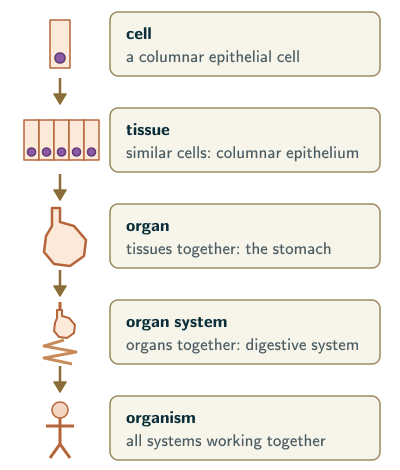
In a multicellular animal, similar cells form tissues, tissues form organs such as the stomach, heart and kidney, and two or more organs working together form an organ system such as the digestive system. This division of labour makes the activities of millions of cells efficient and coordinated; the heart contains all four basic tissues. Morphology is the study of external form, and anatomy the study of the internal organs of animals.
With your textbook
NCERT Biology (Class 11), Chapter 7 “Structural Organisation in Animals”, Section 7.1 “Organ and Organ System”, pages 79–80.
Open the official NCERT chapter (PDF, 1.0 MB, ncert.nic.in) (opens in a new tab)
Checked against the 2026-27 reprint on .
What are organs and organ systems?
Organs and organ systems
When two or more organs perform a common function by their physical and/or chemical interaction, they together form organ system, e.g., digestive system, respiratory system, etc.
NCERT Biology (Class 11), Chapter 7, Introduction, page 79
- A tissue is a group of similar cells with intercellular substances that performs a specific function; all complex animals have only four basic types (page 79). The chapter Summary words it more loosely: a group of cells with intercellular substances performing one or more functions (page 84).
- Tissues, organised in a specific proportion and pattern, form an organ, such as the stomach, lung, heart or kidney (page 79).
- Cells, tissues, organs and organ systems split up the work, showing division of labour, and together keep the body alive (page 79).
In plain words: the body is organised like a company. Cells are the workers, tissues are teams of similar workers, organs are departments made of one or more teams, and organ systems are divisions in which departments cooperate on one big task such as digestion. The same words also name the levels of organisation used to classify animals, but there a level describes a whole group: the most complex rung its body reaches, from the cellular level of sponges to the organ-system level of annelids, arthropods, molluscs, echinoderms and chordates.
From tissues to organs and organ systems
In a unicellular organism, a single cell carries out every function: digestion, respiration and reproduction. In a multicellular animal, the same basic functions are carried out by different groups of cells in a well organised manner (page 79).
- Even a simple animal such as Hydra is made of different types of cells, with the number of cells of each type running into thousands; the human body has billions of cells (page 79).
- Organising cells into tissues, organs and organ systems is essential for more efficient and better coordinated activities of the millions of cells in an organism (page 79).
- Each organ is made of one or more types of tissue. The human heart contains all four: epithelial, connective, muscular and neural (page 80).
- The complexity of organs and organ systems shows a discernible trend, which NCERT calls an evolutionary trend and leaves for Class 12 (page 80).
Morphology and anatomy
Morphology refers to study of form or externally visible features.
NCERT Biology (Class 11), Section 7.1, page 80
- For plants and microbes, morphology means only this: the study of external form.
- For animals, morphology refers to the external appearance of the organs or parts of the body.
- The word anatomy is conventionally used for the study of the morphology of the internal organs of animals (page 80).
NCERT introduces both through the frog, as its example of a vertebrate (page 80).
Solved examples
Example 1: Tissues in one organ
Which tissues make up the human heart?
Answer: all four basic tissues: epithelial, connective, muscular and neural (NCERT page 80).
Example 2: Organ or organ system?
Classify these as organs or organ systems: stomach, digestive system, lung, respiratory system, kidney.
Answer: organs: stomach, lung, kidney; organ systems: digestive system, respiratory system (NCERT page 79).
Example 3: Division of labour
What does NCERT mean by division of labour in the body?
Answer: cells, tissues, organs and organ systems split up the work, each doing its share, so that together they ensure the survival of the body as a whole (NCERT page 79 and Summary, page 84).
Example 4: Morphology in plants and animals
How does the meaning of “morphology” differ between plants and animals?
Answer: in plants and microbes it means only the study of external form; in animals it refers to the external appearance of the organs or body parts, while the study of internal organs is called anatomy (NCERT page 80).
Example 5: Why organise?
Why do multicellular animals organise their cells into tissues, organs and organ systems?
Answer: because such an organisation is essential for more efficient and better coordinated activities of the millions of cells that make up the organism (NCERT page 79).
Common mistakes to avoid
Common mistake
Calling the stomach an organ system
The stomach is an organ; it is part of the digestive system, an organ system.
Common mistake
Thinking every organ has all four tissues
Each organ has one or more types of tissue; the heart is NCERT’s example of one with all four.
Common mistake
Thinking *Hydra* has organs
Hydra has several types of cells, but as a cnidarian it shows only the tissue level of organisation: its cells form tissues, not organs. Organs first appear in flatworms (Platyhelminthes); see the levels of organisation (NCERT Chapter 4, pages 37 and 41).
Common mistake
Using “anatomy” for external features of animals
In animals, external appearance is morphology; anatomy is the study of the internal organs.
Quick revision summary
- A tissue is a group of similar cells with intercellular substances performing a specific function; complex animals have only four basic tissues.
- Tissues form organs (stomach, lung, heart, kidney); two or more organs working together by physical and/or chemical interaction form an organ system (digestive, respiratory).
- The organisation shows division of labour and makes the activities of millions of cells efficient and coordinated.
- The heart contains all four tissues: epithelial, connective, muscular and neural.
- Morphology: external form (in animals, the external appearance of organs and parts); anatomy: the internal organs of animals.
Formula sheet
- cell → tissue → organ → organ system → organism
- tissue: similar cells with intercellular substances
- organ system: organs working together (digestive, respiratory)
- heart: epithelial, connective, muscular, neural tissue
- morphology: external form; anatomy: internal organs
Questions students ask
What is the difference between morphology and anatomy?
Morphology is the study of form or externally visible features, while anatomy is the study of internal structure: NCERT says the word anatomy “conventionally is used for the study of morphology of internal organs in the animals” (Section 7.1, page 80), and calls the study of the internal structure of plants anatomy (Chapter 6, page 71). So a frog’s bulging eyes and tympanum belong to its morphology, and its three-chambered heart and its kidneys to its anatomy. Physiology, a third term NCERT does not define in this chapter, is the study of the functions of the body and its organs.
What are the levels of organisation in an animal’s body?
The levels of organisation in an animal’s body run from the cell to the tissue, the organ, the organ system and the whole organism: similar cells form a tissue, tissues in a specific proportion and pattern form an organ such as the heart, and two or more organs working together form an organ system (NCERT Chapter 7, page 79). Beyond the NCERT text, the US National Cancer Institute’s SEER Training Modules describe the human body the same way. NCERT’s Animal Kingdom chapter uses these terms in a different sense, for the highest level a group reaches, from sponges (cellular) to chordates (organ system).
What is the difference between an organ and an organ system?
An organ, such as the heart, is made of tissues organised in a specific proportion and pattern, while an organ system is two or more organs that perform a common function by their physical and/or chemical interaction (NCERT Chapter 7, page 79). So an organ system is one level above an organ: a frog’s kidney is an organ, while its excretory system is the pair of kidneys, the ureters, the urinary bladder and the cloaca, which together eliminate nitrogenous wastes (NCERT page 82).
How do organ systems work together?
Organ systems work together through the blood, which links them, and through the neural system and the endocrine glands, which coordinate them. In the frog, for example, the digestive system absorbs digested food, the blood carries nutrients, gases and water to the respective sites, and excretory wastes are carried by the blood into the kidney, where they are separated and excreted (NCERT pages 82–83). Hormones from the endocrine glands achieve the chemical coordination of the organs, and the neural system controls them through the brain, spinal cord and nerves (page 83).
How many organ systems are there in the human body?
There is no single fixed number, and NCERT gives none; its examples of organ systems are the digestive and respiratory systems (page 79). Beyond the NCERT text, the US National Cancer Institute’s SEER Training Modules name ten major body systems, the skeletal, muscular, nervous, endocrine, cardiovascular, lymphatic, respiratory, digestive, urinary and reproductive, and adding the skin’s integumentary system, which Encyclopaedia Britannica (‘Organ’) counts as an organ system, gives eleven. The count is a convention, since one organ can serve two systems: the frog’s pancreas makes pancreatic juice for digestion, and its islets are endocrine glands (NCERT pages 81–83).
Practice questions
Try each question first, then open the answer to check your working.
-
Q1. How many basic types of tissues do all complex animals have?
Show answerHide answer
Four (NCERT page 79).
-
Q2. Which of these is not an organ: stomach, kidney, blood, lung?
Show answerHide answer
Blood: NCERT calls it a special connective tissue, so it is a tissue, not an organ (NCERT Chapter 15, page 193).
-
Q3. A student notes a frog’s skin colour, its webbed feet and the length of its intestine. Which notes are morphology and which anatomy?
Show answerHide answer
Skin colour and webbed feet are external features, so they are morphology; the intestine is an internal organ, so its study is anatomy (NCERT pages 80–81).
-
Q4. Which animal does NCERT use to introduce morphology and anatomy?
Show answerHide answer
The frog, as a representative vertebrate (NCERT page 80).