Basis of classification of animals
NCERT Class 11 Biology Chapter 4 Section 4.1
Quick answer
Animal classification compares organisation, symmetry, embryonic germ layers, the body cavity, segmentation and the notochord. A true coelom has a complete mesodermal lining, a pseudocoelom lacks that complete lining, and an acoelomate has no cavity between body wall and gut. A notochord is a mesodermal supporting rod present at least during development in chordates; the broad school comparisons need group-specific exceptions.
With your textbook
NCERT Biology (Class 11), Chapter 4 “Animal Kingdom”, Section 4.1 “Basis of Classification”, pages 37–39.
Open the official NCERT chapter (PDF, 6.2 MB, ncert.nic.in) (opens in a new tab)
Checked against the 2026-27 reprint on .
Why and how animals are classified
Basis of animal classification
These features are used as the basis of animal classification and some of them are discussed here.
NCERT Biology (Class 11), Section 4.1, page 37
- Over a million species of animals have been described, so classification is essential; it also helps to assign a systematic position to newly described species (page 37).
- Despite differences in structure and form, animals share fundamental features: the arrangement of cells, body symmetry, the nature of the coelom, and the patterns of the digestive, circulatory or reproductive systems (page 37).
- NCERT discusses six bases: levels of organisation, symmetry, germ layers, coelom, segmentation and notochord.
In plain words: to sort animals into groups, biologists ask a fixed set of questions. How are the cells organised? Can the body be cut into matching halves? How many embryonic layers form the body? Is there a body cavity, and what lines it? Is the body built of repeated segments? Is there a notochord? The answers sort animals into the broad groups of NCERT Figure 4.4 (page 40); each phylum’s distinctive features then identify it.
Levels of organisation
All members of Animalia are multicellular, but they do not all show the same pattern of organisation of cells (page 37).
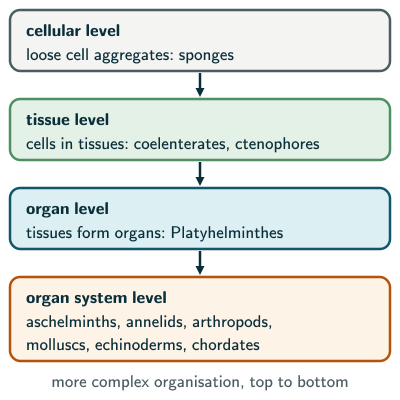
For example, in sponges, the cells are arranged as loose cell aggregates, i.e., they exhibit cellular level of organisation.
NCERT Biology (Class 11), Section 4.1.1, page 37
- Cellular level: sponges; there is some division of labour among the cells.
- Tissue level: coelenterates, and ctenophores (page 42); cells performing the same function are arranged into tissues.
- Organ level: members of Platyhelminthes and other higher phyla; tissues are grouped into organs, each specialised for a particular function.
- Organ system level: annelids, arthropods, molluscs, echinoderms and chordates; organs are associated into functional systems, each concerned with a specific physiological function (pages 37–38). The phylum pages put Aschelminthes (page 43) and Hemichordata (page 45) at this level too.
NCERT Table 2.1 (page 11) gives Animalia tissue/organ/organ system organisation; sponges are the cellular exception.
Organ systems show different patterns of complexity in different groups (page 38):
- Digestive system: the usual flatworm gut has a single opening and is called incomplete. Beyond NCERT’s summary, tapeworms lack an alimentary canal altogether, as described in Medical Microbiology on NCBI Bookshelf; the one-opening description applies when the gut is present. Coelenterates also have a single-opening gastro-vascular cavity (page 41); Aschelminthes have a complete alimentary canal (page 43).
- Circulatory system: open, where blood is pumped out of the heart and the cells and tissues are directly bathed in it; or closed, where blood circulates through a series of vessels of varying diameters (arteries, veins and capillaries). It is open in arthropods (page 44) and hemichordates (page 45), and closed in annelids (page 43) and chordates (page 46).
A complete digestive system has two openings, mouth and anus.
NCERT Biology (Class 11), Section 4.1.1, page 38
Symmetry
Sponges are mostly asymmetrical: no plane that passes through the centre divides them into equal halves (page 38).
When any plane passing through the central axis of the body divides the organism into two identical halves, it is called radial symmetry.
NCERT Biology (Class 11), Section 4.1.2, page 38
- Radial symmetry: coelenterates, ctenophores and adult echinoderms; echinoderm larvae are bilateral (page 45). NCERT Figure 4.4 (page 40) places Echinodermata on the bilateral branch, with a note that symmetry depends on the stage.
Beyond the NCERT Biology text: real radial animals have a fixed number of such planes; a five-armed starfish has five.
- Bilateral symmetry: the body can be divided into identical left and right halves in only one plane, as in annelids and arthropods (page 38).
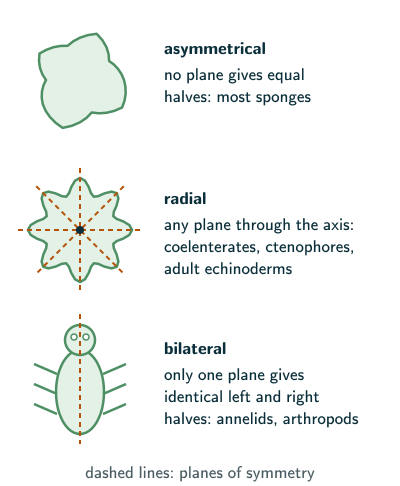
Beyond the NCERT Biology text: a plane of symmetry is a flat plane in space, like the coordinate planes of three-dimensional geometry. Put the x-axis from head to tail and the z-axis from belly to back: the plane of bilateral symmetry is the ZX-plane (y = 0), cutting the body into mirror-image left and right halves.
Diploblastic and triploblastic organisation
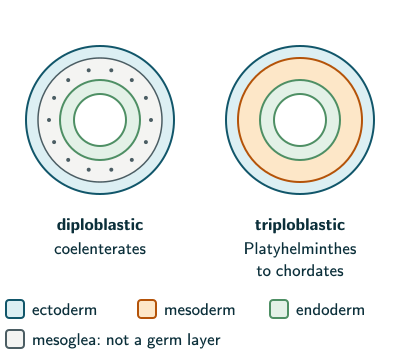
Animals in which the cells are arranged in two embryonic layers, an external ectoderm and an internal endoderm, are called diploblastic animals, e.g., coelenterates.
NCERT Biology (Class 11), Section 4.1.3, page 38
In diploblastic animals an undifferentiated layer, the mesoglea, lies between the ectoderm and the endoderm (page 38). Animals whose developing embryo has a third germinal layer, mesoderm, between the ectoderm and endoderm are triploblastic: Platyhelminthes to chordates (page 39).
Coelom
The presence or absence of a cavity between the body wall and the gut wall is very important in classification (page 39).
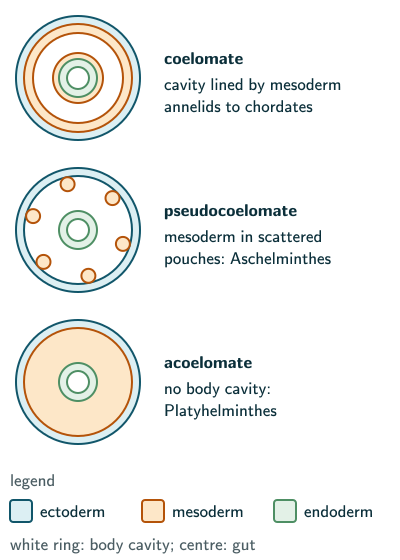
The body cavity, which is lined by mesoderm is called coelom.
NCERT Biology (Class 11), Section 4.1.4, page 39
- Coelomates: have a coelom; for example annelids, molluscs, arthropods, echinoderms, hemichordates and chordates.
- Pseudocoelomates: the cavity is not completely lined by mesoderm. NCERT describes mesoderm as scattered pouches between ectoderm and endoderm; the key distinction is absence of a complete mesodermal lining around the cavity, not absence of all mesoderm. Such a cavity is a pseudocoelom; for example Aschelminthes.
- Acoelomates: no body cavity separates the body wall from the gut; for example Platyhelminthes (page 39).
NCERT Figure 4.4 (page 40) also marks Porifera, Coelenterata and Ctenophora acoelomate: with no mesoderm they have no coelom; the gastro-vascular cavity of coelenterates (page 41) is their gut.
Segmentation
In some animals, the body is externally and internally divided into segments with a serial repetition of at least some organs.
NCERT Biology (Class 11), Section 4.1.5, page 39
In the earthworm, for example, the body shows this pattern, called metameric segmentation, and the phenomenon is known as metamerism (page 39). Arthropods are segmented too, but the mollusc body is unsegmented (page 44).
Notochord
Notochord is a mesodermally derived rod-like structure formed on the dorsal side during embryonic development in some animals.
NCERT Biology (Class 11), Section 4.1.6, page 39
Animals with a notochord are chordates; animals that do not form it are non-chordates, from Porifera to Echinodermata (page 39). Hemichordata, with only a stomochord, a structure similar to the notochord, is also non-chordate (page 45); the page 39 list is given only as examples.
Solved examples
Example 1: Why body cavity matters (NCERT Exercise Q3)
How useful is the study of the nature of the body cavity and coelom in the classification of animals?
Answer: NCERT calls the presence or absence of a body cavity very important in classification (page 39). It separates the bilateral, triploblastic animals into three groups: acoelomates such as Platyhelminthes, pseudocoelomates such as Aschelminthes, whose cavity is not completely lined by mesoderm, and coelomates, from annelids to chordates, whose cavity is lined by mesoderm. NCERT’s broad classification of Animalia (Figure 4.4, page 40) uses exactly this split, and also marks sponges, coelenterates and ctenophores acoelomate.
Example 2: Complete or incomplete?
Why is a typical flatworm gut called incomplete, and does every flatworm have one?
Answer: a typical flatworm gut has one opening for intake and egestion; a complete gut has a mouth and anus (NCERT page 38). Tapeworms are an exception with no alimentary canal and absorb nutrients through the body surface.
Example 3: Open and closed circulation
How does an open circulatory system differ from a closed one?
Answer: in an open system the blood is pumped out of the heart and the cells and tissues are directly bathed in it; in a closed system the blood circulates through a series of vessels of varying diameters: arteries, veins and capillaries (NCERT page 38).
Example 4: Matching body plans
Match each with its body cavity: earthworm (an annelid), roundworm (an aschelminth), flatworm (a platyhelminth).
Answer: earthworm, coelomate; roundworm, pseudocoelomate; flatworm, acoelomate (NCERT page 39; flatworm and roundworm are NCERT’s names, pages 42–43).
Example 5: Symmetry and germ layers together
Coelenterates are radially symmetrical. Are they diploblastic or triploblastic?
Answer: diploblastic: they have an ectoderm and an endoderm with an undifferentiated mesoglea between, and no mesoderm (NCERT page 38).
Example 6: Classifying a specimen (NCERT Exercise Q2)
If you are given a specimen, what steps would you follow to classify it?
Answer: ask NCERT’s fundamental questions in turn (pages 37–39): the level of organisation (cellular, tissue, organ or organ system); the symmetry (asymmetrical, radial or bilateral); the germ layers (diploblastic or triploblastic); the body cavity (acoelomate, pseudocoelomate or coelomate); whether the body is segmented; and whether a notochord is present. These answers place it in NCERT’s broad classification (Figure 4.4, page 40); the distinctive features of each phylum or class then identify the group (Summary, page 52).
Common mistakes to avoid
Common mistake
Calling the mesoglea a third germ layer
The mesoglea of diploblastic animals is an undifferentiated layer; the third germ layer of triploblastic animals is the mesoderm.
Common mistake
Calling any body cavity a coelom
A coelom is a body cavity lined by mesoderm. The pseudocoelom of Aschelminthes is not completely lined by mesoderm. Acoelomate does not mean an animal cannot have a gut cavity.
Common mistake
Giving all radially symmetrical animals the same germ layers
Coelenterates and ctenophores are radial and diploblastic, but adult echinoderms, also radial (NCERT page 38), are triploblastic coelomates (page 39).
Common mistake
Assuming every coelomate is segmented
Molluscs are bilateral, triploblastic and coelomate, yet unsegmented (NCERT page 44).
Quick revision summary
- Bases of classification: levels of organisation, symmetry, germ layers, coelom, segmentation and notochord.
- Levels: cellular (sponges), tissue (coelenterates, ctenophores), organ (Platyhelminthes), organ system (annelids, arthropods, molluscs, echinoderms, chordates).
- Digestive system incomplete (one opening, Platyhelminthes) or complete (mouth and anus); circulation open or closed.
- Symmetry: asymmetrical (most sponges), radial (coelenterates, ctenophores, adult echinoderms), bilateral (annelids, arthropods).
- Diploblastic: ectoderm and endoderm, with mesoglea between (coelenterates); triploblastic: ectoderm, mesoderm and endoderm (Platyhelminthes to chordates).
- Coelomates (annelids to chordates), pseudocoelomates (Aschelminthes), acoelomates (Platyhelminthes).
- Metameric segmentation (earthworm); notochord: mesodermal, dorsal, embryonic; chordates have it, Porifera to Echinodermata and Hemichordata do not.
Formula sheet
- levels: cellular → tissue → organ → organ system
- symmetry: asymmetrical, radial (multiple planes through the axis), bilateral (one plane)
- diploblastic: ectoderm + endoderm (mesoglea between); triploblastic: ectoderm + mesoderm + endoderm
- coelom: body cavity lined by mesoderm
- pseudocoelom: no complete mesodermal lining; acoelomate: no cavity between body wall and gut
- metamerism: segments outside and inside, with serial repetition of at least some organs
- notochord: mesodermal rod, dorsal, embryonic; chordates
Questions students ask
What is the difference between diploblastic and triploblastic animals?
Diploblastic animals develop from two embryonic layers, an external ectoderm and an internal endoderm, with an undifferentiated mesoglea between them, while triploblastic animals have a third germinal layer, the mesoderm, between the ectoderm and the endoderm. Coelenterates such as Hydra, and ctenophores, are diploblastic; all animals from Platyhelminthes to chordates, including annelids, arthropods and human beings, are triploblastic. Because a coelom is a body cavity lined by mesoderm, only triploblastic animals can be coelomates.
What is the difference between radial and bilateral symmetry?
NCERT idealises radial symmetry as division into matching halves by any plane through the central axis; real radial body plans usually have several discrete symmetry planes, while in bilateral symmetry the body can be divided into identical left and right halves in only one plane. Coelenterates such as Hydra, ctenophores and adult echinoderms such as the star fish are radially symmetrical; annelids, arthropods and most other animals from Platyhelminthes to chordates are bilaterally symmetrical, and even echinoderm larvae are bilateral. Sponges are mostly asymmetrical: no plane through the centre divides them into equal halves.
What is the difference between a coelom and a haemocoel?
A coelom is a body cavity lined by mesoderm, while a haemocoel is a body cavity filled with blood, part of an open circulatory system in which the blood pumped out of the heart bathes the cells and tissues directly. NCERT counts arthropods among the coelomates and gives them an open circulatory system; beyond the NCERT text, their true coelom is much reduced, and most of the spaces in their body form a haemocoel. So the haemocoel of an insect is a blood space, not a true coelom.
What is the difference between the notochord and the nerve cord?
The notochord is a mesodermally derived rod-like structure formed on the dorsal side during embryonic development, while the nerve cord is part of the central nervous system, which in chordates is dorsal, hollow and single and lies above the notochord (NCERT Table 4.1, Figure 4.16). Non-chordates have no notochord, but their nervous systems vary. NCERT’s ventral, solid, double-cord comparison fits groups such as annelids; it is not universal, since Hydra has a nerve net (Chapter 18, page 231). In vertebrates the notochord is replaced by a cartilaginous or bony vertebral column in the adult, while the embryonic neural tube forms the brain and spinal cord; the spinal cord is protected by the vertebral column (beyond the NCERT text).
What is the difference between notochord and stomochord?
The notochord is a mesodermally derived rod formed on the dorsal side of the embryo in chordates, while the stomochord is a rudimentary structure in the collar region of hemichordates, which NCERT calls only ‘a structure similar to notochord’. Beyond the NCERT text, the stomochord is a tubular outgrowth of the mouth cavity forward into the proboscis, and it differs from the notochord in origin and function. NCERT places Hemichordata as a separate phylum under non-chordata, although it was earlier considered a subphylum of Chordata.
Practice questions
Try each question first, then open the answer to check your working.
-
Q1. Which is diploblastic: (a) Ctenophora, (b) Platyhelminthes, (c) Aschelminthes, (d) Echinodermata?
Show answerHide answer
(a) Ctenophora (NCERT page 42); the rest are triploblastic (page 39).
-
Q2. What is metamerism? Give an example.
Show answerHide answer
The phenomenon in which the body is divided externally and internally into segments with a serial repetition of at least some organs, as in the earthworm (NCERT page 39).
-
Q3. Which animals show the tissue level of organisation?
Show answerHide answer
Coelenterates (NCERT page 37) and ctenophores (page 42).
-
Q4. In which kind of symmetry can the body be divided into identical halves in only one plane?
Show answerHide answer
Bilateral symmetry (NCERT page 38).