Kingdom Animalia
NCERT Class 11 Biology Chapter 2 Section 2.5
Quick answer
Animalia contains heterotrophic, eukaryotic, multicellular organisms whose cells lack cell walls. Most animals ingest food and many digest it in a cavity, but sponges digest intracellularly; reserves include glycogen and fat. Most can move about, while sexual reproduction involves gamete fusion and development, with internal or external fertilisation rather than universal copulation.
With your textbook
NCERT Biology (Class 11), Chapter 2 “Biological Classification”, Section 2.5 “Kingdom Animalia”, page 19.
Open the official NCERT chapter (PDF, 3.3 MB, ncert.nic.in) (opens in a new tab)
Checked against the 2026-27 reprint on .
What is Kingdom Animalia?
Kingdom Animalia
This kingdom is characterised by heterotrophic eukaryotic organisms that are multicellular and their cells lack cell walls.
NCERT Biology (Class 11), Section 2.5, page 19
- Most animals ingest food (holozoic nutrition); NCERT names glycogen and fat as reserves.
- NCERT Table 2.1 (page 11) summarises tissue, organ and organ-system organisation; Chapter 4 also includes sponges, which have cellular organisation.
In plain words: animals are many-celled eukaryotes whose cells have no wall and which cannot make their own food, so they eat it. NCERT lists their main features in one short section; the phyla are described in Chapter 4, in the classification of animals.
Nutrition
They directly or indirectly depend on plants for food.
NCERT Biology (Class 11), Section 2.5, page 19
A plant-eating animal depends on plants directly; in a grass–deer–tiger food chain, the tiger depends on plants indirectly through the deer. Beyond this NCERT summary, plant dependence is not universal: NOAA describes animals supported by chemosynthetic microbes at deep-sea vents.
Their mode of nutrition is holozoic – by ingestion of food.
NCERT Biology (Class 11), Section 2.5, page 19
They digest their food in an internal cavity and store food reserves as glycogen or fat.
NCERT Biology (Class 11), Section 2.5, page 19
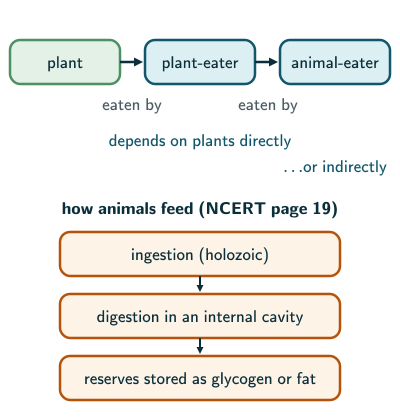
NCERT Chapter 4 provides exceptions to the broad feeding summary: sponges digest food intracellularly (page 40), and parasitic flatworms can absorb nutrients through the body surface (page 42). Thus neither an internal digestive cavity nor ingestion applies to every animal.
Growth, coordination and movement
They follow a definite growth pattern and grow into adults that have a definite shape and size.
NCERT Biology (Class 11), Section 2.5, page 19
Higher forms show elaborate sensory and neuromotor mechanism. Most of them are capable of locomotion.
NCERT Biology (Class 11), Section 2.5, page 19
To move, an animal pushes backward on the ground, water or air, and by Newton’s third law that medium pushes the animal forward with an equal and opposite force (beyond the NCERT Biology text).
Reproduction
The sexual reproduction is by copulation of male and female followed by embryological development.
NCERT Biology (Class 11), Section 2.5, page 19
The quoted sentence describes one common route, not all animal reproduction. NCERT Chapter 4 describes external fertilisation in many bony fishes and amphibians, where gametes unite outside the body without copulation, and asexual reproduction in groups such as sponges. Sexual reproduction involves gamete fusion followed by development; copulation is not a defining requirement.
Animals beside plants and fungi
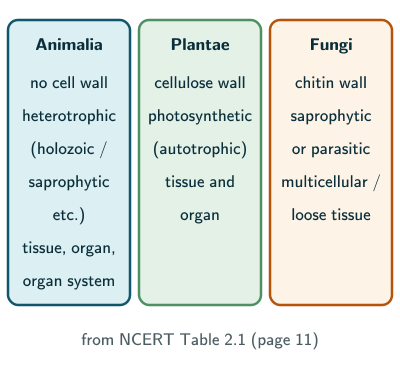
Animalia, Plantae and Fungi are the three kingdoms of mostly many-celled eukaryotes. NCERT Table 2.1 separates them by cell wall, nutrition and body organisation. For animals the table gives heterotrophic nutrition, holozoic, saprophytic etc., while Section 2.5 describes the usual mode, holozoic:
Solved examples
Example 1: Defining features
Give four features of Kingdom Animalia.
Answer: heterotrophic, eukaryotic, multicellular and lacking cell walls. NCERT also summarises holozoic feeding and glycogen/fat reserves (page 19); digestion in a cavity is common but not universal.
Example 2: Direct or indirect?
A deer eats grass and a tiger eats the deer. How does each depend on plants?
Answer: the deer depends on plants directly; the tiger indirectly, through the deer.
Example 3: Holozoic nutrition
What does “holozoic” mean in NCERT’s description of animals?
Answer: nutrition by ingestion of food (NCERT page 19).
Example 4: Food reserves
In what form do animals store their food reserves?
Answer: as glycogen or fat (NCERT page 19).
Example 5: Animals versus fungi
Both animals and fungi are heterotrophic. Give two differences from NCERT Table 2.1.
Answer: animal cells have no cell wall, while fungal walls contain chitin; animal bodies are organised into tissues, organs and organ systems, while fungi are multicellular or have loose tissue (NCERT Table 2.1, page 11).
Example 6: Reproduction
Is copulation required for sexual reproduction in every animal?
Answer: no. The broad Chapter 2 summary mentions copulation, but Chapter 4 includes external fertilisation in many fishes and amphibians. The essential event is fusion of gametes, followed by embryological development.
Common mistakes to avoid
Common mistake
Giving animal cells a cell wall
Animal cells lack cell walls; walls of cellulose belong to plants and walls of chitin to fungi.
Common mistake
Saying all animals move about
NCERT says most animals are capable of locomotion, not all.
Common mistake
Writing starch as the animal reserve
NCERT gives glycogen or fat as the food reserves of animals.
Common mistake
Thinking only animals ingest food
Protozoans such as Amoeba also capture prey, with pseudopodia (NCERT pages 15–16), and NCERT Table 2.1 lists Animalia nutrition as holozoic, saprophytic etc. Only the whole set (multicellular, eukaryotic, heterotrophic, no cell wall) marks an animal.
Common mistake
Confusing holozoic with saprophytic
Holozoic means taking in food by ingestion, followed by digestion; digestion need not occur in a body cavity (it can be intracellular). Saprotrophic organisms absorb soluble nutrients from dead matter; do not confuse this with an animal ingesting dead organic material.
Quick revision summary
- Animalia: heterotrophic, eukaryotic, multicellular organisms whose cells lack cell walls.
- Most ingest food; many familiar food chains depend on plants, but chemosynthetic food webs are exceptions. Digestion may be intracellular or occur in a cavity; reserves include glycogen and fat.
- They follow a definite growth pattern into adults of definite shape and size.
- Higher forms have elaborate sensory and neuromotor mechanisms; most can move about.
- Sexual reproduction: gamete fusion and embryological development; fertilisation can be internal or external, so copulation is not universal.
Formula sheet
- Animalia: heterotrophic, eukaryotic, multicellular, no cell wall
- usual nutrition: holozoic, by ingestion; exceptions occur
- reserves: glycogen or fat
- definite growth pattern, shape and size
- sexual reproduction: gamete fusion, then embryological development
Questions students ask
What is the difference between Kingdom Plantae and Kingdom Animalia?
Plants and animals differ first in nutrition: Kingdom Plantae is mostly photosynthetic, with chloroplasts in photosynthetic cells, whereas Animalia is heterotrophic and most animals ingest food. Parasitic plants and animals need additional qualifications, and sponges digest food intracellularly rather than in a digestive cavity. Plant cells have a cell wall mainly of cellulose, but animal cells lack cell walls, and plant bodies are organised into tissues and organs, most animal bodies into tissues, organs and organ systems (NCERT Table 2.1); sponges have cellular organisation. Animals store food reserves as glycogen or fat, follow a definite growth pattern into adults of definite shape and size, and most can move about.
Is holozoic nutrition the same as heterotrophic nutrition?
Holozoic nutrition is one kind of heterotrophic nutrition, not another name for it: heterotrophs depend on other organisms or on dead organic matter for food, and holozoic organisms, such as animals, get it by ingestion followed by digestion, which may occur inside cells or in a digestive cavity. Other heterotrophs feed differently: saprophytes, such as most fungi, absorb soluble organic matter from dead substrates, and parasites depend on living plants and animals. Accordingly, NCERT Table 2.1 lists Animalia as heterotrophic (holozoic, saprophytic etc.) and Fungi as heterotrophic (saprophytic or parasitic).
How many phyla does NCERT describe in Kingdom Animalia?
NCERT Chapter 4 describes eleven phyla in Kingdom Animalia: Porifera, Coelenterata (Cnidaria), Ctenophora, Platyhelminthes, Aschelminthes, Annelida, Arthropoda, Mollusca, Echinodermata, Hemichordata and Chordata. The first ten are non-chordates, and Chordata is divided further, its subphylum Vertebrata into seven classes. Their salient features and examples are on the classification of animals page.
Practice questions
Try each question first, then open the answer to check your working.
-
Q1. Do all animals digest food in an internal cavity?
Show answerHide answer
No. Chapter 2 gives an internal cavity as its broad summary (page 19), but Chapter 4 describes intracellular digestion in sponges (page 40).
-
Q2. Which animals show elaborate sensory and neuromotor mechanisms, according to NCERT?
Show answerHide answer
The higher forms (NCERT page 19).
-
Q3. Name the kingdom with no cell wall and body organisation at the tissue, organ and organ system level.
Show answerHide answer
Animalia (NCERT Table 2.1).
-
Q4. Explain direct and indirect plant dependence using a grass–deer–tiger food chain.
Show answerHide answer
The deer eats grass directly; the tiger eats the deer and so depends on grass indirectly. This illustrates NCERT’s summary (page 19), but is not universal: animals at some deep-sea vents depend on chemosynthetic microbes.