Kingdom Fungi
NCERT Class 11 Biology Chapter 2 Section 2.3
Quick answer
Fungi are heterotrophic eukaryotes, typically with chitin-containing walls and hyphae forming a mycelium; yeasts are unicellular. They include saprotrophs, parasites and symbionts, and their sexual cycle involves plasmogamy, karyogamy and meiosis, with a dikaryotic stage in ascomycetes and basidiomycetes. NCERT teaches the traditional groups phycomycetes, ascomycetes, basidiomycetes and deuteromycetes; these should not be mistaken for a complete modern classification.
With your textbook
NCERT Biology (Class 11), Chapter 2 “Biological Classification”, Section 2.3 “Kingdom Fungi”, pages 16–18.
Open the official NCERT chapter (PDF, 3.3 MB, ncert.nic.in) (opens in a new tab)
Checked against the 2026-27 reprint on .
What is Kingdom Fungi?
Kingdom Fungi
The fungi constitute a unique kingdom of heterotrophic organisms.
NCERT Biology (Class 11), Section 2.3, page 16
- Their cell walls are made of chitin and polysaccharides.
- Except for the unicellular yeasts, fungi are filamentous: their bodies are made of hyphae.
In plain words: fungi are eukaryotes that cannot make their own food and absorb it from their surroundings. They range from yeasts to bread moulds, mushrooms and toadstools, and are cosmopolitan: they occur in air, water and soil and on animals and plants, preferring warm, humid places (page 16). That is why we keep food in a refrigerator: to slow bacterial and fungal growth; refrigeration does not sterilise food or prevent all spoilage.
Fungi matter to us in many ways (page 16): yeasts are used to make bread and beer, Penicillium is a source of antibiotics, and some fungi cause diseases, such as wheat rust, caused by Puccinia. The white spots on mustard leaves are due to a parasitic fungus.
Body: hyphae and mycelium
Their bodies consist of long, slender thread-like structures called hyphae. The network of hyphae is known as mycelium.
NCERT Biology (Class 11), Section 2.3, page 16
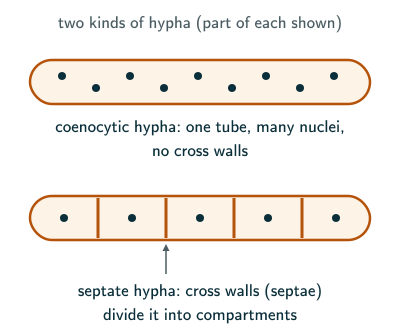
Some hyphae are continuous tubes filled with multinucleated cytoplasm, called coenocytic hyphae; others have septae, or cross walls (page 16).
Nutrition
- Saprophytes: most fungi absorb soluble organic matter from dead substrates.
- Parasites: they depend on living plants and animals.
- Symbionts: in lichens (with algae) and mycorrhiza (with roots of higher plants).
They can also live as symbionts – in association with algae as lichens and with roots of higher plants as mycorrhiza.
NCERT Biology (Class 11), Section 2.3, page 16
Reproduction
Fungi reproduce in three ways (pages 16–17):
- vegetative: fragmentation, fission and budding;
- asexual: spores called conidia, sporangiospores or zoospores;
- sexual: oospores, ascospores and basidiospores.
Spores form in specialised structures; fruiting bodies bear spore-producing structures in many fungi. NCERT describes sporangia, conidiophores, asci and basidia below—these terms are not interchangeable. In NCERT’s overview, the sexual cycle has three steps:
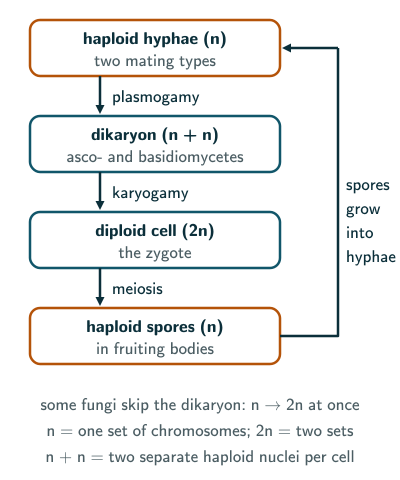
- Plasmogamy: fusion of cytoplasm from compatible cells; these may be gametes or, as NCERT describes for basidiomycetes, vegetative cells.
- Karyogamy: fusion of two nuclei.
- Meiosis in the zygote, giving haploid spores.
Two haploid hyphae of compatible mating types come together and fuse. In some fungi the fused cell is diploid (2n) at once. In others, the ascomycetes and basidiomycetes, a stage with two nuclei per cell (n + n) comes in between:
such a condition is called a dikaryon and the phase is called dikaryophase of fungus.
NCERT Biology (Class 11), Section 2.3, page 17
Later the parental nuclei fuse, the cells become diploid, and reduction division in the fruiting bodies forms haploid spores (page 17).
The four classes
This section follows NCERT’s traditional four-group account for study. Beyond NCERT: it is not a complete modern classification. For example, NCBI Taxonomy places Albugo among oomycetes outside true Fungi; do not apply the chitin-wall rule uncritically to every organism in the historical “phycomycetes” grouping.
The morphology of the mycelium, mode of spore formation and fruiting bodies form the basis for the division of the kingdom into various classes.
NCERT Biology (Class 11), Section 2.3, page 17
Phycomycetes (page 17)
- Found in aquatic habitats, on decaying wood in moist and damp places, or as obligate parasites on plants.
- Mycelium aseptate and coenocytic.
- Asexual spores: zoospores (motile) or aplanospores (non-motile), produced endogenously in a sporangium.
- Sexual: a zygospore forms by fusion of two gametes, which are similar (isogamous) or dissimilar (anisogamous or oogamous).
- Examples: Mucor (NCERT Figure 2.5a), Rhizopus (the bread mould), Albugo (the parasitic fungus on mustard).
Ascomycetes, the sac fungi (pages 17–18)
- Mostly multicellular, e.g. Penicillium, or rarely unicellular, e.g. yeast (Saccharomyces); saprophytic, decomposers, parasitic or coprophilous (growing on dung).
- Mycelium branched and septate.
- Asexual spores: conidia, produced exogenously on the special mycelium called conidiophores.
- Conidia on germination produce mycelium.
- Sexual spores: ascospores, produced endogenously in sac-like asci (singular ascus); the asci are arranged in different types of fruiting bodies called ascocarps.
- Examples: Aspergillus (NCERT Figure 2.5b), Claviceps and Neurospora, which is used extensively in biochemical and genetic work (page 18); morels and truffles are edible delicacies.
Basidiomycetes (page 18)
- Mushrooms, bracket fungi and puffballs; in soil, on logs and tree stumps, and in living plants as parasites (rusts and smuts).
- Mycelium branched and septate.
- Asexual spores generally absent; fragmentation is common. Sex organs are absent: plasmogamy is by fusion of two vegetative or somatic cells of different strains or genotypes.
- The dikaryotic structure gives rise to the basidium, where karyogamy and meiosis produce four basidiospores, formed exogenously on the basidium; the basidia are arranged in fruiting bodies called basidiocarps.
- Examples: Agaricus (mushroom, NCERT Figure 2.5c), Ustilago (smut), Puccinia (rust fungus).
Deuteromycetes, the imperfect fungi (page 18)
Commonly known as imperfect fungi because only the asexual or vegetative phases of these fungi are known.
NCERT Biology (Class 11), Section 2.3.4, page 18
- When their sexual stages are discovered, they are moved to the class they belong to, often ascomycetes or basidiomycetes. Sometimes the asexual and the sexual stage of one fungus had been given two names and placed in different classes until the link was found (page 18).
- They reproduce only by asexual spores, conidia; mycelium septate and branched.
- Saprophytes or parasites, many being decomposers of litter that help in mineral cycling.
- Examples: Alternaria, Colletotrichum, Trichoderma.
Solved examples
Example 1: Plasmogamy, karyogamy, meiosis
Put the three steps of the sexual cycle of fungi in order and say what each does.
Answer: plasmogamy (fusion of cytoplasm from compatible gametes or vegetative cells), karyogamy (fusion of two nuclei), and meiosis in the zygote, giving haploid spores (NCERT page 17).
Example 2: The dikaryon
What is a dikaryon, and in which classes does it occur?
Answer: the condition of two nuclei per cell (n + n), after plasmogamy and before the parental nuclei fuse; it occurs in ascomycetes and basidiomycetes, and the phase is the dikaryophase (NCERT page 17).
Example 3: Endogenous or exogenous?
Where are the spores of phycomycetes, ascomycetes and basidiomycetes formed: inside (endogenously) or outside (exogenously)?
Answer: phycomycetes: asexual spores endogenously in a sporangium; ascomycetes: conidia exogenously on conidiophores and ascospores endogenously in asci; basidiomycetes: basidiospores exogenously on the basidium (NCERT pages 17–18).
Example 4: Why “imperfect”?
Why are deuteromycetes called imperfect fungi, and what happens when their sexual stage is found?
Answer: only their asexual or vegetative phases are known; once the perfect (sexual) stage is discovered, they are moved to their proper class, often ascomycetes or basidiomycetes (NCERT page 18).
Example 5: Classes compared (NCERT Exercise Q9)
Compare the classes of Kingdom Fungi by (i) mode of nutrition and (ii) mode of reproduction.
Answer: (i) Phycomycetes: aquatic, or on decaying wood in moist, damp places, or obligate parasites on plants. Ascomycetes: saprophytic, decomposers, parasitic or coprophilous. Basidiomycetes: in soil, on logs and tree stumps, or parasites in living plants (rusts, smuts). Deuteromycetes: saprophytes or parasites; many decompose litter. (ii) Phycomycetes: zoospores or aplanospores, endogenous in a sporangium; zygospore from isogamous, anisogamous or oogamous gametes. Ascomycetes: conidia, exogenous on conidiophores; ascospores, endogenous in asci, in ascocarps. Basidiomycetes: asexual spores generally absent, fragmentation common; no sex organs, somatic cells of different strains fuse; dikaryon → basidium → four exogenous basidiospores, in basidiocarps. Deuteromycetes: conidia only (NCERT pages 17–18).
Example 6: Matching fungi to their uses and effects
Match each fungus to its use or effect: Puccinia, Penicillium, Neurospora, Albugo, yeast; (a) bread and beer, (b) white spots on mustard leaves, (c) wheat rust, (d) antibiotics, (e) biochemical and genetic work.
Answer: Puccinia: wheat rust; Penicillium: antibiotics; Neurospora: biochemical and genetic work; Albugo: white spots on mustard leaves; yeast: bread and beer.
Common mistakes to avoid
Common mistake
Calling conidia or zoospores sexual spores
Conidia, sporangiospores, zoospores and aplanospores are asexual; oospores, zygospores, ascospores and basidiospores are sexual (NCERT pages 16–17).
Common mistake
Giving fungi cellulose walls
True fungal walls typically contain chitin and other polysaccharides. NCERT’s historical phycomycetes include fungus-like oomycetes such as Albugo, so its examples need the classification qualification above; cellulose is not exclusive to plants.
Common mistake
Putting the dikaryon in every fungus
The dikaryotic (n + n) stage occurs in ascomycetes and basidiomycetes; in some fungi fusion gives a diploid cell at once.
Common mistake
Mixing up the spore names
Ascospores form inside asci (endogenously); basidiospores form exogenously on the basidium; conidia form outside on conidiophores.
Quick revision summary
- Fungi: heterotrophic eukaryotes with walls of chitin and polysaccharides; filamentous (hyphae, mycelium) except the unicellular yeasts.
- Hyphae are coenocytic (multinucleate, no cross walls) or septate.
- Nutrition: mostly saprophytic; also parasites, and symbionts in lichens and mycorrhiza.
- Reproduction: vegetative (fragmentation, fission, budding), asexual spores (conidia, sporangiospores, zoospores), sexual spores (oospores, ascospores, basidiospores); sexual cycle: plasmogamy, karyogamy, meiosis; dikaryon (n + n) in ascomycetes and basidiomycetes.
- NCERT’s traditional classes: phycomycetes (aseptate, zygospores: Mucor, Rhizopus, Albugo), ascomycetes (sac fungi: Penicillium, yeast, Aspergillus, Claviceps, Neurospora), basidiomycetes (Agaricus, Ustilago, Puccinia), deuteromycetes (imperfect: Alternaria, Colletotrichum, Trichoderma).
Formula sheet
- fungi: heterotrophic; walls of chitin and polysaccharides
- sexual cycle: plasmogamy → karyogamy → meiosis
- dikaryon (n + n): ascomycetes and basidiomycetes
- phycomycetes: aseptate, coenocytic; zygospore
- ascomycetes: conidia (exogenous), ascospores in asci
- basidiomycetes: four basidiospores on a basidium
- deuteromycetes: only conidia known
Questions students ask
What is the difference between ascomycetes and basidiomycetes?
Ascomycetes and basidiomycetes both have a branched, septate mycelium and a dikaryotic stage, but ascomycetes, the sac fungi, form their sexual ascospores endogenously, inside sac-like asci grouped in ascocarps, while basidiomycetes form four basidiospores exogenously, on a basidium, in basidiocarps. Ascomycetes also reproduce asexually by conidia on conidiophores, whereas in basidiomycetes asexual spores are generally not found, fragmentation is common and, with no sex organs, plasmogamy is by fusion of two somatic cells of different strains. Examples are Penicillium, Aspergillus and Neurospora among ascomycetes, and the mushrooms, bracket fungi and puffballs among basidiomycetes.
Why are ascomycetes called sac fungi and phycomycetes algal fungi?
Ascomycetes are called sac fungi, NCERT’s common name for them, because their sexual spores, the ascospores, are produced inside sac-like asci (singular ascus). Phycomycetes (from the Greek ‘phykos’, seaweed) are called algal fungi, a name NCERT does not use, because many of them resemble algae: they live in water or in moist, damp places and have an aseptate, coenocytic mycelium and motile zoospores. On the same pattern, basidiomycetes are often called club fungi, after their club-shaped basidium.
How is Kingdom Fungi different from Monera and Protista?
Kingdom Fungi differs from Monera in being eukaryotic, with a nuclear membrane, and from both Monera and Protista in being wholly heterotrophic (saprophytic or parasitic), with no photosynthetic or chemosynthetic members (NCERT Table 2.1). Fungal cell walls contain chitin, while typical eubacterial walls contain peptidoglycan (archaebacteria differ and mycoplasmas have no wall), and only some protists have a wall at all. Most fungi are filamentous, with a mycelium of hyphae (multicellular or loose tissue in Table 2.1, against cellular for Monera and Protista), and the yeasts are the unicellular exception.
Practice questions
Try each question first, then open the answer to check your working.
-
Q1. What is the difference between coenocytic and septate hyphae?
Show answerHide answer
Coenocytic hyphae are continuous tubes filled with multinucleated cytoplasm; septate hyphae have septae, or cross walls (NCERT page 16).
-
Q2. Name two symbiotic associations of fungi.
Show answerHide answer
Lichens (with algae) and mycorrhiza (with roots of higher plants) (NCERT page 16).
-
Q3. Which class are Agaricus, Ustilago and Puccinia in, and what are they commonly called?
Show answerHide answer
Basidiomycetes; mushroom, smut and rust fungus (NCERT page 18).
-
Q4. What are ascocarps?
Show answerHide answer
The fruiting bodies of ascomycetes, in which the asci bearing ascospores are arranged (NCERT page 18).