Fermentation
NCERT Class 11 Biology Chapter 12 Section 12.3
Quick answer
Fermentation is the incomplete oxidation of glucose under anaerobic conditions (NCERT page 157); in alcoholic and lactic acid fermentation, NADH + H is reoxidised to NAD, so glycolysis can continue. Yeast forms ethanol and CO; some bacteria and muscles short of oxygen form lactic acid, without CO. These pathways yield net 2 ATP per glucose through glycolysis; beyond NCERT, yeast and muscle can also ferment when oxygen is present.
With your textbook
NCERT Biology (Class 11), Chapter 12 “Respiration in Plants”, Section 12.3 “Fermentation”, pages 157–158.
Open the official NCERT chapter (PDF, 1.7 MB, ncert.nic.in) (opens in a new tab)
Checked against the 2026-27 reprint on .
Fermentation
Fermentation
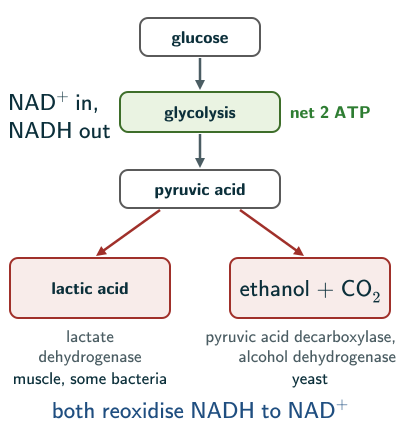
Fermentation is the incomplete oxidation of glucose under anaerobic conditions. After glycolysis, pyruvic acid is turned into ethanol and CO (alcoholic fermentation, as in yeast) or into lactic acid (lactic acid fermentation, as in some bacteria and in muscles short of oxygen) (NCERT page 157).
In both lactic acid and alcohol fermentation not much energy is released; less than seven per cent of the energy in glucose is released and not all of it is trapped as high energy bonds of ATP.
NCERT Biology (Class 11), Section 12.3, page 157
In plain words: without oxygen, a cell can still run glycolysis, but glycolysis needs a steady supply of NAD to keep going. Fermentation is the trick that hands NAD back: the NADH made in glycolysis is used to turn pyruvic acid into ethanol or lactic acid. The cell keeps its 2 ATP per glucose, and most of glucose’s energy stays locked in the end product.
Beyond the NCERT text: oxygen need not be absent. Wikipedia’s article “Crabtree effect” describes the yeast Saccharomyces cerevisiae making ethanol in aerobic conditions when glucose is plentiful, and its article “Lactic acid” says lactate (the conjugate base of lactic acid) is made, and used as a fuel, in resting as well as exercising muscle. What the two fermentations share is that NADH + H is reoxidised to NAD (NCERT page 157). In an NCERT-based answer, give NCERT’s line, “Fermentation takes place under anaerobic conditions” (page 157).
Alcoholic fermentation in yeast
- In fermentation by yeast, the incomplete oxidation of glucose is achieved under anaerobic conditions by reactions in which pyruvic acid is converted to CO and ethanol (NCERT page 157).
- Two enzymes catalyse these reactions: pyruvic acid decarboxylase and alcohol dehydrogenase (page 157).
- The reducing agent, NADH + H, is reoxidised to NAD (page 157).
- Yeasts poison themselves to death when the concentration of alcohol reaches about 13 per cent (page 157).
- NCERT’s chapter Summary adds that fermentation also takes place in germinating seeds (page 164).
The overall reaction is CHO → 2CHOH + 2CO (reasoned from NCERT Figure 12.2, page 157, where each of the two pyruvic acids gives ethanol + CO; balanced in Example 3). Beyond the NCERT text, Wikipedia’s article “Ethanol fermentation” gives the two steps: pyruvic acid decarboxylase first removes CO from pyruvic acid, giving acetaldehyde, and alcohol dehydrogenase then reduces acetaldehyde to ethanol with NADH (facts in our words).
Lactic acid fermentation
- Some bacteria produce lactic acid from pyruvic acid (NCERT page 157).
- In animal cells too, such as muscles during exercise, when oxygen is inadequate for cellular respiration, pyruvic acid is reduced to lactic acid by lactate dehydrogenase (page 157).
- Here too, NADH + H is the reducing agent and is reoxidised to NAD (page 157).
The overall reaction is CHO → 2CHO (lactic acid), with no CO released (reasoned from NCERT Figure 12.2, page 157; balanced in Example 3).
Energy released in fermentation
- In both kinds of fermentation not much energy is released: less than seven per cent of the energy in glucose, and not all of it is trapped in ATP (NCERT page 157).
- The processes are also hazardous: either acid or alcohol is produced (page 157).
- The only ATP made is the ATP of glycolysis, so the net gain is 2 ATP per glucose (Example 1).
- For complete oxidation of glucose, which extracts far more energy, organisms need aerobic respiration, which takes place in the mitochondria in eukaryotes and requires O (NCERT pages 157–158).
Solved examples
Example 1: Net ATP in fermentation (NCERT page 157)
What is the net number of ATP made when one glucose molecule is fermented to alcohol or to lactic acid?
Answer: the steps from pyruvic acid to ethanol or to lactic acid add no ATP; all the ATP comes from glycolysis, which makes 4 ATP directly and uses 2. Net gain: 4 − 2 = 2 ATP per glucose, for both alcoholic and lactic acid fermentation (NCERT pages 156–157; NCERT page 162 states this net gain of two ATP).
Example 2: Alcohol in naturally fermented drinks (NCERT page 157)
Yeasts poison themselves to death when alcohol reaches about 13 per cent. What, then, is the maximum alcohol concentration of naturally fermented beverages, and how are stronger drinks made?
Answer: about 13 per cent, since the yeast dies at that level (NCERT page 157). Stronger drinks are made by distillation: NCERT’s Class 12 Biology says wine and beer are produced without distillation, whereas whisky, brandy and rum are produced by distillation of the fermented broth (Chapter 8, page 152).
Example 3: Balancing the fermentation equations
Check that CHO → 2CHOH + 2CO and CHO → 2CHO balance.
Answer: alcoholic: carbon 6 = 2 × 2 + 2 × 1 = 6; hydrogen 12 = 2 × 6 = 12; oxygen 6 = 2 × 1 + 2 × 2 = 6. Lactic: carbon 6 = 2 × 3; hydrogen 12 = 2 × 6; oxygen 6 = 2 × 3. Both balance (the equations are beyond the NCERT text).
Example 4: Why recycle NAD?
Fermentation makes no extra ATP. Why do cells bother turning pyruvic acid into ethanol or lactic acid?
Answer: glycolysis needs NAD at the step where PGAL becomes BPGA, where NAD is reduced to NADH + H (NCERT page 156). In fermentation, NADH + H is reoxidised to NAD (page 157), so glycolysis, and its 2 ATP, can keep running without oxygen. Without this recycling, all the NAD would end up as NADH, and glycolysis would stop (reasoned from NCERT pages 156–157).
Example 5: Aerobic and anaerobic respiration (NCERT Exercise 7a)
Distinguish between aerobic respiration and anaerobic respiration.
Answer:
| Feature | Aerobic | Anaerobic |
|---|---|---|
| Oxygen | needed | not needed |
| Glucose | fully, to CO + HO | partly, to ethanol + CO or lactic acid |
| Final hydrogen acceptor | O | an organic molecule |
| NADH → NAD | very vigorous | rather slow |
| Net ATP | 38 (NCERT) | 2 |
In eukaryotes, aerobic respiration runs in the cytoplasm and then the mitochondria; fermentation only in the cytoplasm. (NCERT pages 155, 157–158 and 160–162. NCERT uses “anaerobic respiration” for these fermentation pathways, as in its Figure 12.2, so answer a NEET question on anaerobic respiration with these pathways.)
Common mistakes to avoid
Common mistake
Giving lactic acid fermentation a CO product
Yeast’s alcoholic fermentation releases CO along with ethanol; lactic acid fermentation releases no CO (NCERT Figure 12.2, page 157).
Common mistake
Crediting fermentation with extra ATP
Fermentation’s net gain is just the 2 ATP of glycolysis; less than seven per cent of glucose’s energy is released (NCERT page 157).
Common mistake
Naming the wrong enzyme
Lactic acid comes from lactate dehydrogenase; ethanol needs pyruvic acid decarboxylase and alcohol dehydrogenase (NCERT page 157).
Quick revision summary
- Fermentation is the incomplete oxidation of glucose under anaerobic conditions.
- Yeast: pyruvic acid → CO + ethanol, by pyruvic acid decarboxylase and alcohol dehydrogenase; yeast dies at about 13 per cent alcohol.
- Some bacteria, and muscles short of oxygen: pyruvic acid → lactic acid, by lactate dehydrogenase.
- NADH + H is reoxidised to NAD in both; less than seven per cent of glucose’s energy is released; net 2 ATP; acid or alcohol is produced.
Formula sheet
- yeast: pyruvic acid → ethanol + CO
- muscle, some bacteria: pyruvic acid → lactic acid
- net gain: 2 ATP per glucose
- energy released: less than 7 per cent of that in glucose
Questions students ask
What is the difference between alcoholic and lactic acid fermentation?
Alcoholic and lactic acid fermentation both start from the pyruvic acid of glycolysis under anaerobic conditions, but they differ in product, organism and enzymes. In alcoholic fermentation, as in yeast, pyruvic acid is converted to ethanol and CO by pyruvic acid decarboxylase and alcohol dehydrogenase; in lactic acid fermentation, as in some bacteria and in muscles short of oxygen, it is reduced to lactic acid, in muscle by lactate dehydrogenase, with no CO given off (NCERT page 157). What they share is the reoxidation of NADH + H to NAD and a low energy yield, less than seven per cent of the energy in glucose (page 157).
Is fermentation the same as anaerobic respiration?
NCERT uses “anaerobic respiration” broadly for fermentation: NCERT titles its figure of the alcoholic and lactic acid pathways “Major pathways of anaerobic respiration” (page 157), and the NEET (UG) 2026 syllabus lists “fermentation (anaerobic)”. Beyond the NCERT text, microbiologists separate the two: in anaerobic respiration, as in many bacteria, electrons from NADH pass down a membrane electron transport chain to an acceptor other than oxygen, such as nitrate, sulphate or fumarate (Ito and others, mBio, 2020), while in fermentation NADH + H is reoxidised to NAD by reducing pyruvic acid or a compound made from it, as NCERT describes (page 157).
Do plants carry out anaerobic respiration?
Yes, plant cells can ferment when oxygen is limiting. NCERT’s Summary includes germinating seeds (page 164); their oxygen supply is the relevant condition. Glycolysis itself does not directly require oxygen (page 155). Beyond the NCERT text, plant tissues short of oxygen, as in waterlogged soil, often make some lactic acid at first, but alcoholic fermentation, CHO → 2CHOH + 2CO, is the main pathway in most plant species (Ventura and colleagues, Scientific Reports, 2020). Animal muscle, by contrast, makes lactic acid (NCERT page 157).
What are some examples of fermentation in daily life?
Everyday examples of fermentation are curd, bread, idli and dosa, toddy and alcoholic drinks: lactic acid bacteria such as Lactobacillus convert milk to curd, dosa and idli dough is fermented by bacteria and puffs up with CO, bread dough is fermented by baker’s yeast (Saccharomyces cerevisiae), and toddy is made by fermenting the sap of palms (NCERT Class 12 Biology, Chapter 8, page 151). The same yeast ferments malted cereals and fruit juices to ethanol for wine and beer (page 152). In Class 11 terms, curd is a lactic acid fermentation, and bread and wine are alcoholic fermentations by yeast (following NCERT Class 11, page 157).
Practice questions
Try each question first, then open the answer to check your working.
-
Q1. Name the two enzymes that convert pyruvic acid to ethanol and CO in yeast.
Show answerHide answer
Pyruvic acid decarboxylase and alcohol dehydrogenase (NCERT page 157).
-
Q2. Which enzyme reduces pyruvic acid to lactic acid in muscles?
Show answerHide answer
Lactate dehydrogenase (NCERT page 157).
-
Q3. What is the reducing agent in both fermentations, and what is it reoxidised to?
Show answerHide answer
NADH + H; it is reoxidised to NAD (NCERT page 157).