Respiration and gas exchange in plants
NCERT Class 11 Biology Chapter 12 Section 12.1
Quick answer
Cellular respiration oxidises organic substrates in controlled steps and captures part of the released energy in ATP. Plants exchange respiratory gases mainly by diffusion through surfaces, stomata, lenticels and internal air spaces. Aerobic respiration consumes O and releases CO, while net leaf gas exchange also depends on photosynthesis.
With your textbook
NCERT Biology (Class 11), Chapter 12 “Respiration in Plants”, Section 12.1 “Do Plants Breathe?”, pages 154–155.
Open the official NCERT chapter (PDF, 1.7 MB, ncert.nic.in) (opens in a new tab)
Checked against the 2026-27 reprint on .
Respiration and gas exchange in plants
Respiration
Living cells need energy; this lesson examines how oxidation of organic food supplies usable energy. NCERT defines the process:
The breaking of the C-C bonds of complex compounds through oxidation within the cells, leading to release of considerable amount of energy is called respiration.
NCERT Biology (Class 11), Chapter 12, Introduction, page 154
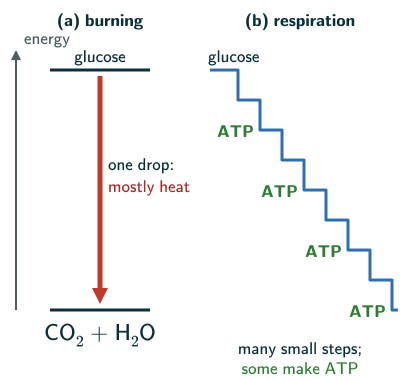
In plain words: respiration is the cell’s way of spending food slowly and carefully, like changing a large note into coins. Instead of burning glucose in one flash, the cell breaks it down in many small, controlled steps and catches the energy in small packets of ATP that it can spend wherever it needs them.
Respiration and respiratory substrates
- Respiration supplies usable energy by oxidising food. Photosynthetic cells also capture light energy directly to make ATP and reducing power. Green plants and cyanobacteria make their own food by photosynthesis, but even in green plants only the cells with chloroplasts photosynthesise, so food must be translocated to all the non-green parts (NCERT page 153).
- NCERT says all respired food ultimately comes from photosynthesis (page 154). This is a broad ecological simplification: its own Chapter 2 describes chemosynthetic autotrophs that build organic matter using chemical energy (page 13).
- In eukaryotes, photosynthesis takes place in the chloroplasts, while the breakdown of food takes place in the cytoplasm and the mitochondria (page 154).
- The compounds oxidised in respiration are the respiratory substrates. Usually these are carbohydrates, but proteins, fats and even organic acids can be used in some plants, under certain conditions (page 154).
ATP as the energy currency
- The energy in respiratory substrates is not released all at once. It comes out in a series of slow, step-wise reactions controlled by enzymes, and is trapped as chemical energy in ATP (NCERT page 154).
- The energy released by oxidation cannot be used directly. It is used to make ATP, and ATP is broken down whenever and wherever energy is needed. So ATP acts as the energy currency of the cell (page 154).
- Respiration also supplies carbon skeletons that the cell uses as precursors to build other molecules (page 154).
The complete combustion of glucose gives CO and water, and most of its energy comes out as heat (NCERT page 155):
CHO + 6O → 6CO + 6HO + energy
The cell cuts this waste by oxidising glucose in several small steps, some of them just large enough for the energy released to be coupled to ATP synthesis: “How this is done is, essentially, the story of respiration” (page 155).
Stomata and lenticels
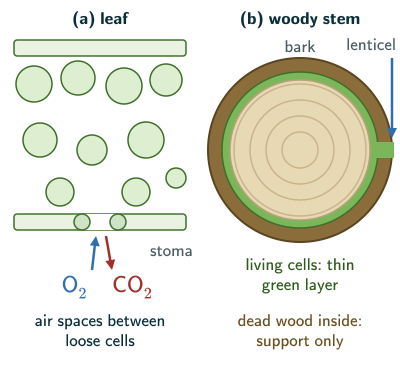
Do plants breathe? Yes, in the sense that they need O for respiration and give out CO. But plants, unlike animals, have no specialised organs for gaseous exchange; they have stomata and lenticels for this purpose (NCERT page 154; see stomata).
Gas exchange without respiratory organs
NCERT gives three general reasons why plants manage without lungs or gills (pages 154–155). These describe typical diffusion arrangements, not a claim that every plant cell is directly exposed to outside air:
- Each plant part takes care of its own gas-exchange needs; very little gas is transported from one part to another.
- Plants do not demand much gas exchange. Roots, stems and leaves respire at rates far lower than animals do. Large volumes of gas are exchanged only during photosynthesis, when each leaf looks after its own needs, and O is not a problem because it is released inside the photosynthesising cells.
- The distance gases must diffuse is short, even in large, bulky plants: each living cell lies quite close to the surface. In woody stems, the living cells form thin layers inside and beneath the bark, which has openings called lenticels, while many mature xylem conducting/supporting cells are dead. Living xylem parenchyma also occurs within sapwood, so the whole interior is not dead (see NCERT Chapter 6 tissue types). The loose packing of parenchyma in leaves, stems and roots gives an interconnected network of air spaces.
Aerobic and anaerobic organisms
- Aerobic respiration of carbohydrate uses oxygen and releases carbon dioxide, water and energy; the combustion reaction needs oxygen (NCERT page 155).
- But some cells live where oxygen may or may not be available. There are good reasons to believe that the first cells on Earth lived in an atmosphere that lacked oxygen (page 155).
- Many organisms today are adapted to anaerobic conditions: some are facultative anaerobes, and for others the anaerobic requirement is obligate (page 155).
- Glycolysis partially oxidises glucose to pyruvate without requiring O. NCERT calls it universal (page 155), but the classical EMP pathway has exceptions and variants among microbes (Baron, Medical Microbiology, “Bacterial Metabolism”).
Solved examples
Example 1: Balancing the combustion of glucose
Check that CHO + 6O → 6CO + 6HO balances.
Answer: carbon: 6 = 6. Hydrogen: 12 = 6 × 2 = 12. Oxygen: 6 + 6 × 2 = 18 on the left; 6 × 2 + 6 × 1 = 18 on the right. It balances (NCERT page 155).
Example 2: Why ATP and not the energy itself?
Why does a cell trap the energy of respiration in ATP instead of using it directly?
Answer: the energy released by oxidation cannot be used directly. Trapped in ATP, it can be carried and released whenever and wherever it is needed, so ATP works as the cell’s energy currency (NCERT page 154). Releasing it in small steps also means that not all of it is lost as heat, as happens in combustion (page 155).
Example 3: No lungs needed
Give three reasons why plants can get along without respiratory organs.
Answer: each plant part takes care of its own gas exchange; plants respire at rates far lower than animals and exchange large volumes of gas only during photosynthesis, when O is made inside the cells; and every living cell is close to the surface, helped by lenticels in woody parts and air spaces between loosely packed parenchyma cells (NCERT pages 154–155).
Example 4: Where O is lacking (NCERT page 155)
NCERT asks you to think of situations and organisms where O is not available. Give examples.
Answer: waterlogged soil and deep mud, where roots and many microbes get little oxygen (beyond the NCERT text); germinating seeds when their oxygen supply becomes limiting, which NCERT’s Summary lists among the places where fermentation takes place (page 164); yeast fermenting sugar (NCERT Section 12.3, page 157); and muscle cells working with too little oxygen (page 157). NCERT notes that the first cells probably lived in an atmosphere without oxygen (page 155).
Example 5: Respiration and combustion (NCERT Exercise 1a)
Differentiate between respiration and combustion.
Answer: combustion oxidises glucose in one step, outside any cell, and most of the energy comes out as heat. Respiration oxidises it inside cells in a series of slow, step-wise reactions controlled by enzymes, and traps much of the energy as ATP; its carbon skeletons are also used to build other molecules (NCERT pages 154–155).
Example 6: Why step by step? (NCERT Exercises 2 and 12)
What are respiratory substrates, and which is the most common? What is the significance of the step-wise release of energy in respiration?
Answer: respiratory substrates are the compounds oxidised in respiration, usually carbohydrates; glucose is the favoured one (NCERT pages 154 and 162). Releasing the energy step by step lets some steps be just large enough to be coupled to ATP synthesis, so the energy is trapped as ATP instead of being lost as heat all at once; the intermediates also serve as carbon skeletons for biosynthesis (NCERT pages 154–155).
Common mistakes to avoid
Common mistake
Saying plants do not respire in light
Living plant tissues continue respiration in light as well as darkness; in a well-lit photosynthesising leaf, photosynthesis commonly dominates net gas exchange (NCERT pages 154–155).
Common mistake
Thinking respiration releases energy in one step
The energy is released in a series of slow, step-wise, enzyme-controlled reactions and trapped as ATP (NCERT page 154).
Common mistake
Giving plants lungs or gills
Plants have no specialised organs for gaseous exchange; they use stomata and lenticels (NCERT page 154).
Quick revision summary
- Respiration breaks C–C bonds by oxidation inside cells, releasing considerable energy; the compounds oxidised are respiratory substrates, usually carbohydrates.
- The energy is released step-wise and trapped in ATP, the energy currency of the cell; carbon skeletons from respiration feed biosynthesis.
- Plants need O and give out CO, but have no respiratory organs: stomata and lenticels serve, each part manages its own needs, demand is low, and living cells are near the surface.
- Some organisms are facultative or obligate anaerobes. Glycolysis needs no O, and microbes also have alternative metabolic pathways.
Formula sheet
- CHO + 6O → 6CO + 6HO + energy
- energy currency of the cell: ATP
- gas exchange in plants: stomata and lenticels
Questions students ask
Why do plants need respiration if they make their own food?
Plants need respiration because photosynthesis stores energy in food, and respiration supplies ATP for cellular work, including in tissues without photosynthetic chloroplasts. NCERT explains that photosynthesis converts light energy into chemical energy stored in the bonds of carbohydrates like glucose, sucrose and starch, and that only cells containing chloroplasts photosynthesise, so food has to be translocated to non-photosynthetic parts, such as roots, which need it for oxidation (page 153). Respiration also yields the carbon skeletons that cells use as precursors to build other molecules (NCERT page 154).
Do plants take in oxygen and give out carbon dioxide at night?
Yes, at night most plants take in O and give out CO, because respiration goes on in every living cell while photosynthesis, which needs light, stops. In daylight respiration continues, but photosynthesis exchanges much larger volumes of gas, and the O it releases inside the leaf cells is available to them (NCERT pages 154–155), so in bright light a leaf gives out O and takes in CO overall. How the two processes differ is compared on the requirements for photosynthesis page.
What is the difference between respiration in plants and animals?
Respiration inside the cells is the same process in plants and animals, the step-wise oxidation of food that traps energy as ATP, but the way the two exchange gases differs. Most animals breathe through respiratory organs, such as gills in fishes and lungs in amphibians, reptiles, birds and mammals, and in humans the gases are carried by the blood (NCERT Chapter 14, pages 183 and 185), while plants have no specialised organs for gaseous exchange: stomata and lenticels let gases in and out by diffusion, and there is very little transport of gases from one plant part to another (NCERT pages 154 and 164). Plant roots, stems and leaves also respire at rates far lower than animals do (page 154).
What is the difference between facultative and obligate anaerobes?
Facultative anaerobes can live with or without oxygen, while for obligate anaerobes the absence of oxygen is a requirement; NCERT names both among the present-day organisms adapted to anaerobic conditions (page 155). Beyond the NCERT text, oxygen inhibits growth of obligate anaerobes, but their ability to survive exposure varies; absence of growth is not the same as instant death. Many are poorly equipped to remove reactive oxygen products, while facultative anaerobes such as Escherichia coli grow either way, respiring aerobically when they have oxygen and falling back on anaerobic respiration or fermentation when they do not (StatPearls, ‘Anaerobic Infections’).
Is Respiration in Plants in the NEET (UG) 2026 syllabus?
Yes, Respiration in Plants is in the NEET (UG) 2026 syllabus: Unit 4, Plant Physiology, of the NMC syllabus lists “Respiration: Exchange gases; Cellular respiration-glycolysis, fermentation (anaerobic), TCA cycle and electron transport system (aerobic); Energy relations - Number of ATP molecules generated; Amphibolic pathways; Respiratory quotient.” These match NCERT Class 11 Biology Chapter 12, Sections 12.1 to 12.7, from gas exchange to the respiratory quotient, so all seven sections of the chapter are covered.
Practice questions
Try each question first, then open the answer to check your working.
-
Q1. What are respiratory substrates?
Show answerHide answer
The compounds oxidised during respiration, usually carbohydrates (NCERT page 154).
-
Q2. In which parts of a eukaryotic cell are food molecules broken down to yield energy?
Show answerHide answer
The cytoplasm and the mitochondria (NCERT page 154).
-
Q3. Which openings in woody stems allow gas exchange?
Show answerHide answer
Lenticels (NCERT page 155).