Tissue systems
NCERT Class 11 Biology Chapter 6 Section 6.1
Quick answer
Plant tissues form epidermal, ground and vascular systems. The epidermal system includes epidermal cells, stomata and hairs; subsidiary cells occur around some stomata, while ground tissue includes supporting, photosynthetic and storage tissues. Vascular bundles contain xylem and phloem: open bundles have cambium, closed bundles do not, and NCERT contrasts radial root bundles with conjoint stem and leaf bundles.
With your textbook
NCERT Biology (Class 11), Chapter 6 “Anatomy of Flowering Plants”, Section 6.1 “The Tissue System”, pages 71–73.
Open the official NCERT chapter (PDF, 1.9 MB, ncert.nic.in) (opens in a new tab)
Checked against the 2026-27 reprint on .
What is a tissue system?
Tissue systems
Study of internal structure of plants is called anatomy.
NCERT Biology (Class 11), Chapter 6, Introduction, page 71
- Cells are organised into tissues, and tissues into organs; monocots and dicots differ anatomically (page 71).
- On the basis of their structure and location, the tissues of a plant form three tissue systems: the epidermal, the ground (fundamental) and the vascular (conducting) tissue system (page 71).
In plain words: a tissue system is a set of tissues that occupy the same kind of position in the plant body and share a job. The epidermis covers and protects, the ground tissue fills, stores and makes food, and the vascular tissue carries water and food.
NCERT’s Section 6.1 opens with “We were discussing types of tissues based on the types of cells present” (page 71), but the 2026–27 book no longer contains that discussion. The tissues themselves (meristems, parenchyma and the rest) are on this chapter’s page on plant tissues.
The epidermal tissue system
The epidermal tissue system is the outermost covering of the whole plant body. It is made of epidermal cells, stomata and the epidermal appendages, the trichomes and hairs (page 71).
The epidermis is the outermost layer of the primary plant body.
NCERT Biology (Class 11), Section 6.1.1, page 71
- Epidermal cells are elongated, compactly arranged and form a continuous layer, usually one cell thick. They are parenchymatous, with a little cytoplasm lining the wall and a large vacuole.
- The outside is often covered by a thick waxy cuticle, which reduces water loss; the cuticle is absent in roots (page 72).
The stomatal apparatus
Stomata are structures in the epidermis of leaves that regulate transpiration and gaseous exchange (page 72). Young dicot stems bear a few as well (NCERT page 75).
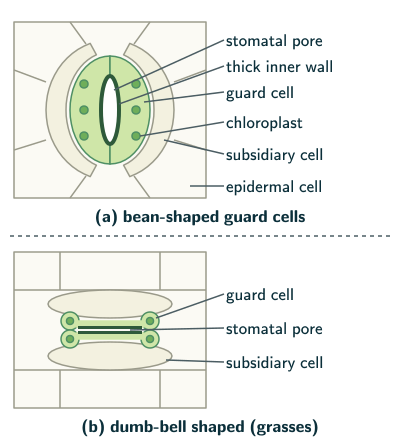
- Each stoma has two guard cells enclosing the stomatal pore. The guard cells are bean-shaped; in grasses they are dumb-bell shaped.
- The outer walls of the guard cells, away from the pore, are thin; the inner walls, towards the pore, are highly thickened.
- The guard cells have chloroplasts and regulate the opening and closing of the stomata.
- Sometimes a few epidermal cells next to the guard cells become specialised in shape and size: these are subsidiary cells.
- The stomatal aperture, the guard cells and the surrounding subsidiary cells together form the stomatal apparatus (page 72).
Root hairs and trichomes
The root hairs are unicellular elongations of the epidermal cells and help absorb water and minerals from the soil.
NCERT Biology (Class 11), Section 6.1.1, page 72
- On the stem, the epidermal hairs are called trichomes. In the shoot they are usually multicellular, branched or unbranched, soft or stiff, and may be secretory.
- Trichomes help prevent water loss by transpiration (page 72).
The ground tissue system
All tissues except the epidermis and the vascular bundles make up the ground tissue (page 72).
- It consists of the simple tissues parenchyma, collenchyma and sclerenchyma.
- Parenchyma is usually present in the cortex, pericycle, pith and medullary rays of primary stems and roots.
- In leaves, the ground tissue is made of thin-walled cells containing chloroplasts and is called the mesophyll (page 72).
- NCERT’s Summary adds that the ground tissue forms the main bulk of the plant, in three zones: cortex, pericycle and pith (page 77).
The vascular tissue system
The vascular system consists of the complex tissues phloem and xylem, which together form the vascular bundles (page 73).
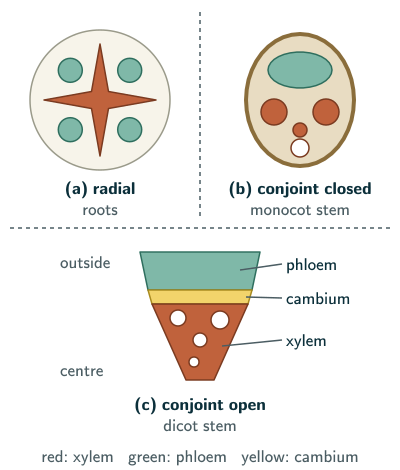
In dicotyledonous stems, cambium is present between phloem and xylem.
NCERT Biology (Class 11), Section 6.1.3, page 73
Radial and conjoint, open and closed bundles
NCERT classifies bundles in two independent ways: by cambium (open or closed) and by where xylem and phloem lie (radial or conjoint) (Summary, page 77). A dicot stem bundle is conjoint, open and endarch, with its protoxylem towards the centre; a monocot stem bundle is conjoint and closed (page 76).
- Open: cambium is present between the phloem and the xylem, so the bundle can form secondary xylem and phloem, as in dicotyledonous stems.
- Closed: no cambium within that bundle, so the bundle cannot add conventional secondary xylem and phloem, as in the monocotyledons.
- Radial: xylem and phloem lie on different, alternating radii, as in roots.
- Conjoint: xylem and phloem lie together on the same radius, as in stems and leaves; the phloem is usually only on the outer side of the xylem (page 73).
Solved examples
Example 1: The stomatal apparatus (NCERT Exercise Q4)
What is the stomatal apparatus? Explain the structure of stomata with a labelled diagram.
Answer: the stomatal aperture, the two guard cells round it and the subsidiary cells around them together form the stomatal apparatus. Each stoma is two guard cells enclosing a pore: bean-shaped in most plants, dumb-bell shaped in grasses. Their outer walls (away from the pore) are thin and their inner walls (towards the pore) highly thickened; they have chloroplasts and regulate the opening and closing of the stoma. Subsidiary cells are epidermal cells near the guard cells that are sometimes specialised in shape and size. Stomata regulate transpiration and gaseous exchange (NCERT page 72). Draw panel (a) of the figure above.
Example 2: Three tissue systems (NCERT Exercise Q5)
Name the three basic tissue systems in flowering plants, and the tissues under each.
Answer:
| System | Made of |
|---|---|
| Epidermal | epidermal cells, stomata, trichomes and hairs |
| Ground | parenchyma, collenchyma, sclerenchyma: cortex, pericycle, pith, medullary rays; mesophyll in leaves |
| Vascular | xylem and phloem, as vascular bundles (with cambium in open bundles) |
(NCERT pages 71–73.)
Example 3: Why study anatomy? (NCERT Exercise Q6)
How is the study of plant anatomy useful to us?
Answer:
- It shows how internal structure suits a plant’s functions and its environment (NCERT page 71).
- It tells monocots from dicots, which are anatomically different (page 71).
Beyond the NCERT text:
- It helps to identify plants and to detect adulteration of plant drugs and foods.
- It helps to judge the quality of timber and fibres, and a tree’s age from its annual rings.
- It guides plant breeders.
Example 4: Open or closed?
Why can a dicot stem bundle form secondary tissues while a monocot bundle cannot?
Answer: the dicot bundle has cambium between phloem and xylem, so it is open and can form secondary xylem and phloem; the monocot bundle has no cambium, so it is closed (NCERT page 73).
Example 5: Root or stem?
A section shows xylem and phloem on alternating radii. Is it from a root or a stem?
Answer: a root: that arrangement is radial, as in roots; stems and leaves have conjoint bundles (NCERT page 73).
Common mistakes to avoid
Common mistake
Thickening the wrong guard-cell wall
The inner walls of guard cells, towards the pore, are thick; the outer walls are thin (NCERT page 72).
Common mistake
Putting a cuticle on roots
The cuticle covers the shoot; it is absent in roots (NCERT page 72).
Common mistake
Saying phloem is always outside the xylem
NCERT says conjoint bundles usually have phloem only on the outer side (page 73); these are collateral. Beyond the NCERT text, cucurbit stems such as pumpkin have phloem on both sides: bicollateral bundles.
Quick revision summary
- Anatomy is the study of internal structure; tissues form three systems: epidermal, ground and vascular.
- Epidermis: one layer of compact cells, a cuticle (absent in roots), stomata, root hairs (unicellular) and trichomes (usually multicellular).
- Stomatal apparatus: pore, guard cells (bean-shaped; dumb-bell in grasses; inner walls thick) and subsidiary cells; stomata regulate transpiration and gaseous exchange.
- Ground tissue: everything except epidermis and vascular bundles; parenchyma, collenchyma, sclerenchyma; mesophyll in leaves.
- Vascular bundles: xylem and phloem; open (with cambium, dicot stems) or closed (monocots); radial (roots) or conjoint (stems, leaves).
Formula sheet
- tissue systems: epidermal, ground, vascular
- stomatal apparatus: pore, guard cells, subsidiary cells
- guard cells: bean-shaped; dumb-bell in grasses; inner walls thick
- ground tissue: all except epidermis and vascular bundles
- open bundle: cambium present (dicot stem); closed: none (monocot)
- radial: roots; conjoint: stems and leaves
Questions students ask
What is the difference between a tissue and a tissue system?
A tissue is a group of cells with a common origin that usually perform a common function, such as parenchyma or xylem, while a tissue system is a set of tissues grouped by their structure and location in the plant body. NCERT recognises three tissue systems: the epidermal system; the ground system, which contains the simple tissues parenchyma, collenchyma and sclerenchyma; and the vascular system, made of the complex tissues xylem and phloem. So one tissue system holds several tissues, and one tissue, such as parenchyma, can occur in more than one system.
What is the difference between stoma and stomata?
Stoma and stomata are the singular and the plural of one word: a stoma is a single pore in the epidermis together with the two guard cells that enclose it, and stomata means two or more of them. NCERT uses the word in this sense (‘Each stoma is composed of two bean-shaped cells known as guard cells which enclose stomatal pore’), while some books use stoma for the pore alone.
What is the difference between stomata and lenticels?
Stomata are pores in the epidermis of leaves and young stems, each enclosed by two guard cells that open and close it, while lenticels are lens-shaped openings in the bark of woody stems and roots, with no guard cells. Stomata regulate transpiration and gaseous exchange; lenticels, formed in secondary growth where the cork cambium cuts off parenchymatous cells instead of cork cells, let gases reach the inner tissues without rapid guard-cell opening and closing. They need not remain structurally unchanged: seasonal closing layers occur in some trees, documented by Kalachanis and Psaras in IAWA Journal (2007). NCERT names lenticels only in Chapter 12, where with stomata they allow gaseous exchange (pages 154–155); how they form is beyond the 2026–27 NCERT text.
Is the epidermis the same as the epidermal tissue system?
The epidermis and the epidermal tissue system are the same outer covering of the primary plant body, named in two ways: NCERT calls the epidermis the outermost layer of the primary plant body, and lists the parts of the epidermal tissue system as the epidermal cells, the stomata and the epidermal appendages, the trichomes and hairs. ‘Epidermis’ names the layer, while ‘epidermal tissue system’ stresses that it is built of several kinds of cells, and many books call it the dermal tissue system. Beyond the 2026–27 NCERT text, in stems and roots that grow in girth the epidermis is later replaced by periderm, which includes protective cork produced by the cork cambium.
Practice questions
Try each question first, then open the answer to check your working.
-
Q1. What is the ground tissue of a leaf called?
Show answerHide answer
The mesophyll (NCERT page 72).
-
Q2. Are root hairs unicellular or multicellular?
Show answerHide answer
Unicellular (NCERT page 72).
-
Q3. What do trichomes help prevent?
Show answerHide answer
Water loss due to transpiration (NCERT page 72).
-
Q4. In a conjoint bundle, where does the phloem usually lie?
Show answerHide answer
Only on the outer side of the xylem (NCERT page 73).