Amphibolic pathway: fats and proteins in respiration
NCERT Class 11 Biology Chapter 12 Section 12.6
Quick answer
The respiratory network is amphibolic because it supports both breakdown and synthesis through shared intermediates. Fatty acids supply acetyl CoA; glycerol joins glycolysis through DHAP, which interconverts with PGAL; amino-acid carbon skeletons enter at several points. Intermediates also support biosynthesis, which uses its own enzymes and energy rather than simply reversing catabolism.
With your textbook
NCERT Biology (Class 11), Chapter 12 “Respiration in Plants”, Section 12.6 “Amphibolic Pathway”, pages 162–163.
Open the official NCERT chapter (PDF, 1.7 MB, ncert.nic.in) (opens in a new tab)
Checked against the 2026-27 reprint on .
The amphibolic pathway
Amphibolic pathway
An amphibolic pathway is one that takes part in both breaking down molecules (catabolism) and building them up (anabolism). NCERT concludes that the respiratory pathway is one:
Because the respiratory pathway is involved in both anabolism and catabolism, it would hence be better to consider the respiratory pathway as an amphibolic pathway rather than as a catabolic one.
NCERT Biology (Class 11), Section 12.6, page 162
In plain words: think of the respiratory pathway as a busy highway with exits and entry ramps. Fats and proteins can drive onto it at different ramps to be burnt for energy. But the same ramps also work as exits: when the cell needs to build fats or proteins, it takes the very same intermediates off the highway as raw material. This shared supply of intermediates is what makes the network amphibolic; synthesis does not simply reverse every breakdown reaction.
Fats and proteins as respiratory substrates
- “Glucose is the favoured substrate for respiration.” NCERT generalises that carbohydrates first become glucose (page 162), but its own sucrose example supplies both glucose and fructose (page 156). Sugars can enter through different glycolytic intermediates.
- Other substrates can also be respired, but they do not enter at the first step; each enters at its own point (page 162; NCERT Figure 12.6).
- Fats are first broken down into glycerol and fatty acids (page 162).
- Fatty acids are first degraded to acetyl CoA, which enters the pathway (page 162).
- Glycerol enters the pathway after being converted to PGAL (page 162). NCERT’s Figure 12.6 draws the glycerol line reaching dihydroxyacetone phosphate, the triose phosphate that is interconverted with PGAL (page 156); use PGAL when quoting the prose, and DHAP when interpreting the figure’s immediate entry point; DHAP and PGAL interconvert.
- Proteins are degraded by proteases into individual amino acids. After deamination, each amino acid, depending on its structure, enters at some stage within the Krebs’ cycle, or even as pyruvate or acetyl CoA (page 162).
| Substrate | Broken into | Enters as |
|---|---|---|
| Carbohydrates | monosaccharides such as glucose and fructose | glucose or glycolytic intermediates |
| Fats | glycerol | DHAP, interconverting with PGAL |
| Fats | fatty acids | acetyl CoA |
| Proteins | amino acids | pyruvate, acetyl CoA or Krebs’ cycle |
PGAL is itself one of the intermediates of glycolysis (NCERT page 156), so glycerol joins the pathway part-way through it.
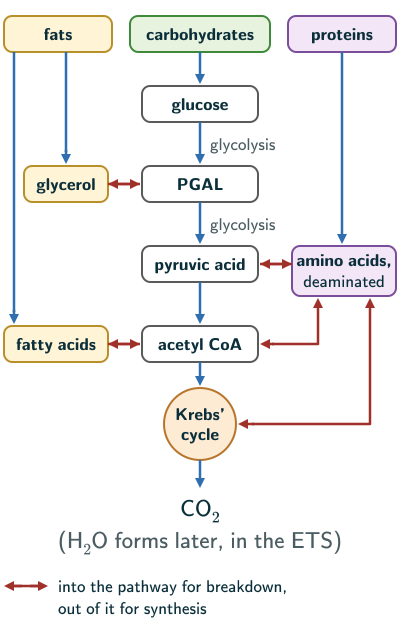
Catabolism and anabolism
- Because respiration breaks substrates down, it has traditionally been called a catabolic process, and the respiratory pathway a catabolic pathway (NCERT page 162).
- But the compounds at which substrates enter the pathway are the very compounds withdrawn from it to make those substrates (page 162).
- Fatty acids: they are broken down to acetyl CoA to be respired; when the organism needs to make fatty acids, acetyl CoA is withdrawn from the pathway for it. So the pathway takes part in both the breakdown and the synthesis of fatty acids (page 162).
- Proteins: similarly, respiratory intermediates form the link in both the breakdown and the synthesis of proteins (page 162).
- NCERT defines the two terms: “Breaking down processes within the living organism is catabolism, and synthesis is anabolism” (page 162). Since the respiratory pathway serves both, it is better called an amphibolic pathway (page 162).
Solved examples
Example 1: Points of entry (NCERT page 162)
At which point does each of these enter the respiratory pathway: (a) sucrose, (b) glycerol, (c) fatty acids, (d) amino acids?
Answer: (a) as glucose and fructose: invertase splits sucrose into the two, and both readily enter glycolysis (NCERT page 156); (b) as PGAL; (c) as acetyl CoA; (d) after deamination, within the Krebs’ cycle, or as pyruvate or acetyl CoA, depending on the amino acid (NCERT page 162).
Example 2: Acetyl CoA from a fatty acid
Palmitic acid has 16 carbons (NCERT Chapter 9, page 106). If its chain is cut into two-carbon acetyl units, how many acetyl CoA does one molecule give?
Answer: 16 ÷ 2 = 8 acetyl CoA. Each joins oxaloacetic acid in the Krebs’ cycle, so one palmitic acid feeds eight turns of the cycle (reasoned: an acetyl group, CHCO–, has two carbons, so a 16-carbon chain can give eight).
Example 3: Withdrawing intermediates
A plant cell needs to make fatty acids. Which respiratory intermediate does it withdraw, and why does this make the pathway amphibolic?
Answer: acetyl CoA. The same compound through which fatty acids enter the pathway when they are respired is withdrawn to build them, so the pathway serves both catabolism and anabolism (NCERT page 162).
Example 4: The amphibolic pathway (NCERT Exercise 9)
Discuss “The respiratory pathway is an amphibolic pathway.”
Answer: respiration breaks substrates down, so the pathway was traditionally called catabolic. But other substrates enter it at set points: fatty acids as acetyl CoA, glycerol as PGAL, and amino acids, after deamination, as pyruvate, acetyl CoA or Krebs’ cycle intermediates. These same compounds are withdrawn from the pathway when the cell makes those substances: acetyl CoA for fatty acids, and respiratory intermediates for proteins. Breaking down is catabolism and synthesis is anabolism; since the pathway is involved in both, it is better called amphibolic (NCERT page 162).
Common mistakes to avoid
Common mistake
Calling respiration purely catabolic
The respiratory pathway also supplies intermediates for synthesis, such as acetyl CoA for fatty acids, so NCERT calls it amphibolic (page 162).
Common mistake
Sending fatty acids into glycolysis
Fatty acids enter as acetyl CoA; only the glycerol part of a fat enters glycolysis, as PGAL (NCERT page 162).
Common mistake
Giving amino acids a single entry point
Depending on their structure, amino acids enter within the Krebs’ cycle, or as pyruvate or acetyl CoA, after deamination (NCERT page 162).
Quick revision summary
- Glucose is the favoured respiratory substrate; other sugars can enter glycolysis at different points.
- Fats split into glycerol, which enters as PGAL, and fatty acids, which enter as acetyl CoA.
- Proteins are split by proteases into amino acids, which after deamination enter as pyruvate, acetyl CoA or within the Krebs’ cycle.
- The same intermediates are withdrawn to build fatty acids and proteins, so the pathway serves both catabolism (breaking down) and anabolism (synthesis): it is amphibolic.
Formula sheet
- carbohydrates → monosaccharides → glycolysis
- fats → glycerol (DHAP ↔ PGAL) + fatty acids (acetyl CoA)
- proteins → amino acids → pyruvate, acetyl CoA or Krebs’ cycle
- catabolism: breaking down; anabolism: synthesis
- amphibolic pathway: used in both catabolism and anabolism
Questions students ask
What is the difference between catabolism and anabolism?
Catabolism is the breaking down of molecules in a living organism and anabolism is their synthesis: in NCERT’s words, “Breaking down processes within the living organism is catabolism, and synthesis is anabolism” (page 162). Catabolism releases energy, as respiration does when it oxidises food and traps the energy as ATP (NCERT page 154), while anabolism uses energy and raw materials, as when the Calvin cycle spends 3 ATP and 2 NADPH for every CO fixed into sugar (NCERT Chapter 11, page 145).
How are catabolism and anabolism linked in a cell?
Catabolism and anabolism are linked by energy and by materials: the energy that catabolic processes such as respiration release is trapped in ATP and then used in the cell’s energy-requiring processes, and the carbon skeletons produced during respiration are used as precursors for the biosynthesis of other molecules (NCERT page 154). The respiratory pathway is where the two meet, which is why NCERT calls it amphibolic rather than catabolic (page 162).
Which part of respiration is amphibolic: glycolysis or the Krebs’ cycle?
Both glycolysis and the Krebs’ cycle belong to the amphibolic pathway: NCERT calls the whole respiratory pathway amphibolic, not one cycle alone (page 162). Acetyl CoA, which feeds the Krebs’ cycle, is withdrawn when fatty acids are made, and amino acids join and leave the pathway at several points, while glycerol from fats joins at the glycolysis stage (NCERT page 162). Beyond the NCERT text, biochemistry books single out the Krebs’ cycle as amphibolic (Nelson and Cox, Lehninger Principles of Biochemistry, Chapter 16), so it is the answer if a question asks for one cycle.
Is the amphibolic pathway in the NEET syllabus?
Yes, the amphibolic pathway is in the NEET (UG) 2026 syllabus: Unit 4, Plant Physiology, lists “Amphibolic pathways” under Respiration, along with glycolysis, fermentation, the TCA cycle and electron transport system, the number of ATP molecules generated and the respiratory quotient. It is NCERT Class 11 Biology Section 12.6, page 162, with its Figure 12.6 on page 163.
Practice questions
Try each question first, then open the answer to check your working.
-
Q1. What is the favoured substrate for respiration?
Show answerHide answer
Glucose (NCERT page 162).
-
Q2. Which entry intermediate does NCERT’s prose name for glycerol?
Show answerHide answer
PGAL (page 162); NCERT Figure 12.6 shows entry at DHAP, which interconverts with PGAL.
-
Q3. Which enzymes break proteins down into amino acids before they are respired?
Show answerHide answer
Proteases (NCERT page 162).