How to analyse chemical composition
NCERT Class 11 Biology Chapter 9 Section 9.1
Quick answer
Living tissues and the earth’s crust share elements in different proportions; NCERT calls the carbon compounds obtained from tissues biomolecules. Grinding tissue in trichloroacetic acid gives an acid-soluble pool of small compounds and an insoluble fraction containing proteins, nucleic acids, polysaccharides and lipids. Major small biomolecules include amino acids, sugars, fatty acids, glycerol, bases, nucleosides and nucleotides.
With your textbook
NCERT Biology (Class 11), Chapter 9 “Biomolecules”, Section 9.1 “How to Analyse Chemical Composition?”, pages 104–107.
Open the official NCERT chapter (PDF, 1.9 MB, ncert.nic.in) (opens in a new tab)
Checked against the 2026-27 reprint on .
Biomolecules and how they are found
Biomolecules
All the carbon compounds that we get from living tissues can be called ‘biomolecules’.
NCERT Biology (Class 11), Section 9.1, page 105
- An elemental analysis of living tissue and of a piece of the earth’s crust gives a similar list of elements: every element in the crust sample is also present in living tissue (page 104).
- The difference is one of proportion: carbon and hydrogen are relatively more abundant in living organisms than in the earth’s crust (page 104).
In plain words: living things are made of the same elements as rocks, but in different amounts. Most of a living tissue is water (70–90 per cent of a cell’s mass, NCERT Table 9.4, page 109), and much of the rest is carbon compounds. Chemists find those compounds by grinding a tissue in acid and separating what dissolves from what does not, and find the inorganic part by burning the tissue and looking at the ash.
Elements in living and non-living matter
NCERT’s Table 9.1 (page 105) compares the percentage by weight of elements:
| Element | Earth’s crust | Human body |
|---|---|---|
| Hydrogen | 0.14 | 9.5 |
| Carbon | 0.03 | 18.5 |
| Oxygen | 46.6 | 65.0 |
| Nitrogen | very little | 3.3 |
| Sulphur | 0.03 | 0.3 |
| Sodium | 2.8 | 0.2 |
| Calcium | 3.6 | 1.5 |
| Magnesium | 2.1 | 0.1 |
| Silicon | 27.7 | negligible |
NCERT notes that the table is adapted from C.N.R. Rao’s Understanding Chemistry (page 105). Carbon makes up 18.5 per cent of the human body against 0.03 per cent of the crust, about 600 times as much; silicon, the second most abundant element of the crust in the table, is negligible in the body. NCERT’s chapter summary (page 118) adds oxygen: “the relative abundance of carbon, hydrogen and oxygen is higher in living systems when compared to inanimate matter”. NCERT Table 9.1 agrees (oxygen 65.0 per cent of the body against 46.6 per cent of the crust), and nitrogen and sulphur are also higher in the body.
Acid-soluble pool and acid-insoluble fraction
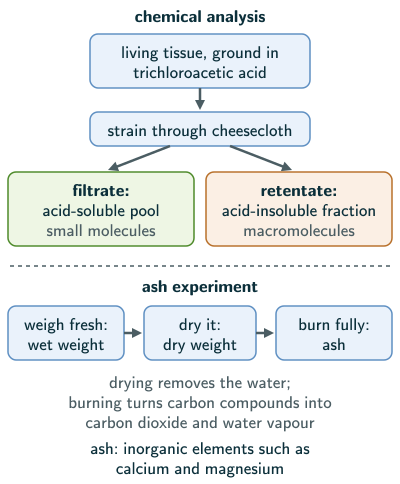
To find the organic compounds in a living tissue (a vegetable or a piece of liver, for example), NCERT describes this analysis (page 104):
- Grind the tissue in trichloroacetic acid (ClCCOOH) with a mortar and pestle to get a thick slurry.
- Strain it through cheesecloth or cotton. Two fractions result: the filtrate, called the acid-soluble pool, and the retentate, called the acid-insoluble fraction.
Scientists have found thousands of organic compounds in the acid-soluble pool (page 104). To identify one, a compound is extracted and put through separation techniques until it is isolated and purified; analytical techniques then suggest its molecular formula and probable structure (page 105).
What the two fractions hold comes in NCERT Section 9.3 (pages 108–109): the compounds of the acid-soluble pool have molecular weights from 18 to about 800 daltons, while the acid-insoluble fraction has only proteins, nucleic acids, polysaccharides and lipids. Lipids, though small, separate with the insoluble fraction because grinding breaks the cell membranes into vesicles that are not water soluble.
Wet weight, dry weight and ash
Living organisms also contain inorganic elements and compounds, shown by a destructive experiment (page 105):
- Weigh a small amount of tissue, say a leaf or liver: this is its wet weight. Dry it: all the water evaporates, and what remains gives the dry weight.
- Burn the tissue fully: all the carbon compounds are oxidised to gases (CO, water vapour) and removed. What remains is the ash, which contains inorganic elements such as calcium and magnesium.
- Inorganic compounds such as sulphate and phosphate are also seen in the acid-soluble fraction.
NCERT’s Table 9.2 (page 105) lists representative inorganic constituents of living tissues: sodium (Na), potassium (K), calcium (Ca), magnesium (Mg), water (HO), and, in its “Compounds” row, NaCl, CaCO and the phosphate and sulphate ions PO and SO. (NCERT writes the calcium and magnesium ions as Ca and Mg.)
Analysis for compounds shows the kinds of organic constituents (NCERT Figure 9.1, page 107) and inorganic constituents (Table 9.2) in living tissue; biologically, NCERT groups the organic ones into amino acids, nucleotide bases, fatty acids and so on (page 105). Figure 9.1 draws two sugars (glucose, CHO, and ribose, CHO), three amino acids (glycine, alanine, serine), lipids (palmitic acid, glycerol, a triglyceride, lecithin and cholesterol), the nitrogen bases adenine (a purine) and uracil (a pyrimidine), two nucleosides (adenosine, uridine) and a nucleotide (adenylic acid).
Amino acids
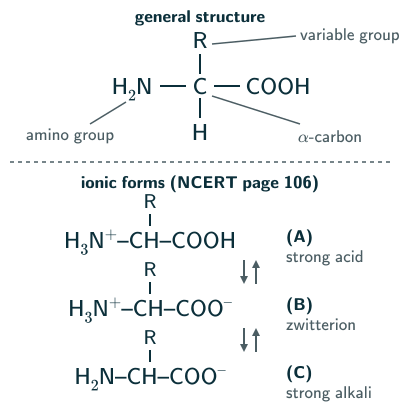
Amino acids are organic compounds containing an amino group and an acidic group as substituents on the same carbon i.e., the α-carbon.
NCERT Biology (Class 11), Section 9.1, page 105
- Hence they are called α-amino acids. They are substituted methanes: the four valencies of the α-carbon carry a hydrogen, a carboxyl group, an amino group and a variable R group (page 105).
- Many amino acids exist, but those in proteins are of only twenty types. The R group may be hydrogen (glycine), a methyl group (alanine), hydroxy methyl (serine), and so on (pages 105–106).
- Their properties come from the amino, carboxyl and R groups. By the number of amino and carboxyl groups, they are acidic (glutamic acid), basic (lysine) or neutral (valine); there are also aromatic amino acids (tyrosine, phenylalanine, tryptophan) (page 106). An acidic amino acid has more carboxyl than amino groups, a basic one more amino than carboxyl groups, and a neutral one equal numbers. ‘Aromatic’ describes the R group, so the three aromatic ones are neutral by this count (reasoned from NCERT page 106).
- The –NH and –COOH groups are ionisable, so the structure of an amino acid changes with the pH of the solution. Of NCERT’s three forms, (B), with –NH and –COO, is the zwitterionic form (page 106): it carries both a positive and a negative charge, so it is neutral overall when the R group is uncharged. Form (A), with –NH and –COOH, is positive overall, and (C), with –NH and –COO, negative. NCERT does not say where each form occurs; in standard chemistry, (A) predominates in strongly acidic solution, (C) in strongly alkaline solution, and (B) over the wide range in between (our reasoning, for the simple amino acid drawn with an uncharged R group).
Lipids
Lipids are generally insoluble in water (page 106).
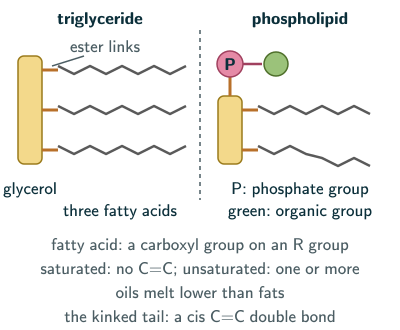
- A fatty acid has a carboxyl group attached to an R group of 1 to 19 carbons: a methyl (–CH), an ethyl (–CH) or a longer chain of –CH groups. Palmitic acid has 16 carbons and arachidonic acid 20, each count including the carboxyl carbon (page 106).
- Fatty acids are saturated (no carbon–carbon double bond) or unsaturated (one or more C=C double bonds) (page 106).
- Glycerol is trihydroxy propane; NCERT calls it ‘another simple lipid’ (page 106), although, unlike most lipids, it mixes freely with water (reasoned from NCERT Class 12 Chemistry, Unit 7, page 204: the lower alcohols hydrogen-bond with water and mix with it in all proportions). In many lipids, fatty acids are esterified with glycerol, giving monoglycerides, diglycerides and triglycerides. These are called fats and oils by melting point: oils have a lower melting point (gingelly oil, for example) and stay liquid in winter (page 106); fats have the higher melting point (reasoned from NCERT page 106).
- Phospholipids contain phosphorus and a phosphorylated organic compound; they are found in cell membranes, and lecithin is an example. Neural tissues have lipids with more complex structures (page 106).
Nitrogen bases, nucleosides and nucleotides
- Some carbon compounds in living organisms contain heterocyclic rings, among them the nitrogen bases adenine, guanine, cytosine, uracil and thymine (page 106).
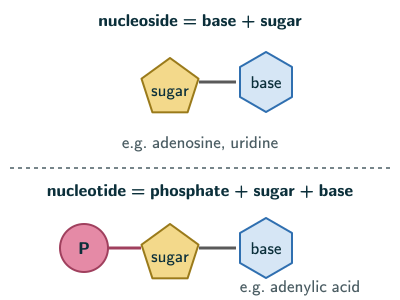
- A nitrogen base attached to a sugar is a nucleoside: adenosine, guanosine, thymidine, uridine and cytidine (page 106).
- If a phosphate group is also esterified to the sugar, it is a nucleotide: adenylic acid, thymidylic acid, guanylic acid, uridylic acid and cytidylic acid (page 106).
- Nucleic acids such as DNA and RNA consist of nucleotides only, and they function as genetic material (page 106).
Solved examples
Example 1: Which fraction?
A piece of liver is ground in trichloroacetic acid and strained. Where do you look for its thousands of small organic compounds, and where for its proteins?
Answer: the thousands of small organic compounds are in the filtrate, the acid-soluble pool (NCERT page 104). The proteins are in the retentate, the acid-insoluble fraction, which holds only four types of organic compounds: proteins, nucleic acids, polysaccharides and lipids (NCERT Section 9.3, page 108). Lipids are small molecules, but they separate with the insoluble fraction because grinding breaks the cell membranes into vesicles that are not water soluble (pages 108–109).
Example 2: Reading NCERT Table 9.1
By weight, how many times more carbon is there in the human body than in the earth’s crust?
Answer: 18.5 ÷ 0.03 ≈ 617, so about 600 times (NCERT Table 9.1, page 105).
Example 3: Classify the amino acids
Classify glutamic acid, lysine, valine and tryptophan.
Answer: glutamic acid is acidic, lysine basic, valine neutral, and tryptophan aromatic (NCERT page 106); by its count of groups, tryptophan is also neutral.
Example 4: Carbons in the R group
NCERT counts 16 carbons in palmitic acid and 20 in arachidonic acid, including the carboxyl carbon. How many carbons are in each R group?
Answer: 16 − 1 = 15 for palmitic acid and 20 − 1 = 19 for arachidonic acid, within NCERT’s range of 1 to 19 carbons (page 106).
Example 5: Draw alanine (NCERT Exercise 7)
Draw the structure of the amino acid alanine.
Answer: an α-carbon bearing a hydrogen, an amino group (–NH), a carboxyl group (–COOH) and, as its R group, a methyl group (–CH) (NCERT pages 105–106). Written in one line, alanine is CH–CH(NH)–COOH.
Example 6: A triglyceride (NCERT Exercise 5)
Explain the composition of a triglyceride.
Answer: one glycerol (trihydroxy propane) with three fatty acids esterified to it. Depending on its melting point, it is a fat or an oil (NCERT page 106).
Common mistakes to avoid
Common mistake
Thinking living matter has its own elements
Every element in a sample of the earth’s crust is also in living tissue; only the relative amounts differ (NCERT page 104).
Common mistake
Calling adenosine a nucleotide
Adenosine is a nucleoside (base + sugar); add a phosphate group and it becomes a nucleotide, adenylic acid (NCERT page 106).
Common mistake
Giving oils the higher melting point
Oils have the lower melting point, which is why they stay liquid in winter (NCERT page 106).
Quick revision summary
- Living tissue and the earth’s crust have the same elements, but carbon and hydrogen are relatively more abundant in living organisms.
- Ground in trichloroacetic acid and strained, a tissue gives a filtrate (acid-soluble pool) and a retentate (acid-insoluble fraction).
- Wet weight, then dry weight after drying, then ash after burning; the ash holds inorganic elements.
- Amino acids: α-carbon with H, COOH, NH and R; 20 in proteins; acidic, basic, neutral, aromatic; zwitterionic form.
- Lipids: fatty acids (saturated or unsaturated), glycerol, glycerides (fats and oils), phospholipids such as lecithin.
- Nitrogen bases; nucleoside = base + sugar; nucleotide = base + sugar + phosphate; DNA and RNA are made of nucleotides.
Formula sheet
- grinding agent: trichloroacetic acid (ClCCOOH)
- filtrate: acid-soluble pool; retentate: acid-insoluble fraction
- amino acid: α-carbon with H, –COOH, –NH and R
- palmitic acid: 16 carbons; arachidonic acid: 20 carbons
- nucleoside: base + sugar; nucleotide: base + sugar + phosphate
Questions students ask
What are biomolecules, according to NCERT?
Biomolecules, in NCERT’s words, are all the carbon compounds that we get from living tissues (NCERT Biology Class 11, page 105). They range from small molecules, such as amino acids, sugars, fatty acids, glycerol, nitrogen bases, nucleosides and nucleotides, to the large proteins, nucleic acids and polysaccharides, and NCERT sorts them by molecular weight into micromolecules and macromolecules. Living tissue also holds inorganic elements and compounds, such as sodium and potassium ions, sulphate and phosphate, which NCERT treats separately from these carbon compounds (page 105).
Does the acid-soluble pool contain organic or inorganic compounds?
The acid-soluble pool contains both organic and inorganic compounds: scientists have found thousands of organic compounds in it, and NCERT notes that inorganic compounds such as sulphate and phosphate are also seen in the acid-soluble fraction (pages 104–105). Its organic compounds are the small ones, such as amino acids, sugars and nucleotides. So a NEET statement that the filtrate holds only organic compounds is false, and so is one that it holds only inorganic ones.
What is the zwitterionic form of an amino acid?
The zwitterionic form of an amino acid is the one in which its amino group carries a positive charge (–NH3+) and its carboxyl group a negative charge (–COO−), form (B) of NCERT’s three structures (page 106); with an uncharged R group it is neutral overall. An ionisable side chain can add further charge, so this diagram is not a complete charge map for every amino acid. NCERT’s Class 12 Chemistry book calls such a zwitterion a dipolar ion and says that in this form amino acids show amphoteric behaviour, as they react with both acids and bases (Unit 10, page 292). Beyond the NCERT text, the isoelectric point is the pH at which the amino acid population has zero average net charge; it does not mean the molecule has no charged groups.
What is the difference between a nucleoside and a nucleotide?
A nucleoside is a nitrogen base attached to a sugar, while a nucleotide also has a phosphate group esterified to the sugar: nucleoside = base + sugar, nucleotide = base + sugar + phosphate (NCERT page 106). So the nucleoside guanosine becomes the nucleotide guanylic acid, and cytidine becomes cytidylic acid; nucleic acids such as DNA and RNA consist of nucleotides only. Beyond the NCERT Class 11 text, NCERT Class 12 Biology adds that the base is linked to carbon 1′ of the sugar by an N-glycosidic linkage, and the phosphate to carbon 5′ by a phosphoester linkage (Chapter 5, page 80).
Is Biomolecules in the NEET (UG) 2026 syllabus?
Biomolecules is in the NEET (UG) 2026 Biology syllabus: Unit 3, Cell Structure and Function, lists the chemical constituents of living cells, the structure and function of proteins, carbohydrates, lipids and nucleic acids, and enzymes, with their types, properties, action, classification and nomenclature. That is NCERT Class 11 Biology, Chapter 9, Sections 9.1 to 9.8, which this page and the next seven cover. The NEET Chemistry syllabus also has a Unit 19, Biomolecules, with carbohydrates, proteins and their four levels of structure, denaturation, enzymes, vitamins, nucleic acids and hormones, which NCERT teaches in Class 12 Chemistry, Unit 10.
Practice questions
Try each question first, then open the answer to check your working.
-
Q1. Which element is about 27.7 per cent of the earth’s crust by weight but negligible in the human body?
Show answerHide answer
Silicon (NCERT Table 9.1, page 105).
-
Q2. What is the R group of glycine, and of serine?
Show answerHide answer
Glycine: a hydrogen; serine: a hydroxy methyl group (NCERT page 106).
-
Q3. What is left after a tissue is burnt completely, and what does it contain?
Show answerHide answer
Ash, which contains inorganic elements such as calcium and magnesium (NCERT page 105).
-
Q4. Name a phospholipid found in cell membranes.
Show answerHide answer
Lecithin (NCERT page 106).