Quantitative analysis of organic compounds
NCERT Class 11 Chemistry Chapter 8 Section 8.10
Quick answer
Quantitative analysis measures elemental mass percentages through products of known composition. Combustion estimates carbon and hydrogen, Dumas or Kjeldahl methods estimate nitrogen, and suitable precipitates estimate chlorine, bromine, iodine, sulphur or phosphorus. Oxygen by difference is reliable only when other constituents are accounted for; a molecular formula also requires molar-mass information.
With your textbook
NCERT Chemistry Part II (Class 11), Chapter 8 “Organic Chemistry – Some Basic Principles and Techniques”, Section 8.10 “Quantitative Analysis”, pages 285–291.
Open the official NCERT chapter (PDF, 4.5 MB, ncert.nic.in) (opens in a new tab)
Checked against the 2026-27 reprint on .
How is the composition of an organic compound measured?
Quantitative analysis
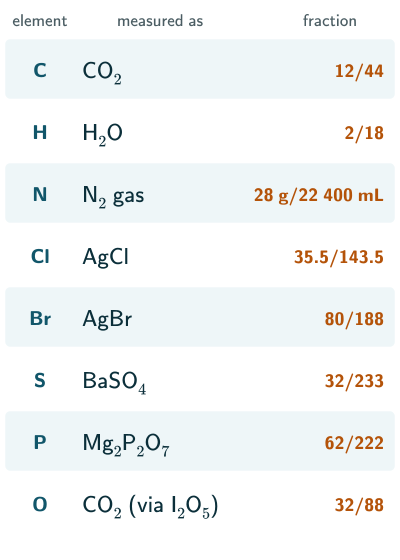
Quantitative analysis finds the mass per cent of each element in an organic compound, from which an empirical formula can be inferred; a molecular formula also requires molar-mass information (NCERT Section 8.10, page 285). Each element is turned into a product of known formula that can be weighed or measured:
- carbon and hydrogen: burnt to CO2 and H2O, absorbed and weighed;
- nitrogen: set free as N2 and its volume measured (Dumas method), or turned into ammonia and titrated (Kjeldahl’s method);
- halogens: precipitated as silver halide (Carius method);
- sulphur: precipitated as BaSO4; phosphorus: as ammonium phosphomolybdate or Mg2P2O7;
- oxygen: usually by difference from 100.
In plain words: you cannot weigh the carbon inside a molecule, but you can burn the compound and weigh the carbon dioxide it makes. Since 44 g of CO2 always contains 12 g of carbon, the mass of carbon follows. Every method on this page uses the same idea: convert the element into a compound of known formula, measure that, and scale back by the fraction of it that is the element.
Carbon and hydrogen
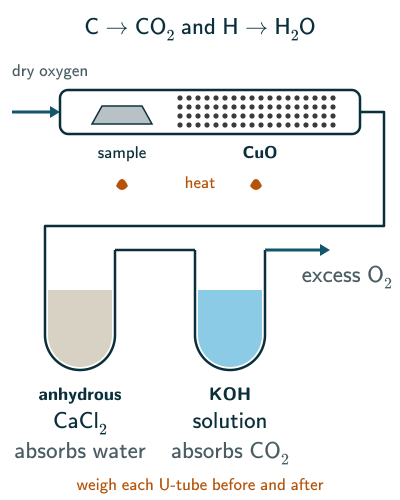
A known mass of the compound is burnt in excess oxygen with copper(II) oxide, which oxidises carbon to carbon dioxide and hydrogen to water (NCERT Section 8.10.1, pages 285–286):
CxHy + (x + y/4)O2 → xCO2 + (y/2)H2O
The gases pass through a weighed U-tube of anhydrous calcium chloride, which absorbs the water, and then a U-tube of concentrated potassium hydroxide solution, which absorbs the carbon dioxide (NCERT Fig. 8.14). The order matters: KOH solution would also take up water. The gains in mass give the masses of water (m1) and carbon dioxide (m2) from m g of compound.
Carbon and hydrogen
% C = (12 × m2 × 100)/(44 × m)
% H = (2 × m1 × 100)/(18 × m)
Here 12/44 is the fraction of carbon in CO2 and 2/18 the fraction of hydrogen in H2O (see mass per cent).
Nitrogen
Dumas method. The compound is heated with copper(II) oxide in an atmosphere of carbon dioxide; its nitrogen is set free as N2, and carbon and hydrogen form CO2 and H2O (NCERT Section 8.10.2, pages 286–287):
Dumas reaction
CxHyNz + (2x + y/2)CuO →
xCO2 + (y/2)H2O + (z/2)N2 + (2x + y/2)Cu
Any oxides of nitrogen are reduced to N2 over heated copper gauze. The gases are collected over potassium hydroxide solution, which absorbs the CO2, and the volume V1 of nitrogen is read in a graduated tube (a nitrometer, NCERT Fig. 8.15) at room temperature T1. Because the gas is collected over an aqueous solution (KOH), it is saturated with water vapour, so its pressure is the atmospheric pressure minus the aqueous tension (the water-vapour pressure over the collecting solution): p1 = atmospheric pressure − aqueous tension (with gas and external pressures equalised). Concentrated KOH lowers water vapour pressure, so use the stated collecting-solution correction rather than automatically substituting a pure-water table. The volume is converted to STP (273 K, 760 mm Hg), using the school ideal-gas approximation of 22 400 mL per mole and 28 g mol−1 for N2. This is the older 1-atm STP convention; the 1-bar convention has a different molar volume:
Dumas method
V (at STP) = (p1 × V1 × 273)/(760 × T1)
% N = (28 × V × 100)/(22 400 × m)
Kjeldahl’s method. The compound is heated with concentrated sulphuric acid (with a little CuSO4, NCERT Fig. 8.16, as catalyst), which turns its nitrogen into ammonium sulphate. The mixture is then heated with excess sodium hydroxide, and the ammonia set free is absorbed in a known excess of standard sulphuric acid. The acid left over is titrated with standard alkali; the difference gives the acid used by the ammonia (NCERT pages 287–288; see acid–base titrations):
- nitrogen in the compound → (NH4)2SO4 during acid digestion (schematic, not a balanced overall equation);
- (NH4)2SO4 + 2NaOH → Na2SO4 + 2NH3 + 2H2O;
- 2NH3 + H2SO4 → (NH4)2SO4.
If V mL of H2SO4 of molarity M is taken and V1 mL of NaOH of the same molarity M neutralises what is left, the leftover acid is V1/2 mL (each H2SO4 needs two NaOH). The acid used by ammonia is (V − V1/2) mL, which took 2(V − V1/2) mL of ammonia of molarity M, and 1000 mL of 1 M NH3 contains 14 g of nitrogen. Mass of nitrogen = 14 × M × 2(V − V1/2)/1000 g; multiplying by 100/m (and 14 × 100/1000 = 1.4):
Kjeldahl’s method
% N = (1.4 × M × 2(V − V1/2))/m
NCERT’s simplified line on page 288 prints 2(V − V/2); the subscript 1 belongs on the second V, as in the line before it.
The unmodified Kjeldahl procedure described here does not work for nitrogen in nitro and azo groups or in a ring (as in pyridine), because that nitrogen is not converted to ammonium sulphate under these conditions (page 288).
Halogens: Carius method
A known mass of the compound is heated with fuming nitric acid and silver nitrate in a sealed hard-glass Carius tube in a furnace (NCERT Section 8.10.3, page 289, Fig. 8.17). Carbon and hydrogen are oxidised to CO2 and H2O, and the halogen forms silver halide, AgX, which is filtered, washed, dried and weighed. Here X means Cl, Br or I; this silver-halide method does not estimate fluorine because AgF is soluble. One mole of AgX contains one mole of X:
Carius method (halogens)
% X = (atomic mass of X × m1 × 100)
/(molar mass of AgX × m)
with m1 g of AgX from m g of compound. For chlorine the factor is 35.5/143.5 and for bromine 80/188. NCERT’s line labelled percentage of halogen (page 289) gives only the mass of halogen in m1 g of AgX; multiply it by 100/m for the percentage, as above.
Sulphur
The compound is heated in a Carius tube with sodium peroxide or fuming nitric acid, which oxidises sulphur to sulphuric acid. Excess barium chloride solution precipitates it as barium sulphate, which is filtered, washed, dried and weighed (NCERT Section 8.10.4, page 289). 233 g of BaSO4 contains 32 g of sulphur:
Sulphur
% S = (32 × m1 × 100)/(233 × m)
Phosphorus
Heating with fuming nitric acid oxidises phosphorus to phosphoric acid, which is precipitated with ammonia and ammonium molybdate as ammonium phosphomolybdate, (NH4)3PO4·12MoO3 (molar mass 1877 g mol−1). Alternatively, magnesia mixture precipitates MgNH4PO4, which on ignition gives Mg2P2O7 (magnesium pyrophosphate, 222 g mol−1, with 62 g of phosphorus) (NCERT Section 8.10.5, page 290):
Phosphorus
% P = (31 × m1 × 100)/(1877 × m) (as phosphomolybdate)
% P = (62 × m1 × 100)/(222 × m) (as Mg2P2O7)
NCERT’s second formula on page 290 is printed with a stray × in place of × m in the denominator.
Oxygen
Oxygen may be estimated by difference: 100 minus the sum of the percentages of all the other elements (NCERT Section 8.10.6, page 290). That works only if every other component has been accounted for; missing elements, moisture, ash and analytical errors otherwise get wrongly assigned to oxygen (reasoned). It can also be estimated directly. The compound is decomposed by heating in a stream of nitrogen, and the gases are passed over red-hot coke, which turns all the oxygen into carbon monoxide; warm iodine pentoxide then oxidises the CO to CO2 and sets free iodine:
- 2C + O2 → 2CO (× 5);
- I2O5 + 5CO → I2 + 5CO2 (× 2).
These are stoichiometric bookkeeping equations; free O2 need not be released from the sample. Each two moles of oxygen atoms from the compound ultimately correspond to two moles of CO2: 32 g of oxygen gives 88 g of CO2.
Oxygen (direct method)
% O = (32 × m1 × 100)/(88 × m)
with m1 g of CO2. The iodine produced can be used instead. Today, carbon, hydrogen and nitrogen are measured on 1–3 mg samples by an automatic CHN elemental analyser (page 290).
Solved examples
Example 1: Carbon and hydrogen (NCERT Problem 8.20, page 286)
0.246 g of a compound gave 0.198 g of CO2 and 0.1014 g of H2O. Find the percentages of carbon and hydrogen.
% C = (12 × 0.198 × 100)/
Answer: C 21.95%, H 4.58%.
Example 2: Dumas method (NCERT Problem 8.21, page 287)
0.3 g of a compound gave 50 mL of nitrogen collected at 300 K and 715 mm. Aqueous tension at 300 K is 15 mm. Find the percentage of nitrogen.
Pressure of N2 = 715 − 15 = 700 mm. Volume at STP = (273 × 700 × 50)/
Answer: 17.46%.
- Note (page 287): NCERT gives the aqueous tension at 300 K as 15 mm. Beyond the NCERT text: pure water’s vapour pressure at 300 K is about 26.5 mm (NIST Chemistry WebBook, Antoine parameters of Bridgeman and Aldrich for 273–303 K), so 15 mm is not pure water’s value; but the nitrogen is collected over potassium hydroxide solution (NCERT page 286), whose vapour pressure is lower, so the 15 mm need not be wrong for that solution (reasoned). In an exam, use the aqueous tension the problem gives.
Example 3: Kjeldahl’s method (NCERT Problem 8.22, pages 288–289)
The ammonia from 0.5 g of a compound neutralised 10 mL of 1 M H2SO4. Find the percentage of nitrogen.
10 mL of 1 M H2SO4 reacts with 20 mL of 1 M NH3, which contains 14 × 20/1000 = 0.28 g of nitrogen. % N = (0.28 × 100)/0.5.
Answer: 56.0%.
Example 4: Kjeldahl with a back titration (NCERT Exercise 8.33, page 294)
The ammonia from 0.50 g of a compound was absorbed in 50 mL of 0.5 M H2SO4; the leftover acid needed 60 mL of 0.5 M NaOH. Find the percentage of nitrogen.
H2SO4 taken = 0.050 × 0.5 = 0.025 mol. NaOH used = 0.060 × 0.5 = 0.030 mol, which neutralises 0.015 mol H2SO4. Acid used by ammonia = 0.010 mol, so NH3 = 0.020 mol and nitrogen = 0.020 × 14 = 0.28 g. With the formula: 1.4 × 0.5 × 2(50 − 60/2)/0.50 gives the same.
Answer: 56.0%.
Example 5: Halogen and sulphur (NCERT Problems 8.23 and 8.24, pages 289–290)
(a) 0.15 g of a compound gave 0.12 g of AgBr. (b) 0.157 g of a compound gave 0.4813 g of BaSO4. Find % Br and % S.
(a) AgBr = 108 + 80 = 188; % Br = (80 × 0.12 × 100)/
Answer: (a) 34.04%; (b) 42.10%.
Example 6: From percentages to a formula
A compound contains 68.85% C and 4.92% H, the rest oxygen. Find its empirical formula (C = 12, H = 1, O = 16).
O = 100 − 68.85 − 4.92 = 26.23%. In 100 g, the mole amounts are C 68.85/12 = 5.7375, H 4.92 and O 26.23/16 = 1.6394. Dividing by 1.6394 gives about 3.50 : 3.00 : 1; multiplying by two gives 7 : 6 : 2 (see empirical formula). These consistent rounded data support a simple whole-number ratio.
Answer: C7H6O2 (benzoic acid is one compound with this formula).
Common mistakes to avoid
Common mistake
Forgetting the aqueous tension
In the Dumas method the gas is collected over aqueous KOH, so it is saturated with water vapour and its own pressure is the total pressure minus the water-vapour pressure over that collecting solution. The stated aqueous tension must match the solution and temperature. Using 715 mm instead of 700 mm in Example 2 gives 17.84% instead of 17.46%.
Common mistake
Missing the factor 2 in Kjeldahl’s method
One H2SO4 takes two NH3 and two NaOH. The leftover acid is V1/2 mL, and the ammonia is twice the acid used. With the acid’s normality N instead (beyond the NCERT text), % N = 1.4 × N × (mL of acid used by NH3)/m. H2SO4 of molarity M is 2M normal, which is where the factor 2 goes.
Common mistake
Using Kjeldahl’s method for every nitrogen compound
Nitro, azo and ring nitrogen (pyridine) are not converted to ammonium sulphate; use the Dumas method for them.
Quick revision summary
- C and H: burn with CuO; H2O in anhydrous CaCl2, then CO2 in KOH; % C = 12m2 × 100/(44m), % H = 2m1 × 100/(18m).
- N (Dumas): N2 volume over KOH, corrected for aqueous tension and to STP; 28 g per 22 400 mL.
- N (Kjeldahl): N → (NH4)2SO4 → NH3 into standard acid; not for nitro, azo or ring N.
- Halogens (Carius): AgX; S: BaSO4 (32/233); P: phosphomolybdate (31/1877) or Mg2P2O7 (62/222).
- O: by difference, or via CO → CO2 with I2O5 (32 g O2 → 88 g CO2).
Formula sheet
- % C = 12 × m2 × 100/(44 × m); % H = 2 × m1 × 100/(18 × m)
- Dumas: % N = 28 × V × 100/(22 400 × m), V at STP
- Kjeldahl: % N = 1.4 × M × 2(V − V1/2)/m
- % X = atomic mass of X × m1 × 100/(molar mass of AgX × m)
- % S = 32 × m1 × 100/(233 × m)
Questions students ask
How is the Kjeldahl method used to find the protein in food?
The Kjeldahl method finds protein indirectly: it measures the per cent of nitrogen in a food, and since most proteins contain about 16% nitrogen, the protein content is taken as % N × 6.25 (that is, 100/16). A lentil flour found to contain 3.8% nitrogen would be reported as about 24% protein, while some foods use their own factors, such as 6.38 for milk and 5.70 for wheat endosperm flour (whole-wheat factors differ). Because the method counts all the nitrogen that ends up as ammonium sulphate, not only that of protein, an adulterant such as urea in milk raises the apparent protein content. The Dumas method, now run in automatic combustion analysers, is also widely used for protein because it is faster and needs no concentrated acid.
What is the percentage of nitrogen in urea, and how is it estimated?
Urea, NH2CONH2 (molar mass 60 g mol−1), contains 28 × 100/60 = 46.7% nitrogen (see Example 2 of the introduction), and because its nitrogen is in amide groups, which concentrated sulphuric acid turns into ammonium sulphate, it can be estimated by Kjeldahl’s method. For example, 0.18 g of urea (0.0030 mol) gives 0.0060 mol of NH3, which neutralises 0.0030 mol of H2SO4, or 30 mL of 0.1 M acid; then % N = 14 × 0.0060 × 100/0.18 = 46.7%. The Dumas method gives the same result when combustion, reduction and gas collection are quantitative.
Are the Kjeldahl, Dumas and Carius methods in the JEE Main 2027 and NEET (UG) 2026 syllabuses?
Yes, the Kjeldahl, Dumas and Carius methods fall within both syllabuses: JEE Main 2027 (NTA) and NEET (UG) 2026 (NMC) list ‘Quantitative analysis (basic principles only) – estimation of carbon, hydrogen, nitrogen, halogens, sulphur and phosphorus’ and ‘numerical problems in organic quantitative analysis’ under Unit 13, Purification and Characterisation of Organic Compounds. The methods are not named there, but they are how NCERT Section 8.10 estimates nitrogen, halogens and sulphur, so percentage calculations like the solved examples here are to be expected. Oxygen is not in the list, although NCERT describes its estimation too.
Which elements are estimated by the Carius method?
The Carius method estimates halogens and sulphur: the compound is heated with fuming nitric acid in a sealed hard-glass Carius tube, which oxidises its carbon and hydrogen and turns a halogen, with silver nitrate present, into silver halide, or sulphur into sulphuric acid, weighed as barium sulphate. Sealing the tube lets the acid be heated far above its boiling point, allowing vigorous oxidation; quantitative recovery still has to be established for the sample. For example, 0.40 g of an iodo compound giving 0.470 g of AgI (235 g mol−1) contains (127 × 0.470 × 100)/
How do you pronounce Kjeldahl?
Kjeldahl is usually pronounced KEL-dahl in English, with the j silent: the method is named after the Danish chemist Johan Kjeldahl, who introduced it in 1883 while working at the Carlsberg Laboratory in Copenhagen. It is spelt with kj at the start and dahl at the end, and NCERT calls it Kjeldahl’s method.
Practice questions
Try each question first, then open the answer to check your working.
-
Q1. A compound contains 69% carbon and 4.8% hydrogen. What masses of CO2 and H2O are produced when 0.20 g of it is burnt completely (NCERT Exercise 8.32)?
Show answerHide answer
Carbon = 0.20 × 0.69 = 0.138 g, so CO2 = 0.138 × 44/12 = 0.506 g. Hydrogen = 0.20 × 0.048 = 0.0096 g, so H2O = 0.0096 × 18/2 = 0.0864 g.
-
Q2. 0.3780 g of an organic chloro compound gave 0.5740 g of AgCl in a Carius estimation. Find the percentage of chlorine (NCERT Exercise 8.34).
Show answerHide answer
AgCl = 108 + 35.5 = 143.5. % Cl = (35.5 × 0.5740 × 100)/
(143.5 × 0.3780) = 37.57%. -
Q3. 0.468 g of an organic sulphur compound gave 0.668 g of BaSO4 by the Carius method. Find the percentage of sulphur (NCERT Exercise 8.35).
Show answerHide answer
% S = (32 × 0.668 × 100)/
(233 × 0.468) = 19.60%.