Structural representations of organic compounds
NCERT Class 11 Chemistry Chapter 8 Section 8.3
Quick answer
Organic structures can be shown as complete, condensed or bond-line formulas, with wedge-and-dash drawings used for spatial information. In bond-line drawings, unlabelled ends and bends represent carbon, and hydrogens on carbon are usually omitted. Connectivity alone does not specify every possible stereoisomer.
With your textbook
NCERT Chemistry Part II (Class 11), Chapter 8 “Organic Chemistry – Some Basic Principles and Techniques”, Section 8.3 “Structural Representations of Organic Compounds”, pages 258–261.
Open the official NCERT chapter (PDF, 4.5 MB, ncert.nic.in) (opens in a new tab)
Checked against the 2026-27 reprint on .
How are organic structures written?
Structural representations of organic compounds
Organic structures are written in several ways (NCERT Section 8.3, pages 258–260):
- complete structural formula: every atom and every bond shown as a dash (single –, double =, triple ≡); lone pairs may or may not be shown;
- condensed structural formula: some or all bond dashes left out, identical groups shown with a subscript, as in CH3CH3 or CH3(CH2)6CH3;
- bond-line formula: only lines, in a zig-zag; carbons and the hydrogens on them are not written, line ends and junctions are carbons, and other atoms (O, N, Cl…) are written in;
- three-dimensional formula: solid and dashed wedges show bonds coming towards and going away from the viewer.
In plain words: chemists draw the same molecule in more or less detail depending on the job. Showing every bond is clear but slow; a condensed formula fits on one line; a bond-line drawing shows the carbon skeleton at a glance; wedges show how the molecule sits in space. These representations can describe the same connectivity, but a formula without stereochemical information may leave several stereoisomers possible. Preserve any specified stereochemistry when switching representations.
Complete and condensed formulas
A Lewis (dot) structure becomes simpler when each two-electron bond is drawn as a dash: one dash for a single bond, two for a double bond and three for a triple bond. Lone pairs on oxygen, nitrogen, sulphur and the halogens may or may not be shown. These complete structural formulas show every atom (NCERT Section 8.3.1, page 258).
Leaving out some or all of the dashes, and writing the number of identical groups on an atom as a subscript, gives a condensed structural formula (page 258):
| Compound | Condensed formula |
|---|---|
| Ethane | CH3CH3 |
| Ethene | H2C=CH2 |
| Ethyne | HC≡CH |
| Methanol | CH3OH |
| Octane | CH3(CH2)6CH3 |
In the last one, the six CH2 groups of CH3CH2CH2CH2CH2CH2CH2CH3 are written once with a subscript 6. A group hanging off the chain is put in brackets after the carbon that carries it: 3-methyloctane is CH3CH2CH(CH3)CH2CH2CH2CH2CH3.
Bond-line formulas
For still more speed, organic chemists draw only lines (page 258):
- carbon symbols and hydrogens attached to carbon are normally omitted;
- carbon–carbon bonds are drawn as a zig-zag;
- each end of a single line is a CH3 group, unless an atom or group is written there; the end of a double or triple line is =CH2 or ≡CH;
- each junction or bend is a carbon atom carrying as many hydrogens as it needs to make four bonds;
- every other atom, such as O, N or Cl, is written in, with its hydrogens.
So 3-methyloctane is a zig-zag of eight carbons with a short line, the methyl group, at the third carbon. 2-Bromobutane, CH3CHBrCH2CH3, is a zig-zag of four carbons with Br on the second.
In cyclic compounds the ring is drawn as a polygon: a triangle for cyclopropane, a pentagon for cyclopentane and a hexagon for cyclohexane. In these saturated carbocyclic examples, each unsubstituted corner is a CH2 group, so chlorocyclohexane is a hexagon with Cl at one corner (page 259).
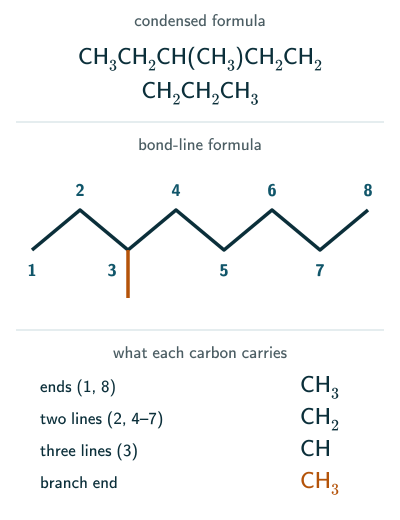
Counting hydrogens. For ordinary neutral tetravalent carbon, with any charges or radicals explicitly shown, in a bond-line drawing, a carbon at a line end has 3 hydrogens, one where two lines meet has 2, where three meet 1, and where four meet none, in each case for single bonds. A double bond counts as two lines and a triple bond as three.
Carbons in a triple bond are sp, with a 180° angle, so the triple line and the next bond are drawn in one straight line. The point where the triple line becomes a single line is still a carbon, even without a bend (NCERT Problem 8.6 (c)).
Three-dimensional representation
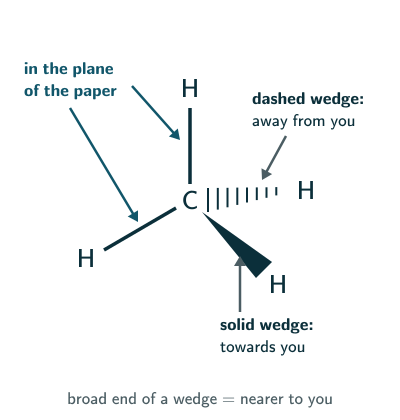
To show the 3-D shape on flat paper, wedges are used (NCERT Section 8.3.2, page 260):
- a normal line (—) is a bond in the plane of the paper;
- a solid wedge is a bond coming out of the paper towards the viewer;
- a dashed wedge is a bond going behind the paper, away from the viewer;
- NCERT uses a perspective-style dashed wedge, broad at the near carbon. Modern IUPAC recommendations put the narrow end at the stereogenic centre for both solid and hashed wedges: solid projects towards the viewer, hashed away. Read an older diagram using its stated convention; do not infer a new stereocentre at the far end from wedge width alone.
For methane, two C–H bonds are drawn in the plane, one as a solid wedge and one as a dashed wedge (NCERT Fig. 8.1, page 260). Together they show the tetrahedral arrangement of the four bonds.
Molecular models are physical aids to seeing 3-D shapes, made of wood, plastic or metal (NCERT box, page 260):
- framework model: only the bonds, not the atoms, so it shows the pattern of bonding;
- ball-and-stick model: balls for atoms and sticks for bonds; for C=C, springs replace the sticks (ball-and-spring model);
- space-filling model: each atom made to its relative size from its van der Waals radius, with no bonds shown, so it shows the volume each atom occupies.
Computer graphics are also used for molecular modelling.
Solved examples
Example 1: From condensed to complete (NCERT Problem 8.4, page 259)
Expand into complete structural formulas: (a) CH3CH2COCH2CH3; (b) CH3CH=CH(CH2)3CH3.
(a) A five-carbon chain. The middle carbon has a double bond to oxygen, C=O, and no hydrogen; the two carbons next to it are CH2; the two ends are CH3. In the complete formula every bond is a dash: each end carbon has three C–H dashes, each CH2 carbon two, and the middle carbon a double dash up to O (NCERT drawing, page 259). With only the C–C and C=O bonds drawn, it reads H3C–CH2–C(=O)–CH2–CH3.
(b) Seven carbons: CH3–CH=CH–CH2–CH2–CH2–CH3. The (CH2)3 unfolds into three CH2 groups; in the complete formula each of their C–H bonds, and those of the =CH– carbons, is drawn as a dash as well.
Answer: (a) C5H10O, 10 hydrogens in all; (b) C7H14, a double bond between carbons 2 and 3. Each carbon ends up with four bonds.
Example 2: Condensed and bond-line formulas (NCERT Problem 8.5, page 259)
Write a condensed formula and describe the bond-line formula for (a) HOCH2CH2CH2CH(CH3)CH(CH3)CH3; (b) N≡C–CH(OH)–C≡N.
(a) Condensed: HO(CH2)3CH(CH3)CH(CH3)2. Bond-line: HO at one end of a zig-zag of six carbons, with a methyl branch on the fourth and on the fifth carbon counting from the OH end.
(b) Condensed: HOCH(CN)2. Bond-line: one carbon carrying OH and two CN groups, written as an upside-down Y: OH on the line going up, NC and CN at the ends of the two lines going down.
Answer: (a) HO(CH2)3CH(CH3)CH(CH3)2; (b) HOCH(CN)2.
Example 3: Reading bond-line formulas (NCERT Problem 8.6, pages 259–260)
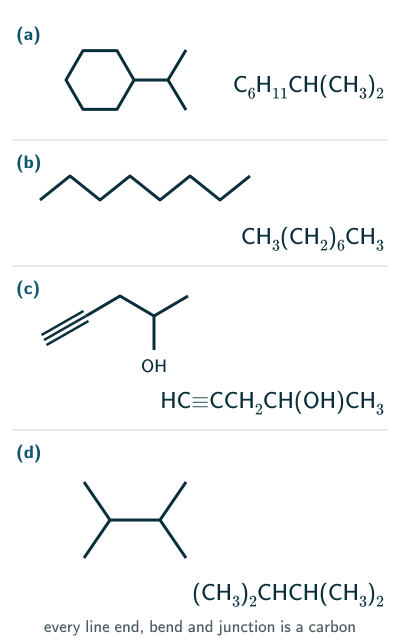
Expand the four bond-line formulas in the figure below to show every carbon and hydrogen.
Count the carbons at ends, bends and junctions, then add hydrogens to make four bonds on each. In (c) the free end of the triple line is ≡CH (4 − 3 = 1 H); the carbon where it meets the single line has 3 + 1 = 4 bonds and no H; then CH2, CH carrying OH, and a CH3 end: 1 + 0 + 2 + 1 + 3 + 1 (OH) = 8 H.
Answer: (a) a cyclohexane ring carrying an isopropyl group, C6H11–CH(CH3)2, C9H18; (b) octane, CH3(CH2)6CH3, C8H18; (c) HC≡C–CH2–CH(OH)–CH3, C5H8O; (d) (CH3)2CH–CH(CH3)2, C6H14.
Example 4: Molecular formula from a bond-line drawing
2-Bromobutane is drawn as a zig-zag of four carbons with Br on the second. Find its molecular formula.
Ends: 2 × CH3. The second carbon has three lines (two carbons and Br), so it is CH. The third carbon has two lines, so it is CH2. Hydrogens: 3 + 1 + 2 + 3 = 9.
Answer: C4H9Br, the same as CH3CHBrCH2CH3.
Common mistakes to avoid
Common mistake
Forgetting the hydrogens in a bond-line formula
For the ordinary neutral carbons in these drawings, the total bond order is four. A bend with two single lines is CH2, not C; a single-line end is CH3.
Common mistake
Counting a double bond as one line
At a carbon with a double bond, the double bond uses two of its four bonds. In CH3CH=CH2 drawn as bond-line, the middle carbon has only one hydrogen.
Common mistake
Thinking the zig-zag is only a drawing style
The zig-zag is not just a drawing habit: it matches the roughly 109.5° angles at each sp3 carbon of a real chain.
Quick revision summary
- Complete formula: every atom and bond; condensed: dashes dropped, repeats as subscripts; bond-line: skeleton only.
- Bond-line rules: a single-line end is CH3, bends and junctions are carbons filled with H to four bonds, heteroatoms written in; rings as polygons.
- 3-D: plain line in the plane, solid wedge towards the viewer, dashed wedge away.
- Models: framework (bonds only), ball-and-stick (ball-and-spring for C=C), space-filling (van der Waals sizes).
Formula sheet
- Hydrogens on a bond-line carbon = 4 − bonds drawn to it (double line = 2, triple line = 3)
- Single bonds only: line end = CH; two lines = CH; three lines = CH; four lines = C
Questions students ask
Is a skeletal formula the same as a bond-line formula?
Yes, a skeletal formula is the same as NCERT’s bond-line formula: both draw the carbon skeleton as a zig-zag of lines, with a carbon at every unlabelled line end and bend, the hydrogens on carbon left out and other atoms such as O, N or Cl written in; some books call it a line-angle formula. The other names match too: a displayed or expanded structural formula is NCERT’s complete structural formula, with every atom and bond drawn, while some books use a plain ‘structural formula’ for a condensed one, such as CH3CH2CH2OH for propan-1-ol.
How do you write the structural formula of ethanol?
Ethanol, C2H6O, has the condensed formula CH3CH2OH (also written C2H5OH), and its complete structural formula draws all eight bonds as dashes: five C–H, one C–C, one C–O and one O–H, with three hydrogens on the first carbon and two on the second. As a bond-line formula it is two lines meeting at an angle with OH written at the far end: the free end is the CH3 carbon and the bend is the CH2 carbon. The two lone pairs on oxygen may be shown or left out.
How is benzene drawn as a bond-line formula?
Benzene, C6H6, is drawn as a hexagon in which every other side is a double line (a Kekulé structure) or as a hexagon with a circle inside, which shows its six π electrons spread evenly round the ring. Each corner is a CH group: in the Kekulé drawing every corner carbon has one single and one double line, three bonds in all, so it carries 4 − 3 = 1 hydrogen. A substituent is written at a corner, so methylbenzene (toluene), C7H8, is the hexagon with a short line, the CH3 group, at one corner.
What is the difference between wedge-dash, sawhorse and Newman projections?
Wedge-dash formulas, sawhorse projections and Newman projections all show a molecule’s 3-D shape on flat paper. A wedge-dash formula draws each bond as a plain line in the plane, a solid wedge towards the viewer or a dashed wedge away; a sawhorse projection draws the C–C bond as a slanting line, seen obliquely, with three bonds at each end; a Newman projection looks straight along the C–C bond, so the front carbon is a point where its three bonds meet and the rear carbon a circle with its bonds drawn from the edge. Sawhorse and Newman projections show the staggered and eclipsed conformations of ethane, NCERT Unit 9, Hydrocarbons.
Practice questions
Try each question first, then open the answer to check your working.
-
Q1. Write a condensed formula for CH3–CH2–CH2–CH2–CH2–CH3.
Show answerHide answer
CH3(CH2)4CH3 (hexane, C6H14).
-
Q2. A bond-line formula is a plain hexagon. What is the compound and its molecular formula?
Show answerHide answer
Cyclohexane. Each of the six corners is a carbon with two lines, so it is CH2: C6H12.
-
Q3. In a wedge-and-dash drawing, what do a solid wedge and a dashed wedge mean?
Show answerHide answer
A solid wedge is a bond coming out of the paper towards the viewer; a dashed wedge is a bond going behind the paper, away from the viewer. Plain lines lie in the plane of the paper.