Qualitative analysis of organic compounds
NCERT Class 11 Chemistry Chapter 8 Section 8.9
Quick answer
Qualitative analysis identifies elements in an organic compound by converting them into detectable products. Sodium fusion can convert nitrogen, sulphur and chlorine, bromine or iodine into ions tested in the extract; carbon and hydrogen can be detected through carbon dioxide and water, and phosphorus through phosphate. Correct reagent treatment and controls are essential to interpret the results.
With your textbook
NCERT Chemistry Part II (Class 11), Chapter 8 “Organic Chemistry – Some Basic Principles and Techniques”, Section 8.9 “Qualitative Analysis of Organic Compounds”, pages 284–285.
Open the official NCERT chapter (PDF, 4.5 MB, ncert.nic.in) (opens in a new tab)
Checked against the 2026-27 reprint on .
How are the elements in an organic compound detected?
Qualitative analysis of organic compounds
Organic compounds contain carbon and almost always hydrogen (CCl4, in Example 4, has none), and may also contain oxygen, nitrogen, sulphur, halogens and phosphorus (NCERT Section 8.9, page 284).
- Carbon and hydrogen are detected by heating the compound with copper(II) oxide: carbon gives CO2 (lime water turns milky) and hydrogen gives water (anhydrous copper sulphate turns blue).
- Nitrogen, sulphur and halogens are detected by Lassaigne’s test: fusing the compound with sodium turns them into the ions CN−, S2− and X−, which are then tested in the sodium fusion extract.
- Phosphorus is oxidised to phosphate and detected with ammonium molybdate.
In plain words: many target elements in an organic compound are covalently bound, so ordinary ion tests may not work directly. Ionic organic compounds and easily ionised groups require interpretation rather than this blanket rule. Each method first turns an element into a simple, recognisable product: carbon into carbon dioxide, nitrogen into cyanide, sulphur into sulphide. Then a familiar test with a clear colour or precipitate shows that element is there.
Detecting carbon and hydrogen
The compound is heated with copper(II) oxide. Carbon is oxidised to carbon dioxide, which turns lime water milky, and hydrogen to water, which turns white anhydrous copper sulphate blue (NCERT Section 8.9.1, page 284):
- C + 2CuO → 2Cu + CO2, then CO2 + Ca(OH)2 → CaCO3↓ + H2O;
- H2 + CuO → Cu + H2O (as NCERT writes it; the hydrogen comes from the compound, so 2H + CuO → Cu + H2O, like the C + 2CuO line, says the same), then 5H2O + CuSO4 (white) → CuSO4·5H2O (blue).
The same oxidation, with the water and carbon dioxide weighed, is used to estimate carbon and hydrogen.
Lassaigne’s test: the sodium fusion extract
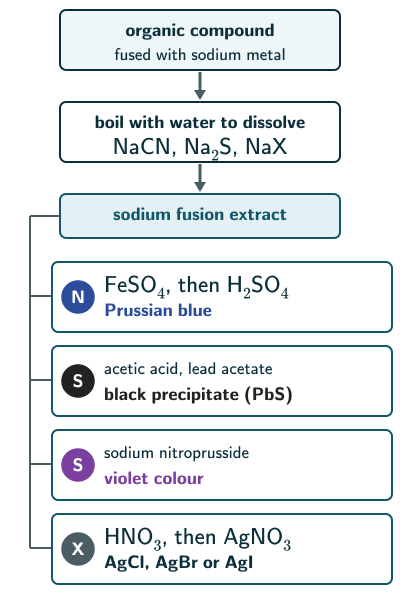
Nitrogen, sulphur and halogens are converted from covalent to ionic form by fusing the compound with sodium metal (NCERT Section 8.9.2, page 284):
- Na + C + N → NaCN (heat);
- 2Na + S → Na2S;
- Na + X → NaX (X = Cl, Br or I).
C, N, S and X come from the organic compound. The fused mass is boiled with distilled water, which dissolves the sodium cyanide, sulphide and halide: this solution is the sodium fusion extract, also called Lassaigne’s extract.
Test for nitrogen
The extract is boiled with iron(II) sulphate and then acidified with concentrated sulphuric acid. With appropriate reagent blanks and successful fusion, a Prussian blue colour indicates nitrogen (pages 284–285). The cyanide first forms sodium hexacyanidoferrate(II); on heating with concentrated sulphuric acid some iron(II) is oxidised to iron(III), which gives iron(III) hexacyanidoferrate(II) (ferriferrocyanide), the Prussian blue:
- 6CN− + Fe2+ → [Fe(CN)6]4−;
- 3[Fe(CN)6]4− + 4Fe3+ + xH2O → Fe4[Fe(CN)6]3·xH2O (Prussian blue).
Test for sulphur
- The extract is acidified with acetic acid and lead acetate is added: a black precipitate of lead sulphide shows sulphur, S2− + Pb2+ → PbS.
- With sodium nitroprusside, a violet colour shows sulphur: S2− + [Fe(CN)5NO]2− → [Fe(CN)5NOS]4− (page 285).
Nitrogen and sulphur together. If both are present, sodium fusion can give sodium thiocyanate, Na + C + N + S → NaSCN. With iron(III) it gives a blood red colour, Fe3+ + SCN− → [Fe(SCN)]2+, rather than Prussian blue if thiocyanate formation has used up the available cyanide. The outcome depends on the fusion conditions and sodium amount. Fusion with excess sodium breaks the thiocyanate up into cyanide and sulphide, NaSCN + 2Na → NaCN + Na2S, which then give their usual tests (page 285).
Test for halogens
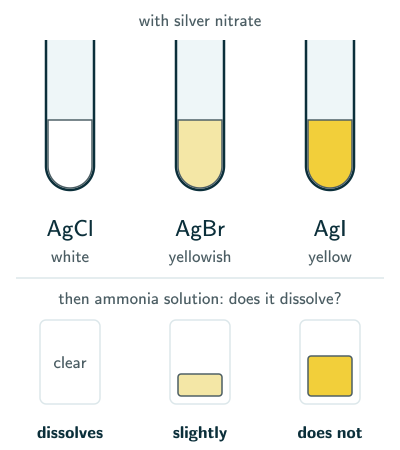
The extract is acidified with nitric acid and treated with silver nitrate, X− + Ag+ → AgX (page 285):
| Precipitate | In ammonia solution | Halogen |
|---|---|---|
| White AgCl | dissolves in dilute ammonia | chlorine |
| Cream/pale yellow AgBr | little dissolves in dilute ammonia; dissolves in concentrated ammonia | bromine |
| Yellow AgI | does not dissolve appreciably even in concentrated ammonia | iodine |
Fluorine is not detected this way: silver fluoride is soluble in water, so no precipitate forms.
If nitrogen or sulphur is also present, the extract is first boiled with concentrated nitric acid to decompose the cyanide and sulphide, which would otherwise interfere with the silver nitrate test. The order of the solubilities in ammonia follows the solubility products of the silver halides, AgCl > AgBr > AgI.
Test for phosphorus
NCERT lists phosphorus with Lassaigne’s test in Section 8.9.2, but it is not tested in the sodium fusion extract: a separate sample is heated with an oxidising agent, sodium peroxide, which oxidises phosphorus to phosphate. The solution is boiled with nitric acid and treated with ammonium molybdate; a yellow colour or precipitate of ammonium phosphomolybdate shows phosphorus (NCERT page 285):
- Na3PO4 + 3HNO3 → H3PO4 + 3NaNO3.
Ammonium phosphomolybdate
H3PO4 + 12(NH4)2MoO4 + 21HNO3
→ (NH4)3PO4·12MoO3
+ 21NH4NO3 + 12H2O
Solved examples
Example 1: Why fuse with sodium? (NCERT Exercise 8.26, page 294)
Explain why an organic compound is fused with sodium before testing for nitrogen, sulphur and halogens.
These elements are held by covalent bonds and do not give ionic tests. Sodium converts them into the ionic compounds NaCN, Na2S and NaX, which dissolve in water and give the usual tests for CN−, S2− and X−.
Answer: to change covalently bound N, S and X into ions that can be detected.
Example 2: Nitric acid before silver nitrate (NCERT Exercise 8.25, page 294)
Why is nitric acid added to the sodium fusion extract before silver nitrate when testing for halogens?
If N or S is present, the extract contains CN− and S2−, which would give precipitates of AgCN (white) and Ag2S (black) with silver nitrate and be mistaken for halides. Acid treatment and heating remove their interference: protonation can release HCN and H2S, and nitric acid can also oxidise these species. This is a supervised fume-cupboard operation, not an open-bench gas test. Nitric acid is used rather than hydrochloric acid, which would itself add Cl− and give AgCl.
Answer: to remove cyanide and sulphide, which would also precipitate with Ag+.
Example 3: Acetic acid, not sulphuric acid (NCERT Exercise 8.31, page 294)
Why is the extract acidified with acetic acid, not sulphuric acid, for the lead acetate test?
Sulphuric acid would precipitate white lead sulphate, PbSO4, with the lead acetate and obscure the result. Acetic acid acidifies without adding a precipitating anion.
Answer: to avoid a white precipitate of PbSO4 that would interfere with the black PbS test.
Example 4: Carbon tetrachloride and silver nitrate (NCERT Exercise 8.29, page 294)
Will CCl4 give a white precipitate of AgCl on heating with silver nitrate?
The chlorine in CCl4 is bound covalently and is not released as Cl− on simply heating with silver nitrate.
Answer: no. Sodium fusion is the method used here to convert it into chloride ions, after which the treated extract gives AgCl.
Example 5: Reading the results
A sodium fusion extract gives a blood red colour with iron(III) chloride but no Prussian blue. With excess sodium in a second fusion, it gives Prussian blue and a black precipitate with lead acetate. What does the compound contain?
The blood red colour is the thiocyanate test, so N and S are both present. With excess sodium the thiocyanate breaks up into NaCN (Prussian blue) and Na2S (black PbS).
Answer: nitrogen and sulphur.
Common mistakes to avoid
Common mistake
Naming the wrong compound as Prussian blue
Prussian blue is iron(III) hexacyanidoferrate(II), Fe4[Fe(CN)6]3 (NCERT Exercise 8.37), not Na4[Fe(CN)6], which forms first and is only pale yellow.
Common mistake
Expecting Prussian blue from every nitrogen compound
In the ordinary test without added carbon, cyanide formation needs carbon as well as nitrogen in the sample. Hydrazine (NH2NH2) and hydroxylamine (NH2OH) have no carbon, so they give no Prussian blue. Diazonium salts lose N2 on heating and can also fail the test.
Common mistake
Expecting Prussian blue when sulphur is also present
With N and S together and insufficient sodium, thiocyanate can form and give a blood-red iron(III) test. Excess sodium favours separate cyanide and sulphide tests; “both elements always mean no blue” is too absolute.
Common mistake
Skipping the nitric acid
Without boiling with nitric acid, cyanide or sulphide in the extract gives a false precipitate with silver nitrate.
Quick revision summary
- C and H: heat with CuO; CO2 turns lime water milky, H2O turns anhydrous CuSO4 blue.
- Lassaigne’s test: fuse with Na; extract contains NaCN, Na2S, NaX.
- N: FeSO4, then conc. H2SO4, Prussian blue Fe4[Fe(CN)6]3.
- S: lead acetate (acetic acid) gives black PbS; nitroprusside gives violet.
- N and S: NaSCN, blood red with Fe3+.
- Halogens: HNO3, then AgNO3; AgCl white (soluble in NH3), AgBr cream/pale yellow (dissolves in concentrated ammonia), AgI yellow (not appreciably soluble).
- P: oxidise to phosphate; ammonium molybdate gives yellow ammonium phosphomolybdate.
Formula sheet
- Na + C + N → NaCN; 2Na + S → NaS; Na + X → NaX
- 3[Fe(CN)] + 4Fe → Fe[Fe(CN)] (Prussian blue)
- S + Pb → PbS (black); X + Ag → AgX
Questions students ask
Which chapter is Lassaigne’s test in, and is it in the JEE Main 2027 and NEET (UG) 2026 syllabuses?
Lassaigne’s test is in Unit 8 of NCERT Class 11 Chemistry Part II, Organic Chemistry – Some Basic Principles and Techniques, Section 8.9.2 (pages 284–285), and it is in both exam syllabuses. JEE Main 2027 (NTA) and NEET (UG) 2026 (NMC) list ‘Qualitative analysis – detection of nitrogen, sulphur, phosphorus and halogens’ under Unit 13, Purification and Characterisation of Organic Compounds, and the ‘detection of extra elements (nitrogen, sulphur, halogens) in organic compounds’ under Unit 20, Principles Related to Practical Chemistry. In school, the CBSE Class 11 practical syllabus for 2026–27 includes detecting nitrogen, sulphur and chlorine in organic compounds.
How is the sodium fusion extract prepared?
In the supervised laboratory procedure, sodium fusion extract is prepared by heating the small quantity of dry sodium specified by the laboratory manual in a fusion tube until it melts, adding a little of the organic compound, heating the tube to red heat and then plunging it, still red hot, into about 10 mL of distilled water in a china dish, where the tube cracks. The contents are boiled for a few minutes and filtered, and the clear filtrate, which holds the sodium cyanide, sulphide and halide, is the extract used for all the tests. Distilled water is essential, because the chloride in tap water would give a false test for chlorine with silver nitrate.
Why is the sodium fusion extract alkaline?
The sodium fusion extract is alkaline because the excess sodium reacts with the water to form sodium hydroxide, 2Na + 2H2O → 2NaOH + H2, and because sodium cyanide and sodium sulphide are salts of the weak acids HCN and H2S, whose anions hydrolyse, CN− + H2O ⇌ HCN + OH−. The alkali must be neutralised before the silver nitrate test, since OH− would precipitate brown silver oxide, Ag2O, which is one more reason the extract is acidified with nitric acid first.
Does urea give Lassaigne’s test for nitrogen?
Yes, urea, NH2CONH2, gives a positive Lassaigne’s test for nitrogen: it contains carbon as well as nitrogen, so fusion with sodium forms sodium cyanide and the extract gives Prussian blue. Aniline, C6H5NH2, glycine, NH2CH2COOH, and nitrobenzene, C6H5NO2, pass the test for the same reason: these compounds supply both carbon and nitrogen for cyanide formation, although decomposition or unsuccessful fusion can cause false negatives.
How do you pronounce Lassaigne’s test?
Lassaigne’s test is said the French way, roughly la-SEN-yuh, with the ‘gn’ like the ‘ny’ in canyon and only a faint final ‘uh’; the name is spelt with a double s and ‘-aigne’ (not Lassagne or Lassaign). It is named after the French chemist Jean Louis Lassaigne, who in 1843 detected nitrogen in organic compounds by fusing them with potassium. Sodium replaced potassium in 1879 and tests for sulphur and halogens were added later, hence the test’s other name, the sodium fusion test.
Practice questions
Try each question first, then open the answer to check your working.
-
Q1. Which colour shows nitrogen in Lassaigne’s test, and what compound causes it (NCERT Exercise 8.37)?
Show answerHide answer
Prussian blue, due to iron(III) hexacyanidoferrate(II), Fe4[Fe(CN)6]3 (option (b) in NCERT’s exercise).
-
Q2. A sodium fusion extract, acidified with nitric acid, gives a yellow precipitate with silver nitrate that does not dissolve in ammonia solution. Which halogen is present?
Show answerHide answer
Iodine: AgI is yellow and insoluble in ammonia solution.
-
Q3. How are carbon and hydrogen detected in an organic compound?
Show answerHide answer
Heat it with copper(II) oxide. Carbon is oxidised to CO2, which turns lime water milky (CaCO3); hydrogen is oxidised to water, which turns white anhydrous copper sulphate blue (CuSO4·5H2O).