Redox reactions as electron transfer
NCERT Class 11 Chemistry Chapter 7 Section 7.2
Quick answer
Oxidation loses electrons and reduction gains them; the oxidising agent accepts electrons and the reducing agent donates them. Half reactions balance the electrons lost and gained, while oxidation numbers extend this bookkeeping to covalent compounds. Under comparable aqueous conditions zinc reduces copper ions and copper reduces silver ions, giving the tendency Zn > Cu > Ag; concentrations and kinetics can affect observations.
With your textbook
NCERT Chemistry Part II (Class 11), Chapter 7 “Redox Reactions”, Section 7.2 “Redox Reactions in Terms of Electron Transfer Reactions”, pages 237–239.
Open the official NCERT chapter (PDF, 1.9 MB, ncert.nic.in) (opens in a new tab)
Checked against the 2026-27 reprint on .
What is redox in terms of electrons?
Oxidation and reduction as electron transfer
Oxidation : Loss of electron(s) by any species. Reduction : Gain of electron(s) by any species. Oxidising agent : Acceptor of electron(s). Reducing agent : Donor of electron(s).
NCERT Chemistry Part II (Class 11), Section 7.2, page 237
- A redox reaction can be split into two half reactions, one showing the loss of electrons (oxidation) and one the gain (reduction). Added together, they give the overall reaction.
- The electrons lost by the reducing agent are exactly the electrons gained by the oxidising agent.
In plain words: when sodium burns in chlorine, each sodium atom hands one electron to chlorine, giving Na+ and Cl− ions. Sodium, which loses the electron, is oxidised; chlorine, which gains it, is reduced. Because an electron cannot vanish, one substance can lose electrons only if another takes them, which is why oxidation and reduction always go together.
From the classical idea to electron transfer
By the classical idea, sodium is oxidised in each of these reactions, because oxygen or a more electronegative element is added to it, while chlorine, oxygen and sulphur are reduced, because the electropositive element sodium is added to them (NCERT Section 7.2, page 237):
- 2Na(s) + Cl2(g) → 2NaCl(s)
- 4Na(s) + O2(g) → 2Na2O(s)
- 2Na(s) + S(s) → Na2S(s)
The Na2O equation is the specified oxide-formation example, not a prediction that burning sodium always gives only this oxide; peroxide can form too. All three specified products are ionic compounds (see the ionic bond), better written Na+Cl−, (Na+)2O2− and (Na+)2S2−. The charges show what really happened: each sodium atom loses one electron and the non-metal takes them. Two electrons move in 2Na + Cl2 and in 2Na + S, but four move in 4Na + O2, because each of the two oxygen atoms takes two.
Half reactions
For the formation of sodium chloride, the two steps are (page 237):
Half reactions for sodium chloride
Oxidation: 2Na → 2Na+ + 2e−
Reduction: Cl2 + 2e− → 2Cl−
Sum: 2Na + Cl2 → 2Na+Cl−, or 2NaCl
Each step is a half reaction: it shows the electrons explicitly. On adding the two, the 2e− on each side cancel, because every electron lost is gained. The displayed state-free half reactions are electron bookkeeping. If gaseous ions are explicitly used as NCERT does, lattice formation is an additional step needed to reach the solid; states cannot be ignored in a thermochemical or electrode-potential calculation.
Sodium, which is oxidised, is the reducing agent: it donates electrons and so reduces chlorine. Chlorine, which is reduced, is the oxidising agent: it accepts electrons and so oxidises sodium. NCERT points out that the electron definitions were reached by matching each species’ classical behaviour with its electron transfer (page 237), so the two views agree wherever both can be used.
The electron view also settles the case that troubled the classical idea, 2Na + H2 → 2NaH: sodium hydride is ionic, Na+H−, so sodium loses electrons and hydrogen gains them (NCERT Problem 7.2, Example 1 below).
Competitive electron transfer reactions
Zinc in copper nitrate solution. Place a strip of zinc in aqueous copper nitrate for about an hour. The strip becomes coated with reddish copper and the blue colour of the solution, due to Cu2+, fades away (NCERT Section 7.2.1, Fig. 7.1, page 238). Passing hydrogen sulphide through the colourless solution and making it alkaline with ammonia gives white zinc sulphide, ZnS, which shows that Zn2+ ions have formed. The reaction is
Zn(s) + Cu2+(aq) → Zn2+(aq) + Cu(s)
The nitrate ions take no part, so they are left out. Zinc loses two electrons and is oxidised; the copper ion gains them and is reduced.
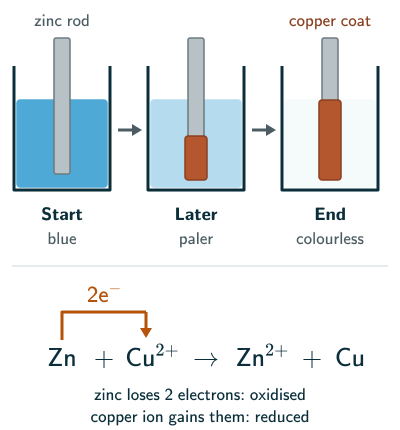
The reverse is negligible under ordinary conditions. A strip of copper in zinc sulphate solution shows no visible change. Even the very sensitive test with hydrogen sulphide, which would give black copper sulphide, CuS, finds no Cu2+. So the equilibrium for the zinc–copper reaction lies very far towards Zn2+ and Cu (page 238).
Copper in silver nitrate solution. The solution slowly turns blue and silver deposits on the copper rod (NCERT Fig. 7.2, pages 238–239):
Cu(s) + 2Ag+(aq) → Cu2+(aq) + 2Ag(s)
Copper releases two electrons, one to each of two silver ions, and the equilibrium again greatly favours the products.
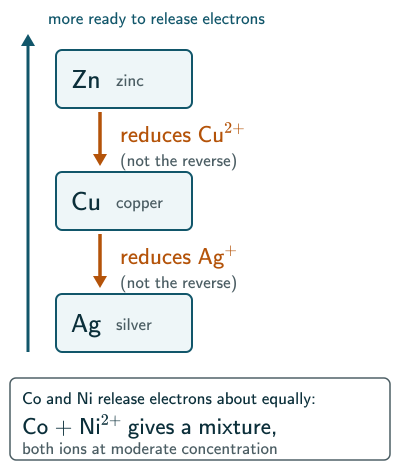
Cobalt in nickel sulphate solution. For Co(s) + Ni2+(aq) ⇌ Co2+(aq) + Ni(s), tests at equilibrium find both Ni2+ and Co2+ at moderate concentrations: neither side is greatly favoured, because cobalt and nickel release electrons about equally readily (pages 238–239).
Electron-releasing tendency and the activity series
Zinc releases electrons to copper ions, and copper releases electrons to silver ions, so the tendency of these metals to release electrons is in the order Zn > Cu > Ag (page 239). Under comparable aqueous conditions, a higher metal is thermodynamically favoured to reduce ions of a lower one. Concentrations, complex formation, oxide films and competing reactions with water can change observed behaviour; the series predicts tendency, not rate. Careful: in NCERT’s table of standard electrode potentials (Table 7.1, page 251), the best electron releasers, such as Li, K and Na, are at the bottom, so there a metal reduces the ions of metals listed above it. NCERT compares this competition for electrons with the competition among acids for releasing protons. Extended to many metals, the list becomes the metal activity series, or electrochemical series. The same competition is used in galvanic cells, in which a redox reaction is the source of electrical energy (page 239).
Solved examples
Example 1: Sodium hydride (NCERT Problem 7.2, pages 237–238)
Justify that 2Na(s) + H2(g) → 2NaH(s) is a redox change.
Sodium hydride is ionic, Na+H−, so the half reactions are
- 2Na → 2Na+ + 2e− (loss of electrons);
- H2 + 2e− → 2H− (gain of electrons).
Answer: Sodium is oxidised and hydrogen is reduced, so the reaction is a redox change. Sodium is the reducing agent and hydrogen the oxidising agent.
Example 2: Magnesium and chlorine
Write the half reactions for Mg + Cl2 → MgCl2 and name the oxidising agent.
Magnesium chloride is Mg2+(Cl−)2. Oxidation: Mg → Mg2+ + 2e−. Reduction: Cl2 + 2e− → 2Cl−. The two electrons cancel on adding.
Answer: Chlorine accepts the electrons, so it is the oxidising agent; magnesium is the reducing agent.
Example 3: Will it react?
Using the order Zn > Cu > Ag, predict whether a reaction occurs when (a) a zinc rod is placed in silver nitrate solution; (b) a silver wire is placed in copper sulphate solution.
(a) Zinc is above silver, so it gives electrons to Ag+: Zn + 2Ag+ → Zn2+ + 2Ag. (b) Silver is below copper, so it cannot reduce Cu2+.
Answer: (a) Yes, silver deposits on the zinc; (b) no visible reaction.
Example 4: Counting the electrons
When a zinc strip is placed in excess copper nitrate solution, 6.54 g of zinc dissolves. How many moles of electrons pass from zinc to copper ions, and what mass of copper is deposited? (Zn = 65.4, Cu = 63.5 g mol−1)
Moles of Zn = 6.54/65.4 = 0.100 mol (see molar mass). Each Zn gives 2e−, so 0.200 mol of electrons. Each Cu2+ takes 2e−, so 0.100 mol Cu forms: 0.100 × 63.5 = 6.35 g. If all deposited copper remains attached and there are no other losses, the strip is only 6.54 − 6.35 = 0.19 g lighter.
Answer: 0.200 mol of electrons (about 1.20 × 10²³ electrons); 6.35 g of copper.
Common mistakes to avoid
Common mistake
Swapping loss and gain
Oxidation is loss of electrons, reduction is gain. A common way to remember it: OIL RIG (Oxidation Is Loss, Reduction Is Gain).
Common mistake
Calling the reducing agent “reduced”
The reducing agent gives away electrons, so it is itself oxidised. In Zn + Cu2+, zinc is the reducing agent and is oxidised.
Common mistake
Copying the sodium oxide scheme as printed
NCERT’s electron-transfer scheme on page 237 writes 2Na + O2 → (Na+)2O2− with 2e−, and oxygen does not balance. Write 4Na + O2 → 2(Na+)2O2−: 4e− are lost and 4e− gained.
Common mistake
Adding half reactions without matching electrons
Before adding, multiply the half reactions so that the electrons lost equal the electrons gained. For aluminium and copper ions, 2Al → 2Al3+ + 6e− and 3Cu2+ + 6e− → 3Cu give 2Al + 3Cu2+ → 2Al3+ + 3Cu.
Quick revision summary
- Oxidation: loss of electrons; reduction: gain of electrons.
- Oxidising agent: electron acceptor (is reduced); reducing agent: electron donor (is oxidised).
- Half reactions show the electrons; electrons lost = electrons gained.
- Zn + Cu2+ and Cu + 2Ag+ go almost completely; Co + Ni2+ gives a mixture.
- Electron-releasing tendency: Zn > Cu > Ag; extended, this is the activity (electrochemical) series.
Formula sheet
- Oxidation = loss of electrons; reduction = gain of electrons
- Oxidising agent accepts electrons; reducing agent donates electrons
- Electrons lost = electrons gained
- Electron-releasing tendency: Zn > Cu > Ag
Questions students ask
Why is oxidation called loss of electrons?
Oxidation is called loss of electrons because combining with oxygen, the original meaning of oxidation, takes electrons away from the other element: when aluminium burns, 4Al + 3O2 → 2Al2O3, each aluminium atom gives three electrons to the more electronegative oxygen and becomes Al3+. Chemists saw the same loss of electrons when metals react with chlorine or sulphur instead, so the name oxidation was extended to every loss of electrons, with or without oxygen, and reduction to every gain. The word is historical: the modern definition counts the electrons, not the oxygen.
Is every chemical reaction a redox reaction?
No, a reaction is a redox reaction only if electrons are transferred or shifted between atoms, which shows up as a change in the oxidation number of at least one element; acid–base neutralisations and most precipitation reactions are not redox. In HCl + NaOH → NaCl + H2O a proton passes from the acid to the base, and in AgNO3 + NaCl → AgCl + NaNO3 the ions only change partners: every element keeps its oxidation number (H +1, O −2, Na +1, Cl −1, Ag +1, N +5). A free element on either side usually signals a redox reaction, but the sure test is a change of oxidation number: 3O2 → 2O3, oxygen to ozone, is not redox.
Why are metals good reducing agents?
Many reactive metals are good reducing agents because forming their ions is favourable in the reaction medium; noble metals are much weaker. A typical oxidation is Ca → Ca2+ + 2e−. The alkali metals, with one ns electron and the lowest ionisation enthalpies of their periods, are among the strongest; by E⊖ in water lithium leads (−3.05 V) despite its higher ionisation enthalpy, because its small Li+ ion is so strongly hydrated. Non-metals such as oxygen and the halogens, one or two electrons short of an octet, are typically oxidising agents, though hydrogen and carbon are good reducing agents.
Are electrons transferred or shared in a redox reaction?
Electron transfer can occur between ions or at electrodes without making a new ionic compound, for example Fe3+ + e− → Fe2+. Formation of KBr is conveniently described by ionic electron bookkeeping, while N2 + 3H2 → 2NH3 forms polar covalent bonds. Oxidation numbers assign their bonding electrons formally to the more electronegative atom; they are not measurements of complete physical charge transfer. Such reactions still count as redox, because chemists treat the shift as complete and track it with oxidation numbers: nitrogen goes from 0 to −3 and is reduced, and hydrogen from 0 to +1 and is oxidised.
Practice questions
Try each question first, then open the answer to check your working.
-
Q1. Write the two half reactions for 4Na(s) + O2(g) → 2Na2O(s) and show that the electrons balance.
Show answerHide answer
Oxidation: 4Na → 4Na+ + 4e−. Reduction: O2 + 4e− → 2O2−. Four electrons are lost and four gained; adding gives 4Na + O2 → 2(Na+)2O2−.
-
Q2. In 2Al(s) + 3Cu2+(aq) → 2Al3+(aq) + 3Cu(s), how many electrons are transferred, and which species is the oxidising agent?
Show answerHide answer
Each Al loses 3e−, so 2Al lose 6e−; each Cu2+ gains 2e−, so 3Cu2+ gain 6e−. Six electrons are transferred. Cu2+ accepts them, so it is the oxidising agent.
-
Q3. A silver spoon is left in copper nitrate solution. Does the solution change? Explain.
Show answerHide answer
No visible displacement is expected under ordinary conditions. Silver releases electrons less readily than copper (Zn > Cu > Ag), so reduction of Cu2+ by silver is unfavourable under comparable conditions; the reverse reaction, Cu + 2Ag+, is the one that goes.