Redox reactions and electrode processes
NCERT Class 11 Chemistry Chapter 7 Section 7.4
Quick answer
A galvanic cell separates oxidation and reduction so electrons flow through an external wire while ions complete the circuit. In the Daniell cell zinc is the negative anode and copper the positive cathode, giving a standard voltage of 1.10 V. Standard electrode potentials use unit activities at a specified temperature; actual reaction direction also depends on composition and observed rates depend on kinetics.
With your textbook
NCERT Chemistry Part II (Class 11), Chapter 7 “Redox Reactions”, Section 7.4 “Redox Reactions and Electrode Processes”, pages 249–251.
Open the official NCERT chapter (PDF, 1.9 MB, ncert.nic.in) (opens in a new tab)
Checked against the 2026-27 reprint on .
What are electrode processes?
Redox couple and electrode potential
A redox couple is defined as having together the oxidised and reduced forms of a substance taking part in an oxidation or reduction half reaction.
NCERT Chemistry Part II (Class 11), Section 7.4, page 250
- A couple is written oxidised form/reduced form, for example Zn2+/Zn and Cu2+/Cu.
- When the two half reactions of a redox reaction take place in separate vessels, the electrons travel through a wire: this is a galvanic cell, such as the Daniell cell.
- The potential of each electrode measured under standard conditions, against the hydrogen electrode taken as 0.00 V, is its standard electrode potential, E⊖ (also written E°).
In plain words: drop zinc into copper sulphate solution and the electrons jump straight from zinc atoms to copper ions, so no useful external electrical work is collected; the released energy largely heats the surroundings. Put the zinc and the copper ions in separate beakers, join them with a wire and an ionic connection, and the electrons flow through the wire to get there: the reaction now drives an electric current. How strongly each couple pushes or pulls electrons is measured by its electrode potential.
From direct to indirect electron transfer
When a zinc rod is dipped in copper sulphate solution, zinc is oxidised to zinc ions and copper ions are reduced to copper by direct transfer of electrons, and heat is evolved (NCERT pages 249–250). To make the transfer indirect, the zinc must be kept away from the copper sulphate solution:
- one beaker holds copper sulphate solution with a copper strip;
- the other holds zinc sulphate solution with a zinc strip.
At the surface of each metal, both the oxidised and the reduced forms of the same species are present, Cu2+ and Cu in one beaker, Zn2+ and Zn in the other. These are the two redox couples. The slash here names a redox couple; in full cell notation a vertical line marks a phase boundary, and the sequence follows the cell layout. Couples are conventionally named with the oxidised form first: Zn2+/Zn and Cu2+/Cu (page 250).
The Daniell cell
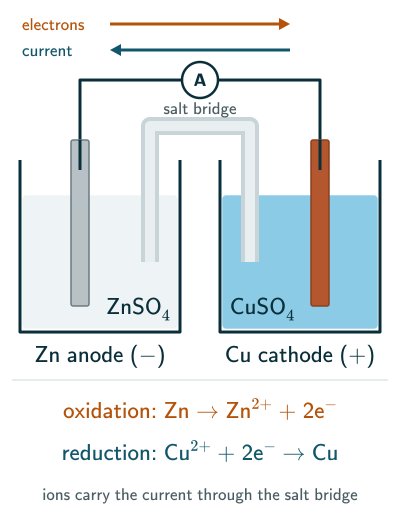
The two beakers stand side by side, and their solutions are joined by a salt bridge. This is a U-tube holding a solution of potassium chloride or ammonium nitrate, usually set to a jelly by boiling with agar-agar and cooling. It connects the solutions electrically while minimising bulk mixing. The zinc and copper rods are joined by a metal wire through an ammeter and, in NCERT’s set-up, a switch (NCERT Fig. 7.3, page 250). This set-up is the Daniell cell.
- With the switch off, no sustained external current flows; interfacial charge equilibration and possible side reactions need not stop.
- With the switch on, electrons pass from Zn to Cu2+ not directly but through the wire, and the ammeter shows a current.
- Inside the cell, the circuit is completed by ions moving through the salt bridge: anions move into the zinc beaker, where Zn2+ ions are forming, and cations into the copper beaker, where Cu2+ ions are being removed, so each solution stays electrically neutral. Potassium chloride and ammonium nitrate are strong electrolytes, so the bridge is full of mobile ions.
Zinc is oxidised at the zinc rod, the anode, Zn → Zn2+ + 2e−, which therefore becomes the negative electrode. Copper ions take up the electrons at the copper rod, the cathode, Cu2+ + 2e− → Cu, the positive electrode. The electrons flow through the wire from zinc to copper; the conventional current flows the opposite way, from copper to zinc (page 250).
Electrode potentials
A current can flow only if there is a potential difference between the two rods, now called electrodes. The potential of each electrode is its electrode potential (page 250). The standard electrode potential, E⊖, refers to unit activities and a specified temperature, commonly 298 K in tables. For an ideal dilute solute, activity is approximated by concentration divided by its standard concentration; a gas uses its 1 bar standard state, and a pure solid or liquid has unit activity. NCERT uses the older 1 atm reference; the pressure-reference correction is small for the examples here but depends on the half reaction.
By convention, the standard hydrogen electrode, 2H+ + 2e− → H2(g), has E⊖ = 0.00 V. Each E⊖ measures the tendency of the couple to stay in its oxidised or its reduced form (pages 250–251):
- a negative E⊖ means its reduced form is a stronger reducing agent than H2 under standard conditions;
- a positive E⊖ means its oxidised form is a stronger oxidising agent than H+ under standard conditions; correspondingly its reduced form is a weaker reducing agent than H2.
The table of standard electrode potentials
NCERT Table 7.1 (page 251) lists reductions, oxidised form + ne− → reduced form, at 298 K. Some of its values:
| Couple | E⊖/V |
|---|---|
| F2/F− | +2.87 |
| MnO4−/Mn2+ (acid) | +1.51 |
| Cl2/Cl− | +1.36 |
| Cr2O72−/Cr3+ (acid) | +1.33 |
| Br2/Br− | +1.09 |
| Ag+/Ag | +0.80 |
| Fe3+/Fe2+ | +0.77 |
| I2/I− | +0.54 |
| Cu2+/Cu | +0.34 |
| H+/H2 | 0.00 |
| Pb2+/Pb | −0.13 |
| Ni2+/Ni | −0.25 |
| Fe2+/Fe | −0.44 |
| Zn2+/Zn | −0.76 |
| Al3+/Al | −1.66 |
| Mg2+/Mg | −2.36 |
| Na+/Na | −2.71 |
| K+/K | −2.93 |
| Li+/Li | −3.05 |
Going up the table, the oxidised forms on the left become stronger oxidising agents, with fluorine the strongest among these listed couples. Going down, the reduced forms become stronger reducing agents, with lithium the strongest among those listed under the specified aqueous standard conditions (page 251).
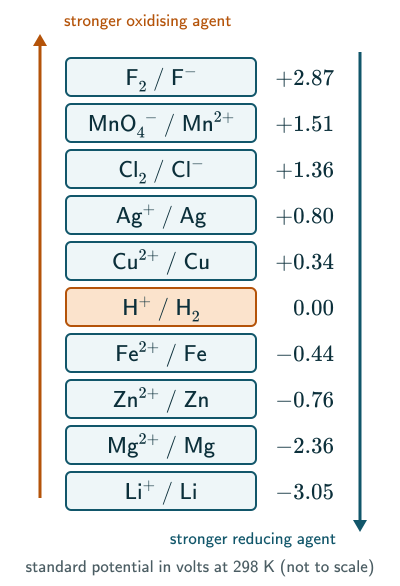
Using the table. A reaction between the oxidised form of one couple and the reduced form of another has a favourable standard-state Gibbs change if the first couple has the higher E⊖. Actual reaction direction follows the actual cell potential, which depends on activities; surface films, kinetics and competing reactions also matter. Copper (Cu2+/Cu, +0.34 V) is oxidised by Ag+ (+0.80 V) but not by H+ (0.00 V), which is why copper does not give hydrogen with dilute hydrochloric acid while zinc (−0.76 V) does. This is the same order of electron-releasing tendency, Zn > Cu > Ag, that NCERT Section 7.2.1 found from displacement reactions. Note that in this table the best reducing agents are at the bottom.
In Class 12 you will find the voltage of a cell from the two potentials, E⊖cell = E⊖cathode − E⊖anode. For the Daniell cell this is 0.34 − (−0.76) = 1.10 V. Both values are reduction potentials read straight from the table; do not change the sign of the anode’s value before subtracting. A positive E⊖cell means ΔG° is negative. In Example2(d), 0.77 − 0.80 = −0.03 V makes ΔG° positive, but the reaction can still proceed from a mixture with sufficiently low product activities.
Solved examples
Example 1: Reading the Daniell cell
In the Daniell cell, name the anode and the cathode, their signs, the reaction at each, and the direction of electron flow in the wire. Find E⊖cell from NCERT Table 7.1.
Zinc has the lower E⊖ (−0.76 V), so it is oxidised: Zn → Zn2+ + 2e− at the anode, which is negative. At the copper cathode, positive, Cu2+ + 2e− → Cu.
Answer: Electrons flow through the wire from zinc to copper; E⊖cell = 0.34 − (−0.76) = 1.10 V.
Example 2: Which reactions are feasible? (NCERT Exercise 7.26, page 254)
Using NCERT Table 7.1, predict whether the forward standard-state reaction is favourable: (a) Fe3+ and I−; (b) Ag+ and Cu; (c) Fe3+ and Cu; (d) Ag and Fe3+; (e) Br2 and Fe2+.
Compare the E⊖ of the oxidant’s couple with that of the reductant’s couple.
- (a) Fe3+/Fe2+ +0.77 > I2/I− +0.54: yes, 2Fe3+ + 2I− → 2Fe2+ + I2.
- (b) Ag+/Ag +0.80 > Cu2+/Cu +0.34: yes, 2Ag+ + Cu → 2Ag + Cu2+.
- (c) +0.77 > +0.34: yes, 2Fe3+ + Cu → 2Fe2+ + Cu2+.
- (d) Fe3+ would have to oxidise Ag, but +0.77 < +0.80: unfavourable under standard conditions. It can still react if Ag+ and Fe2+ activities are initially low; ΔE° = −0.03 V gives K ≈ 0.31 at 298 K, not zero.
- (e) Br2/Br− +1.09 > +0.77: yes, Br2 + 2Fe2+ → 2Br− + 2Fe3+.
Answer: All except (d) have positive standard cell potential. This is the textbook standard-state comparison, not a claim that (d) never reacts. (NCERT’s exercise refers to “Table 8.1”; the table is Table 7.1.)
Example 3: The order of displacement (NCERT Exercise 7.28, page 255)
Arrange Al, Cu, Fe, Mg and Zn in the order in which they displace each other from solutions of their salts.
Each metal can displace those with higher E⊖: Mg −2.36, Al −1.66, Zn −0.76, Fe −0.44, Cu +0.34 V.
Answer: Mg > Al > Zn > Fe > Cu is the standard thermodynamic order for these couples. Displacement to the right is favourable under comparable conditions; passivation (notably Al), concentrations and competing water reactions can affect what is observed.
Example 4: A zinc–silver cell (NCERT Exercise 7.30, page 255)
Depict the galvanic cell for Zn(s) + 2Ag+(aq) → Zn2+(aq) + 2Ag(s), and state which electrode is negative, what carries the current and the reaction at each electrode.
A zinc rod in a zinc salt solution and a silver rod in silver nitrate solution, joined by a wire and a salt bridge: Zn | Zn2+(aq) || Ag+(aq) | Ag, where || marks the salt bridge.
Answer: The zinc electrode is negative (anode: Zn → Zn2+ + 2e−); silver is positive (cathode: Ag+ + e− → Ag). Electrons carry the current in the wire and ions carry it in the solutions and salt bridge. E⊖cell = 0.80 − (−0.76) = 1.56 V. The equation doubles the silver reaction, but E⊖ does not double.
Common mistakes to avoid
Common mistake
Mixing up the signs of the electrodes
In a galvanic cell such as the Daniell cell, the anode (oxidation) is negative and the cathode (reduction) is positive. The anode is always where oxidation happens. In an electrolytic cell, as in Q9, the anode is positive, because it is joined to the positive terminal of the supply; oxidation still happens there.
Common mistake
Drawing current and electrons the same way
Electrons flow in the wire from anode to cathode; the conventional current in the wire flows from cathode to anode; inside the cell, ions carry it.
Common mistake
Multiplying *E*<sup>⊖</sup> by the coefficients
Writing 2Ag+ + 2e− → 2Ag does not change E⊖, which stays +0.80 V. An electrode potential does not depend on how many times the equation is written.
Common mistake
Expecting the best reducing agents at the top
NCERT’s table lists reductions with the strongest oxidising agent, F2, at the top, so the strongest reducing agents, such as Li and K, are at the bottom.
Quick revision summary
- Redox couple: oxidised and reduced forms together, written oxidised/reduced (Zn2+/Zn).
- Daniell cell: a zinc rod in ZnSO4 and a copper rod in CuSO4 joined by a wire and a salt bridge; anode Zn (−), cathode Cu (+); electrons from Zn to Cu through the wire.
- Standard electrode potential: unit activities, gas standard pressure 1 bar (NCERT: 1 atm), specified temperature (table: 298 K); H+/H2 = 0.00 V by convention.
- More positive E⊖: stronger oxidising agent (F2); more negative: stronger reducing agent (Li).
- The oxidant’s couple having higher E⊖ gives favourable standard-state driving force; actual direction depends on activities.
Formula sheet
- E⊖ of H+/H2 = 0.00 V by convention
- Higher E⊖: stronger oxidising agent; lower E⊖: stronger reducing agent
- E⊖(cell) = E⊖(cathode) − E⊖(anode); Daniell cell 1.10 V
Questions students ask
Is a Daniell cell the same as a galvanic cell?
A Daniell cell is one particular galvanic cell, the zinc–copper cell Zn | Zn2+(aq) || Cu2+(aq) | Cu, while galvanic cell (also called voltaic cell) is the general name for any cell in which a spontaneous redox reaction produces electrical energy. So every Daniell cell is a galvanic cell, but not every galvanic cell is a Daniell cell: compatible half-cells with different actual electrode potentials, such as Pb2+/Pb and Ag+/Ag, can make one when a wire and suitable ionic connection complete the circuit. The opposite device is an electrolytic cell, in which an external supply drives a non-spontaneous redox reaction, as in the electrolysis of molten sodium chloride.
Why is the standard electrode potential of the hydrogen electrode zero?
The standard hydrogen electrode has E⊖ = 0.00 V by convention, not by measurement, because the potential of a single electrode cannot be measured on its own: a voltmeter can only measure the difference between two electrodes. Chemists therefore chose one reference, platinum in contact with H2 gas at 1 bar and H+ ions at unit activity, assigned it zero at every temperature, and quote every other standard electrode potential as the voltage of a cell made with it. So Al3+/Al at −1.66 V means that a standard aluminium electrode is 1.66 V negative with respect to the hydrogen electrode.
Why is KCl or KNO3 used in a salt bridge?
A salt bridge is filled with KCl, KNO3 or NH4NO3 because the cation and the anion of each salt move at almost the same speed, so they carry nearly equal shares of the current and the extra potential that forms where two solutions meet, the liquid junction potential, stays very small. The salt must also not react with either solution. KCl is therefore avoided when a beaker contains Ag+, Pb2+ or Hg22+ ions, which would precipitate as chlorides, and KNO3 or NH4NO3 is used instead.
What is the difference between electrode potential and cell potential?
Electrode potential belongs to a single electrode, one couple such as Cu2+/Cu, and is measured against the standard hydrogen electrode, while cell potential, or emf, is the difference between the potentials of the two electrodes of a cell when no current is drawn: E⊖cell = E⊖cathode − E⊖anode. For a cell made from Mg2+/Mg (−2.36 V) and Cu2+/Cu (+0.34 V), magnesium is the anode and E⊖cell = 0.34 − (−2.36) = 2.70 V. How the emf changes with concentration, through the Nernst equation, is Class 12 Electrochemistry.
What is the difference between the activity series and the electrochemical series?
In NCERT Class 11 the activity series and the electrochemical series are one list under two names, but many books separate them: the activity series ranks metals by how vigorously they react, and the electrochemical series ranks couples of metals and non-metals by standard electrode potential, from F2/F− to Li+/Li. The orders mostly agree, as a lower E⊖ means a stronger reducing agent. They differ where speed matters: lithium has the most negative E⊖ yet reacts with water more gently than sodium, as E⊖ shows how far a reaction goes, not how fast.
Is electrochemistry in Class 11 or Class 12?
Electrochemistry is mainly a Class 12 chapter: NCERT Class 12 Chemistry Part I, Unit 2, covers galvanic and electrolytic cells, the Nernst equation, conductance, batteries and fuel cells. Class 11 introduces it at the end of Redox Reactions, in Section 7.4, with redox couples, the Daniell cell and standard electrode potentials. The JEE Main 2027 and NEET (UG) 2026 syllabuses join both parts in one unit, Unit 7: Redox Reactions and Electrochemistry, so Class 11 redox and Class 12 electrochemistry are best revised together.
Practice questions
Try each question first, then open the answer to check your working.
-
Q1. Which is the stronger reducing agent, zinc or iron? Use NCERT Table 7.1.
Show answerHide answer
Zinc: Zn2+/Zn is −0.76 V, more negative than Fe2+/Fe, −0.44 V, so zinc gives up electrons more readily.
-
Q2. Why does zinc give hydrogen with dilute hydrochloric acid, but copper does not?
Show answerHide answer
H+/H2 is 0.00 V. Zn2+/Zn (−0.76 V) is below it, so zinc can reduce H+ to H2. Cu2+/Cu (+0.34 V) is above it, so copper cannot. Copper does dissolve in nitric acid, but there the oxidant is nitrate, NO3−/NO (+0.97 V in NCERT Table 7.1), not H+, and no hydrogen is given off.
-
Q3. In the Daniell cell, what is the job of the salt bridge, and what happens if it is removed?
Show answerHide answer
It completes the circuit inside the cell by the movement of ions, without letting the solutions mix, and keeps each solution electrically neutral. Without it, charge builds up in the beakers, sustained current rapidly ceases and the net cell reaction is arrested; a brief charging transient can occur.