General introduction to organic chemistry
NCERT Class 11 Chemistry Chapter 8 Section 8.1
Quick answer
Organic chemistry studies carbon compounds, whose variety arises from strong carbon–carbon bonding, catenation and bonding to other elements. Wöhler’s laboratory synthesis of urea in 1828, followed by other syntheses, helped overturn the idea that organic substances required a special vital force. Some simple carbon compounds are conventionally treated as inorganic.
With your textbook
NCERT Chemistry Part II (Class 11), Chapter 8 “Organic Chemistry – Some Basic Principles and Techniques”, Section 8.1 “General Introduction”, pages 256–257.
Open the official NCERT chapter (PDF, 4.5 MB, ncert.nic.in) (opens in a new tab)
Checked against the 2026-27 reprint on .
What is organic chemistry?
Organic chemistry
Organic chemistry is the branch of chemistry that studies the compounds of carbon, chiefly those in which carbon is bonded to carbon and to hydrogen, oxygen, nitrogen, sulphur, phosphorus and the halogens (NCERT Unit 8 opening and Section 8.1, page 256).
- Carbon can form covalent bonds with other carbon atoms, building chains and rings: this property is called catenation.
- Organic compounds were once thought to need a vital force found only in living things. Wöhler’s synthesis of urea in 1828, and later the syntheses of acetic acid (Kolbe, 1845) and methane (Berthelot, 1856), showed that they can be made in the laboratory from inorganic substances.
In plain words: the chemistry of living things, from the DNA that carries genetic information to the proteins in our blood, muscles and skin, is mostly the chemistry of carbon compounds. So are clothes, fuels, polymers such as plastics, dyes and medicines (NCERT page 256). Carbon is special because its atoms join one another in long chains and rings while also bonding to a few other elements, which gives an enormous variety of compounds.
Carbon and catenation
Carbon forms covalent bonds with other carbon atoms, a property called catenation, and also with hydrogen, oxygen, nitrogen, sulphur, phosphorus and the halogens. Compounds built this way are studied as organic chemistry (page 256). Carbon can do this so well because it is tetravalent: with four valence electrons it normally forms four covalent bonds in neutral, closed-shell compounds (see hybridisation of carbon). Its small atom also makes strong C–C bonds.
NCERT opens the unit by saying that catenation was learnt in the previous unit. In the current book the previous unit is Redox Reactions, which does not cover catenation. The sentence is left over from an earlier order of units, so the idea is explained here instead.
From vital force to laboratory synthesis
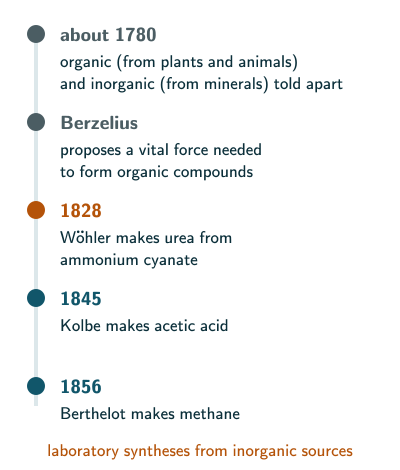
Around 1780, chemists began to separate organic compounds, obtained from plants and animals, from inorganic compounds, prepared from mineral sources (NCERT page 256). The Swedish chemist Berzelius (spelt Berzilius in NCERT) proposed that a vital force in living things was needed to form organic compounds.
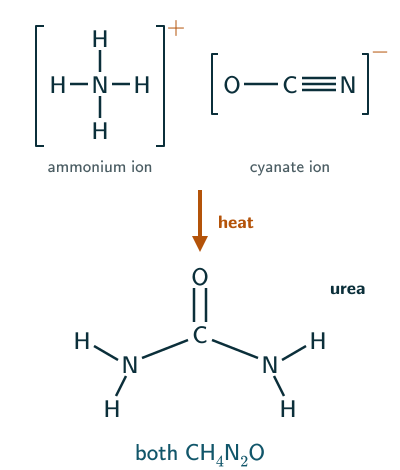
In 1828, Friedrich Wöhler (written F. Wohler in NCERT, without the umlaut) made urea, a typical organic compound found in urine, by heating ammonium cyanate, an inorganic salt:
Wöhler’s synthesis of urea
NH4CNO (ammonium cyanate)
→ NH2CONH2 (urea), on heating
Both substances have the formula CH4N2O, so they are isomers. The atoms are only rearranged, from the ions NH4+ and OCN− into one molecule. The pioneering syntheses of acetic acid by Kolbe (1845) and of methane by Berthelot (1856) then showed conclusively that organic compounds can be made from inorganic sources in a laboratory (page 256).
The modern view
Today the line between organic and inorganic compounds is drawn by composition, not by origin: organic compounds are compounds of carbon, made by living things or in the laboratory. A few simple carbon compounds, such as carbon monoxide, carbon dioxide, carbonates and simple metal cyanides, are by custom treated as inorganic. What turned organic chemistry into its modern form was the electronic theory of covalent bonding (NCERT page 257), which explains the shapes and reactions of carbon compounds; the next topics of this unit build on it.
Solved examples
Example 1: A rearrangement, not a new composition
Show that Wöhler’s reaction NH4CNO → NH2CONH2 changes no atoms, only their arrangement, and find the molar mass of urea (C = 12.0, H = 1.0, N = 14.0, O = 16.0 g mol−1).
NH4CNO: N 2, H 4, C 1, O 1. NH2CONH2: N 2, H 4, C 1, O 1. Both are CH4N2O. Molar mass = 12.0 + 4(1.0) + 2(14.0) + 16.0 = 60.0 g mol−1.
Answer: Same atoms, same formula, CH4N2O; molar mass 60.0 g mol−1.
Example 2: Composition of urea
Find the mass percentage of nitrogen in urea, NH2CONH2 (molar mass 60.0 g mol−1).
Mass of nitrogen in one mole = 2 × 14.0 = 28.0 g, so N = 28.0/60.0 × 100 (see mass per cent).
Answer: 46.7% nitrogen, which is why urea is a valuable nitrogen fertiliser.
Example 3: Why Wöhler’s result mattered
Explain why the synthesis of urea from ammonium cyanate argued against the vital force theory.
The vital force theory held that organic compounds could form only in living organisms. Ammonium cyanate is an inorganic salt, and Wöhler turned it into urea, an organic compound produced by living bodies, using only heat in a laboratory.
Answer: An organic compound was made without any living organism, so no special vital force could be needed for it. Later syntheses, including Kolbe’s acetic acid and Berthelot’s methane, strengthened the case; the historical change in ideas was gradual.
Example 4: Organic or inorganic?
Classify each as usually treated as organic or inorganic: (a) methane, CH4; (b) carbon dioxide, CO2; (c) urea; (d) sodium carbonate, Na2CO3; (e) acetic acid, CH3COOH.
Compounds of carbon are organic, except a few simple ones that are by custom inorganic: the oxides of carbon, carbonates, simple metal cyanides and inorganic cyanates. Urea has no C–H or C–C bond, but counts as organic. Organic nitriles, sometimes called alkyl cyanides, are also organic; the exception for cyanides refers to simple inorganic salts. These boundaries are conventional, not a rule that every organic substance must be a covalent molecule.
Answer: Organic: (a), (c), (e). Inorganic: (b), (d).
Common mistakes to avoid
Common mistake
Defining organic compounds by their source
Organic today means a compound of carbon, not a compound made by a living thing. Urea made in a factory is just as organic as urea in urine.
Common mistake
Thinking Wöhler made urea from elements
He started from ammonium cyanate, a compound. The point was that the starting material was inorganic, not that it was a set of elements.
Common mistake
Treating every carbon compound as organic
CO, CO2, carbonates and simple metal cyanides contain carbon but are by custom classed as inorganic.
Quick revision summary
- Organic chemistry: the chemistry of carbon compounds; carbon bonds to itself (catenation) and to H, O, N, S, P and halogens.
- About 1780: organic (from plants and animals) separated from inorganic (from minerals); Berzelius’s vital force.
- 1828 Wöhler: urea from ammonium cyanate; 1845 Kolbe: acetic acid; 1856 Berthelot: methane.
- The electronic theory of covalent bonding gave organic chemistry its modern shape.
Formula sheet
- Wöhler (1828): NHCNO → NHCONH on heating (both CHNO)
- Kolbe (1845): acetic acid; Berthelot (1856): methane
Questions students ask
What is the difference between organic and inorganic chemistry?
Organic chemistry studies the compounds of carbon, chiefly those built on C–C and C–H bonds, such as hydrocarbons, sugars and proteins, while inorganic chemistry studies the elements and all other compounds, among them a few simple carbon compounds such as CO2, carbonates and simple metal cyanides. Most organic compounds are covalent molecules, many of which melt and boil at low temperatures and burn, as ethanol (boiling point 78 °C) does, whereas many inorganic compounds are ionic solids with high melting points, such as sodium chloride (801 °C).
Why does carbon form so many compounds?
Carbon forms many millions of compounds because it is tetravalent and shows catenation: each carbon normally makes four covalent bonds in the ordinary neutral compounds studied here and can link to other carbon atoms in chains, branches and rings of almost any size. It also forms double and triple bonds and bonds firmly to hydrogen, oxygen, nitrogen, sulphur and the halogens, so one skeleton can carry many functional groups. The same atoms can also be joined in several ways, as isomers: the alkane C8H18 alone has 18 structural isomers.
Why is catenation much more extensive in carbon than in lead?
Carbon forms extensive, stable chains because its small atoms form strong C–C bonds. Catenation is much less extensive among the heavier group 14 elements: their element–element bonds are generally less robust, and other bonding arrangements compete. Lead–lead bonds do exist in specially prepared compounds, so “lead never catenates” is too absolute; carbon’s extraordinary variety is the key comparison.
What is the difference between catenation and tetravalency?
Catenation is the ability of an element’s atoms, above all carbon’s, to bond to one another in chains and rings, while tetravalency is carbon’s ability to form four covalent bonds, which comes from its four valence electrons. The two work together: because each carbon has four bonds, a carbon in a chain can bond to two neighbours and still hold two hydrogens, as each CH2 of an alkane does, or bond to three or four other carbons and make a branch. They are separate properties, though: silicon is also tetravalent but shows far less catenation.
Is the vital force theory in the JEE Main 2027 and NEET (UG) 2026 syllabuses?
No, the vital force theory is not named in either syllabus: Unit 14 of JEE Main 2027 and of NEET (UG) 2026, Some Basic Principles of Organic Chemistry, begins with the tetravalency of carbon, so the history in NCERT Section 8.1 (the vital force, Wöhler, Kolbe and Berthelot) is background to the unit rather than a listed topic. The units of both syllabuses that match Class 11 organic chemistry are Unit 13, Purification and Characterisation of Organic Compounds, and Unit 14, which together cover the NCERT unit Organic Chemistry – Some Basic Principles and Techniques, and Unit 15, Hydrocarbons.
Practice questions
Try each question first, then open the answer to check your working.
-
Q1. What is catenation, and why does it matter for organic chemistry?
Show answerHide answer
Catenation is the ability of an element to form covalent bonds with atoms of the same element. Carbon catenates very readily, building long chains, branches and rings, which is why it forms such a huge variety of compounds.
-
Q2. Name the inorganic compound Wöhler heated to obtain urea, and give the year.
Show answerHide answer
Ammonium cyanate, NH4CNO, in 1828.
-
Q3. According to NCERT, which two later syntheses showed conclusively that organic compounds can be made in the laboratory from inorganic sources?
Show answerHide answer
Kolbe’s synthesis of acetic acid (1845) and Berthelot’s synthesis of methane (1856).