Nomenclature of organic compounds
NCERT Class 11 Chemistry Chapter 8 Section 8.5
Quick answer
For the simple organic compounds studied here, select a suitable parent containing the principal functional group, number it by the applicable priority rules, and add substituent prefixes alphabetically. Multiple-bond locants come before branch locants, while the principal characteristic group has priority. Some familiar names, including acetic acid and toluene, are retained preferred IUPAC names.
With your textbook
NCERT Chemistry Part II (Class 11), Chapter 8 “Organic Chemistry – Some Basic Principles and Techniques”, Section 8.5 “Nomenclature of Organic Compounds”, pages 262–270.
Open the official NCERT chapter (PDF, 4.5 MB, ncert.nic.in) (opens in a new tab)
Checked against the 2026-27 reprint on .
How are organic compounds named?
IUPAC nomenclature
The IUPAC (International Union of Pure and Applied Chemistry) system, from the same body that names new elements, names organic compounds so that the structure can be worked out from the name (NCERT Section 8.5, page 262). A systematic name is built from the parent hydrocarbon (the longest suitable carbon chain or a ring) and the functional groups attached to it (NCERT Section 8.5.1, page 262):
- a word root for the number of carbons in the parent chain: meth-, eth-, prop-, but-, pent-, hex-…;
- a primary suffix for saturation: -ane (all single bonds), -ene (C=C), -yne (C≡C);
- a secondary suffix for the principal functional group: -ol, -al, -one, -oic acid…;
- prefixes with locants (position numbers) for branches and other substituents, in alphabetical order.
In plain words: a name such as 6-methyloctan-3-ol reads like an address. “Oct” says the main chain has eight carbons, “an” that its carbon–carbon bonds are single, “ol” that it is an alcohol with OH on carbon 3, and “6-methyl” that a CH3 branch sits on carbon 6. Learn the order of the parts and a handful of rules, and the simple names in this lesson can be turned back into connectivity. A name without stereodescriptors may leave stereochemistry unspecified.
Common and IUPAC names
Before the IUPAC system, compounds were named after their source or a property: citric acid is found in citrus fruits, and formic acid in red ants (Latin formica, ant). These trivial or common names are still used, especially when the systematic name is long; buckminsterfullerene, for the C60 cluster of carbon, was named after the architect R. Buckminster Fuller, whose geodesic domes it resembles (NCERT page 262). Some common names from NCERT Table 8.1 (page 262):
| Compound | Common name |
|---|---|
| (H3C)2CHCH3 | Isobutane |
| (H3C)4C | Neopentane |
| HCHO | Formaldehyde |
| (H3C)2CO | Acetone |
| CHCl3 | Chloroform |
| CH3COOH | Acetic acid |
| C6H5OCH3 | Anisole |
| C6H5NH2 | Aniline |
| C6H5COCH3 | Acetophenone |
Naming alkanes
Straight chains. Acyclic hydrocarbons with only single bonds are alkanes, a saturated family; saturated rings are cycloalkanes (paraffin is an older term for alkanes, meaning little affinity). Unsaturated hydrocarbons contain at least one C=C or C≡C (NCERT page 263). A straight-chain alkane is named by a prefix for the number of carbons and the ending -ane (NCERT Section 8.5.2, Table 8.2, page 263). The prefixes for one to four carbons come from trivial names; from five onwards they come from number words (pent- to oct- and dec- are Greek; non- is Latin):
| C | Name | C | Name |
|---|---|---|---|
| 1 | Methane | 6 | Hexane |
| 2 | Ethane | 7 | Heptane |
| 3 | Propane | 8 | Octane |
| 4 | Butane | 9 | Nonane |
| 5 | Pentane | 10 | Decane |
NCERT also lists icosane (C20H42) and triacontane (C30H62).
Alkyl groups. Removing one hydrogen from an alkane gives an alkyl group, named by changing -ane to -yl: methyl (–CH3, Me), ethyl (–CH2CH3, Et), propyl (Pr), butyl (Bu) (NCERT Table 8.3, page 263). Branched alkyl groups have trivial names (page 263):
- isopropyl, (CH3)2CH–;
- sec-butyl, CH3CH2CH(CH3)–;
- isobutyl, (CH3)2CHCH2–;
- tert-butyl, (CH3)3C–;
- neopentyl, (CH3)3CCH2–.
Branched alkanes (NCERT rules, pages 264–265):
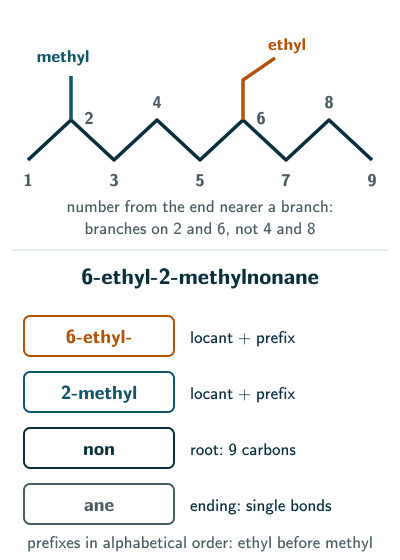
- Find the longest carbon chain: it is the parent (root) chain. In NCERT’s example the longest chain has nine carbons, so the parent is nonane, not an eight-carbon chain.
- Number the chain from the end that gives the branched carbons the lowest possible numbers: 2 and 6, not 4 and 8.
- Write the alkyl groups as prefixes with their locants, in alphabetical order, numbers separated from words by hyphens and with no break before the parent: 6-ethyl-2-methylnonane.
- Identical groups are counted with di-, tri-, tetra-…, and their locants separated by commas: 2,4-dimethylpentane, 2,2,4-trimethylpentane. The multiplying prefixes are ignored in alphabetical order: 3-ethyl-4,4-dimethylheptane (e before m). Inside a bracketed (complex) substituent, though, the whole name counts, di- included: (2,2-dimethylbutyl) is alphabetised under d.
- If two groups are in equivalent positions, the one first in alphabetical order gets the lower number: 3-ethyl-6-methyloctane, not 6-ethyl-3-methyloctane.
- A branched substituent is numbered from the carbon attached to the parent chain and written in brackets: 1,3-dimethylbutyl-; 5-(2-ethylbutyl)-3,3-dimethyldecane. Trivial prefixes such as isopropyl are allowed only when the group carries no further substituents (page 265).
For alphabetical order, iso- and neo- count as part of the name of the alkyl group, but sec- and tert- do not: 5-sec-butyl-4-isopropyldecane (b before i). If two chains are equally long, choose the one with more side chains (page 265).
Rings. A saturated monocyclic compound takes the prefix cyclo-: cyclopentane, cyclohexane. With substituents, the rules above apply: 1-methyl-3-propylcyclohexane (alphabetical order decides which gets 1), and 3-ethyl-1,1-dimethylcyclohexane, not 1-ethyl-3,3-dimethylcyclohexane (the set 1,1,3 is lower than 1,3,3) (page 265).
Compounds with functional groups
A functional group is usually the site of chemical reactivity: CH3OH, CH3CH2OH and (CH3)2CHOH all release hydrogen with sodium because of their –OH group (NCERT Section 8.5.3, pages 265–266). To name such a compound (page 266):
- identify the functional group, which fixes the suffix;
- for the simple acyclic examples here, choose a parent containing the maximum number of principal functional groups, then the longest suitable chain and number it so that the functional group gets the lowest possible number;
- if there are several functional groups, the one highest in priority is the principal functional group and gives the suffix; the others are named as prefixes;
- after the principal group, the C=C and C≡C bonds taken together get the lowest locants; only if both ends tie does the double bond get the lower number. Branches come last: CH3CH=CHCH2C≡CH is hex-4-en-1-yne, not hex-2-en-5-yne.
The order of decreasing seniority for some characteristic functional groups (page 266) is shown below. Multiple bonds follow characteristic-group locants; they are numbered together, with C=C preferred only when the multiple-bond locants tie:
–COOH > –SO3H > –COOR > –COCl > –CONH2 > –CN > –CHO > >C=O > –OH > –NH2
–R, C6H5–, halogens, –NO2 and alkoxy (–OR) are always written as prefixes. So HOCH2(CH2)3CH2COCH3 is 7-hydroxyheptan-2-one (ketone over alcohol), and BrCH2CH=CH2 is 3-bromoprop-1-ene (page 266).
With two or more groups of the same kind, di-, tri-… go before the class suffix and the full alkane name is kept: CH2(OH)CH2(OH) is ethane-1,2-diol. For more than one double or triple bond, the alkane name loses its -ne (butane → buta-) before -diene or -diyne: CH2=CH–CH=CH2 is buta-1,3-diene (page 266).
Suffixes and prefixes for the main classes, from NCERT Table 8.4 (page 267):
| Class | Ending | Example |
|---|---|---|
| Alkene | -ene | But-1-ene |
| Alkyne | -yne | But-1-yne |
| Alcohol | -ol | Butan-2-ol |
| Aldehyde | -al | Butanal |
| Ketone | -one | Butan-2-one |
| Nitrile | -nitrile | Pentanenitrile |
| Carboxylic acid | -oic acid | Butanoic acid |
| Ester | -oate | Methyl propanoate |
| Acyl halide | -oyl halide | Butanoyl chloride |
| Amine | -amine | Butan-2-amine |
| Amide | -amide | Butanamide |
When a group is not the principal one, it is written as a prefix: hydroxy- (–OH), oxo- (>C=O; formyl- or oxo- for –CHO), cyano- (–CN), carboxy- (–COOH), amino- (–NH2). In the substitutive naming system used here, halides, ethers and nitro compounds are expressed with prefixes: halo- (1-bromobutane), alkoxy- (ethoxyethane) and nitro- (1-nitrobutane).
The carbon of –CHO, –COOH, –CN and similar groups at the end of a chain is counted as carbon 1 of the chain: butanal is CH3CH2CH2CHO, with four carbons. NCERT’s example for sulphonic acids, CH3SO3H, is called methylsulphonic acid in Table 8.4; its IUPAC name is methanesulphonic acid.
Substituted benzene compounds
For substituted benzenes the substituent is put as a prefix to benzene: methylbenzene (toluene), methoxybenzene (anisole), nitrobenzene and bromobenzene; the common names are used universally too (NCERT Section 8.5.4, pages 268–269). NCERT also lists aminobenzene (aniline). Aniline is a retained preferred IUPAC name, with benzenamine a systematic alternative.
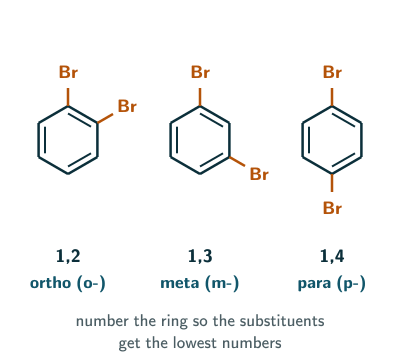
- Two substituents: number the ring so that they get the lowest numbers: 1,3-dibromobenzene, not 1,5-. In the trivial system, the positions 1,2, 1,3 and 1,4 are called ortho (o-), meta (m-) and para (p-): m-dibromobenzene (page 269).
- Three or more: o-, m- and p- cannot be used. Use the lowest set of locants: 1-chloro-2,4-dinitrobenzene (1,2,4 beats 1,3,4); 2-chloro-1-methyl-4-nitrobenzene. Only when two numberings give the same set does the substituent first in alphabetical order get the lower number: 1-bromo-3-chloro-5-nitrobenzene.
- Common name as the base: the substituent of the base compound is carbon 1: 2-chloro-4-methylanisole, 4-ethyl-2-methylaniline, 3,4-dimethylphenol.
- When benzene is attached to a chain carrying a functional group, it is a substituent called phenyl, C6H5– (Ph) (page 269).
Solved examples
Example 1: Naming a branched alkane (NCERT rules, page 264)
Name CH3–CH(CH3)–CH2–CH2–CH2–CH(CH2CH3)–CH2–CH2–CH3.
The longest chain has nine carbons: nonane (the ethyl branch is not part of a longer chain, since going through it gives only eight). Numbered from the left, the branches are on C2 and C6; from the right, on C4 and C8. Take 2 and 6. Alphabetical order: ethyl before methyl.
Answer: 6-ethyl-2-methylnonane.
Example 2: Spotting wrong names (NCERT Problem 8.7, page 265)
Explain why (a) 2,5,6-trimethyloctane is correct and not 3,4,7-trimethyloctane; (b) 3-ethyl-5-methylheptane and not 5-ethyl-3-methylheptane.
(a) Compare the locant sets term by term: 2,5,6 against 3,4,7. At the first point of difference, 2 is lower than 3, so 2,5,6 wins. (NCERT’s printed solution writes 3,5,7 by mistake.) (b) The two groups are in equivalent positions (3 and 5 either way), so the group first in alphabetical order, ethyl, gets the lower number.
Answer: (a) lowest locants; (b) alphabetical order breaks the tie.
Example 3: Names with functional groups (NCERT Problem 8.8, pages 266–268)
Name (i) CH3CH2CH(OH)CH2CH2CH(CH3)CH2CH3; (ii) CH3CH2COCH2COCH3; (iii) CH3COCH2CH2CH2COOH; (iv) HC≡C–CH=CH–CH=CH2.
(i) Alcohol, -ol; longest chain with OH: eight carbons; OH on C3, methyl on C6. (ii) Two ketone groups, -dione, on C2 and C4 of a six-carbon chain. (iii) Ketone and acid: the acid is principal, so the chain is numbered from the COOH carbon and the ketone at C5 becomes oxo-. (iv) Two C=C and one C≡C on a six-carbon chain: either end gives the set 1,3,5, so the double bonds take the lower numbers: double bonds at 1 and 3, triple bond at 5.
Answer: (i) 6-methyloctan-3-ol; (ii) hexane-2,4-dione; (iii) 5-oxohexanoic acid; (iv) hexa-1,3-dien-5-yne.
Example 4: Structures from names (NCERT Problem 8.9 (i), (ii) and (v), page 268)
Write the structures of (i) 2-chlorohexane; (ii) pent-4-en-2-ol; (iii) 6-hydroxyheptanal.
(i) Six carbons, Cl on C2. (ii) Five carbons, OH on C2, C=C from C4 to C5. (iii) Seven carbons including the CHO carbon as C1, OH on C6.
Answer: (i) CH3CH2CH2CH2CH(Cl)CH3; (ii) CH2=CHCH2CH(OH)CH3; (iii) CH3CH(OH)CH2CH2CH2CH2CHO. In NCERT’s two ring examples, 3-nitrocyclohexene has NO2 on C3 next to the C1=C2 double bond, and cyclohex-2-en-1-ol has OH on C1 with the double bond from C2 to C3.
Example 5: Benzene derivatives (NCERT Problem 8.10, page 270)
Describe the structures of (a) o-ethylanisole; (b) p-nitroaniline; (c) 2,3-dibromo-1-phenylpentane; (d) 4-ethyl-1-fluoro-2-nitrobenzene.
Answer: (a) a benzene ring with OCH3 and C2H5 on neighbouring carbons; (b) NH2 and NO2 on opposite carbons (1,4); (c) C6H5–CH2–CHBr–CHBr–CH2–CH3, a pentane chain with phenyl on C1 and Br on C2 and C3; (d) F on C1, NO2 on C2 and C2H5 on C4 of the ring.
Example 6: Isooctane
Name (CH3)3C–CH2–CH(CH3)2.
The longest chain: CH3–C(CH3)2–CH2–CH(CH3)–CH3, five carbons. Numbering from the left gives methyls at 2, 2 and 4; from the right, 2, 4 and 4. The set 2,2,4 is lower.
Answer: 2,2,4-trimethylpentane (NCERT page 264), the compound known as isooctane.
Common mistakes to avoid
Common mistake
Missing the longest chain
The longest chain is often not the one drawn in a straight line; it may turn through a branch. “2-Ethylbutane” is wrong: the ethyl group extends the chain, and the compound is 3-methylpentane.
Common mistake
Counting di- and tri- in alphabetical order
Multiplying prefixes are ignored, as are sec- and tert-: 3-ethyl-4,4-dimethylheptane, not 4,4-dimethyl-3-ethylheptane. Iso- and neo- do count, and so does di- inside a bracketed substituent: (2,2-dimethylbutyl) is alphabetised under d.
Common mistake
Giving branches priority over the functional group
Number the chain so that the principal functional group gets the lowest number, even if the branches then get higher ones: 6-methyloctan-3-ol, not 3-methyloctan-6-ol.
Common mistake
Leaving out the carbon of CHO or COOH
In aldehydes, acids and nitriles at the end of a chain, that carbon is C1: CH3CH2COOH is propanoic acid, not ethanoic acid.
Quick revision summary
- Name = locants and prefixes (alphabetical) + word root (chain length) + -ane/-ene/-yne + suffix of the principal functional group.
- Longest chain (with the functional group); lowest locants; alphabetical order breaks ties; di-, tri-, sec-, tert- ignored in alphabetising, iso- and neo- counted.
- Priority: –COOH > –SO3H > –COOR > –COCl > –CONH2 > –CN > –CHO > >C=O > –OH > –NH2; halogens, –NO2, –OR, –R and C6H5– only as prefixes.
- Benzene: lowest locants; o-, m-, p- = 1,2-, 1,3-, 1,4-; phenyl = C6H5–.
Formula sheet
- Name = prefixes with locants + root + -ane/-ene/-yne + suffix
- ortho = 1,2; meta = 1,3; para = 1,4
Questions students ask
What are the IUPAC names of acetone, acetic acid and ethyl alcohol?
The IUPAC name of acetone, CH3COCH3, is propanone (in full, propan-2-one); acetic acid, CH3COOH, has the systematic alternative ethanoic acid, while acetic acid itself is the retained preferred IUPAC name; and ethyl alcohol, C2H5OH, is ethanol. Each IUPAC name is read from the structure, ‘prop’ and ‘eth’ counting three and two carbons and the endings -one, -oic acid and -ol naming the ketone, acid and alcohol groups, whereas a common name records history: ‘acetic’ comes from Latin acetum, vinegar. The same rules turn formaldehyde, HCHO, into methanal and chloroform, CHCl3, into trichloromethane.
What is the IUPAC name of benzene?
Benzene is itself the IUPAC name of C6H6: IUPAC keeps it as the name of the parent ring, and its derivatives are named from it, as chlorobenzene and nitrobenzene are. IUPAC also keeps phenol for C6H5OH (rather than benzenol), aniline for C6H5NH2, and benzoic acid and benzaldehyde for C6H5COOH and C6H5CHO. Toluene is also a retained preferred IUPAC name; methylbenzene is an acceptable systematic alternative. Anisole is retained for general nomenclature, while methoxybenzene is its preferred systematic name.
How do you name an ester in the IUPAC system?
An ester, RCOOR′, is named in two words: first the alkyl group R′ that came from the alcohol, then the acid part with -oic acid changed to -oate, so CH3COOC2H5 is ethyl ethanoate (common name ethyl acetate) and HCOOCH3 is methyl methanoate. The carbon of the C=O group belongs to the acid part and is counted in its chain: CH3CH2CH2COOC2H5, made from butanoic acid and ethanol, is ethyl butanoate.
How are ethers named in the IUPAC system?
For a simple acyclic ether, R–O–R′, the substitutive name is an alkoxyalkane: the larger alkyl group gives the parent alkane, and the smaller one, together with the oxygen, becomes an alkoxy prefix such as methoxy- (CH3O–) or ethoxy- (C2H5O–). So CH3OCH2CH2CH3 is 1-methoxypropane (common name methyl propyl ether) and CH3OC2H5 is methoxyethane (ethyl methyl ether). An alkoxy group never takes a suffix, so when the molecule has a group that does, the alkoxy group stays a prefix: CH3OCH2CH2OH is 2-methoxyethan-1-ol.
Which chapter of Class 11 covers IUPAC nomenclature of organic compounds?
IUPAC nomenclature of organic compounds is NCERT Section 8.5, Nomenclature of Organic Compounds (pages 262–270), in Unit 8, Organic Chemistry – Some Basic Principles and Techniques, of the Class 11 Chemistry book, Part II. Unit 14 of JEE Main 2027 and of NEET (UG) 2026, Some Basic Principles of Organic Chemistry, lists it as ‘Nomenclature (Trivial and IUPAC)’, and the rules are used again in Unit 9, Hydrocarbons, and in the Class 12 units on haloalkanes, alcohols, carbonyl compounds and amines. The IUPAC naming of coordination compounds is a separate topic, in the Class 12 unit Coordination Compounds.
What is the best way to learn IUPAC nomenclature?
The best way to learn IUPAC nomenclature is step by step: first the word roots for one to ten carbons (meth-, eth-, prop-, but- … dec-), then naming alkanes by the longest chain, lowest locants and alphabetical order, then the suffixes and priority order of functional groups, and last benzene derivatives. Practise both ways, naming a given structure and drawing the structure from a name, since a sufficiently specified name fixes the connectivity, with additional stereodescriptors needed when stereochemistry matters.
Practice questions
Try each question first, then open the answer to check your working.
-
Q1. Which is the correct IUPAC name in each pair (NCERT Exercise 8.5)? (a) 2,2-dimethylpentane or 2-dimethylpentane; (b) 2,4,7-trimethyloctane or 2,5,7-trimethyloctane; (c) 2-chloro-4-methylpentane or 4-chloro-2-methylpentane; (d) but-3-yn-1-ol or but-4-ol-1-yne.
Show answerHide answer
(a) 2,2-Dimethylpentane: every methyl needs its own locant. (b) 2,4,7-Trimethyloctane: 2,4,7 is lower than 2,5,7 at the first difference. (c) 2-Chloro-4-methylpentane: the locants 2,4 tie, so chloro, first alphabetically, gets 2. (d) But-3-yn-1-ol: the –OH, which gives the suffix, gets the lowest number.
-
Q2. Name Cl2CHCH2OH (NCERT Exercise 8.4 (f)).
Show answerHide answer
Alcohol on a two-carbon chain, numbered from the OH carbon: C1 carries OH, C2 carries two Cl. Name: 2,2-dichloroethan-1-ol (often written 2,2-dichloroethanol).
-
Q3. Write the condensed formulas of (a) 2,2,4-trimethylpentane and (b) hexanedial (from NCERT Exercise 8.7), and name the functional groups.
Show answerHide answer
(a) (CH3)3CCH2CH(CH3)2, an alkane with no functional group. (b) OHC(CH2)4CHO, six carbons with an aldehyde group (–CHO) at each end.