Classification of hydrocarbons
NCERT Class 11 Chemistry Chapter 9 Section 9.1
Quick answer
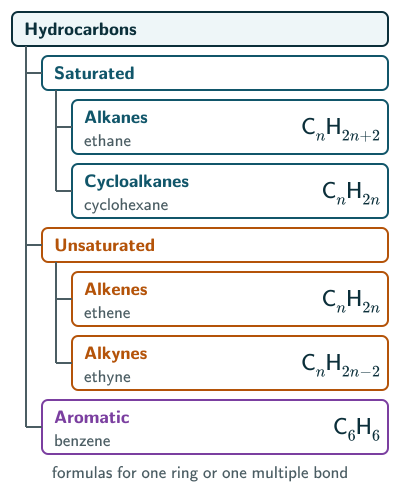
The classification of hydrocarbons, compounds of carbon and hydrogen only, sorts them by their carbon–carbon bonds into three classes: saturated (alkanes, CnH2n+2, and cycloalkanes), unsaturated (alkenes, CnH2n for one C=C, and alkynes, CnH2n−2 for one C≡C) and aromatic, such as benzene. Each ring or π bond means two fewer hydrogen atoms than in the alkane with the same number of carbons. Hydrocarbons are used as fuels such as LPG, CNG, petrol and diesel, and as raw materials for polymers, dyes and drugs.
With your textbook
NCERT Chemistry Part II (Class 11), Chapter 9 “Hydrocarbons”, Section 9.1 “Classification”, pages 295–296.
Open the official NCERT chapter (PDF, 3.3 MB, ncert.nic.in) (opens in a new tab)
Checked against the 2026-27 reprint on .
What are hydrocarbons and how are they classified?
Hydrocarbons
The term ‘hydrocarbon’ is self-explanatory which means compounds of carbon and hydrogen only.
NCERT Chemistry Part II (Class 11), Chapter 9, Hydrocarbons, page 295
By the type of carbon–carbon bonds they contain, hydrocarbons fall into three main classes (NCERT Section 9.1, pages 295–296):
- saturated hydrocarbons, with only C–C and C–H single bonds: open-chain alkanes and ring cycloalkanes;
- unsaturated hydrocarbons, with carbon–carbon multiple bonds: double bonds (alkenes), triple bonds (alkynes) or both;
- aromatic hydrocarbons, a special type of ring compound such as benzene.
In plain words: a hydrocarbon is built only from carbon and hydrogen, and it is sorted by how its carbons are joined. If every carbon–carbon bond is single, the hydrocarbon is saturated; an open chain of this kind holds the most hydrogens possible. A double or triple bond means fewer hydrogens, so the molecule is unsaturated. A ring also removes two hydrogens, but a ring with only single bonds (a cycloalkane) is still saturated. Benzene and its relatives are rings with a special, extra-stable arrangement of electrons, and they form a class of their own.
Hydrocarbons in daily life
Hydrocarbons are important sources of energy (NCERT page 295):
- LPG (liquefied petroleum gas) is a domestic fuel with the least pollution; kerosene is also a domestic fuel but causes some pollution.
- CNG (compressed natural gas) is natural gas, found in the upper strata while drilling oil wells, compressed for use in vehicles; LNG (liquefied natural gas) is obtained by liquefying natural gas.
- Petrol, diesel and kerosene come from the fractional distillation of petroleum; coal gas comes from the destructive distillation of coal.
- Petrol- and CNG-run vehicles cause less pollution.
Beyond the NCERT text: LPG is mainly butane and propane, and natural gas, and so CNG and LNG, is mainly methane.
Beyond fuels, hydrocarbons are used to make polymers such as polythene, polypropene and polystyrene; higher hydrocarbons are solvents for paints and starting materials for many dyes and drugs (page 295).
The three classes
Saturated hydrocarbons contain only C–C and C–H single bonds. With an open chain they are alkanes, general formula CnH2n+2 (NCERT page 296); with a closed chain, or ring, they are cycloalkanes. NCERT gives no cycloalkane formula, but a ring costs two hydrogens, so a cycloalkane with one ring is CnH2n. Each carbon is sp3 hybridised and tetrahedral.
Unsaturated hydrocarbons contain carbon–carbon multiple bonds:
- alkenes, with at least one C=C, general formula CnH2n for one double bond;
- alkynes, with at least one C≡C, CnH2n−2 for one triple bond;
- compounds with two or more multiple bonds, such as buta-1,3-diene.
Aromatic hydrocarbons (arenes) are a special type of ring compound, of which benzene, C6H6, is the parent. Their rings are unusually stable, and they react mainly by substitution, not addition.
NCERT suggests building models: toothpicks and plasticine balls for alkanes, and spring models for alkenes, alkynes and aromatic hydrocarbons, keeping in mind that carbon is tetravalent and hydrogen monovalent (page 296).
Counting rings and multiple bonds
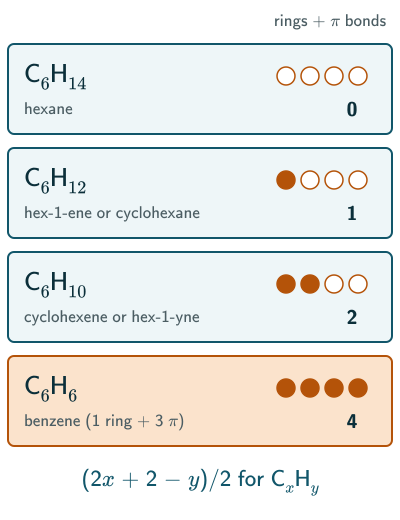
Beyond the NCERT text, but very useful: compared with an open-chain alkane of the same number of carbons, each ring and each π bond means two fewer hydrogen atoms. The degree of unsaturation (also called the double bond equivalent) counts them from the molecular formula alone:
Degree of unsaturation for C<sub>x</sub>H<sub>y</sub>
degree of unsaturation = (2x + 2 − y)/2
= number of rings + number of π bonds
A C=C counts 1, a C≡C counts 2 and a ring counts 1. Benzene, C6H6, has (12 + 2 − 6)/2 = 4: one ring and three π bonds.
Solved examples
Example 1: Which class?
Classify: (a) C3H8, propane; (b) cyclopentane; (c) CH3CH=CH2; (d) HC≡CCH3; (e) toluene, C6H5CH3.
Answer: (a) saturated, alkane; (b) saturated, cycloalkane; (c) unsaturated, alkene; (d) unsaturated, alkyne; (e) aromatic.
Example 2: General formulas
Write the molecular formulas of the alkane, the alkene and the alkyne with five carbon atoms.
Alkane CnH2n+2: C5H12. Alkene CnH2n: C5H10. Alkyne CnH2n−2: C5H8.
Answer: C5H12, C5H10, C5H8.
Example 3: One formula, two classes
C6H12 fits the alkene formula. Must it be an alkene?
Degree of unsaturation = (12 + 2 − 12)/2 = 1: either one π bond or one ring. Hex-1-ene has a C=C; cyclohexane has a ring and no multiple bond.
Answer: no. C6H12 may be an alkene or a cycloalkane; only the structure decides.
Example 4: Reading a formula
A hydrocarbon C7H8 has no triple bond. What could it be?
Degree of unsaturation = (14 + 2 − 8)/2 = 4. Four rings and π bonds in seven carbons without a triple bond strongly suggests a benzene ring (one ring, three π bonds) with one CH3.
Answer: toluene (methylbenzene), C6H5CH3, is the usual answer; the formula alone does not prove it.
Common mistakes to avoid
Common mistake
Calling every ring compound aromatic
Cyclohexane and cyclohexene are rings but not aromatic: they behave like alkanes and alkenes. Aromatic means benzene-like.
Common mistake
Taking the formula as proof of the class
CnH2n fits both alkenes and cycloalkanes, and CnH2n−2 fits alkynes, dienes and cycloalkenes. The degree of unsaturation counts rings and π bonds together.
Common mistake
Calling a cycloalkane unsaturated
Cyclohexane, C6H12, has a degree of unsaturation of 1, but that 1 is its ring. It has only single bonds, so it is a saturated hydrocarbon; only C=C and C≡C bonds make a hydrocarbon unsaturated.
Common mistake
Counting a triple bond as one unsaturation
A C≡C has two π bonds, so it counts 2 in the degree of unsaturation.
Quick revision summary
- Hydrocarbons: compounds of carbon and hydrogen only; fuels (LPG, CNG, LNG, petrol, diesel, kerosene) and raw materials for polymers, dyes and drugs.
- Saturated: alkanes CnH2n+2, cycloalkanes CnH2n.
- Unsaturated: alkenes CnH2n for one C=C, alkynes CnH2n−2 for one C≡C.
- Aromatic: benzene and related rings.
- Degree of unsaturation = (2x + 2 − y)/2 = rings + π bonds.
Formula sheet
- Alkanes CnH2n+2; cycloalkanes and alkenes CnH2n; alkynes CnH2n−2
- Degree of unsaturation of CxHy = (2x + 2 − y)/2 = rings + π bonds
Questions students ask
What is the difference between saturated and unsaturated hydrocarbons?
Saturated hydrocarbons have only single carbon–carbon bonds, as in ethane, while unsaturated ones have at least one C=C or C≡C bond, as in ethene, CH2=CH2, and so fewer hydrogens than the alkane with the same number of carbons. Saturated ones react mainly by substitution, under heat or light; unsaturated ones add H2, halogens or HBr across their π bonds, so at room temperature they decolourise bromine in CCl4 and alkanes do not. Benzene has π bonds too, but reacts mainly by substitution, so it is classed apart, as aromatic.
What is the difference between LPG and CNG?
LPG (liquefied petroleum gas) is mainly propane and butane, liquefied under moderate pressure in cylinders for cooking, while CNG (compressed natural gas) is mainly methane, which cannot be liquefied by pressure at room temperature, so it is kept as a gas at about 200 bar and used mostly in vehicles. Propane (44 g mol) and butane (58 g mol) are heavier than air (about 29 g mol), so leaked LPG collects near the floor, while methane (16 g mol) rises and disperses. PNG (piped natural gas) is natural gas sent to kitchens through pipes, and LNG is natural gas cooled to about 111 K (−162 °C), methane’s boiling point, so that it can be shipped as a liquid.
What is the difference between hydrocarbons and carbohydrates?
Hydrocarbons contain only carbon and hydrogen, such as methane, CH4, while carbohydrates contain carbon, hydrogen and oxygen, usually with hydrogen and oxygen in water’s 2 : 1 ratio, as in glucose, C6H12O6, and sucrose, C12H22O11. Carbohydrates are polyhydroxy aldehydes or ketones, or give them on hydrolysis, and their many –OH groups make sugars soluble in water, whereas hydrocarbons are non-polar and practically insoluble. Both give CO2 and H2O and release energy when oxidised, hydrocarbons burnt as fuels and carbohydrates respired as food; carbohydrates are a Class 12 topic (Biomolecules).
How do you find the degree of unsaturation of a compound containing oxygen, nitrogen or a halogen?
With oxygen, nitrogen or halogens present, the degree of unsaturation is (2nC + 2 + nN − nH − nX)/2, counting the carbon, nitrogen, hydrogen and halogen atoms: oxygen and sulphur are ignored, a halogen counts as a hydrogen, and each nitrogen adds 1 inside the bracket. Ethanal, C2H4O, gives (4 + 2 − 4)/2 = 1, its C=O; chloroethene, C2H3Cl, gives (4 + 2 − 3 − 1)/2 = 1, its C=C; and pyridine, C5H5N, gives (10 + 2 + 1 − 5)/2 = 4, one ring and three π bonds. The result is still rings + π bonds, now counting C=O and C=N too.
What does a degree of unsaturation of 4 mean?
A degree of unsaturation of 4 means that the rings and π bonds of the molecule add up to four, in any combination: a benzene ring alone accounts for exactly 4 (one ring and three C=C), and so do two C≡C bonds. For example, C9H12, with (18 + 2 − 12)/2 = 4, is most often a benzene compound, such as isopropylbenzene (cumene), while buta-1,3-diyne, HC≡C–C≡CH (C4H2), also has 4 with no ring at all. The same number is called the double bond equivalent or the index of hydrogen deficiency, and only the structure decides which combination is present.
Why are hydrocarbons used as fuels?
Hydrocarbons are used as fuels because they burn in enough air to carbon dioxide and water with a large release of heat: burning methane releases 890 kJ mol, about 55 kJ g, and butane, a main part of LPG, about 2877 kJ mol, nearly 50 kJ g. They are stable until lit, so they can be stored and carried safely, and as gases or liquids they mix well with air and leave little ash. They are also abundant: petroleum and natural gas supply them in large amounts, which refining sorts into fuels for homes, vehicles and industry.
Is the degree of unsaturation in the JEE Main 2027 and NEET (UG) 2026 syllabuses?
The degree of unsaturation is not named in the JEE Main 2027 (NTA) or NEET (UG) 2026 (NMC) syllabus, whose Unit 15, Hydrocarbons, lists ‘Classification, isomerism, IUPAC nomenclature, general methods of preparation, properties and reactions’. NCERT uses the phrase only in passing, for benzene in Section 9.5.2, and gives no formula. It is still a useful shortcut for those listed topics, since it turns a molecular formula into the number of rings and π bonds, the first step in drawing the isomers of a formula or in working out a structure from clues.
Practice questions
Try each question first, then open the answer to check your working.
-
Q1. Which fuel does NCERT describe as a domestic fuel with the least pollution, and which as causing some pollution?
Show answerHide answer
LPG causes the least pollution as a domestic fuel; kerosene causes some pollution.
-
Q2. Find the degree of unsaturation of C4H6 and give two structures that fit.
Show answerHide answer
(8 + 2 − 6)/2 = 2. For example but-1-yne, HC≡CCH2CH3 (one triple bond), and buta-1,3-diene, CH2=CH–CH=CH2 (two double bonds). Cyclobutene (one ring, one double bond) also fits.
-
Q3. Why were alkanes earlier called paraffins?
Show answerHide answer
Because they are inert under normal conditions and do not react with acids, bases and most other reagents; the name comes from the Latin parum, little, and affinis, affinity (NCERT page 296).