Alkanes
NCERT Class 11 Chemistry Chapter 9 Section 9.2
Quick answer
Alkanes are saturated open-chain hydrocarbons, CnH2n+2, with sp3 carbons joined by single bonds. They are made by hydrogenating alkenes and alkynes, by the Wurtz reaction, by decarboxylation (one carbon fewer) and by Kolbe electrolysis, and they burn as fuels and are halogenated in light by a free radical chain. Rotation about the C–C bond gives conformations; in ethane the staggered form is about 12.5 kJ mol−1 more stable than the eclipsed.
With your textbook
NCERT Chemistry Part II (Class 11), Chapter 9 “Hydrocarbons”, Section 9.2 “Alkanes”, pages 296–306.
Open the official NCERT chapter (PDF, 3.3 MB, ncert.nic.in) (opens in a new tab)
Checked against the 2026-27 reprint on .
What are alkanes?
Alkanes
As already mentioned, alkanes are saturated open chain hydrocarbons containing carbon - carbon single bonds.
NCERT Chemistry Part II (Class 11), Section 9.2, page 296
- General formula CnH2n+2; methane, CH4, is the first member (NCERT page 296).
- Every carbon is sp3 hybridised and tetrahedral.
- They are unreactive under normal conditions, so they were once called paraffins (Latin parum, little, and affinis, affinity).
In plain words: alkanes are chains of carbon atoms joined by single bonds, with hydrogen atoms on every bond that is left over. Methane, ethane, propane and butane are all alkanes. They have no double bonds and no lone pairs for a reagent to attack, so they react only under harsh conditions: heat, light or a flame. That is also why they make such good fuels: they keep safely until they are burnt.
Structure and the homologous series
NCERT builds the family from methane: replace one hydrogen of CH4 by a –CH3 group and you get ethane, C2H6; do it again and you get C3H8, then C4H10, and so on (NCERT Section 9.2, page 296). Each member differs from the next by CH2, so the alkanes form a homologous series with the general formula CnH2n+2. Methane itself is a gas found in coal mines and marshy places.
Methane is tetrahedral, as VSEPR theory predicts for four bond pairs: carbon at the centre, a hydrogen at each corner of a regular tetrahedron, and every H–C–H angle 109.5°. In higher alkanes these tetrahedra are joined together. Each carbon is sp3 hybridised: the C–C bonds form by head-on overlap of sp3 orbitals of two carbons, and the C–H bonds by overlap of an sp3 orbital of carbon with the 1s orbital of hydrogen. The C–C bond is 154 pm long.
NCERT page 296 gives the C–H bond length in alkanes as 112 pm. That is too long: the C–H bond in alkanes is about 109 pm, the value NCERT itself gives for ethane in Unit 4 (Section 4.6.2, page 123).
Nomenclature and isomerism
The first three alkanes, methane, ethane and propane, have only one structure each. From butane onwards the carbons can be joined in more than one way (NCERT Section 9.2.1, pages 296–298):
- C4H10: butane, CH3CH2CH2CH3 (b.p. 272.4 K), and 2-methylpropane (isobutane), (CH3)2CHCH3 (b.p. 261.0 K);
- C5H12: pentane (b.p. 309.1 K), 2-methylbutane (isopentane, b.p. 300.9 K) and 2,2-dimethylpropane (neopentane, b.p. 282.5 K).
The boiling points are those of NCERT Table 9.2 (page 302); the structures on pages 296–297 print them rounded, as 273 K, 261 K, 309 K and 301 K.
These compounds have the same molecular formula but different structures and properties, so they are structural isomers. Because they differ only in the carbon chain, continuous in one and branched in the other, they are called chain isomers. The number grows fast: C6H14 has five, C7H16 nine, and C10H22 as many as 75 (NCERT page 298).
Degree of a carbon atom. A carbon joined to no other carbon (as in methane) or to one carbon is primary (1°); terminal carbons are always primary. A carbon joined to two carbons is secondary (2°), to three tertiary (3°), and to four quaternary (4°, or neo) (NCERT page 297). Hydrogens take the name of their carbon: 2-methylpropane has nine primary hydrogens and one tertiary hydrogen.
Alkyl groups. Removing one hydrogen from an alkane gives an alkyl group, general formula CnH2n+1: –CH3 (methyl), –C2H5 (ethyl), –C3H7 (propyl or isopropyl) (NCERT page 298). The C5H11 group alone has eight isomeric forms (NCERT Problem 9.2).
Naming. Alkanes are named by the IUPAC rules of Unit 8. Pick the longest chain (if two chains are equally long, the one with more substituents), number it so that the substituents get the lowest locants, and list the substituents alphabetically, ignoring di, tri, sec and tert. To go the other way, from a name to a structure, write the parent chain, number it, attach the substituents at the numbered carbons, and finally add hydrogens until every carbon has four bonds (NCERT page 299). NCERT’s Problems 9.3–9.5 practise both directions; Example 2 below works through all three.
Preparation
Petroleum and natural gas are the main sources of alkanes, but they can also be made in the laboratory (NCERT Section 9.2.2, pages 300–301).
1. From unsaturated hydrocarbons: hydrogenation. Dihydrogen adds to alkenes and alkynes in the presence of finely divided platinum, palladium or nickel. The metal adsorbs H2 on its surface and activates the H–H bond. Platinum and palladium work at room temperature; nickel needs a higher temperature and pressure.
- CH2=CH2 + H2 → CH3–CH3 (ethene to ethane)
- CH3CH=CH2 + H2 → CH3CH2CH3 (propene to propane)
- CH3C≡CH + 2H2 → CH3CH2CH3 (propyne to propane)
Three slips in NCERT’s equations 9.1–9.3 on page 300: the product of 9.1 is labelled “Propane” but is ethane; the reactant of 9.2 is labelled “Propane” but is propene; and 9.3 shows only one H2, but an alkyne needs two molecules of H2 (one for each π bond) to become an alkane.
2. From alkyl halides.
- Reduction. Alkyl halides, except fluorides, are reduced to alkanes by zinc and dilute hydrochloric acid: CH3Cl + H2 → CH4 + HCl (Zn, H+). Chloroethane gives ethane and 1-chloropropane gives propane in the same way.
- Wurtz reaction. Alkyl halides react with sodium in dry ether (free from moisture) to give higher alkanes with an even number of carbon atoms, two alkyl groups joined together: 2CH3Br + 2Na → CH3–CH3 + 2NaBr, and 2C2H5Br + 2Na → CH3CH2CH2CH3 + 2NaBr (butane). NCERT’s equation 9.7 names the reactant “Bromomenthane”; it is bromomethane (menthane is a different compound).
NCERT asks what happens if two different alkyl halides are used. Beyond the NCERT text: each alkyl group can pair with its own kind or with the other, so three alkanes form together, which are hard to separate (Example 4). This is why the Wurtz reaction is used only for symmetrical alkanes.
3. From carboxylic acids.
- Decarboxylation. The sodium salt of a carboxylic acid heated with soda lime (sodium hydroxide and calcium oxide) loses carbon dioxide and gives an alkane with one carbon atom fewer than the acid: CH3COONa + NaOH → CH4 + Na2CO3 (CaO, heat).
- Kolbe’s electrolytic method. Electrolysis of an aqueous solution of the sodium or potassium salt of a carboxylic acid gives, at the anode, an alkane with an even number of carbon atoms: 2CH3COONa + 2H2O → CH3–CH3 + 2CO2 + H2 + 2NaOH.
The path NCERT gives for Kolbe’s electrolytic method (page 301): at the anode each acetate ion gives up an electron to become an acetate free radical, which loses CO2 to give a methyl free radical; two methyl radicals join to form ethane. At the cathode, water takes electrons and hydrogen gas is set free. Because the product is always two alkyl groups joined, the smallest alkane Kolbe’s method can give is ethane: methane cannot be prepared this way.
Physical properties
Alkanes are almost non-polar, because the C–C and C–H bonds are covalent and carbon and hydrogen differ very little in electronegativity. Their molecules are held only by weak van der Waals forces (NCERT Section 9.2.3, pages 301–302). As a result:
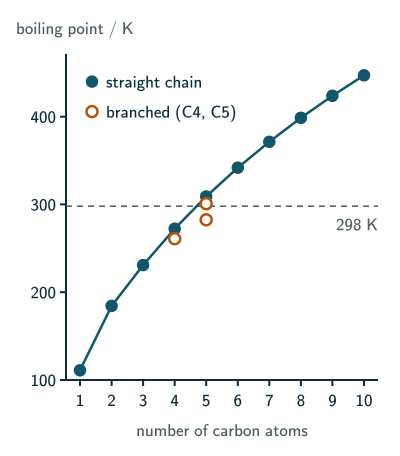
- at 298 K, the straight-chain alkanes C1 to C4 are gases, C5 to C17 are liquids and those with 18 or more carbons are solids (2,2-dimethylpropane, b.p. 282.5 K, is a gas at 298 K);
- they are colourless and odourless;
- they do not dissolve in water but do dissolve in non-polar solvents: like dissolves like. Petrol and the lower fractions of petroleum remove grease stains in dry cleaning because grease, a mixture of higher alkanes, is also non-polar and hydrophobic.
Boiling points. The boiling point rises steadily with molecular mass, because the van der Waals forces grow with the size, or surface area, of the molecule. Among isomers, branching lowers the boiling point: pentane boils at 309.1 K, 2-methylbutane at 300.9 K and 2,2-dimethylpropane at 282.5 K (NCERT Table 9.2, page 302). As branches are added, the molecule becomes more nearly spherical, the area of contact between molecules shrinks, and the weaker forces are overcome at a lower temperature.
| Alkane | b.p./K | m.p./K |
|---|---|---|
| Methane, CH4 | 111.0 | 90.5 |
| Ethane, C2H6 | 184.4 | 101.0* |
| Propane, C3H8 | 230.9 | 85.3 |
| Butane, C4H10 | 272.4 | 134.6 |
| 2-Methylpropane | 261.0 | 114.7 |
| Pentane, C5H12 | 309.1 | 143.3 |
| 2-Methylbutane | 300.9 | 113.1 |
| 2,2-Dimethylpropane | 282.5 | 256.4 |
| Hexane, C6H14 | 341.9 | 178.5 |
| Heptane, C7H16 | 371.4 | 182.4 |
| Octane, C8H18 | 398.7 | 216.2 |
| Nonane, C9H20 | 423.8 | 222.0 |
| Decane, C10H22 | 447.1 | 243.3 |
| Eicosane, C20H42 | 615.0 | 309.7 |
Data from NCERT Table 9.2 (page 302), which also lists the molecular masses (16 u for methane, rising by 14 u for each CH2); eicosane is spelt icosane in current IUPAC names. *The melting point of ethane printed in the table, 101.0 K, is wrong: ethane melts at about 90 K (−182.8 °C).
Melting points do not rise as smoothly as boiling points, because they also depend on how well the molecules pack in a crystal: compact 2,2-dimethylpropane melts at 256.4 K, far above its isomers.
Chemical properties
Alkanes are generally inert towards acids, bases, oxidising agents and reducing agents, but they react under suitable conditions (NCERT Section 9.2.3, pages 302–304).
Substitution: halogenation
One or more hydrogen atoms of an alkane can be replaced by halogens, a nitro group or a sulphonic acid group; lower alkanes, however, do not undergo nitration or sulphonation. Halogenation takes place at a high temperature (573–773 K) or in diffused sunlight or ultraviolet light. Chlorination of methane in light gives a mixture of all four chloromethanes, one hydrogen at a time:
- CH4 + Cl2 → CH3Cl + HCl (chloromethane)
- CH3Cl + Cl2 → CH2Cl2 + HCl (dichloromethane)
- CH2Cl2 + Cl2 → CHCl3 + HCl (trichloromethane)
- CHCl3 + Cl2 → CCl4 + HCl (tetrachloromethane)
Ethane gives chloroethane in the same way: CH3CH3 + Cl2 → CH3CH2Cl + HCl.
Two orders to remember (NCERT page 303):
- the rate of reaction with halogens is F2 > Cl2 > Br2 > I2: fluorination is too violent to control, and iodination is very slow and reversible;
- hydrogens are replaced in the order 3° > 2° > 1° (NCERT page 303 prints this as 3 > 2 > 1, with the degree signs lost).
Iodination is carried out with an oxidising agent such as HIO3 or HNO3, which removes the HI formed:
- CH4 + I2 ⇌ CH3I + HI
- HIO3 + 5HI → 3I2 + 3H2O
Removing a product pulls the reversible reaction forward, as Le Chatelier’s principle predicts.
The free radical mechanism
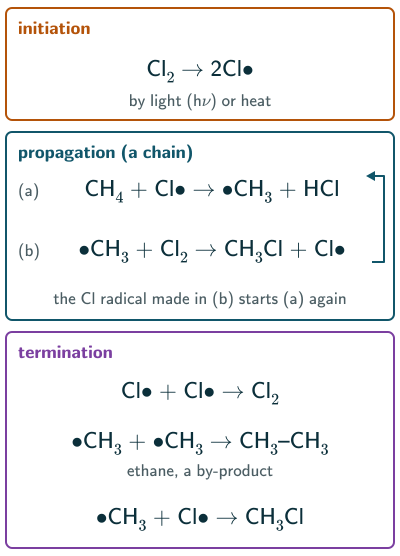
Halogenation goes by a free radical chain mechanism in three steps (NCERT page 303):
- Initiation. Light or heat breaks the Cl–Cl bond by homolysis, giving two chlorine free radicals: Cl2 → 2Cl•. The Cl–Cl bond breaks first because it is weaker than the C–C and C–H bonds.
- Propagation. (a) A chlorine radical takes a hydrogen from methane: CH4 + Cl• → •CH3 + HCl. (b) The methyl radical attacks a second chlorine molecule: •CH3 + Cl2 → CH3Cl + Cl•. The new chlorine radical starts step (a) again, so (a) and (b) repeat as a chain. Similar steps give the more highly chlorinated products, for example CH3Cl + Cl• → •CH2Cl + HCl, then •CH2Cl + Cl2 → CH2Cl2 + Cl•.
- Termination. The chain stops when the reactants are used up or when two radicals meet: Cl• + Cl• → Cl2; •CH3 + •CH3 → CH3–CH3; •CH3 + Cl• → CH3Cl. The last step makes the product, but it uses up radicals and so ends the chain.
The second termination step explains why ethane appears as a by-product when methane is chlorinated.
Combustion
Heated in air or dioxygen, alkanes burn completely to carbon dioxide and water, with the evolution of a large amount of heat (NCERT page 303). The enthalpy of combustion is large and negative, which is why alkanes are used as fuels:
- CH4(g) + 2O2(g) → CO2(g) + 2H2O(l); ΔcH⊖ = −890 kJ mol−1
- C4H10(g) + 13/2 O2(g) → 4CO2(g) + 5H2O(l); ΔcH⊖ = −2875.84 kJ mol−1
NCERT’s Unit 5 gives −2658.0 kJ mol−1 for the same equation, but that figure fits water formed as vapour (about −2657 kJ mol−1). With liquid water, as written, −2875.84 kJ mol−1 is close to the accepted −2877 kJ mol−1 worked out on the enthalpy of combustion page linked above.
General combustion equation of an alkane
CnH2n+2 + ((3n + 1)/2) O2 → nCO2 + (n + 1)H2O
Each carbon needs one O2 and each pair of hydrogens half an O2, so a Cn alkane needs n + (n + 1)/2 = (3n + 1)/2 molecules of O2.
With too little air or dioxygen, combustion is incomplete and carbon black forms: CH4(g) + O2(g) → C(s) + 2H2O(l). Carbon black is used to make ink, printer ink and black pigments, and as a filler, for example in rubber (NCERT prints “filters”). In NCERT’s equations 9.17 and 9.18 on page 303 the symbol ΔcH⊖ prints with Ä for Δ and è for ⊖ (a font fault), 9.17 has no = sign before −890, and the water in 9.17, 9.18 and 9.20 is marked (1) where (l), liquid, is meant; the same fault prints Cl as “C1” in many equations on pages 300–303.
Other reactions
Controlled oxidation. Heated with a regulated supply of dioxygen or air at high pressure over a suitable catalyst, alkanes give a variety of oxidation products (NCERT page 304):
- 2CH4 + O2 → 2CH3OH (Cu, 523 K, 100 atm; methanol)
- CH4 + O2 → HCHO + H2O (Mo2O3, heat; methanal)
- 2CH3CH3 + 3O2 → 2CH3COOH + 2H2O ((CH3COO)2Mn, heat; ethanoic acid)
Ordinarily alkanes resist oxidation, but an alkane with a tertiary hydrogen is oxidised by potassium permanganate to the corresponding alcohol: (CH3)3CH → (CH3)3COH, 2-methylpropane to 2-methylpropan-2-ol. NCERT’s equation 9.24 prints the product as “2-Methylpropane-2-01”, with the digits 0 and 1 for the letters “ol” and the final e of propane kept.
Isomerisation. n-Alkanes heated with anhydrous aluminium chloride and hydrogen chloride gas rearrange to branched alkanes. n-Hexane, CH3(CH2)4CH3, gives mainly 2-methylpentane and 3-methylpentane. NCERT’s equation 9.25 prints the formula of n-hexane as “CH3(CH)2)4CH3”; it should be CH3(CH2)4CH3.
Aromatization (reforming). n-Alkanes with six or more carbons, heated to 773 K at 10–20 atm over oxides of vanadium, molybdenum or chromium supported on alumina, lose hydrogen and close into a ring, giving benzene and its homologues: C6H14 → C6H6 + 4H2. NCERT’s equation 9.26 leaves out the 4H2. NCERT asks which alkane would give toluene, C7H8: n-heptane (Q10).
Reaction with steam. Methane and steam at 1273 K over a nickel catalyst give carbon monoxide and dihydrogen; this is the industrial preparation of hydrogen: CH4 + H2O → CO + 3H2.
Pyrolysis (cracking). Higher alkanes heated to a high temperature break into smaller alkanes, alkenes and so on. n-Hexane at 773 K gives C6H12 + H2, or C4H8 + C2H6, or C3H6 + C2H4 + CH4. Pyrolysis is believed to be a free radical reaction; oil gas or petrol gas is made from kerosene or petrol this way. Dodecane, a constituent of kerosene, heated to 973 K over platinum, palladium or nickel, gives heptane and pentene: C12H26 → C7H16 + C5H10 + other products.
Conformations
The C–C σ bond is symmetrical about the internuclear axis, so turning one carbon about this axis does not disturb the overlap. This permits rotation about the C–C single bond, and the rotation produces different arrangements of the atoms in space (NCERT Section 9.2.4, page 305):
Conformations
Such spatial arrangements of atoms which can be converted into one another by rotation around a C-C single bond are called conformations or conformers or rotamers.
NCERT Chemistry Part II (Class 11), Section 9.2.4, page 305
An alkane can have an infinite number of conformations. The rotation is not completely free, though: it is hindered by a small energy barrier of 1–20 kJ mol−1, caused by weak repulsion between the bonds on adjacent carbons. This repulsion is called torsional strain.
Conformations of ethane. Hold one carbon still and turn the other about the C–C axis. Of the infinite number of arrangements, two are extreme (NCERT page 305):
- eclipsed: the hydrogens on the two carbons are as close together as possible;
- staggered: they are as far apart as possible;
- any arrangement in between is a skew conformation.
In every conformation the bond angles and bond lengths stay the same; only the angle of rotation changes.
Drawing them. In a Sawhorse projection the molecule is viewed obliquely, from one side of the C–C axis rather than straight down it, and the C–C bond is drawn as a longer straight line, tilted to the right or left at its upper end. The front carbon is at the lower end and the rear carbon at the upper end; each carries three lines for its three hydrogens, at 120° to each other. In a Newman projection the C–C bond is viewed head on: the front carbon is a point, with its three hydrogens on lines at 120° to each other, and the rear carbon is a circle, with its hydrogens on shorter lines from the edge of the circle, also at 120°.
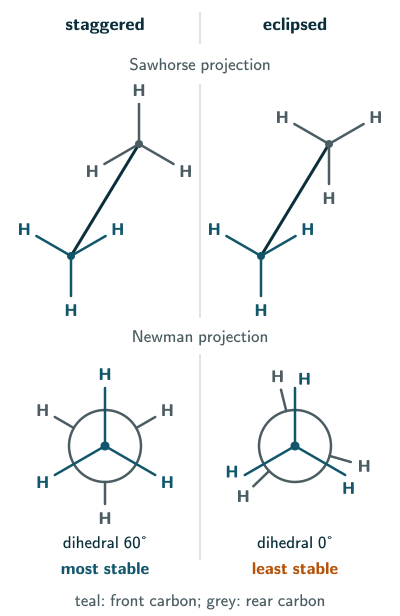
Relative stability. In the staggered form the electron clouds of the C–H bonds are as far apart as possible: repulsion is least, energy lowest and stability greatest. Turning to the eclipsed form brings the C–H bond clouds closer, so repulsion and energy rise and stability falls (NCERT page 306). The size of the torsional strain depends on the angle of rotation about the C–C bond, called the dihedral or torsional angle: 60° in the staggered form and 0° in the eclipsed form. The staggered form has the least torsional strain and is the preferred conformation.
The energy difference between the two forms is only about 12.5 kJ mol−1. Even at ordinary temperatures, ethane molecules gain enough energy from collisions to cross this barrier, so rotation about the C–C bond in ethane is almost free for all practical purposes, and the conformers of ethane have never been separated and isolated.
Solved examples
Example 1: Isomers of C<sub>6</sub>H<sub>14</sub> (NCERT Problem 9.1)
Write the structures of the chain isomers of C6H14 and their IUPAC names.
Start from the longest chain and shorten it step by step, moving the branches:
- six carbons: CH3CH2CH2CH2CH2CH3, hexane;
- five carbons with a methyl: CH3CH(CH3)CH2CH2CH3, 2-methylpentane, and CH3CH2CH(CH3)CH2CH3, 3-methylpentane;
- four carbons with two methyls: (CH3)2CHCH(CH3)2, 2,3-dimethylbutane, and (CH3)3CCH2CH3, 2,2-dimethylbutane.
A methyl on carbon 4 of pentane is the same as one on carbon 2, and an ethyl on carbon 2 of butane makes a five-carbon chain, so there are no others.
Answer: five isomers: hexane, 2-methylpentane, 3-methylpentane, 2,3-dimethylbutane and 2,2-dimethylbutane.
Example 2: Names and structures (NCERT Problems 9.3–9.5)
(a) Name (CH3)3CCH2C(CH3)3 and (CH3)2C(C2H5)2. (b) Why are “2-ethylpentane” and “5-ethyl-3-methylheptane” wrong? (c) Write the structures of 3,4,4,5-tetramethylheptane and 2,5-dimethylhexane.
(a) The first has a five-carbon chain with two methyls on each of carbons 2 and 4: 2,2,4,4-tetramethylpentane. In the second, the longest chain runs through both ethyl groups, CH3CH2–C(CH3)2–CH2CH3, five carbons with two methyls on carbon 3: 3,3-dimethylpentane. (NCERT also names tetra-tert-butylmethane: 3,3-di-tert-butyl-2,2,4,4-tetramethylpentane.)
(b) In CH3CH(C2H5)CH2CH2CH3, the chain through the ethyl group has six carbons, not five, so the name is 3-methylhexane. In the second, both ends give the locant set {3, 5}; the tie goes to the group first in alphabetical order, ethyl, which must get the lower number: 3-ethyl-5-methylheptane.
(c) Write the parent chain, number it, and attach the groups. Seven carbons with methyls on carbons 3, 4, 4 and 5: CH3CH2CH(CH3)C(CH3)2CH(CH3)CH2CH3. Six carbons with methyls on carbons 2 and 5: (CH3)2CHCH2CH2CH(CH3)2.
Answer: (a) 2,2,4,4-tetramethylpentane; 3,3-dimethylpentane. (b) 3-methylhexane; 3-ethyl-5-methylheptane. (c) CH3CH2CH(CH3)C(CH3)2CH(CH3)CH2CH3 (C11H24); (CH3)2CHCH2CH2CH(CH3)2 (C8H18).
Example 3: Choosing the salt (part (a) is NCERT Problem 9.6)
(a) Which sodium salt gives propane on decarboxylation? (b) Which sodium salt gives butane by Kolbe’s method?
(a) Decarboxylation removes one carbon, so a four-carbon acid is needed: sodium butanoate. CH3CH2CH2COONa + NaOH → CH3CH2CH3 + Na2CO3 (CaO, heat).
(b) Kolbe’s method joins two alkyl groups after each acid loses CO2. Butane is C2H5–C2H5, so the acid must carry an ethyl group: propanoic acid. 2C2H5COONa + 2H2O → C4H10 + 2CO2 + H2 + 2NaOH.
Answer: (a) sodium butanoate; (b) sodium propanoate.
Example 4: Wurtz reaction with two halides
A mixture of bromomethane and bromoethane is treated with sodium in dry ether. What forms?
The methyl and ethyl groups pair at random: CH3–CH3 (ethane), CH3–C2H5 (propane) and C2H5–C2H5 (butane). For the cross product: CH3Br + C2H5Br + 2Na → C3H8 + 2NaBr.
Answer: a mixture of ethane, propane and butane. So the Wurtz reaction is not a good way to make propane, or any alkane with an odd number of carbons.
Example 5: Combustion arithmetic
(a) How much heat is released when 4.0 g of methane burns completely? (b) What mass of CO2 forms when 11 g of propane burns?
(a) 4.0 g of CH4 (16 g mol−1) is 0.25 mol; heat = 0.25 × 890 = 222.5 kJ.
(b) C3H8 + 5O2 → 3CO2 + 4H2O, with 5 = (3 × 3 + 1)/2. 11 g of propane (44 g mol−1) is 0.25 mol, which gives 3 × 0.25 = 0.75 mol of CO2 = 0.75 × 44 = 33 g.
Answer: (a) 222.5 kJ; (b) 33 g of CO2.
Example 6: Counting monochloro products
How many monochloro products (structural isomers) can 2-methylbutane and 2,2-dimethylpropane give?
Count the kinds of hydrogen, that is, the sets of symmetry-equivalent carbons that carry hydrogen. In CH3CH(CH3)CH2CH3 the two methyls on carbon 2 are equivalent; the CH, the CH2 and the end CH3 are each different. In C(CH3)4 all twelve hydrogens are equivalent.
Answer: 2-methylbutane gives 4 (1-chloro-2-methylbutane, 2-chloro-2-methylbutane, 2-chloro-3-methylbutane, 1-chloro-3-methylbutane); 2,2-dimethylpropane gives only 1. (Counting stereoisomers, 2-methylbutane gives 6: 1-chloro-2-methylbutane and 2-chloro-3-methylbutane each have a chiral carbon and exist as two enantiomers.)
Example 7: Staggered or eclipsed?
In a Newman projection of ethane, the front C–H bonds point at 0°, 120° and 240°, and the rear ones at 60°, 180° and 300°. Name the conformation and say whether it is the more stable one.
Each rear bond lies halfway between two front bonds, at a dihedral angle of 60°, so the hydrogens are as far apart as possible.
Answer: staggered: the most stable conformation, about 12.5 kJ mol−1 lower in energy than the eclipsed form.
Common mistakes to avoid
Common mistake
Using the Wurtz reaction for an odd-numbered alkane
Two different halides give a mixture of three alkanes. The Wurtz reaction is useful only for symmetrical alkanes with an even number of carbons.
Common mistake
Getting the carbon count wrong in decarboxylation and Kolbe’s method
Decarboxylation gives one carbon fewer than the acid (sodium ethanoate → methane). Kolbe’s method joins two alkyl groups, so sodium ethanoate gives ethane, and methane cannot be made at all.
Common mistake
Thinking branching raises the boiling point
For isomers, branching lowers the boiling point (pentane 309.1 K, 2,2-dimethylpropane 282.5 K). Compare only isomers: 2,2-dimethylpropane still boils above butane, 272.4 K, because it is heavier.
Common mistake
Adding one H<sub>2</sub> to an alkyne to get an alkane
A triple bond has two π bonds, so two molecules of H2 are needed: CH3C≡CH + 2H2 → CH3CH2CH3. NCERT’s equation 9.3 shows only one.
Common mistake
Treating conformers like separable isomers
Conformers interconvert by rotation about a single bond; the barrier in ethane is only about 12.5 kJ mol−1, so they cannot be isolated. Bond lengths and bond angles do not change between them.
Quick revision summary
- Alkanes: saturated open-chain hydrocarbons, CnH2n+2; sp3 carbons, C–C 154 pm, C–H about 109 pm (not NCERT’s 112 pm). Alkyl groups CnH2n+1.
- Chain isomers: C4 2, C5 3, C6 5, C7 9, C10 75. Carbons are 1°, 2°, 3° or 4°.
- Preparation: hydrogenation (Pt, Pd at room temperature; Ni hotter); Zn/HCl reduction of RX (not fluorides); Wurtz, 2RX + 2Na → R–R (even carbons); decarboxylation (one C fewer); Kolbe electrolysis (even carbons, no methane).
- Physical: non-polar, van der Waals forces; C1–C4 gases at 298 K; b.p. rises with size and falls with branching.
- Halogenation: free radical chain (initiation, propagation, termination); F2 > Cl2 > Br2 > I2; 3° > 2° > 1°; iodination needs HIO3 or HNO3; ethane is a by-product of methane chlorination.
- Combustion: ΔcH⊖(CH4) = −890 kJ mol−1; incomplete combustion gives carbon black. Also controlled oxidation, isomerisation (AlCl3/HCl), aromatization (773 K, 10–20 atm), steam reforming (Ni, 1273 K) and pyrolysis.
- Conformations: staggered (60°, most stable) and eclipsed (0°); barrier in ethane 12.5 kJ mol−1, so rotation is almost free.
Formula sheet
- Alkanes CnH2n+2; alkyl groups CnH2n+1
- CnH2n+2 + ((3n + 1)/2) O2 → nCO2 + (n + 1)H2O
- Wurtz: 2RX + 2Na → R–R + 2NaX; decarboxylation: RCOONa + NaOH → RH + Na2CO3
- Halogenation rate F2 > Cl2 > Br2 > I2; hydrogens replaced 3° > 2° > 1°
- Ethane: staggered more stable than eclipsed by about 12.5 kJ mol−1
Questions students ask
Why are alkanes unreactive, and why do they react by substitution?
Alkanes are unreactive because all their bonds are strong σ bonds, C–C and C–H, which are almost non-polar, so they offer no π electrons, lone pairs or partly charged atoms for an electrophile or a nucleophile to attack. Every carbon already holds four atoms, so nothing can add to an alkane without a bond breaking first: a new atom can only take the place of a hydrogen, which is why their typical reaction is substitution. Even that needs heat or light to split the halogen molecule into free radicals, as when methane is chlorinated at 573–773 K or in diffused sunlight.
Why is dry ether used in the Wurtz reaction?
Dry ether is used in the Wurtz reaction because sodium, and the alkylsodium thought to form from it as an intermediate, react with water: moisture would use up the sodium, 2Na + 2H2O → 2NaOH + H2, and turn the alkyl group into R–H, R–Na + H2O → R–H + NaOH, instead of joining two alkyl groups into R–R. Diethyl ether, C2H5OC2H5, dissolves the alkyl halide but has no acidic hydrogen, so it does not react with sodium; it is in fact often dried over sodium wire. With 1-bromopropane, dry ether gives hexane, while moisture would give propane instead.
Why does the Wurtz reaction fail with tertiary alkyl halides?
The Wurtz reaction fails with tertiary alkyl halides because their bulky alkyl groups cannot easily join, and the strongly basic alkylsodium (or the alkyl radical) removes a hydrogen from a neighbouring carbon instead, so elimination gives an alkene and an alkane in place of the coupled product. 2-Bromo-2-methylpropane gives mainly 2-methylpropene and 2-methylpropane, 2(CH3)3CBr + 2Na → (CH3)2C=CH2 + (CH3)3CH + 2NaBr, and hardly any 2,2,3,3-tetramethylbutane. Secondary halides also give some alkene in this way, so the Wurtz reaction works best with primary alkyl halides.
What is the difference between the Wurtz, Wurtz–Fittig and Fittig reactions?
The Wurtz reaction joins two alkyl groups, 2RX + 2Na → R–R + 2NaX in dry ether, while the Wurtz–Fittig reaction joins an alkyl group to an aryl group: an alkyl halide and an aryl halide with sodium in dry ether give an alkylbenzene, as in CH3Br + C6H5Br + 2Na → C6H5CH3 + 2NaBr (toluene). The Fittig reaction joins two aryl groups: 2C6H5Cl + 2Na → C6H5–C6H5 + 2NaCl (biphenyl). The Wurtz reaction is a Class 11 preparation of alkanes; it returns, with the Wurtz–Fittig and Fittig reactions, in the Class 12 unit Haloalkanes and Haloarenes.
What is the difference between Kolbe’s reaction and Kolbe electrolysis?
Kolbe electrolysis (Kolbe’s electrolytic method in NCERT, often just called the Kolbe reaction) makes alkanes: electrolysing an aqueous sodium or potassium carboxylate joins two alkyl groups at the anode, 2RCOONa + 2H2O → R–R + 2CO2 + H2 + 2NaOH. Kolbe’s reaction, as NCERT Class 12 names it (the Kolbe–Schmitt reaction), is a reaction of phenol: sodium phenoxide is heated with carbon dioxide under pressure, and acidifying the product gives salicylic acid (2-hydroxybenzoic acid), the starting material for aspirin. Both are named after Hermann Kolbe; Kolbe electrolysis is in Class 11 Hydrocarbons, Kolbe’s reaction in Class 12 Alcohols, Phenols and Ethers.
What is the difference between chlorination and bromination of alkanes?
Chlorination and bromination of alkanes go by the same free radical chain, but chlorination is faster and much less selective: a chlorine atom removes 1°, 2° and 3° hydrogens at rates within a factor of about 5, while the less reactive bromine atom takes mainly the most easily removed one, so the order 3° > 2° > 1° matters far more in bromination. In standard textbook data (beyond NCERT), propane, with six 1° and two 2° hydrogens, gives about 45% 1-chloropropane and 55% 2-chloropropane in light at 298 K, but about 97% 2-bromopropane in light at about 400 K. Bromination is therefore the better choice when one product is wanted, while chlorination gives mixtures that must be separated.
What are the conformations of butane, and are they in the JEE Main 2027 and NEET (UG) 2026 syllabuses?
Rotation about the central C2–C3 bond of butane gives four named conformations: anti, with the two CH3 groups 180° apart (most stable); gauche, 60° apart (about 3.8 kJ mol higher); eclipsed, 120° apart, each CH3 eclipsing a hydrogen (about 16 kJ mol higher); and fully eclipsed, 0°, CH3 on CH3 (about 19 kJ mol higher, least stable). The bulky methyl groups add steric strain to the torsional strain of ethane, yet the conformers still interconvert at room temperature. Both syllabuses name only ‘Sawhorse and Newman projections (of ethane)’ in Unit 15, and NCERT treats only ethane, so butane goes beyond both.
Practice questions
Try each question first, then open the answer to check your working.
-
Q1. Write the molecular formula of the alkane with nine carbon atoms and of its alkyl group.
Show answerHide answer
C9H20 (CnH2n+2) and –C9H19 (CnH2n+1).
-
Q2. How many primary, secondary, tertiary and quaternary carbons are there in 2,2,4-trimethylpentane, (CH3)3CCH2CH(CH3)CH3?
Show answerHide answer
Five primary (the five CH3 groups), one secondary (CH2), one tertiary (CH) and one quaternary (carbon 2): eight carbons in all.
-
Q3. Give the IUPAC name of CH3CH(C2H5)CH2CH(CH3)CH3.
Show answerHide answer
The longest chain runs through the ethyl group: six carbons, with methyls on carbons 2 and 4 from one end (3 and 5 from the other). Name: 2,4-dimethylhexane.
-
Q4. Why can methane not be prepared by the Wurtz reaction or by Kolbe’s method?
Show answerHide answer
Both methods join two alkyl groups, so the product has at least two carbons; the smallest is ethane. Methane can be made instead by decarboxylating sodium ethanoate with soda lime, or by reducing chloromethane with Zn and HCl.
-
Q5. Which alkane forms when sodium 2-methylpropanoate, (CH3)2CHCOONa, is heated with soda lime?
Show answerHide answer
The –COONa group is replaced by H: (CH3)2CH2, which is CH3CH2CH3, propane. (CH3)2CHCOONa + NaOH → CH3CH2CH3 + Na2CO3.
-
Q6. Why is ethane found among the products when methane is chlorinated in light (NCERT Exercise 9.1)?
Show answerHide answer
Chlorination is a free radical chain: propagation, Cl• + CH4 → •CH3 + HCl, makes methyl radicals, and in termination two of them can combine: •CH3 + •CH3 → CH3–CH3.
-
Q7. Arrange in order of increasing boiling point: pentane, 2,2-dimethylpropane, butane, 2-methylbutane. What does this show about the effect of branching (NCERT Exercise 9.15)?
Show answerHide answer
Butane (272.4 K) < 2,2-dimethylpropane (282.5 K) < 2-methylbutane (300.9 K) < pentane (309.1 K) (NCERT Table 9.2). The C5 isomers boil above butane because they are heavier; among them, more branching means a lower boiling point: the molecule becomes more nearly spherical, the area of contact shrinks, and the weaker van der Waals forces are overcome at a lower temperature.
-
Q8. Write the balanced equation for the complete combustion of hexane and state the moles of O2 needed per mole.
Show answerHide answer
C6H14 + 19/2 O2 → 6CO2 + 7H2O, so 9.5 mol of O2 per mole of hexane ((3 × 6 + 1)/2 = 19/2).
-
Q9. In the staggered and eclipsed conformations of ethane, what are the dihedral angles? Do the H–C–H bond angles change between them?
Show answerHide answer
60° (staggered) and 0° (eclipsed). No: bond angles and bond lengths stay the same; only the angle of rotation about the C–C bond changes.
-
Q10. Which alkane would you use to prepare toluene by aromatization? Write the equation.
Show answerHide answer
n-Heptane: CH3(CH2)5CH3 → C6H5CH3 + 4H2 (773 K, 10–20 atm, oxides of V, Mo or Cr on alumina). The seven-carbon chain closes into a six-membered ring with one carbon left as the methyl group.