Alkynes
NCERT Class 11 Chemistry Chapter 9 Section 9.4
Quick answer
Alkynes are unsaturated hydrocarbons with at least one C≡C, general formula CnH2n−2; the triple bond is one σ and two π bonds between sp carbons, so molecules such as ethyne are linear. A hydrogen on a triply bonded carbon is acidic and reacts with sodium or sodamide. Alkynes add two molecules of H2, halogens or HX, give carbonyl compounds with water in the presence of Hg2+ and dilute H2SO4 at 333 K, and ethyne trimerises to benzene at 873 K.
With your textbook
NCERT Chemistry Part II (Class 11), Chapter 9 “Hydrocarbons”, Section 9.4 “Alkynes”, pages 314–318.
Open the official NCERT chapter (PDF, 3.3 MB, ncert.nic.in) (opens in a new tab)
Checked against the 2026-27 reprint on .
What are alkynes?
Alkynes
Alkynes are unsaturated hydrocarbons that contain at least one carbon–carbon triple bond (NCERT Section 9.4, page 314).
- They have still fewer hydrogens than alkenes: the general formula is CnH2n−2.
- The first stable member is ethyne, HC≡CH, popularly called acetylene.
- Each triply bonded carbon is sp hybridised, and the H–C≡C–H unit is linear.
In plain words: a triple bond holds two carbons with one σ bond and two π bonds, so an alkyne is “doubly unsaturated” at that spot. It can add two molecules of a reagent, one after the other. And because the triply bonded carbon has the most s character of any carbon, a hydrogen on it is slightly acidic, something no alkane or alkene can show.
Acetylene burnt with oxygen gives the very hot oxyacetylene flame used for welding, and alkynes are the starting materials for a large number of organic compounds (NCERT page 314). NCERT calls this arc welding; the oxyacetylene flame is used in gas welding, while arc welding uses an electric arc.
Nomenclature and isomerism
In the common system alkynes are named as derivatives of acetylene; in the IUPAC system the -ane of the corresponding alkane becomes -yne, and the position of the triple bond is given by the number of its first carbon (NCERT Section 9.4.1, pages 314–315). The general IUPAC rules for the chain and substituents still apply.
| Structure | IUPAC name (common name) |
|---|---|
| HC≡CH | Ethyne (acetylene) |
| CH3–C≡CH | Propyne (methylacetylene) |
| CH3CH2–C≡CH | But-1-yne (ethylacetylene) |
| CH3–C≡C–CH3 | But-2-yne (dimethylacetylene) |
NCERT numbers this table 9.2 on page 314, a number it has already used for the alkane data table on page 302; it is the third table of the unit.
Ethyne and propyne have only one structure each. Butyne has two, but-1-yne and but-2-yne, which differ in the position of the triple bond: they are position isomers. C5H8 has three alkynes (NCERT page 314):
- HC≡C–CH2–CH2–CH3, pent-1-yne (I);
- CH3–C≡C–CH2–CH3, pent-2-yne (II);
- HC≡C–CH(CH3)–CH3, 3-methylbut-1-yne (III).
I and II are position isomers; I and III, and II and III, are chain isomers. Alkynes have no geometrical isomers: the C≡C unit is linear, and each triply bonded carbon carries only one other group.
Structure of the triple bond
Each carbon of ethyne has two sp hybrid orbitals (NCERT Section 9.4.2, page 315):
- one sp orbital of each carbon overlaps head on with that of the other carbon to form the C–C σ bond;
- the other sp orbital of each carbon overlaps with the 1s orbital of a hydrogen to form a C–H σ bond, so the H–C–C angle is 180°;
- each carbon keeps two unhybridised 2p orbitals, perpendicular to each other and to the C–C axis. They overlap sideways with the parallel 2p orbitals of the other carbon to form two π bonds.
So ethyne has one C–C σ bond, two C–H σ bonds and two C–C π bonds. The C≡C bond (bond enthalpy 823 kJ mol−1) is stronger than C=C (681 kJ mol−1) and C–C (348 kJ mol−1), and shorter: 120 pm, against 154 pm for C–C. NCERT gives the C=C length here as 133 pm, while Section 9.3.1 (page 306) gives 134 pm; the two values agree to within rounding.
Electron cloud between two carbon atoms is cylindrically symmetrical about the internuclear axis.
NCERT Chemistry Part II (Class 11), Section 9.4.2, page 315
The two π bonds lie in perpendicular planes, and together their electron clouds wrap round the C–C axis like a sleeve. Thus, ethyne is a linear molecule.
Preparation
1. From calcium carbide. On an industrial scale ethyne is made by treating calcium carbide with water. Calcium carbide is made by heating quicklime with coke, and quicklime by heating limestone (NCERT Section 9.4.3, pages 315–316):
- CaCO3 → CaO + CO2 (heat)
- CaO + 3C → CaC2 + CO
- CaC2 + 2H2O → Ca(OH)2 + C2H2
NCERT’s equation 9.55 prints the first reaction as CaCO3 → CaO + O2. That does not balance: limestone loses carbon dioxide, not oxygen.
2. From vicinal dihalides. Alcoholic potassium hydroxide removes one molecule of hydrogen halide from a vicinal dihalide to give an alkenyl (vinylic) halide; sodamide, NaNH2, then removes the second to give the alkyne:
- BrCH2–CH2Br + KOH → CH2=CHBr + KBr + H2O (alcohol)
- CH2=CHBr + NaNH2 → HC≡CH + NaBr + NH3
The second step needs the much stronger base, because a halogen on a doubly bonded carbon is held more firmly.
Physical properties
Alkynes follow the same trends as alkenes and alkanes (NCERT Section 9.4.4, page 316):
- the first three members are gases, the next eight are liquids and the higher ones are solids (by “first three” NCERT means ethyne, propyne and but-1-yne: but-2-yne boils at about 300 K, 27 °C, and is a liquid at room temperature);
- all alkynes are colourless; ethyne has a characteristic odour and the others are odourless (NCERT prints “Ethyene”, meaning ethyne);
- they are weakly polar, lighter than water and immiscible with it, but soluble in organic solvents such as ethers, carbon tetrachloride and benzene;
- melting point, boiling point and density increase with molar mass.
Acidic character
Sodium metal and sodamide (NaNH2) both turn ethyne into sodium acetylide (sodium ethynide): sodium sets free dihydrogen, while sodamide, a very strong base, sets free ammonia. Ethene and ethane show no such reaction (NCERT page 316, which calls both reagents strong bases and says both give dihydrogen; the equations below show what each actually gives):
- HC≡CH + Na → HC≡C−Na+ + ½H2 (monosodium ethynide)
- HC≡C−Na+ + Na → Na+C−≡C−Na+ + ½H2 (disodium ethynide)
- CH3–C≡C–H + NaNH2 → CH3–C≡C−Na+ + NH3 (sodium propynide)
Why ethyne is acidic. In ethyne the hydrogens are on sp carbons; in ethene they are on sp2 carbons and in ethane on sp3 carbons. With the most s character (50%), the sp orbital is the most electronegative, so it pulls the C–H bonding pair closest to carbon and the hydrogen leaves most easily as a proton. This is the same rule as on the shapes of carbon compounds page: the more s character, the more electronegative the carbon.
You may note that the hydrogen atoms attached to the triply bonded carbons are acidic but not all the hydrogen atoms of alkynes.
NCERT Chemistry Part II (Class 11), Section 9.4.4, page 316
So only a terminal alkyne, with an H on a triply bonded carbon, reacts: but-1-yne gives sodium but-1-ynide with NaNH2, but but-2-yne, CH3C≡CCH3, does not. These reactions tell terminal alkynes from alkenes, alkanes and internal alkynes. Beyond the NCERT text, the usual laboratory tests for a terminal alkyne are a white precipitate with ammoniacal silver nitrate and a red one with ammoniacal copper(I) chloride. The acidity trends (NCERT page 316) are:
- HC≡CH > H2C=CH2 > CH3–CH3;
- HC≡CH > CH3–C≡CH ≫ CH3–C≡C–CH3.
In the first trend NCERT prints ethene as “H2C–CH2”, without its double bond. In the second, the electron-releasing (+I) methyl group of propyne makes the propynide ion less stable than the ethynide ion, so propyne is slightly the weaker acid; but-2-yne has no hydrogen on a triply bonded carbon at all. These are relative terms: ethyne is a far weaker acid than water, but much stronger than ethene or ethane.
Addition reactions
A triple bond can add two molecules of dihydrogen, halogen or hydrogen halide, one after the other. Most of these are electrophilic additions: the electrophile adds first to give a vinylic cation, the nucleophile then completes the alkene, and the alkene adds a second molecule. In unsymmetrical alkynes the addition follows Markovnikov’s rule, and the product depends on the stability of the vinylic cation (NCERT page 317).
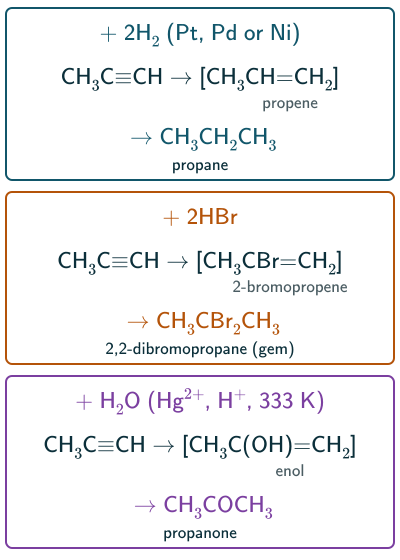
Dihydrogen (Pt, Pd or Ni) adds in two steps through the alkene:
- HC≡CH + H2 → [H2C=CH2]; + H2 → CH3–CH3
- CH3C≡CH + H2 → [CH3CH=CH2]; + H2 → CH3CH2CH3
With a calculated amount of H2 over Lindlar’s catalyst the reaction stops at the cis alkene; sodium in liquid ammonia gives the trans alkene (NCERT Section 9.3.4, page 309; see preparation of alkenes).
Halogens. Propyne and bromine give 1,2-dibromopropene, CH3CBr=CHBr, and then 1,1,2,2-tetrabromopropane, CH3CBr2CHBr2. The reddish orange colour of bromine in carbon tetrachloride disappears, the same test for unsaturation as for alkenes.
Hydrogen halides. Two molecules of HCl, HBr or HI add to form gem dihalides, in which both halogens are on the same carbon:
- HC≡CH + HBr → [CH2=CHBr] (bromoethene); + HBr → CH3CHBr2 (1,1-dibromoethane)
- CH3C≡CH + HBr → [CH3CBr=CH2] (2-bromopropene); + HBr → CH3CBr2CH3 (2,2-dibromopropane)
The second HBr also follows Markovnikov’s rule: its Br goes to the carbon that already carries a Br, because that carbon has fewer hydrogens.
Water. Alkynes do not react with water on their own, but one molecule of water adds on warming with mercuric sulphate and dilute sulphuric acid at 333 K. The first product, an enol (OH on a doubly bonded carbon), rearranges (isomerises) at once into a carbonyl compound:
- HC≡CH + H2O → [CH2=CH–OH] → CH3CHO (ethanal)
- CH3C≡CH + H2O → [CH3C(OH)=CH2] → CH3COCH3 (propanone)
Ethyne is the only alkyne that gives an aldehyde; every other alkyne gives a ketone, because at least one triply bonded carbon carries an alkyl group and the OH goes there (Markovnikov), leaving the C=O between two carbons.
Polymerisation
Linear polymerisation. Under suitable conditions ethyne gives polyacetylene (polyethyne), a high molecular weight polyene with repeating units –(CH=CH–CH=CH)n–. Under special conditions this polymer conducts electricity; thin films of it can be used as battery electrodes, being good conductors that are lighter and cheaper than metals (NCERT pages 317–318).
Cyclic polymerisation. Passed through a red hot iron tube at 873 K, three molecules of ethyne join to form benzene: 3HC≡CH → C6H6. Benzene is the starting molecule for its derivatives, dyes, drugs and many other compounds, and NCERT calls this the best route from aliphatic to aromatic compounds. NCERT Problem 9.14 uses it to make benzene from ethanoic acid (Example 5).
Solved examples
Example 1: Isomers of C<sub>6</sub>H<sub>10</sub> (NCERT Problem 9.13)
Write the alkynes C6H10, the fifth member of the series, with their IUPAC names, and say what isomerism the pairs show.
Straight chain: hex-1-yne, HC≡CCH2CH2CH2CH3; hex-2-yne, CH3C≡CCH2CH2CH3; hex-3-yne, CH3CH2C≡CCH2CH3. Five-carbon chain with a methyl: 3-methylpent-1-yne, HC≡CCH(CH3)CH2CH3; 4-methylpent-1-yne, HC≡CCH2CH(CH3)2; 4-methylpent-2-yne, CH3C≡CCH(CH3)2. Four-carbon chain: 3,3-dimethylbut-1-yne, HC≡CC(CH3)3.
Answer: seven alkynes. Pairs with the same chain (such as hex-1-yne and hex-2-yne) are position isomers; pairs with different chains (such as hex-1-yne and 3-methylpent-1-yne) are chain isomers.
Example 2: Ethyne from calcium carbide
What volume of ethyne at 273 K and 1 atm (22.4 L mol−1) is obtained from 32 g of calcium carbide (CaC2 = 64 g mol−1)?
CaC2 + 2H2O → Ca(OH)2 + C2H2: one mole of carbide gives one mole of ethyne. 32 g is 0.5 mol, so 0.5 mol of C2H2 = 0.5 × 26 = 13 g, occupying 0.5 × 22.4 = 11.2 L.
Answer: 11.2 L (13 g) of ethyne (11.35 L at 273.15 K and 1 bar, where the molar volume is 22.7 L).
Example 3: Which react with sodamide?
Which of but-1-yne, but-2-yne and but-1-ene react with NaNH2? Write the equation.
Only a hydrogen on a triply bonded carbon is acidic enough. But-1-yne, CH3CH2C≡CH, has one; but-2-yne has none (both triply bonded carbons carry CH3); but-1-ene has hydrogens only on sp2 and sp3 carbons.
Answer: only but-1-yne: CH3CH2C≡CH + NaNH2 → CH3CH2C≡C−Na+ + NH3.
Example 4: Two-step additions
Give the final products of (a) propyne with excess HBr, (b) propyne with water (Hg2+, H+, 333 K), (c) ethyne with excess bromine.
(a) Markovnikov twice: H to the CH end each time, Br to the middle carbon both times. (b) The enol CH3C(OH)=CH2 rearranges to the ketone. (c) Br2 adds twice, one Br to each carbon each time.
Answer: (a) 2,2-dibromopropane, CH3CBr2CH3 (a gem dihalide); (b) propanone, CH3COCH3; (c) 1,1,2,2-tetrabromoethane, CHBr2CHBr2.
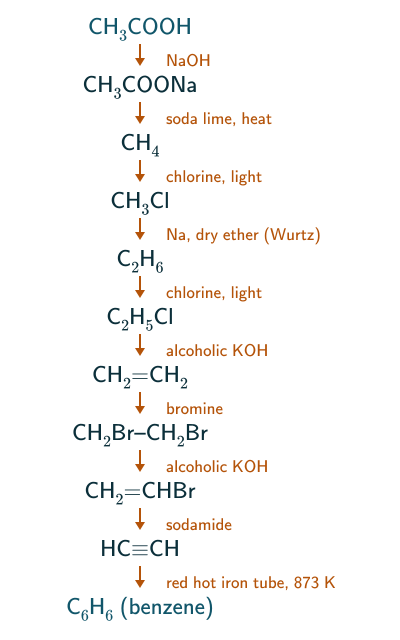
Example 5: Ethanoic acid to benzene (NCERT Problem 9.14)
How will you convert ethanoic acid into benzene?
Shorten to one carbon, double it, then build up unsaturation:
- CH3COOH + NaOH → CH3COONa + H2O;
- CH3COONa + NaOH → CH4 + Na2CO3 (soda lime, heat);
- CH4 + Cl2 → CH3Cl + HCl (light);
- 2CH3Cl + 2Na → C2H6 + 2NaCl (Wurtz, dry ether);
- C2H6 + Cl2 → C2H5Cl + HCl (light);
- C2H5Cl + KOH (alc.) → CH2=CH2 + KCl + H2O;
- CH2=CH2 + Br2 → CH2BrCH2Br;
- CH2BrCH2Br + KOH (alc.) → CH2=CHBr + KBr + H2O;
- CH2=CHBr + NaNH2 → HC≡CH + NaBr + NH3;
- 3HC≡CH → C6H6 (red hot iron tube, 873 K).
Answer: the ten steps above; the key moves are decarboxylation (one carbon fewer), the Wurtz reaction (doubling to two carbons) and the cyclic polymerisation of ethyne.
Example 6: Telling but-1-yne from but-2-yne
How can sodium metal tell but-1-yne from but-2-yne?
But-1-yne has an acidic H on its terminal triply bonded carbon: 2CH3CH2C≡CH + 2Na → 2CH3CH2C≡CNa + H2. But-2-yne has none.
Answer: but-1-yne sets free hydrogen gas and forms a sodium alkynide; but-2-yne, with no acidic hydrogen, forms no such salt and sets free no hydrogen. (Sodium in liquid ammonia can still reduce but-2-yne to trans-but-2-ene, a different reaction.)
Common mistakes to avoid
Common mistake
Thinking every hydrogen of an alkyne is acidic
Only a hydrogen on a triply bonded carbon is acidic. Propyne has one acidic H out of four; but-2-yne has none.
Common mistake
Writing a vicinal dihalide from two HBr
Two molecules of HX give a gem dihalide (both halogens on one carbon), because the second addition also follows Markovnikov’s rule. A vicinal dihalide comes from adding X2 to an alkene.
Common mistake
Expecting an alcohol from the hydration of an alkyne
The enol formed first rearranges at once to a carbonyl compound: ethanal from ethyne, ketones from other alkynes.
Common mistake
Writing O<sub>2</sub> for the gas from limestone
CaCO3 → CaO + CO2. NCERT’s equation 9.55 prints O2, which does not balance.
Common mistake
Comparing bond strengths the wrong way
C≡C (823 kJ mol−1) is stronger overall than C=C (681) and C–C (348), yet alkynes are reactive: their π bonds, not the σ bond, are attacked.
Quick revision summary
- Alkynes: CnH2n−2, at least one C≡C; ethyne (acetylene) is used in the oxyacetylene welding flame.
- Naming: -yne, locant of the first triply bonded carbon; position and chain isomers; no geometrical isomers. C4H6 2, C5H8 3, C6H10 7 alkynes.
- C≡C: sp carbons, one σ + two π at right angles, 180°, 120 pm, 823 kJ mol−1; cylindrical electron cloud; linear.
- Preparation: CaC2 + 2H2O (CaC2 from CaO + 3C; CaO from limestone, with CO2); vicinal dihalide with alcoholic KOH, then NaNH2.
- Physical: three gases, next eight liquids; colourless; weakly polar; immiscible with water.
- Acidity: H on an sp carbon (50% s) is acidic: reacts with Na or NaNH2; HC≡CH > H2C=CH2 > CH3CH3; terminal alkynes only.
- Additions: two molecules of H2, X2 (bromine test), HX (gem dihalides, Markovnikov), H2O with Hg2+/H+ at 333 K (carbonyl compounds).
- Polymerisation: polyacetylene (conducts); 3C2H2 → C6H6 in a red hot iron tube at 873 K.
Formula sheet
- Alkynes CnH2n−2; C≡C = one σ bond + two π bonds
- CaC2 + 2H2O → Ca(OH)2 + C2H2
- HC≡CH + NaNH2 → HC≡CNa + NH3; only H on a triply bonded carbon is acidic
- RC≡CH + 2HBr → RCBr2CH3 (gem dihalide, Markovnikov twice)
- 3C2H2 → C6H6 (red hot iron tube, 873 K)
Questions students ask
What is the difference between terminal and internal alkynes?
A terminal alkyne has its triple bond at the end of the chain, with a hydrogen on one triply bonded carbon (RC≡CH, such as pent-1-yne), while an internal alkyne has carbon groups on both (RC≡CR′, such as pent-2-yne). Only terminal alkynes have an acidic hydrogen, so only they form salts (alkynides) with sodium, sodamide or ammoniacal silver nitrate (Tollens’ reagent), which gives a white precipitate of the silver alkynide: CH3CH2CH2C≡CH + [Ag(NH3)2]+ → CH3CH2CH2C≡CAg↓ + NH4+ + NH3. Pent-2-yne gives no precipitate, so the test tells the two apart.
Why does acetylene not react with NaOH?
Acetylene (ethyne) does not react with NaOH because it is a much weaker acid than water: its pKa is about 25, against 15.7 for water, so OH− is too weak a base to remove its proton. The amide ion of sodamide is a far stronger base, as its conjugate acid, ammonia (pKa about 38), is a weaker acid than ethyne, so HC≡CH + NaNH2 → HC≡C−Na+ + NH3 goes almost to completion. The order of acid strength is H2O > C2H5OH > HC≡CH > NH3 > CH2=CH2 > CH3CH3, which is also why water turns sodium ethynide back into ethyne.
Are alkynes more reactive than alkenes?
Alkynes are usually less reactive than alkenes towards electrophilic addition, even though they have two π bonds: bromine, for example, adds to ethyne more slowly than to ethene. The sp carbons, with 50% s character, hold the π electrons more tightly than sp2 carbons do, and the vinylic cation formed when an electrophile adds to an alkyne is less stable than the alkyl carbocation formed from an alkene. Alkynes are not less reactive in every way: on a metal catalyst they take up hydrogen in preference to alkenes, which is why Lindlar’s catalyst can stop at the alkene, and a terminal alkyne gives up a proton to NaNH2, which no alkene does.
What is the difference between acetylene and ethylene?
Acetylene is the common name of ethyne, HC≡CH (C2H2), an alkyne, while ethylene is that of ethene, CH2=CH2 (C2H4), an alkene. Ethyne has a triple bond between sp carbons, so the molecule is linear (180°) with a C≡C length of 120 pm, while ethene has a double bond between sp2 carbons, so it is planar, with angles of about 120° and a C=C length of 134 pm. Ethyne’s hydrogens are weakly acidic and it can add two molecules of H2 or Br2, while ethene’s are not and it adds one. Ethyne fuels the oxyacetylene welding flame; ethene is made into polythene and is the plant hormone that ripens fruit.
How does calcium carbide ripen mangoes, and why is it banned in India?
Calcium carbide ripens mangoes because it reacts with moisture to give acetylene, CaC2 + 2H2O → Ca(OH)2 + C2H2, and acetylene acts on the fruit like ethylene, the natural ripening hormone, though more weakly. India’s food regulator, FSSAI, prohibits it because industrial carbide carries traces of arsenic and phosphorus compounds, which give the toxic gases arsine and phosphine and can leave residues on the fruit and harm the people handling it. FSSAI permits ethylene gas instead, at a low concentration, usually in ripening chambers.
Why is acetylene used for welding?
Acetylene is used for welding because it burns in pure oxygen with the hottest flame of any common fuel gas, above 3000 °C, hot enough to melt steel locally. Two facts combine: ethyne is an endothermic compound (ΔfH⊖ about +227 kJ mol), so its combustion also releases that stored energy, and 2C2H2 + 5O2 → 4CO2 + 2H2O forms only one molecule of water per molecule of fuel, so less heat is spent warming the products. Propane and LPG give more heat per mole but a cooler flame, so they serve for heating and cutting, not for welding steel.
Practice questions
Try each question first, then open the answer to check your working.
-
Q1. Write the molecular formula of the alkyne with five carbon atoms and give the structural formulas and IUPAC names of its isomers (NCERT Exercise 9.3 (b)).
Show answerHide answer
C5H8 (CnH2n−2): HC≡C–CH2–CH2–CH3, pent-1-yne; CH3–C≡C–CH2–CH3, pent-2-yne; HC≡C–CH(CH3)–CH3, 3-methylbut-1-yne.
-
Q2. How many σ and π bonds are there in ethyne and in propyne?
Show answerHide answer
Ethyne, HC≡CH: 3 σ (one C–C, two C–H) and 2 π. Propyne, CH3C≡CH: 6 σ (two C–C, four C–H) and 2 π.
-
Q3. Why is ethyne more acidic than ethene and ethane?
Show answerHide answer
Its hydrogens are on sp carbons, with 50% s character, against 33% (sp2) in ethene and 25% (sp3) in ethane. The sp carbon is the most electronegative, so it holds the C–H bonding pair most strongly and the hydrogen leaves most easily as H+.
-
Q4. Write the equations for the preparation of ethyne from limestone and coke.
Show answerHide answer
CaCO3 → CaO + CO2 (heat); CaO + 3C → CaC2 + CO; CaC2 + 2H2O → Ca(OH)2 + C2H2.
-
Q5. What is formed when ethyne reacts with (a) excess HBr, (b) water in the presence of HgSO4 and dilute H2SO4 at 333 K?
Show answerHide answer
(a) 1,1-Dibromoethane, CH3CHBr2, through bromoethene. (b) Ethanal, CH3CHO, through the enol CH2=CHOH.
-
Q6. Which alkynes C4H6 form a sodium salt with sodium metal? Give a reason.
Show answerHide answer
Only but-1-yne, CH3CH2C≡CH, forms a sodium salt and sets free hydrogen, because it has a hydrogen on a triply bonded carbon. But-2-yne, CH3C≡CCH3, has no such hydrogen, so it forms no salt (sodium in liquid ammonia can still reduce it to trans-but-2-ene).
-
Q7. Name the product of the cyclic polymerisation of ethyne and state the conditions.
Show answerHide answer
Benzene: three molecules of ethyne join when passed through a red hot iron tube at 873 K. 3C2H2 → C6H6.
-
Q8. Arrange C–C, C=C and C≡C in order of (a) bond length and (b) bond enthalpy.
Show answerHide answer
(a) C–C (154 pm) > C=C (134 pm) > C≡C (120 pm). (b) C≡C (823 kJ mol−1) > C=C (681) > C–C (348).
-
Q9. Which reagents convert 1,2-dibromoethane into ethyne?
Show answerHide answer
Alcoholic KOH first (removes one HBr, giving bromoethene), then sodamide, NaNH2 (removes the second HBr).
-
Q10. What is polyacetylene and why is it interesting?
Show answerHide answer
A linear polymer of ethyne, –(CH=CH–CH=CH)n–, with alternating single and double bonds. Under special conditions it conducts electricity, and thin films can serve as battery electrodes that are lighter and cheaper than metals.