Carcinogenicity and toxicity of hydrocarbons
NCERT Class 11 Chemistry Chapter 9 Section 9.6
Quick answer
Benzene and polynuclear hydrocarbons with more than two fused benzene rings are toxic and carcinogenic (cancer causing). They form on incomplete combustion of tobacco, coal and petroleum, and in the body they undergo biochemical reactions that damage DNA and cause cancer. NCERT’s examples include 1,2-benzanthracene, 3-methylcholanthrene and 1,2-benzpyrene.
With your textbook
NCERT Chemistry Part II (Class 11), Chapter 9 “Hydrocarbons”, Section 9.6 “Carcinogenicity and Toxicity”, page 325.
Open the official NCERT chapter (PDF, 3.3 MB, ncert.nic.in) (opens in a new tab)
Checked against the 2026-27 reprint on .
Which hydrocarbons are toxic and carcinogenic?
Carcinogenic hydrocarbons
Benzene and polynuclear hydrocarbons containing more than two benzene rings fused together are toxic and said to possess cancer producing (carcinogenic) property.
NCERT Chemistry Part II (Class 11), Section 9.6, page 325
- Toxic means harmful to living things; carcinogenic means able to cause cancer.
- Polynuclear (polycyclic) aromatic hydrocarbons have several benzene rings fused together, two neighbouring rings sharing a C–C bond, as in naphthalene, one of the benzenoid compounds of Unit 8.
In plain words: benzene itself, and the larger flat molecules made of three or more benzene rings joined edge to edge, are poisons, and some of them can cause cancer. They are not rare laboratory curiosities: they form whenever organic matter burns without enough air, so they are found in tobacco smoke and in the smoke and soot from coal and petroleum.
Where they come from
Such polynuclear hydrocarbons are formed on incomplete combustion of organic materials like tobacco, coal and petroleum (NCERT Section 9.6, page 325). When a fuel burns in plenty of air, its carbon ends up as carbon dioxide, as in complete combustion in thermodynamics. With too little air, part of the carbon is left as soot (carbon black), and, beyond the NCERT text, some carbon fragments join into fused-ring aromatic molecules.
Beyond the NCERT text, the same incomplete burning happens in vehicle engines, so exhaust carries these hydrocarbons, and in smoke from wood and coal fires, and in food charred over a flame. Good ventilation, complete combustion and avoiding tobacco smoke all reduce exposure.
How they cause cancer
They enter into human body and undergo various biochemical reactions and finally damage DNA and cause cancer.
NCERT Chemistry Part II (Class 11), Section 9.6, page 325
In more detail, beyond the NCERT text: the hydrocarbons themselves are fairly unreactive, but the body’s own chemistry changes them into reactive products. These can bond to DNA, and damaged DNA that is copied wrongly can start the uncontrolled cell growth of cancer.
NCERT’s examples
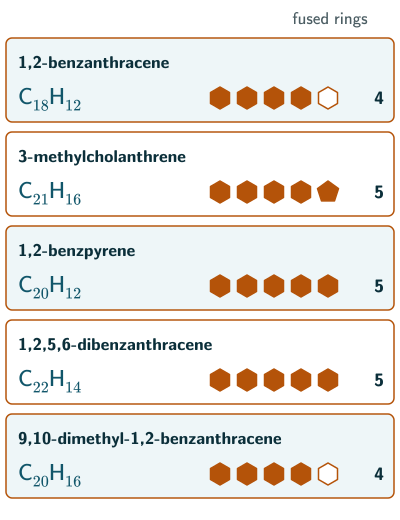
The box on NCERT page 325 shows five carcinogenic hydrocarbons, each with four or five fused rings:
- 1,2-benzanthracene (four rings);
- 3-methylcholanthrene (four six-membered rings and one five-membered ring, with a methyl group);
- 1,2-benzpyrene (five rings);
- 1,2,5,6-dibenzanthracene (five rings);
- 9,10-dimethyl-1,2-benzanthracene (four rings, with two methyl groups).
Beyond NCERT: most of these are older names. Today 1,2-benzanthracene is usually called benz[a]anthracene, 1,2,5,6-dibenzanthracene is dibenz[a,h]anthracene and 9,10-dimethyl-1,2-benzanthracene is 7,12-dimethylbenz[a]anthracene. The structure NCERT draws for 1,2-benzpyrene is the compound now called benzo[a]pyrene (older name 3,4-benzpyrene); in older books, the name 1,2-benzpyrene belongs to a different isomer, benzo[e]pyrene, so NCERT’s label does not match its drawing.
Solved examples
Example 1: Which fall under NCERT’s description?
Which of these does NCERT’s description cover: benzene, naphthalene (two fused rings), anthracene (three fused rings), 1,2-benzanthracene (four fused rings), hexane?
The description covers benzene itself and polynuclear hydrocarbons with more than two fused benzene rings.
Answer: benzene, anthracene and 1,2-benzanthracene. Naphthalene has only two fused rings, and hexane is not aromatic.
Example 2: Rings and π bonds from the formula
1,2-Benzpyrene is C20H12. Use the degree of unsaturation to check that five fused rings fit.
Degree of unsaturation = (2 × 20 + 2 − 12)/2 = 15, which equals rings + π bonds. Five rings leave 15 − 5 = 10 π bonds, that is, 20 π electrons, one for each of the 20 sp2 carbons.
Answer: 15 = 5 rings + 10 π bonds, so five fused rings fit the formula.
Example 3: Why incomplete combustion matters
Methane burns completely as CH4 + 2O2 → CO2 + 2H2O, but with too little air as CH4 + O2 → C + 2H2O (NCERT equation 9.20; see combustion of alkanes). Why is the second kind of burning linked to carcinogens?
In incomplete burning, carbon is left unburnt as soot; NCERT states that polynuclear hydrocarbons form under these conditions (beyond the NCERT text: carbon fragments join into fused rings), and they are carried in the smoke and soot.
Answer: incomplete combustion leaves carbon as soot and polynuclear hydrocarbons; burning with enough air turns the carbon into CO2 instead.
Common mistakes to avoid
Common mistake
Thinking only large ring systems are dangerous
NCERT names benzene itself as toxic and carcinogenic, along with the polynuclear hydrocarbons.
Common mistake
Applying NCERT’s description to naphthalene
NCERT’s description needs more than two fused rings. Naphthalene has two; anthracene, with three, is the first that the description covers, and NCERT’s examples all have four or five. This does not make naphthalene harmless; it is toxic in its own right.
Common mistake
Calling the hydrocarbon itself the reactive species
NCERT says they undergo various biochemical reactions in the body and finally damage DNA. Beyond NCERT: the hydrocarbons themselves are fairly unreactive, and it is the reactive products of these reactions that bond to DNA.
Quick revision summary
- Benzene and polynuclear hydrocarbons with more than two fused benzene rings are toxic and carcinogenic.
- They form on incomplete combustion of tobacco, coal and petroleum.
- In the body they undergo biochemical reactions that damage DNA and cause cancer.
- NCERT’s examples: 1,2-benzanthracene, 3-methylcholanthrene, 1,2-benzpyrene, 1,2,5,6-dibenzanthracene, 9,10-dimethyl-1,2-benzanthracene.
Formula sheet
- Complete combustion: CH4 + 2O2 → CO2 + 2H2O; incomplete: CH4 + O2 → C + 2H2O
- Degree of unsaturation of CxHy = (2x + 2 − y)/2 = rings + π bonds
- 1,2-Benzanthracene C18H12 (4 rings); 1,2-benzpyrene C20H12 (5 rings)
Questions students ask
What is the difference between toxic and carcinogenic?
A toxic substance harms the body, often soon after exposure and more severely the larger the dose, while a carcinogenic substance can cause cancer, usually by damaging DNA, often years after repeated exposure. Carbon monoxide is highly toxic, as it binds to haemoglobin and stops it carrying oxygen, but it does not cause cancer; benzene is both, since a large dose of its vapour causes dizziness and unconsciousness, while long exposure to small amounts can cause leukaemia, a cancer of the blood-forming cells. Carcinogenicity is thus one particular kind of toxicity.
Are polycyclic and polynuclear aromatic hydrocarbons the same?
Polycyclic aromatic hydrocarbons (PAHs) and polynuclear aromatic hydrocarbons are two names for the same compounds, hydrocarbons with two or more fused benzene rings, such as naphthalene, anthracene and benzo[a]pyrene; ‘polyaromatic hydrocarbons’ is a third name. ‘Polynuclear’ comes from the old name ‘benzene nucleus’ for a benzene ring, so it means ‘many rings’ and has nothing to do with atomic nuclei; NCERT says ‘polynuclear hydrocarbons’, while PAH is the usual name in health and environmental reports. Some books also count unfused ring systems such as biphenyl as polynuclear, but NCERT’s carcinogens all have fused rings.
What is benzopyrene, and where is it found?
Benzopyrene usually means benzo[a]pyrene, C20H12, a pale yellow solid with five fused benzene rings and the best-known carcinogenic polycyclic aromatic hydrocarbon; it is the compound NCERT draws as 1,2-benzpyrene. It forms whenever organic matter burns incompletely, so it is found in tobacco smoke, vehicle exhaust, coal tar, soot and smoked or charcoal-grilled food, and it has no commercial use apart from research. In the body, liver enzymes oxidise it to a diol epoxide, which bonds to the guanine bases of DNA and can cause the copying errors that start cancer.
Which carcinogenic hydrocarbon is present in petrol?
Benzene is the carcinogenic hydrocarbon of most concern in petrol: it is a natural part of crude oil and also forms in refining, and Indian BS VI petrol (IS 2796) may contain at most 1% benzene by volume. Petrol vapour at filling stations therefore carries some benzene, and incomplete burning in engines adds polynuclear hydrocarbons such as benzo[a]pyrene to the exhaust. Most other hydrocarbons in petrol, such as the heptane and octane isomers, are not known to cause cancer on their own, but in 2025 the International Agency for Research on Cancer (IARC) classed petrol as a whole as carcinogenic to humans, so breathing its vapour is best kept to a minimum.
Which foods contain polycyclic aromatic hydrocarbons?
Polycyclic aromatic hydrocarbons reach food in the highest amounts when it is cooked or processed with smoke or an open flame: charcoal-grilled, barbecued and tandoori meat and fish, smoked foods and the charred parts of any food carry the most, because fat dripping onto the flame burns incompletely and the smoke coats the food. Smaller amounts settle on cereals and leafy vegetables from polluted air, and enter oils when oilseeds are dried with smoke; as these are eaten in large amounts, food is the main source of PAHs for non-smokers. Grilling farther from the flame, not letting food char and cutting off burnt parts all reduce the amount eaten.
Is carcinogenicity and toxicity in the JEE Main 2027 and NEET (UG) 2026 syllabuses?
Carcinogenicity and toxicity is not named in the JEE Main 2027 (NTA) or NEET (UG) 2026 (NMC) syllabus: Unit 15, Hydrocarbons, of both covers the classification, nomenclature, preparation and reactions of alkanes, alkenes, alkynes and aromatic hydrocarbons, with nothing on toxicity. It is NCERT Section 9.6 (page 325) of Class 11 Chemistry Part II, and the CBSE Class 11 syllabus for 2026–27 lists ‘Carcinogenic and Toxicity’ in Unit 9, Hydrocarbons, so it counts for CBSE school examinations. The nearest entrance-exam line is Unit 16’s ‘environmental effects of chloroform, iodoform, freons and DDT’.
Practice questions
Try each question first, then open the answer to check your working.
-
Q1. Which hydrocarbons does NCERT describe as toxic and carcinogenic?
Show answerHide answer
Benzene, and polynuclear hydrocarbons containing more than two benzene rings fused together (NCERT page 325).
-
Q2. How are polynuclear hydrocarbons formed, and name three sources.
Show answerHide answer
By the incomplete combustion of organic materials such as tobacco, coal and petroleum.
-
Q3. How do these hydrocarbons cause cancer?
Show answerHide answer
They enter the human body, undergo various biochemical reactions and finally damage DNA, which causes cancer.
-
Q4. Name any three of the carcinogenic hydrocarbons shown by NCERT.
Show answerHide answer
Any three of: 1,2-benzanthracene, 3-methylcholanthrene, 1,2-benzpyrene, 1,2,5,6-dibenzanthracene and 9,10-dimethyl-1,2-benzanthracene.
-
Q5. Find the degree of unsaturation of 1,2-benzanthracene, C18H12, and show that it fits four fused rings.
Show answerHide answer
(36 + 2 − 12)/2 = 13 = rings + π bonds. Four rings leave 9 π bonds, 18 π electrons for the 18 sp2 carbons.