Types of solutions
NCERT Class 12 Chemistry Chapter 1 Section 1.1
Quick answer
A solution is a homogeneous mixture, with solvent designation usually based on the major component and the retained physical state. NCERT classifies binary solutions into nine types using the components’ states before mixing; gaseous solutions contain vapour rather than droplets or dust. Solid alloys count as solutions when they form one homogeneous phase.
With your textbook
NCERT Chemistry Part I (Class 12), Chapter 1 “Solutions”, Section 1.1 “Types of Solutions”, pages 1–2.
Open the official NCERT chapter (PDF, 3.9 MB, ncert.nic.in) (opens in a new tab)
Checked against the 2026-27 reprint on .
What is a solution?
Solution, solvent and solute
A solution is a homogeneous mixture: its composition and properties are the same throughout. The solvent is generally the component present in the largest amount, and it decides the physical state of the solution; the other components are the solutes (NCERT Section 1.1, page 1). In NCERT’s words:
Solutions are homogeneous mixtures of two or more than two components.
NCERT Chemistry Part I (Class 12), Section 1.1, page 1
NCERT’s unit deals with binary solutions, of two components. Solvent and solute can each be a gas, a liquid or a solid, which gives nine types (NCERT Table 1.1, page 2).
In plain words: stir sugar into water and it disappears. Every spoonful of the result tastes the same, because the sugar is spread evenly down to the level of molecules. That evenness is what makes it a solution. In muddy water the particles can be seen and they settle, so it is not one. The same idea covers air and many alloys.
Why solutions matter
- Almost all processes in the body occur in liquid solutions, and in daily life we rarely meet pure substances: most things are mixtures, and their uses depend on their composition (NCERT page 1).
- Alloys show how much composition matters: brass (copper and zinc) behaves quite differently from German silver (copper, zinc and nickel) or bronze (copper and tin) (NCERT page 1).
- Tiny amounts matter too. NCERT: “1 part per million (ppm) of fluoride ions in water prevents tooth decay, while 1.5 ppm causes the tooth to become mottled and high concentrations of fluoride ions can be poisonous (for example, sodium fluoride is used in rat poison)” (page 1). Beyond the NCERT text: these are not exact thresholds, since fluorosis depends on total fluoride exposure while teeth develop. WHO’s drinking-water guideline is 1.5 mg L−1, with increasing risk above it; CDC reports the US fluoridation recommendation as 0.7 mg L−1 (WHO Guidelines for Drinking-water Quality, 2022; CDC, About Dental Fluorosis).
- Intravenous injections “are always dissolved in water containing salts at particular ionic concentrations that match with blood plasma concentrations” (NCERT page 1). Strictly, what matters is the osmotic effect, together with chemical compatibility with blood: normal saline, 0.9% (mass/volume) sodium chloride, is isotonic with the fluid in blood cells and “safe to inject intravenously” (NCERT Section 1.6, page 22), though it does not contain every ion in plasma (reasoned).
- So a solution is described not just by what is in it but by how much: its concentration, the next topic.
Binary solutions
- A binary solution has exactly two components, a solvent and one solute (NCERT pages 1–2).
- Which one is the solvent? NCERT gives two marks of the solvent: it is generally the component present in the largest quantity, and it decides the physical state of the solution (NCERT page 1). In a glass of sugar water, water is both.
- Solvent designation is a convention: for the ordinary examples here, the component whose state is retained is called the solvent even if it is not the greater mass. For example, a thick syrup can hold more sugar than water by mass, yet it is a liquid, like water, so water is still taken as the solvent.
- An idealised single-phase brass containing only copper and zinc is a binary solid solution; German silver, of copper, zinc and nickel, is not, because it has three components (NCERT page 1).
- A solution is homogeneous, unlike a heterogeneous mixture such as sand stirred into water, whose parts can be seen and separated.
Gaseous, liquid and solid solutions
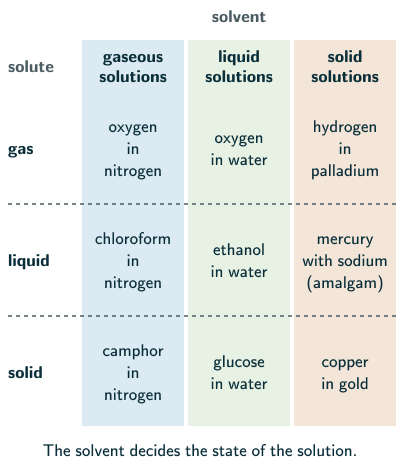
- The solvent’s state names the solution: a gas as solvent gives a gaseous solution, a liquid a liquid solution, a solid a solid solution. Each solvent can take a gas, a liquid or a solid as solute (NCERT Table 1.1, page 2):
- Gaseous solutions: a mixture of oxygen and nitrogen gases (gas in gas); chloroform vapour mixed with nitrogen (liquid-origin solute in gas); camphor vapour in nitrogen (solid-origin solute in gas). The solute-state labels refer to the substances before mixing: suspended droplets or dust would not make a gaseous solution.
- Liquid solutions: oxygen dissolved in water (gas in liquid); ethanol dissolved in water (liquid in liquid); glucose dissolved in water (solid in liquid).
- Solid solutions: hydrogen in palladium (gas in solid); a solid sodium–mercury amalgam of suitable composition (liquid-origin solute in solid; other amalgam compositions may be liquid); copper dissolved in gold (solid in solid).
- NCERT’s unit mostly considers liquid solutions and how they form, then their properties, such as vapour pressure and colligative properties (NCERT page 1).
Solved examples
Example 1: Name the type
For each solution, name the solvent and the solute and say which type it is: (a) soda water, carbon dioxide in water; (b) brass, zinc in copper; (c) sugar syrup; (d) hydrogen held in palladium.
Answer: (a) Solvent water, solute carbon dioxide: gas in liquid. (b) Solvent copper, solute zinc: solid in solid. (c) Solvent water, solute sugar: solid in liquid. (d) Solvent palladium, solute hydrogen: gas in solid (types from NCERT Table 1.1, page 2).
Example 2: Fluoride in drinking water
Water of density 1 kg L−1 contains 1 ppm of fluoride ions by mass. How much fluoride is in 2 L of it, and how much at 1.5 ppm?
Answer: 2 L has a mass of 2 kg = 2 × 10⁶ mg. At 1 ppm, fluoride = 2 × 10⁶ mg/106 = 2 mg; at 1.5 ppm, 3 mg (levels from NCERT page 1; ppm defined in NCERT Eq. (1.3), page 3).
Example 3: Binary or not?
Which of these are binary solutions: brass, bronze, German silver, a solution of glucose and salt in water?
Answer: The idealised two-component brass (copper and zinc) and bronze (copper and tin) are binary mixtures, and are solutions when single-phase. Commercial alloys may contain extra elements or several phases. German silver (copper, zinc and nickel) and glucose with salt in water each have three components, so they are not (NCERT page 1).
Example 4: Which is the solvent?
20 mL of ethanol is mixed with 80 mL of water. Which is the solvent?
Answer: Water, the component present in the larger amount; the solution is a liquid, like both components (NCERT page 1).
Common mistakes to avoid
Common mistake
Thinking every solution is a liquid
Air is a gaseous solution and many alloys, such as brass, are solid solutions (types as in NCERT Table 1.1, page 2).
Common mistake
Calling any mixture with water a solution
Only a homogeneous mixture is a solution; sand stirred into water is a heterogeneous mixture (homogeneous: NCERT page 1).
Common mistake
Thinking the solvent must be water
The solvent is whichever component sets the state, usually the one in the largest amount: nitrogen in air, copper in brass (rule from NCERT page 1).
Quick revision summary
- A solution is a homogeneous mixture of two or more components.
- Solvent: usually the component in the largest amount; it decides the state. The others are solutes.
- A binary solution has two components.
- The solvent’s state gives gaseous, liquid and solid solutions; with three possible solute states, there are nine types.
- Tiny concentrations can matter: fluoride illustrates how concentration and total exposure affect benefits and risks; NCERT’s numbers are not sharp biological thresholds.
Formula sheet
- Gaseous solutions: O in N; CHCl in N; camphor in N
- Liquid solutions: O, CHOH or glucose in water
- Solid solutions: H in Pd; Hg with Na; Cu in Au
- Brass: Cu + Zn; bronze: Cu + Sn; German silver: Cu + Zn + Ni
- ppm = (parts of component ÷ total parts) × 10
Questions students ask
Is every alloy a solid solution?
No. A solid solution is one homogeneous solid phase; many alloys contain two or more phases. NCERT’s approximate 15% atomic-radius rule is one factor favouring substitutional solubility, not a guarantee (Class 12 Unit 4, page 104). Beyond the NCERT text, many slowly cooled carbon steels contain pearlite, a layered mixture of ferrite and iron carbide, rather than one uniform solid solution (Wikipedia, “Pearlite”).
What are substitutional and interstitial solid solutions?
In a substitutional solid solution, solute atoms occupy solvent-atom sites, as in a suitable single-phase copper–gold alloy. In an interstitial solid solution, small atoms occupy gaps in the host lattice, as carbon does in austenite or hydrogen in palladium. Hydrogen absorbed in palladium is principally atomic; the label “gas in solid” identifies its source. Interstitial compounds such as TiC are related examples of small atoms in a metal lattice, but an interstitial compound and a dilute solid solution are not identical concepts (NCERT Class 12 Unit 4, page 104).
What is the difference between a true solution, a colloid and a suspension?
In the usual school examples, a true solution contains molecular or ionic solute dispersed homogeneously; a suspension contains larger particles that can settle and be filtered. Colloidal dimensions are roughly 1 nm to 1 μm in at least one direction, and such dispersions can scatter light, as milk and fog do (Wikipedia, “Colloid”). These size boundaries are approximate: dissolved macromolecules may exceed 1 nm, so particle size alone is not an absolute test of whether a material is a molecular solution.
Are types of solutions in the JEE Main and NEET syllabus?
Types of solutions are not named in the JEE Main 2027 or the NEET (UG) 2026 syllabus: Unit 5, Solutions, of both begins with “Different methods for expressing the concentration of solution” and lists no types of solution. The ideas on this page, solution, solvent, solute and binary solution, are still used throughout that unit, from concentration to colligative properties. NCERT also asks about the types in its Exercises 1.1 and 1.2 (NCERT page 27), so school examinations can set them.
Practice questions
Try each question first, then open the answer to check your working.
-
Q1. What makes a mixture a solution?
Show answerHide answer
It must be homogeneous: its composition and properties must be the same throughout (NCERT page 1).
-
Q2. Give NCERT’s example of a liquid solute in a solid solvent, and of a solid solute in a gaseous solvent.
Show answerHide answer
An amalgam of mercury with sodium; camphor in nitrogen gas (NCERT Table 1.1, page 2).
-
Q3. Why is the state of a solution set by its solvent and not its solute?
Show answerHide answer
NCERT states that the solvent determines the state (page 1). The reason (reasoned): when the components are in different states, the one whose state the solution keeps is called the solvent. In most solutions it is also the main component, with the solute particles spread among its particles.