Vapour pressure of liquid solutions
NCERT Class 12 Chemistry Chapter 1 Section 1.4
Quick answer
For an ideal liquid solution with approximately ideal vapour, Raoult’s law relates each partial vapour pressure to its liquid mole fraction and pure-component vapour pressure. The total pressure is linear in liquid composition, and a mixture’s vapour is enriched in the more volatile component. A non-volatile solute lowers solvent vapour pressure in the ideal dilute model; real mixtures require activity corrections.
With your textbook
NCERT Chemistry Part I (Class 12), Chapter 1 “Solutions”, Section 1.4 “Vapour Pressure of Liquid Solutions”, pages 9–13.
Open the official NCERT chapter (PDF, 3.9 MB, ncert.nic.in) (opens in a new tab)
Checked against the 2026-27 reprint on .
What is the vapour pressure of a solution?
Vapour pressure and Raoult’s law
The vapour pressure of a liquid is the pressure its vapour exerts over it at equilibrium, at a given temperature (NCERT page 12). In a solution, each volatile component contributes a partial vapour pressure, and Raoult’s law relates it to that component’s mole fraction in the liquid. In NCERT’s words, for a solution of volatile liquids:
the partial vapour pressure of each component of the solution is directly proportional to its mole fraction present in solution.
NCERT Chemistry Part I (Class 12), Section 1.4.1, page 10
So p1 = x1p10, where p10 is the vapour pressure of pure component 1 at the same temperature (NCERT Eq. (1.12), page 10). A non-volatile solute, such as sugar, lowers the vapour pressure of the solvent (NCERT page 12).
In plain words: molecules escape from the liquid and return from the vapour. At equilibrium those opposing rates balance. For an ideal liquid mixture with an approximately ideal vapour, Raoult’s law says that halving a component’s liquid mole fraction halves its equilibrium partial vapour pressure at the same temperature.
Vapour pressure of liquid-liquid solutions
- A liquid solution has a liquid solvent; the solute can be a gas, a liquid or a solid. Gases in liquids were covered under solubility; here the solutes are liquids and solids (NCERT page 9).
- The liquid solvent is generally volatile; the solute may or may not be. NCERT considers binary solutions of (i) liquids in liquids and (ii) solids in liquids (NCERT page 9).
- Take a binary solution of two volatile liquids, components 1 and 2, in a closed vessel. Both evaporate until the vapour and the liquid are in equilibrium. The total vapour pressure is then ptotal, and the partial vapour pressures p1 and p2 depend on the mole fractions x1 and x2 in the liquid (NCERT page 9).
- The French chemist François-Marie Raoult gave the relationship, now called Raoult’s law (NCERT page 9). His name is François-Marie; NCERT’s “Francois Marte” is a spelling error. The concentration–pressure relationship is the point needed here.
Unless stated otherwise, the calculations below assume an ideal liquid solution, ideal-gas vapour at low pressure, fixed temperature and enough liquid to remain at equilibrium. Mole fractions refer to the equilibrium liquid, which can differ from the initially mixed composition if much material evaporates.
Raoult’s law for two volatile liquids
- For each component (NCERT Eqs. (1.12)–(1.13), page 10):
Raoult’s law (NCERT Eqs. 1.12–1.13)
- By Dalton’s law of partial pressures, the total pressure is their sum, ptotal = p1 + p2 (NCERT Eq. (1.14), page 10). With x1 = 1 − x2 (NCERT Eqs. (1.15)–(1.16), page 10):
Total vapour pressure (NCERT Eqs. 1.15–1.16)
- So (NCERT page 10):
- the total vapour pressure can be related to the mole fraction of either component;
- it varies linearly with x2;
- depending on the two pure vapour pressures, it rises or falls as the mole fraction of component 1 rises.
- Composition of the vapour. The vapour above the liquid has its own mole fractions, y1 and y2. By Dalton’s law (NCERT Eqs. (1.17)–(1.19), page 11):
Mole fraction in the vapour (NCERT Eq. 1.19)
- Putting xi = yiptotal/pi0 into x1 + x2 = 1 gives the total pressure from the vapour’s composition (reasoned from NCERT Eqs. (1.12)–(1.19)):
Total pressure from the vapour composition
- For an ideal mixture containing both components with different pure vapour pressures, the vapour is richer in the more volatile component, the one with the higher pure vapour pressure (NCERT page 11; see Example 1). NCERT says “always”, but azeotropes, met next, have liquid and vapour of the same composition (NCERT page 14).
Vapour pressure–composition plots
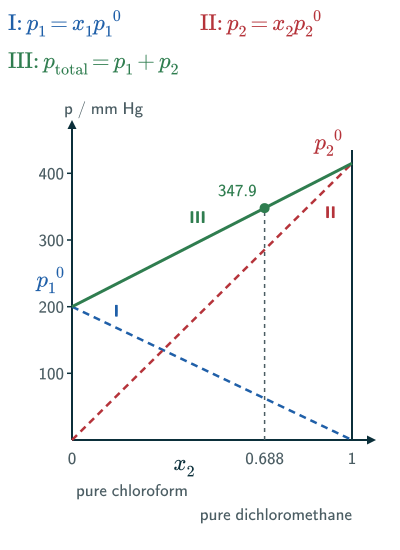
- Plotting p1 and p2 against the mole fractions gives straight lines (I and II in NCERT Figure 1.3), each passing through the point where that component’s mole fraction is one (NCERT page 10).
- The plot of ptotal against x2 (line III) is also a straight line. If component 1 is the less volatile, p10 < p20, the lowest value of ptotal is p10 and the highest is p20 (NCERT page 10).
- A solution that follows these straight lines at every composition is an ideal solution; real solutions that do not are taken up next, in ideal and non-ideal solutions (NCERT page 13).
Raoult’s law as a special case of Henry’s law
- Raoult’s law, pi = xipi0, and Henry’s law, p = KHx, have the same form: the partial pressure of a volatile component, or a gas, is proportional to its mole fraction in the solution (NCERT page 12).
- Only the constant differs: Raoult’s law becomes a special case of Henry’s law in which KH becomes equal to p10 (NCERT page 12). Strictly, the constants coincide for an ideal solution; in a general real mixture, Henry’s law describes a component’s infinite-dilution limit while Raoult’s limit is near the pure component, so their constants need not match (reasoned).
Vapour pressure of solutions of solids in liquids
- Many solutions are solids dissolved in liquids: sodium chloride, glucose, urea or cane sugar in water, and iodine or sulphur in carbon disulphide (NCERT page 12).
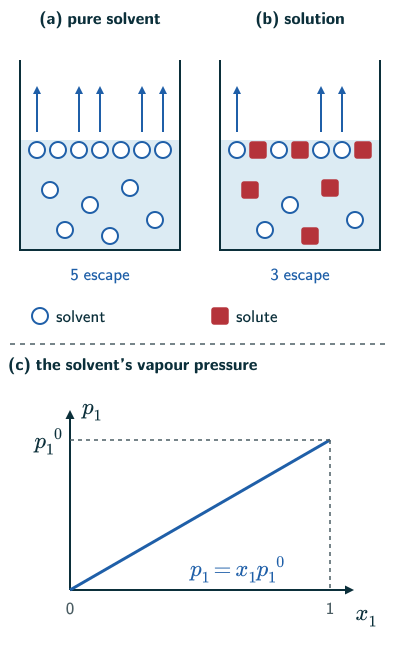
- In a pure liquid the whole surface is occupied by the liquid’s molecules. Add a non-volatile solute and the vapour comes from the solvent alone, and the vapour pressure of the solution is found to be lower than that of the pure solvent at the same temperature (NCERT page 12, NCERT Figure 1.4).
- NCERT’s picture: solute particles now take up part of the surface, so fewer solvent molecules escape from it, and the vapour pressure falls (NCERT page 12). Treat it as a picture only. A sucrose molecule is much bigger than a urea molecule and would cover more surface, yet equal moles of the two lower the vapour pressure by nearly the same amount. What sets the lowering is the solvent’s mole fraction (reasoned).
- In the ideal dilute particle-count model, the fall depends on the number of solute particles relative to solvent: 1.0 mol of sucrose or 1.0 mol of urea in one kg of water lowers its vapour pressure by nearly the same amount at the same temperature (NCERT page 12; see Example 4).
- NCERT states Raoult’s law in a general form, for any solution (NCERT page 12). Strictly, it holds over the whole range only for ideal solutions, and for the solvent of a dilute solution; non-ideal solutions, taken up next, deviate from it (ideal-solution model; thermodynamic activity corrections apply to real mixtures). For a non-volatile solute (component 2) in a solvent (component 1), only the solvent counts (NCERT Eq. (1.20), page 13):
Solvent with a non-volatile solute (NCERT Eq. 1.20)
- A plot of p1 against x1 is a straight line from zero to p10 (NCERT Figure 1.5, page 13). Since x1 = 1 − x2, the lowering is p10 − p1 = x2p10, the starting point of colligative properties (reasoned; NCERT develops it in Section 1.6.1).
Solved examples
Example 1: Chloroform and dichloromethane (NCERT Example 1.5)
At 298 K the vapour pressures of chloroform (CHCl3) and dichloromethane (CH2Cl2) are 200 mm Hg and 415 mm Hg. A solution is made from 25.5 g of CHCl3 and 40 g of CH2Cl2. Find (i) its vapour pressure and (ii) the mole fractions in the vapour.
Answer: Molar masses: CH2Cl2 85 g mol−1, CHCl3 119.5 g mol−1. Moles: 40/85 = 0.4706 and 25.5/119.5 = 0.2134, total 0.6840. So x(CH2Cl2) = 0.688 and x(CHCl3) = 0.312.
(i) ptotal = 200 + (415 − 200) × 0.688 = 347.9 mm Hg.
(ii) p(CH2Cl2) = 0.688 × 415 = 285.5 mm Hg and p(CHCl3) = 0.312 × 200 = 62.4 mm Hg, so y(CH2Cl2) = 285.5/347.9 = 0.82 and y(CHCl3) = 0.18. The vapour is richer in the more volatile dichloromethane (NCERT Example 1.5, page 11).
NCERT slip (page 11): the working says “Using equation (2.16)” and “the relation (2.19)”; they are Eqs. (1.16) and (1.19).
Example 2: An equimolar mixture
Liquids A and B have vapour pressures of 300 mm Hg and 100 mm Hg at some temperature and form an ideal solution. For a solution with equal moles of each, find the total vapour pressure and the mole fraction of A in the vapour.
Answer: pA = 0.5 × 300 = 150 and pB = 0.5 × 100 = 50, so ptotal = 200 mm Hg; yA = 150/200 = 0.75, richer in A than the liquid (NCERT Eqs. (1.12)–(1.19), pages 10–11).
Example 3: Composition from the total pressure
Two liquids, of pure vapour pressures 400 mm Hg (component 2) and 200 mm Hg (component 1), form an ideal solution whose total vapour pressure is 300 mm Hg. Find x2.
Answer: 300 = 200 + (400 − 200)x2, so x2 = 0.5 (NCERT Eq. (1.16), page 10).
Example 4: Sucrose and urea give the same lowering
1.0 mol of sucrose and, separately, 1.0 mol of urea are each dissolved in 1 kg of water. By what fraction does each lower the vapour pressure of water?
Answer: 1 kg of water is 55.5 mol, so xwater = 55.5/56.5 = 0.982 in both, and p1 = 0.982p10: each lowers it by about 1.8%. This uses Raoult’s law (NCERT page 12) in its ideal, non-associating form; real sucrose and urea solutions need not have exactly equal activities (reasoned).
Example 5: Water with glucose
The vapour pressure of pure water at a given temperature is 23.8 mm Hg. Assuming ideal-solution behaviour, what is the vapour pressure when the mole fraction of glucose is 0.10?
Answer: xwater = 0.90, so p = 0.90 × 23.8 = 21.4 mm Hg (NCERT Eq. (1.20), page 13).
Common mistakes to avoid
Common mistake
Using the liquid’s mole fractions for the vapour
The vapour has its own composition, yi = pi/ptotal, richer in the more volatile component (NCERT page 11).
Common mistake
Adding pure vapour pressures for the total
ptotal = x1p10 + x2p20: each pure vapour pressure is weighted by its mole fraction (NCERT Eq. (1.15), page 10).
Common mistake
Thinking the solute’s nature sets the lowering
For an ideal dilute solution, lowering depends on solute particle number; dissociation, association and nonideal activities can change the result (NCERT page 12).
Quick revision summary
- Raoult’s law: p1 = x1p10 and p2 = x2p20 for volatile components.
- ptotal = p1 + p2 = p10 + (p20 − p10)x2, linear in x2.
- In the vapour, pi = yiptotal; the vapour is richer in the more volatile component.
- For an ideal solution, Henry’s constant equals the pure-component vapour pressure; real mixtures have distinct pure-solvent and infinite-dilution limits.
- A non-volatile solute lowers the solvent’s vapour pressure: p1 = x1p10.
Formula sheet
- p1 = x1 p10; p2 = x2 p20
- ptotal = p1 + p2 = p10 + (p20 − p10) x2
- pi = yi ptotal
- Henry: p = KH x; for an ideal solution KH = pi0
- 1/ptotal = y1/p10 + y2/p20
Questions students ask
What is the difference between vapour pressure and partial pressure?
Vapour pressure is the pressure of a vapour in equilibrium with its own liquid at a given temperature (NCERT page 12), while partial pressure is the share of a gas mixture’s total pressure due to one of its gases (Dalton’s law). Above an ideal solution the two meet: each volatile component’s partial vapour pressure is its pure vapour pressure times its mole fraction, p1 = x1p10, and these add up to the total vapour pressure (NCERT page 10). Beyond the NCERT text, a liquid’s vapour pressure is practically unaffected by air or another gas above it (Wikipedia, “Vapor pressure”).
Does vapour pressure depend on the surface area or the amount of liquid?
For ordinary bulk phases at fixed temperature and liquid composition, equilibrium vapour pressure is independent of area and amount while liquid remains: a pure liquid’s is set by its nature and the temperature (liquid–vapour equilibrium; NCERT Class 11 Chemistry, Unit 6, pages 170–171), and a solution’s also by its composition, p1 = x1p10 in an ideal one (NCERT page 10). A larger surface lets molecules escape faster but also return faster, so the same pressure is only reached sooner (reasoned). Removing a well-mixed portion initially leaves the same composition. If a changed headspace causes appreciable selective evaporation, the remaining liquid composition and vapour pressure can then change; tiny-droplet curvature effects are also outside this bulk model.
What is the SI unit of vapour pressure?
The SI unit of vapour pressure, as of any pressure, is the pascal (1 Pa = 1 N m), but chemistry books also use the bar, the atmosphere and mm Hg: NCERT gives vapour pressures in mm Hg, bar and kPa and Henry’s law constants in kbar (NCERT pages 8, 11, 16 and 28). Beyond the NCERT text, 1 bar = 10 Pa, 1 atm = 101 325 Pa = 1.01325 bar ≈ 760 mm Hg, and 1 mm Hg ≈ 1 torr ≈ 133.3 Pa. In Raoult’s law, p1 = x1p10, the mole fraction has no unit, so p1 comes out in whatever unit p10 is given in.
What is the difference between Raoult’s law and Dalton’s law?
Raoult’s law links a solution to its vapour, while Dalton’s law of partial pressures, which adds partial pressures to give the total, is about the vapour alone. By Raoult’s law a volatile component’s partial vapour pressure is its mole fraction in the liquid times its pure vapour pressure, pi = xipi0; by Dalton’s law it is also its mole fraction in the vapour times the total pressure, pi = yiptotal (NCERT pages 10–11). Raoult’s law holds only for ideal solutions and the solvent of dilute ones, Dalton’s for non-reacting, nearly ideal gases; together they give the vapour’s composition (NCERT Example 1.5).
What are the limitations of Raoult’s law?
Raoult’s law holds at every composition only for ideal solutions, such as the nearly ideal benzene and toluene, whose A–B attractions match the A–A and B–B ones (NCERT page 13), and for the solvent of a dilute solution. It fails for non-ideal solutions and misjudges the lowering for a solute that dissociates or associates, such as NaCl in water or ethanoic acid in benzene, unless the van ’t Hoff factor is used (NCERT pages 24–25). Beyond the NCERT text, it treats the vapour as an ideal gas, so it is less accurate at high pressures (ideal-solution model; thermodynamic activity corrections apply to real mixtures).
Is Raoult’s law in the JEE Main and NEET syllabus?
Yes, Raoult’s law is in Unit 5, Solutions, of both the JEE Main 2027 and the NEET (UG) 2026 syllabuses, which list “the vapour pressure of solutions” and Raoult’s law, then ideal and non-ideal solutions and vapour pressure–composition plots. The relative lowering of vapour pressure, Raoult’s law for a non-volatile solute, is listed with the colligative properties. Raoult’s law as a special case of Henry’s law is not named, though Henry’s law itself is listed in Unit 6, Equilibrium, of both.
Practice questions
Try each question first, then open the answer to check your working.
-
Q1. State Raoult’s law for a solution of two volatile liquids.
Show answerHide answer
The partial vapour pressure of each component is directly proportional to its mole fraction in the solution: pi = xipi0 (NCERT page 10).
-
Q2. Why is the vapour above an ideal solution of two liquids richer in the more volatile one?
Show answerHide answer
Its partial pressure, xipi0, is larger for the same mole fraction because its pi0 is higher, and yi = pi/ptotal (NCERT page 11).
-
Q3. For the solution of Example 1, find the total vapour pressure if the mole fraction of dichloromethane were 0.40.
Show answerHide answer
ptotal = 200 + 215 × 0.40 = 286 mm Hg (NCERT Eq. (1.16), page 10).