Expressing the concentration of solutions
NCERT Class 12 Chemistry Chapter 1 Section 1.2
Quick answer
Concentration can be expressed by mass or volume percentage, mass per volume, parts per million, mole fraction, molarity or molality. Molarity uses litres of solution, while molality uses kilograms of solvent; the reporting basis and units must be stated. At fixed composition, mass-based measures and mole fraction are temperature-independent, while volume-based measures generally vary.
With your textbook
NCERT Chemistry Part I (Class 12), Chapter 1 “Solutions”, Section 1.2 “Expressing Concentration of Solutions”, pages 2–5.
Open the official NCERT chapter (PDF, 3.9 MB, ncert.nic.in) (opens in a new tab)
Checked against the 2026-27 reprint on .
What is the concentration of a solution?
Concentration
The concentration of a solution tells how much solute it holds in a given amount of solution or solvent. Calling a solution dilute or concentrated is too vague for real use, so it is expressed in numbers (NCERT Section 1.2, page 2). In NCERT’s words:
Composition of a solution can be described by expressing its concentration.
NCERT Chemistry Part I (Class 12), Section 1.2, page 2
NCERT lists seven ways: mass percentage, volume percentage, mass by volume percentage, parts per million, mole fraction, molarity and molality (NCERT pages 2–5). Normality (N) is not among these seven measures or separately named in the Solutions syllabus list; it may still appear in titration discussions. You first met mass per cent, mole fraction, molarity and molality with reactions in solutions in Class 11.
In plain words: “a little sugar in water” could mean anything. A concentration puts a number on it, and the right number depends on the job: percentages for labels, ppm for traces, mole fraction for vapour pressure, molarity for measuring out by volume, and molality when the temperature changes.
Mass percentage and volume percentage
- Mass percentage (w/w) of a component is its mass as a percentage of the total mass of the solution (NCERT Eq. (1.1), page 2). With wA the mass of component A and w the total mass of the solution:
Mass percentage (NCERT Eq. 1.1)
- So 10% glucose in water by mass means 10 g of glucose dissolved in 90 g of water, making 100 g of solution. Mass percentage is common in industry: NCERT’s example of a commercial bleaching solution contains 3.62 mass percentage of sodium hypochlorite in water (NCERT page 2).
- Volume percentage (V/V) is the volume of a component as a percentage of the total volume of the solution (NCERT Eq. (1.2), page 2). With VA the volume of component A and V the total volume of the solution:
Volume percentage (NCERT Eq. 1.2)
- So 10% ethanol in water means 10 mL of ethanol made up with water to 100 mL of solution. Solutions of liquids are commonly given this way: NCERT gives a 35% (v/v) ethylene glycol solution as an antifreeze example in car engines, where it lowers the freezing point of water to 255.4 K (NCERT page 3).
- NCERT’s pair, 255.4 K and −17.6 °C, uses T(°C) = T(K) − 273; with 273.15, 255.4 K is −17.75 °C, about −17.8 °C (reasoned).
- Note: the volume of the solution is not always the sum of the volumes mixed, which is why volume percentage is defined using the final volume of solution (reasoned from NCERT page 3).
Mass by volume percentage
- Mass by volume percentage (w/V) is the mass of solute, in grams, dissolved in 100 mL of the solution. It is commonly used in medicine and pharmacy (NCERT page 3).
- So a 5% (w/V) glucose solution has 5 g of glucose in every 100 mL of solution (reasoned from NCERT page 3).
Parts per million
- For solutes present in trace quantities, concentration is given in parts per million (ppm) (NCERT Eq. (1.3), page 3):
Parts per million (NCERT Eq. 1.3)
- NCERT lists ppm on mass-to-mass, volume-to-volume or mass-to-volume reporting bases (NCERT page 3).
- A litre of sea water, of mass 1030 g, contains about 6 × 10⁻³ g of dissolved oxygen: 5.8 g per 106 g of sea water, or 5.8 ppm (NCERT page 3; worked in Q4 below). Pollutants in water are often given in μg mL−1 or ppm (NCERT page 3); for dilute water these are nearly equal, since 1 mL of water has a mass of about 1 g (reasoned).
For a dimensionless ppm ratio, numerator and denominator must use the same kind of quantity. A mass-per-volume report such as mg L−1 equals the numerical mass-based ppm only approximately for a dilute aqueous solution of density near 1 kg L−1; state the basis rather than treating them as universally interchangeable.
Mole fraction
- The mole fraction x of a component is its number of moles divided by the total number of moles of all the components; the subscript names the component (NCERT Eq. (1.4), page 3).
- In a binary solution of A and B (NCERT Eq. (1.5), page 3):
Mole fraction (NCERT Eq. 1.5)
- The mole fractions of all the components add up to one (NCERT Eq. (1.7), page 3):
Sum of mole fractions (NCERT Eq. 1.7)
- Mole fraction is very useful for relating physical properties, such as vapour pressure, to concentration, and for gas mixtures (NCERT page 3).
Molarity
- Molarity (M) is the number of moles of solute dissolved in one litre, or one cubic decimetre, of solution (NCERT Eq. (1.8), page 4). With nB the moles of solute and V the volume of the solution in litres:
Molarity (NCERT Eq. 1.8)
- So a 0.25 mol L−1 (0.25 M) solution of NaOH has 0.25 mol of NaOH in one litre of solution (NCERT page 4). The molar mass turns grams into moles.
- Dilution. Adding solvent changes the volume, not the moles of solute, so M1V1 = M2V2, as in Class 11.
- NCERT slip (page 4): the working of NCERT Example 1.2 says “Using equation (2.8)”. The molarity equation is Eq. (1.8).
Molality
- Molality (m) is the number of moles of solute per kilogram of solvent (NCERT Eq. (1.9), page 5):
Molality (NCERT Eq. 1.9)
- So a 1.00 mol kg−1 (1.00 m) solution of KCl has 1 mol, 74.5 g, of KCl dissolved in 1 kg of water (NCERT page 5).
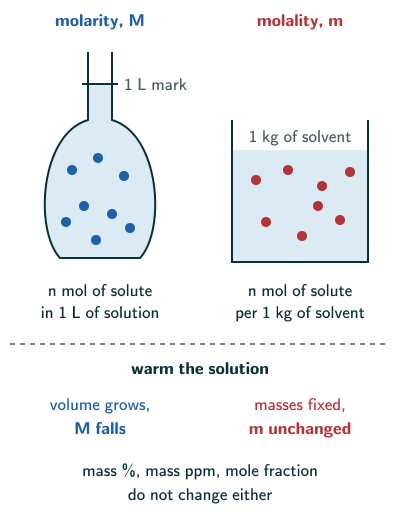
- Temperature. NCERT says mass %, ppm, mole fraction and molality do not depend on temperature, but molarity does, because volume changes with temperature and mass does not (NCERT page 5). This assumes fixed composition, without reaction or loss by evaporation. Volume-based concentrations generally vary with temperature; volume percentage can also vary if the component and solution expand differently. Always specify its reference temperature.
- Converting (beyond the NCERT text): for a solution of density d (g mL−1), molarity M and molar mass of solute MB (g mol−1), one litre has a mass of 1000d g, of which M × MB g is solute, so m = 1000M/(1000d − M × MB). In practice, start from a convenient amount, such as 100 g of solution, as in Example 4.
Solved examples
Example 1: Mole fraction of ethylene glycol (NCERT Example 1.1)
Calculate the mole fraction of ethylene glycol (C2H6O2) in a solution containing 20% of it by mass.
Answer: Take 100 g of solution: 20 g of glycol and 80 g of water. Molar mass of C2H6O2 = 12 × 2 + 1 × 6 + 16 × 2 = 62 g mol−1, so it has 20/62 = 0.323 mol (NCERT truncates this to 0.322), and water 80/18 = 4.444 mol. xglycol = 0.323/(0.323 + 4.444) = 0.068, and xwater = 1 − 0.068 = 0.932 (NCERT Example 1.1, page 4).
Example 2: Molarity of NaOH (NCERT Example 1.2)
Calculate the molarity of a solution containing 5 g of NaOH in 450 mL of solution.
Answer: Moles of NaOH = 5/40 = 0.125 mol; volume = 0.450 L. M = 0.125/0.450 = 0.278 M, that is, 0.278 mol L−1 or 0.278 mol dm−3 (NCERT Example 1.2, page 4).
Example 3: Molality of ethanoic acid (NCERT Example 1.3)
Calculate the molality of 2.5 g of ethanoic acid (CH3COOH) in 75 g of benzene.
Answer: Molar mass of CH3COOH (C2H4O2) = 60 g mol−1, so 2.5 g is 0.0417 mol. Mass of benzene = 0.075 kg. m = 0.0417/0.075 = 0.556 mol kg−1 (NCERT Example 1.3, page 5).
Example 4: One solution, three units (NCERT Intext Question 1.5)
A 20% (mass/mass) aqueous solution of KI has a density of 1.202 g mL−1. Find (a) its molality, (b) its molarity, (c) the mole fraction of KI.
Answer: Take 100 g of solution: 20 g of KI (molar mass 166 g mol−1, so 0.1205 mol) and 80 g of water (4.444 mol). (a) m = 0.1205/0.080 = 1.51 mol kg−1. (b) Volume = 100/1.202 = 83.2 mL, so M = 0.1205/0.0832 = 1.45 M. (c) xKI = 0.1205/(0.1205 + 4.444) = 0.0264 (NCERT Intext Question 1.5, page 5; worked here). NCERT’s answer key (page 30) prints 1.5 mol kg−1, 1.45 mol L−1 and 0.0263. Its 1.5 is 1.51 to two figures. Its 0.0263 is what 0.12 mol of KI gives (0.12/4.564 = 0.0263), while the 0.1205 mol that its 1.45 needs gives 0.0264, so only the last digit differs (reasoned).
Example 5: Urea for a molal solution (NCERT Intext Question 1.4)
Calculate the mass of urea (NH2CONH2) needed to make 2.5 kg of 0.25 molal aqueous solution.
Answer: Urea is 60 g mol−1. 0.25 mol of it, 15 g, goes with 1 kg of water, making 1015 g of solution. For 2500 g of solution: 15 × 2500/1015 = 36.9 g, about 37 g (NCERT Intext Question 1.4, page 5; worked here).
In Example 4, the reported KI mole fraction is the analytical composition based on formula units added. Dissolved KI largely dissociates into ions; fractions based on the actual ionic species would count those separately, as needed in colligative-property models.
Common mistakes to avoid
Common mistake
Dividing by the solvent for molarity
Molarity divides by the volume of the whole solution; molality divides by the mass of the solvent alone (NCERT pages 4–5).
Common mistake
Forgetting that molarity changes with temperature
Volume changes with temperature, so molarity does too; molality, mass % and mole fraction do not (NCERT page 5).
Common mistake
Taking a 2.5 kg solution as 2.5 kg of water
In a molality problem the kilograms are of solvent; subtract the solute’s mass first, as in Example 5 (NCERT Eq. (1.9), page 5).
Quick revision summary
- Mass % = mass of component ÷ mass of solution × 100; volume % uses volumes; w/V % is grams of solute per 100 mL of solution.
- ppm = parts of component ÷ total parts × 106, for traces.
- Mole fraction xA = nA/(nA + nB); all mole fractions add to 1.
- Molarity: moles per litre of solution. Molality: moles per kg of solvent.
- At fixed composition, mass %, mass-based ppm, mole fraction and molality are temperature-independent; volume-based measures generally vary.
Formula sheet
- Mass % = (mass of component ÷ mass of solution) × 100
- Volume % = (volume of component ÷ volume of solution) × 100
- ppm = (parts of component ÷ total parts) × 10
- xA = nA/(nA + nB); x1 + x2 + … = 1
- M = moles of solute ÷ volume of solution in L
- m = moles of solute ÷ mass of solvent in kg
- m = 1000M/(1000d − M × MB), with d in g/mL and MB in g/mol
- MV = MV (dilution)
Questions students ask
What is the molarity of pure water?
Pure water is about 55.5 M: a litre of it has a mass of about 1000 g, and 1000 g ÷ 18.02 g mol = 55.5 mol, the figure NCERT uses for a litre of water in Henry’s law sums (NCERT Example 1.4, page 8). More exactly, water’s density at 25 °C is 0.997 g mL (beyond the NCERT text; NIST Chemistry WebBook), so a litre holds 997/18.02 = 55.3 mol, and the value falls over temperature ranges where water expands; water near 0–4 °C is a familiar exception to simple expansion on warming. Pure water has no solute, so this is its molar concentration rather than the molarity of a solution; a retained 1 kg sample of water contains the same amount of H2O when temperature changes.
Why is molality preferred over molarity?
Molality is preferred over molarity when the temperature changes, because it is made up from two masses, which do not change with temperature, while molarity depends on the volume of the solution, which does (NCERT page 5). Beyond the NCERT text, water’s density falls from 0.998 g mL at 20 °C to 0.992 g mL at 40 °C (NIST Chemistry WebBook), so a dilute aqueous solution expands by about 0.6% and its molarity falls by about 0.6%, while its molality stays the same. The boiling-point and freezing-point formulas use molality too, as a solution made up at room temperature is measured near its boiling or freezing point (reasoned).
How are molality and mole fraction related?
In a binary solution the solute’s molality and mole fraction x2 are related by m = 1000x2/(x1M1), where x1 = 1 − x2 and M1 is the solvent’s molar mass in g mol (beyond the NCERT text, from NCERT Eq. (1.5) and Eq. (1.9)). It holds because 1 kg of solvent is 1000/M1 mol, with x2/x1 mol of solute per mole of solvent. So an aqueous solution with x2 = 0.050 has m = 1000 × 0.050/(0.950 × 18) = 2.92 mol kg; in a dilute solution x1 ≈ 1, so the molality is nearly proportional to the mole fraction.
What are the SI units of molarity and molality?
The SI unit of molarity is the mole per cubic metre (mol m), with 1 M = 1 mol L = 1 mol dm = 1000 mol m, and that of molality is the mole per kilogram (mol kg); NCERT uses mol L and mol kg (NCERT pages 4–5). Beyond the NCERT text, the NIST Guide to the SI calls molarity amount-of-substance concentration, c, and calls the name molarity, the term molal and the unit symbols M and m (as in 0.25 M and 1.00 m) obsolete, while keeping molality in mol kg (NIST Special Publication 811, Sections 8.6.5 and 8.6.8). Mass and volume percentages, ppm by mass or by volume and mole fraction have no unit.
Is a 5% (w/V) solution also 5% by mass?
A 5% (w/V) solution is 5% by mass only if its density is exactly 1 g mL: it has 5 g of solute in 100 mL of solution (NCERT page 3), but 100 mL of solution has a mass of 100d g, where d is its density in g mL. So for a 5% (w/V) glucose solution of density 1.02 g mL, 100 mL has a mass of 102 g, and the mass percentage is 5/102 × 100 = 4.9%. In general, mass % = (w/V %)/d, so the two are close for dilute aqueous solutions and differ more as the density moves away from 1 g mL (reasoned).
Practice questions
Try each question first, then open the answer to check your working.
-
Q1. 22 g of benzene is dissolved in 122 g of carbon tetrachloride. Find the mass percentage of each (NCERT Intext Question 1.1).
Show answerHide answer
Total mass = 144 g. Benzene: 22/144 × 100 = 15.28%; carbon tetrachloride: 122/144 × 100 = 84.72% (worked here).
-
Q2. Find the mole fraction of benzene in a solution containing 30% benzene by mass in carbon tetrachloride (NCERT Intext Question 1.2).
Show answerHide answer
In 100 g: benzene 30/78 = 0.385 mol; CCl4 70/154 = 0.455 mol. xbenzene = 0.385/(0.385 + 0.455) = 0.458 (worked here). NCERT’s answer key (page 30) prints 0.459 and 0.541. Rounding benzene up to 0.385 mol while keeping 0.4545 mol of CCl4 gives 0.385/(0.385 + 0.4545) = 0.459; unrounded, 0.3846/(0.3846 + 0.4545) = 0.458, the difference is only in rounding, and the given 30% does not justify treating that last digit as a material disagreement.
-
Q3. Find the molarity of (a) 30 g of Co(NO3)2·6H2O in 4.3 L of solution, (b) 30 mL of 0.5 M H2SO4 diluted to 500 mL (NCERT Intext Question 1.3).
Show answerHide answer
(a) Molar mass = 59 + 2 × 62 + 6 × 18 = 291 g mol−1, so 30 g is 0.103 mol; 0.103/4.3 = 0.024 M. (b) Moles = 0.030 × 0.5 = 0.015 mol; 0.015/0.500 = 0.030 M (worked here).