Colligative properties and determination of molar mass
NCERT Class 12 Chemistry Chapter 1 Section 1.6
Quick answer
In the dilute ideal model, colligative effects depend on solute particle concentration: relative vapour-pressure lowering, boiling-point elevation, freezing-point depression and osmotic pressure. Their formulas require the appropriate volatility, phase and membrane assumptions and can estimate solute molar mass. Reverse osmosis uses a pressure difference above the osmotic-pressure difference to produce water with much lower dissolved salt content.
With your textbook
NCERT Chemistry Part I (Class 12), Chapter 1 “Solutions”, Section 1.6 “Colligative Properties and Determination of Molar Mass”, pages 15–23.
Open the official NCERT chapter (PDF, 3.9 MB, ncert.nic.in) (opens in a new tab)
Checked against the 2026-27 reprint on .
What are colligative properties?
Colligative properties
Colligative properties are properties of a solution that depend only on how many solute particles there are, not on what they are. NCERT names four (NCERT Section 1.6, page 15): relative lowering of vapour pressure, elevation of boiling point, depression of freezing point and osmotic pressure. In NCERT’s words:
All these properties depend on the number of solute particles irrespective of their nature relative to the total number of particles present in the solution.
NCERT Chemistry Part I (Class 12), Section 1.6, page 15
The name comes from Latin: co, together, and ligare, to bind (NCERT page 15). Because they count particles, each one can be used to find the molar mass of a solute (NCERT pages 16–22).
In plain words: dissolve a suitable non-volatile solute such as sugar, urea or a protein in water, and the solvent molecules get a little “diluted” by the solute particles. Fewer of them escape as vapour, so the solution boils hotter and freezes colder, and water from outside tries to push in through any membrane that lets only water through. How big each effect is depends on how many particles you added, not which kind.
These particle-count laws are dilute ideal-solution approximations at fixed solvent and conditions. The formulas below assume a non-associating, non-dissociating solute; use an appropriate van ’t Hoff factor or activity model otherwise. Vapour-pressure lowering and boiling elevation require a non-volatile solute; freezing depression assumes pure solvent crystallises; osmotic pressure requires a membrane that retains the solute.
Relative lowering of vapour pressure
- A non-volatile solute lowers the vapour pressure of the solvent. Raoult showed that the lowering depends only on the concentration of solute particles, not on their identity (NCERT page 15).
- From Raoult’s law, p1 = x1p10 (NCERT Eq. (1.22), page 15), the lowering is Δp1 = p10 − p1 = p10(1 − x1), and since x2 = 1 − x1 (NCERT Eqs. (1.23)–(1.24), page 15):
Lowering of vapour pressure (NCERT Eq. 1.24)
- With several non-volatile solutes, the lowering depends on the sum of their mole fractions (NCERT page 15).
- Dividing by p10 gives the relative lowering of vapour pressure, equal to the mole fraction of the solute (NCERT Eqs. (1.25)–(1.26), pages 15–16):
Relative lowering (NCERT Eq. 1.25)
- For a dilute solution, n2 ≪ n1, so x2 ≈ n2/n1. With masses w1, w2 and molar masses M1, M2 of solvent and solute, this gives the molar mass of the solute (NCERT Eqs. (1.27)–(1.28), page 16):
Molar mass from the lowering (NCERT Eq. 1.28)
Elevation of boiling point
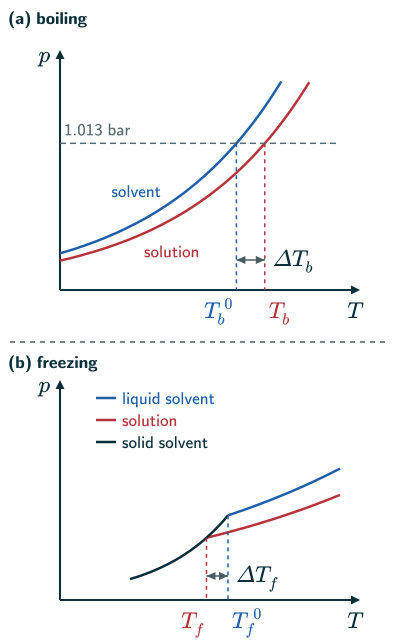
- A liquid boils when its vapour pressure equals the external pressure: water boils at 373.15 K because its vapour pressure there is 1.013 bar (NCERT page 16).
- A non-volatile solute lowers the vapour pressure, so at 373.15 K an aqueous sucrose solution has a vapour pressure below 1.013 bar. It must be heated further to boil: under this non-volatile-solute model at the same external pressure, the solution’s boiling point is higher than that of the pure solvent (NCERT pages 16–17, NCERT Figure 1.7).
- The elevation of boiling point is ΔTb = Tb − Tb0. For dilute solutions it is directly proportional to the molality m of the solute (NCERT Eqs. (1.29)–(1.30), page 17):
Elevation of boiling point (NCERT Eq. 1.30)
- Kb, in K kg mol−1, is the boiling point elevation constant, molal elevation constant or ebullioscopic constant (NCERT page 17).
- With m = 1000w2/(M2w1), masses in grams (NCERT Eq. (1.31), page 17), a measured ΔTb gives the molar mass (NCERT Eqs. (1.32)–(1.33), page 17):
Molar mass from the boiling point (NCERT Eq. 1.33)
- NCERT slip (page 17): NCERT says a solution of 1 mol of sucrose in 1000 g of water boils at 373.52 K. With Kb = 0.52 K kg mol−1 and water boiling at 373.15 K, a 1 m solution should boil at about 373.15 + 0.52 = 373.67 K; 373.52 K would take water’s boiling point as 373.0 K. In a problem, use Tb = 373.15 K + Kbm, or the boiling point the question gives.
Depression of freezing point
- At the freezing point, solid and liquid are in dynamic equilibrium, so the freezing point is the temperature at which the vapour pressure of the liquid equals that of the solid (NCERT page 18).
- The onset of pure-solvent crystallisation occurs when the solvent’s chemical potential matches that in the solid; this can be represented by equality of its equilibrium vapour pressures. Its vapour pressure is lower, so this happens at a lower temperature: the freezing point is depressed (NCERT page 18, NCERT Figure 1.8).
- As freezing proceeds, the remaining solution becomes more concentrated, so the whole sample need not freeze at one temperature. The depression of freezing point, ΔTf = Tf0 − Tf, is directly proportional to molality for a dilute solution (NCERT Eq. (1.34), page 18):
Depression of freezing point (NCERT Eq. 1.34)
- Kf, in K kg mol−1, depends on the solvent and is the freezing point depression constant, molal depression constant or cryoscopic constant (NCERT pages 18–19).
- As for boiling, the molar mass follows (NCERT Eqs. (1.35)–(1.36), page 19):
Molar mass from the freezing point (NCERT Eq. 1.36)
Ebullioscopic and cryoscopic constants
- For a specified pressure and pure-solvent transition temperature, Kb and Kf are solvent constants in the dilute-limit approximation. They can be found from its molar mass M1 (g mol−1), its boiling or freezing point in kelvin and its enthalpy of vaporisation or fusion in J mol−1, with R = 8.314 J mol−1 K−1 (NCERT Eqs. (1.37)–(1.38), page 19; units reasoned from the 1000):
Cryoscopic constant (NCERT Eq. 1.37)
Ebullioscopic constant (NCERT Eq. 1.38)
- The enthalpies of fusion and vaporisation are the ones from Class 11 Thermodynamics; Example 7 recovers water’s Kf from them.
- NCERT Table 1.3 (page 19) gives, in K kg mol−1:
| Solvent | Kb | Kf |
|---|---|---|
| Water | 0.52 | 1.86 |
| Ethanol | 1.20 | 1.99 |
| Cyclohexane | 2.79 | 20.00 |
| Benzene | 2.53 | 5.12 |
| Chloroform | 3.63 | 4.79 |
| Carbon tetrachloride | 5.03 | 31.8 |
| Carbon disulphide | 2.34 | 3.83 |
| Diethyl ether | 2.02 | 1.79 |
| Acetic acid | 2.93 | 3.90 |
- NCERT slip (page 19): NCERT Table 1.3 gives water’s freezing point as 273.0 K; it is 273.15 K, which NCERT Example 1.9 (page 20) uses. Use 273.15 K unless a question gives another value.
Osmosis and osmotic pressure
- Raw mangoes shrivel when pickled in brine, wilted flowers revive in fresh water, and blood cells shrink in sufficiently hypertonic saline. In each, the substance is bound by a membrane, natural (pig’s bladder, parchment) or synthetic (cellophane), with submicroscopic pores (NCERT page 20).
- An ideal semipermeable membrane lets the solvent pass while retaining the solute. Size can contribute, but real membrane selectivity also depends on molecular interactions and transport; it is not merely a sieve for “large” solutes. Such a membrane is a semipermeable membrane (SPM) (NCERT page 21).
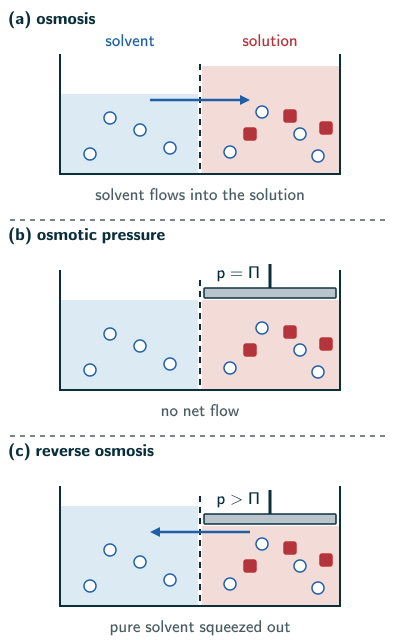
- If an SPM separates a solvent from a solution, solvent flows through it from the pure solvent into the solution: osmosis. The flow goes on until equilibrium is reached, and at equal hydrostatic pressure and temperature, the ideal dilute model predicts flow towards the higher concentration of retained particles. More generally the direction follows solvent chemical potential, and pressure can oppose or reverse it (NCERT page 21, NCERT Figure 1.9).
- In NCERT Figure 1.9 (page 20) the solution rises in a thistle funnel until the extra column, of height h, stops the flow, so Π = hρg, with ρ the density of the solution (reasoned).
- The flow can be stopped by applying extra pressure on the solution. In NCERT’s words:
The osmotic pressure of a solution is the excess pressure that must be applied to a solution to prevent osmosis, i.e., to stop the passage of solvent molecules through a semipermeable membrane into the solution.
NCERT Chemistry Part I (Class 12), Section 1.6.4, page 21
- For dilute solutions, osmotic pressure Π is proportional to the molarity C at a given temperature T (NCERT Eqs. (1.39)–(1.40), page 21), much like the ideal gas equation:
Osmotic pressure (NCERT Eq. 1.39)
- With n2 = w2/M2 moles in V litres of solution, ΠV = w2RT/M2, so (NCERT Eqs. (1.41)–(1.42), page 21):
Molar mass from osmotic pressure (NCERT Eq. 1.42)
- The method is widely used for proteins, polymers and other macromolecules. Its measurements are made near room temperature, it uses molarity rather than molality, and its value is large even for very dilute solutions. That suits biomolecules, which are generally not stable at higher temperatures, and polymers, which dissolve poorly (NCERT pages 21–22).
- Everyday osmosis (NCERT pages 22–23): concentrated brine can remove water from mango tissue; water can restore turgor to wilted plant tissue. Salt and sugar preserve food largely by lowering water activity and inhibiting microbial growth, not by guaranteeing that every bacterium dies. Fluid retention and edema involve physiological regulation; impaired removal of salt and water can contribute, as in kidney disease (NIDDK), rather than edema being a simple universal consequence of eating salt.
Isotonic, hypertonic and hypotonic solutions
- Two solutions of equal osmotic pressure at the same temperature are iso-osmotic. NCERT calls them isotonic under its ideal membrane model, where all solutes are retained. For a real cell, tonicity describes the effect on cell volume and depends on which solutes its membrane retains; iso-osmotic does not always mean isotonic.
- The fluid inside a blood cell is isotonic with 0.9% (mass/volume) sodium chloride, called normal saline, a familiar clinical fluid when supplied as an appropriately manufactured sterile injection; ordinary salt water is not an injectable preparation (NCERT page 22).
- In the simple red-cell comparison using aqueous NaCl, a solution appreciably above 0.9% (mass/volume) is hypertonic: water flows out of the cells and they shrink. In a sufficiently lower-concentration NaCl solution, which is hypotonic, water flows into the cells and they swell (NCERT page 22).
Reverse osmosis and water purification
- If a pressure difference larger than the osmotic-pressure difference is applied to the solution, the direction of osmosis is reversed: pure solvent flows out of the solution through the SPM. This is reverse osmosis (NCERT page 23, NCERT Figure 1.11).
- It is used to desalinate sea water: under enough pressure, water with greatly reduced salt content passes out through the membrane. Polymer membranes are used; a workable one is a film of cellulose acetate on a support, which preferentially transports water and rejects most dissolved salts. Real membranes have finite rejection; the permeate is not necessarily absolutely pure. For seawater the required pressure is high; practical flow also requires pressure above the osmotic threshold to overcome transport resistance (NCERT page 23).
- Many countries now use desalination plants for drinking water (NCERT page 23).
Solved examples
Example 1: Molar mass from vapour pressure (NCERT Example 1.6)
The vapour pressure of pure benzene (78 g mol−1) is 0.850 bar. With 0.5 g of a non-volatile non-electrolyte in 39.0 g of benzene, it falls to 0.845 bar. Find the molar mass of the solid.
Answer: (0.850 − 0.845)/0.850 = (0.5 × 78)/(M2 × 39), so M2 = 0.5 × 78 × 0.850/(0.005 × 39) = 170 g mol−1 in the dilute approximation (NCERT Example 1.6, page 16). Keeping the exact ideal mole-fraction denominator gives 169 g mol−1; the difference is small compared with the precision of these data.
NCERT slip (page 16): the working cites “equation (2.28)”; it is Eq. (1.28).
Example 2: Glucose raises the boiling point (NCERT Example 1.7)
18 g of glucose (180 g mol−1) is dissolved in 1 kg of water. At what temperature does it boil at 1.013 bar? Kb = 0.52 K kg mol−1.
Answer: m = 0.1 mol kg−1, so ΔTb = 0.52 × 0.1 = 0.052 K, and the solution boils at 373.15 + 0.052 = 373.202 K (NCERT Example 1.7, pages 17–18).
Example 3: Molar mass from the boiling point (NCERT Example 1.8)
1.80 g of a non-volatile solute in 90 g of benzene raises its boiling point from 353.23 K to 354.11 K. Kb = 2.53 K kg mol−1. Find the molar mass.
Answer: ΔTb = 0.88 K. M2 = 2.53 × 1.8 × 1000/(0.88 × 90) = 57.5, about 58 g mol−1 (NCERT Example 1.8, page 18).
NCERT slip (page 18): the working cites “expression (2.33)”; it is Eq. (1.33).
Example 4: Antifreeze (NCERT Example 1.9)
45 g of ethylene glycol (C2H6O2, 62 g mol−1) is mixed with 600 g of water. Find (a) the freezing point depression and (b) the freezing point.
Answer: Moles = 45/62 = 0.726; m = 0.726/0.600 = 1.21 mol kg−1. (a) ΔTf = 1.86 × 1.21 = 2.25 K. (b) Tf = 273.15 − 2.25 = 270.90 K. NCERT rounds the molality to 1.2 and gets 2.2 K and 270.95 K (NCERT Example 1.9, page 20).
Example 5: Molar mass from the freezing point (NCERT Example 1.10)
1.00 g of a non-electrolyte in 50 g of benzene lowers its freezing point by 0.40 K. Kf = 5.12 K kg mol−1. Find the molar mass.
Answer: M2 = 5.12 × 1.00 × 1000/(0.40 × 50) = 256 g mol−1 (NCERT Example 1.10, page 20).
Example 6: A protein’s molar mass (NCERT Example 1.11)
200 cm3 of an aqueous solution contains 1.26 g of a protein, and its osmotic pressure at 300 K is 2.57 × 10⁻³ bar. Find the molar mass. R = 0.083 L bar mol−1 K−1.
Answer: M2 = w2RT/(ΠV) = 1.26 × 0.083 × 300/(2.57 × 10−3 × 0.200) ≈ 6.10 × 10⁴ g mol−1 (NCERT Example 1.11, page 22).
NCERT slips (page 22): the working cites “equation (2.42)”, which is Eq. (1.42), and prints 61 022 g mol−1; direct arithmetic gives 61 039, but both round to the same 6.10 × 10⁴ at the precision justified by the inputs.
Example 7: Water’s K<sub>f</sub> from its enthalpy of fusion
Use NCERT Eq. (1.37) with ΔfusH = 6000 J mol−1 (NCERT Class 11 Chemistry, Unit 5, page 147), R = 8.314 J mol−1 K−1, M1 = 18 g mol−1 and Tf = 273.15 K.
Answer: Kf = 8.314 × 18 × 273.152/(1000 × 6000) ≈ 1.86 K kg mol−1, as in NCERT Table 1.3 (worked here).
Common mistakes to avoid
Common mistake
Using molarity for boiling and freezing point changes
Boiling and freezing point changes use molality, moles per kg of solvent; osmotic pressure uses molarity, moles per litre of solution (NCERT pages 17–21).
Common mistake
Adding the depression to the freezing point
The freezing point falls: Tf = Tf0 − ΔTf. The boiling point rises: Tb = Tb0 + ΔTb (NCERT pages 17–18).
Common mistake
Sending the solvent the wrong way in osmosis
At equal temperature and hydrostatic pressure, solvent flows towards lower solvent activity, typically from pure solvent or a dilute solution into a more concentrated solution of membrane-retained solute (NCERT page 21).
Quick revision summary
- Colligative properties depend on the number of solute particles, not their nature: relative lowering of vapour pressure, elevation of boiling point, depression of freezing point and osmotic pressure.
- Relative lowering = x2; for dilute solutions ≈ w2M1/(M2w1).
- ΔTb = Kbm and ΔTf = Kfm, with m the molality; Kb and Kf depend only on the solvent.
- Π = CRT, with C the molarity; best for proteins and polymers.
- Normal saline is 0.9% (m/V) NaCl: approximately isotonic with red blood cells. Reverse osmosis needs a pressure above Π.
Formula sheet
- (p10 − p1)/p10 = x2 ≈ (w2 M1)/(M2 w1)
- ΔTb = Kb m
- ΔTf = Kf m
- m = 1000 w2/(M2 w1)
- M2 = 1000 K w2/(ΔT w1), with Kb or Kf
- Kf = R M1 Tf2/(1000 Δfus H)
- Π = CRT
- M2 = w2 RT/(Π V)
Questions students ask
Which properties of a solution are not colligative?
Any property that depends on what the solute is, not only on how many particles it gives, is not colligative, such as the colour, density, viscosity, optical activity and electrical conductivity of a solution (reasoned). The vapour pressure, boiling point and freezing point themselves are not colligative either, since they depend mainly on the solvent; only the relative lowering of vapour pressure, the elevation of boiling point and the depression of freezing point are, with osmotic pressure (NCERT page 15). The elevation and depression still depend on the solvent, through Kb and Kf, but in a given solvent only the number of solute particles matters.
Why do colligative properties depend only on the number of solute particles?
Colligative properties depend only on the number of solute particles because their common thermodynamic origin is lowering of the solvent’s chemical potential on mixing; vapour-pressure lowering is one manifestation, and by Raoult’s law the relative lowering equals the solute’s mole fraction x2, a count of particles whatever they are (NCERT pages 15–16). So the solution must be heated more to boil and cooled more to freeze, and solvent passes into it, where its escaping tendency is lower (reasoned from NCERT pages 16–21). This holds for a non-volatile solute in a dilute solution; a solute that dissociates or associates changes the count, which the van ’t Hoff factor corrects.
What does the graph of osmotic pressure against concentration look like?
For a dilute solution at a fixed temperature, a graph of osmotic pressure Π against molarity C is a straight line through the origin with slope RT, since Π = CRT (NCERT Eq. (1.39), page 21). At 298 K, with R = 0.083 L bar mol K, the slope is 24.7 bar L mol, so a 0.015 M solution of a non-electrolyte has Π ≈ 0.37 bar; at a higher temperature the line is steeper. Plotted against the absolute temperature at a fixed molarity, Π is again a straight line, of slope CR, just as the pressure of a gas is at fixed volume.
What is osmolarity, and how is it different from molarity?
Osmolarity is the number of moles of dissolved particles per litre of solution, i × molarity for a solute giving i particles per formula unit (beyond the NCERT text; Wikipedia, “Osmotic concentration”); it sets the osmotic pressure, Π = iCRT, with i the van ’t Hoff factor (NCERT page 24). Normal saline, 0.9% (mass/volume) NaCl, is 9 g L ÷ 58.5 g mol = 0.154 mol L, or 308 mOsmol L with i = 2, close to the 300 mOsmol L NCERT Class 11 Biology gives for the glomerular filtrate, plasma without its proteins (pages 208 and 215).
What is the difference between osmotic pressure and tonicity?
Osmotic pressure is a property of one solution, measured against pure solvent across a membrane only the solvent can cross (NCERT page 21); NCERT calls normal saline isotonic with blood cells as both have the same osmotic pressure (NCERT page 22). Beyond the NCERT text, tonicity compares a solution with a cell’s fluid and counts only the solutes that the cell membrane holds back (Wikipedia, “Tonicity”). NaCl is effectively retained over the relevant short timescale, so its osmotic concentration is a useful approximation to its effect on red-cell volume, but urea does: a urea solution of the same osmolarity as blood is hypotonic to red cells, which can take up urea and then water, swelling and potentially lysing.
Are colligative properties in the JEE Main and NEET syllabus?
Yes, colligative properties are in Unit 5, Solutions, of both the JEE Main 2027 and the NEET (UG) 2026 syllabuses, which list “Colligative properties of dilute solutions - a relative lowering of vapour pressure, depression of freezing point, the elevation of boiling point and osmotic pressure”, then the determination of molecular mass from them. Neither names isotonic solutions or reverse osmosis, though NCERT teaches both (NCERT pages 22–23). Abnormal molar masses and the van ’t Hoff factor, listed next in both, are in NCERT Section 1.7, Abnormal Molar Masses (pages 23–26).
Practice questions
Try each question first, then open the answer to check your working.
-
Q1. The vapour pressure of pure water at 298 K is 23.8 mm Hg. 50 g of urea (NH2CONH2) is dissolved in 850 g of water. Find the vapour pressure of water over the solution and its relative lowering (NCERT Intext Question 1.9).
Show answerHide answer
Urea: 50/60 = 0.833 mol; water: 850/18 = 47.2 mol. x2 = 0.833/48.06 = 0.0173 = relative lowering, so p = 23.8 × (1 − 0.0173) = 23.4 mm Hg (worked here).
-
Q2. The boiling point of water at 750 mm Hg is 99.63 °C. How much sucrose (342 g mol−1) must be added to 500 g of water so that it boils at 100 °C? (NCERT Intext Question 1.10; it gives no Kb, so take 0.52 K kg mol−1 from NCERT Table 1.3.)
Show answerHide answer
ΔTb = 0.37 K, so m = 0.37/0.52 = 0.712 mol kg−1; in 0.500 kg that is 0.356 mol, or 0.356 × 342 ≈ 122 g of sucrose (worked here).
-
Q3. How much ascorbic acid (C6H8O6, 176 g mol−1) must be dissolved in 75 g of acetic acid to lower its melting point by 1.5 °C? Kf = 3.9 K kg mol−1 (NCERT Intext Question 1.11).
Show answerHide answer
m = 1.5/3.9 = 0.385 mol kg−1; in 0.075 kg that is 0.0288 mol, or 0.0288 × 176 ≈ 5.08 g (worked here).