Solubility and Henry’s law
NCERT Class 12 Chemistry Chapter 1 Section 1.3
Quick answer
Solubility is the equilibrium saturation amount at specified temperature, pressure and solvent composition. In the dilute Henry-law regime, a dissolved gas’s mole fraction is proportional to its own partial pressure, with the constant depending on gas, solvent and temperature. Many gases in water dissolve less on warming near room temperature, while ordinary pressure changes usually have little effect on solid solubility.
With your textbook
NCERT Chemistry Part I (Class 12), Chapter 1 “Solutions”, Section 1.3 “Solubility”, pages 5–9.
Open the official NCERT chapter (PDF, 3.9 MB, ncert.nic.in) (opens in a new tab)
Checked against the 2026-27 reprint on .
What is solubility?
Solubility
The equilibrium solubility of a substance is the amount that dissolves at saturation in a given amount of solvent at a given temperature. In NCERT’s words:
Solubility of a substance is its maximum amount that can be dissolved in a specified amount of solvent at a specified temperature.
NCERT Chemistry Part I (Class 12), Section 1.3, page 5
It depends on the nature of the solute and the solvent, and on temperature and pressure (NCERT page 5). For a gas in the dilute limit, Henry’s law says that at constant temperature its solubility is proportional to its partial pressure above the solution (NCERT page 7).
In plain words: keep stirring salt into water and at some point no more dissolves; the extra just sits at the bottom. That limit is the solubility. For a gas, push harder on it and more squeezes into the liquid, which is why a soda fizzes when you open it and the pressure drops.
Solubility of a solid in a liquid
- Like dissolves like. Sodium chloride and sugar dissolve readily in water, but naphthalene and anthracene do not; in benzene it is the other way round. Polar solutes dissolve in polar solvents and non-polar solutes in non-polar solvents: in general, a solute dissolves in a solvent if the intermolecular interactions are similar in the two, “like dissolves like” (NCERT page 6). Strictly, it is a guide, not a sufficient criterion: the overall Gibbs energy change includes entropy (reasoned).
- When a solid is added to a solvent, some of it dissolves (dissolution); some dissolved particles collide with the solid and separate out again (crystallisation). When the two happen at the same rate, a dynamic equilibrium is reached and the concentration of the solute stays constant at that temperature and pressure (NCERT page 6):
Dissolution equilibrium (NCERT Eq. 1.10)
- A saturated solution holds no more solute at that temperature and pressure; its concentration equals the equilibrium solubility. When solid is present, dissolution and crystallisation are in dynamic balance; a saturated solution can also be separated from excess solid. An unsaturated solution can dissolve more solute at the same temperature (NCERT page 6).
- Effect of temperature. The equilibrium follows Le Chatelier’s principle. If dissolving a solid in a nearly saturated solution is endothermic (ΔsolH > 0), its solubility increases as the temperature rises; if it is exothermic (ΔsolH < 0), its solubility decreases. Experiment agrees (NCERT page 6).
- Effect of pressure. Over ordinary laboratory pressure ranges, pressure usually has little effect on solid solubility. Both phases are nearly incompressible and the dissolution volume change is usually small; high pressures can matter (NCERT page 6).
Solubility of a gas in a liquid
- Many gases dissolve in water. Oxygen dissolves only a little, and it is this dissolved oxygen that sustains aquatic life; hydrogen chloride is highly soluble (NCERT page 6).
- The solubility of gases depends strongly on pressure and temperature, and it increases with pressure (NCERT pages 6–7).
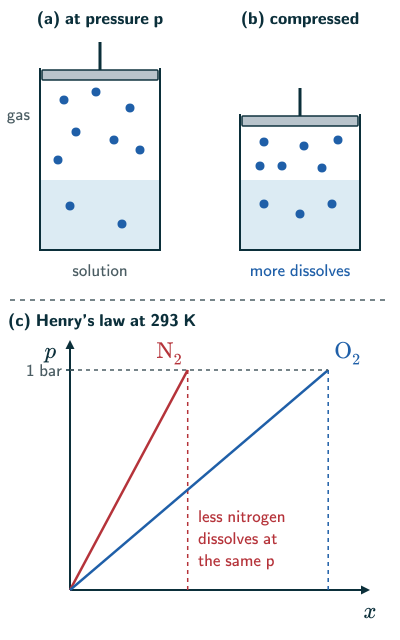
- Why pressure helps (NCERT page 7, NCERT Figure 1.1): picture a gas over its solution at equilibrium, with gas molecules entering and leaving the solution at the same rate. Push a piston down to compress the gas. There are now more molecules per unit volume above the solution, so more of them strike its surface and enter it. More gas dissolves until a new equilibrium is reached, with more gas in solution than before.
Henry’s law and its applications
- Henry was the first to relate the solubility of a gas to its pressure; his contemporary Dalton reached a similar conclusion independently (NCERT page 7). In NCERT’s words:
The law states that at a constant temperature, the solubility of a gas in a liquid is directly proportional to the partial pressure of the gas present above the surface of liquid or solution.
NCERT Chemistry Part I (Class 12), Section 1.3.2, page 7
- Taking the mole fraction x of the gas in solution as its solubility, and its partial pressure above the solution as p, the most common form is (NCERT Eq. (1.11), page 7):
Henry’s law (NCERT Eq. 1.11)
- KH is the Henry’s law constant. A plot of p against x is a straight line whose slope is KH, as NCERT Figure 1.2 shows for HCl in cyclohexane at 293 K (NCERT page 7). In Class 11 you met the same law in terms of mass of gas dissolved.
- KH depends on the gas, solvent composition and temperature. At a given pressure, the higher KH, the lower the solubility (NCERT pages 7–8).
- Henry’s law is a dilute-limit relation for a specified dissolved molecular species. At high pressure gas fugacity replaces ideal partial pressure; chemical reaction in solution can change the total absorbed amount, which need not equal the molecular species counted by Henry’s law (IUPAC Henry’s-law recommendations, 2022).
- NCERT Table 1.2 (page 8) gives, in water:
| Gas | T/K | KH/kbar |
|---|---|---|
| He | 293 | 144.97 |
| H2 | 293 | 69.16 |
| N2 | 293 | 76.48 |
| N2 | 303 | 88.84 |
| O2 | 293 | 34.86 |
| O2 | 303 | 46.82 |
| Argon | 298 | 40.3 |
| CO2 | 298 | 1.67 |
| Formaldehyde | 298 | 1.83 × 10⁻⁵ |
| Methane | 298 | 0.413 |
| Vinyl chloride | 298 | 0.611 |
- NCERT slip (page 8): methane. NCERT’s Table 1.2 gives 0.413 kbar for methane. Beyond the NCERT text: the primary Henry-constant compilation by Rolf Sander (2023) gives a representative concentration/pressure constant near 1.4 × 10⁻⁵ mol m−3 Pa−1 at 298.15 K. At 1 bar this gives about 1.4 × 10⁻³ mol per litre of water, x ≈ 2.5 × 10⁻⁵, hence KH ≈ 40 kbar, about a hundred times NCERT’s value (reasoned from Sander’s constant). In a problem, use the value the question gives; if asked for NCERT’s table entry, quote 0.413 kbar.
- The formaldehyde entry also needs care. Beyond the NCERT text: formaldehyde reacts with water, so a measured constant counts all its dissolved forms; such an effective constant is not the constant of unreacted formaldehyde alone (Wikipedia, “Henry’s law”, effective Henry’s law constants).
- Applications (NCERT pages 8–9):
- Soft drinks. To raise the solubility of CO2 in soft drinks and soda water, the bottle is sealed under high pressure.
- Scuba divers. High pressure increases dissolved inert gas in blood and tissues. During decompression, gas bubbles may form and cause decompression sickness; helium-containing mixtures reduce nitrogen exposure but do not eliminate decompression risk (Divers Alert Network, Decompression Illness). NCERT’s stated 11.7% helium, 56.2% nitrogen and 32.1% oxygen mixture is an illustrative mixture, not simply air diluted with helium: 11.7% helium added to an air-based final mixture would leave about 69% nitrogen and 18.5% oxygen. Breathing-gas selection and decompression schedules are depth- and exposure-dependent, not determined by Henry’s law alone.
- High altitudes. The partial pressure of oxygen is lower, so the blood and tissues of people living there, and of climbers, hold less oxygen. Climbers become weak and unable to think clearly. NCERT calls this anoxia; strictly, a shortage of oxygen is hypoxia, and anoxia means a complete absence of oxygen (Wikipedia, “Hypoxia (medicine)”).
Effect of temperature on the solubility of gases
- Solubility of gases in liquids decreases with rise in temperature. Dissolving a gas is like condensation, and heat is evolved; since dissolution is an equilibrium and is exothermic, by Le Chatelier’s principle the solubility falls as the temperature rises (NCERT page 9).
- Strictly, this holds where dissolution is exothermic, as for common gases in water near room temperature; it is not a law for every gas, solvent and temperature range (reasoned). Beyond the NCERT text: in water, the Henry’s-law solubility of many gases passes through a minimum, below 120 °C for most permanent gases, and rises again above it (Wikipedia, “Henry’s law”).
- The data agree: KH for N2 rises from 76.48 to 88.84 kbar, and for O2 from 34.86 to 46.82 kbar, between 293 K and 303 K (NCERT Table 1.2, page 8). Thus cooler water can hold more dissolved oxygen at the same oxygen partial pressure, which is why, NCERT says, “aquatic species are more comfortable in cold waters rather than in warm waters” (page 8; see Example 4). Strictly, a species’ preferred temperature also depends on its physiology (reasoned).
Solved examples
Example 1: Nitrogen dissolved in water (NCERT Example 1.4)
N2 is bubbled through water at 293 K with a partial pressure of 0.987 bar. With KH = 76.48 kbar, how many millimoles of N2 dissolve in 1 litre of water?
Answer: x = p/KH = 0.987 bar/76 480 bar = 1.29 × 10⁻⁵. A litre of water is 55.5 mol, and n is tiny beside it, so x ≈ n/55.5 and n = 1.29 × 10−5 × 55.5 = 7.16 × 10⁻⁴ mol = 0.716 mmol (NCERT Example 1.4, page 8).
Example 2: CO<sub>2</sub> in soda water (NCERT Intext Question 1.7)
KH for CO2 in water is 1.67 × 10⁸ Pa at 298 K. How much CO2 is in 500 mL of soda water packed under 2.5 atm of CO2 at 298 K?
Answer: p = 2.5 × 1.013 × 105 Pa = 2.53 × 10⁵ Pa, so x = 2.53 × 10⁵/(1.67 × 108) = 1.52 × 10⁻³. 500 mL of water is 500/18 = 27.8 mol, so n(CO2) ≈ 1.52 × 10−3 × 27.8 = 0.0421 mol, that is, 0.0421 × 44 ≈ 1.85 g (NCERT Intext Question 1.7, page 9; worked here).
Example 3: Henry’s law constant for H<sub>2</sub>S (NCERT Intext Question 1.6)
The solubility of H2S in water at STP is 0.195 m. Find its Henry’s law constant.
Answer: 0.195 mol of H2S per kg of water (55.5 mol): x = 0.195/(0.195 + 55.5) = 3.50 × 10⁻³. Taking STP as 273.15 K and 1 bar, KH = p/x = 1 bar/(3.50 × 10−3) ≈ 286 bar. Books that still take STP as 1 atm (1.013 bar) get about 289 bar (NCERT Intext Question 1.6, page 9; worked here).
Example 4: Warmer water holds less oxygen
Air has p(O2) ≈ 0.21 bar. Using NCERT Table 1.2, by what fraction does the solubility of oxygen in water fall between 293 K and 303 K?
Answer: x = p/KH: 0.21/34 860 = 6.0 × 10⁻⁶ at 293 K and 0.21/46 820 = 4.5 × 10⁻⁶ at 303 K. The ratio is 34.86/46.82 = 0.74, so by the supplied NCERT values about 26% less oxygen dissolves at 303 K (NCERT Table 1.2, page 8; the 0.21 bar is beyond the NCERT text). This is a calculation using the supplied textbook table; quantitative physical predictions require one consistent measured temperature-dependent dataset. Beyond the NCERT text: measured data give a smaller fall, about 17% (from oxygen’s temperature constant, −ΔsolH/R = 1700 K, in Wikipedia, “Henry’s law”), so NCERT’s two oxygen values lie too far apart. In an exam, use NCERT’s table values.
Example 5: Helium or nitrogen?
At 293 K, which dissolves more in water at the same partial pressure, helium or nitrogen, and by what factor?
Answer: Nitrogen, which has the smaller KH. The ratio of mole fractions is KH(He)/KH(N2) = 144.97/76.48 = 1.9 (NCERT Table 1.2, page 8).
Common mistakes to avoid
Common mistake
Reading a large K<sub>H</sub> as a soluble gas
In p = KHx, a larger KH means a smaller mole fraction at the same pressure: the gas is less soluble (NCERT page 7). Other standard conventions write the constant the other way up, as solubility per unit pressure; then a larger constant means a more soluble gas, so check the units (IUPAC Henry’s-law recommendations, 2022).
Common mistake
Expecting pressure to help solids dissolve
Ordinary laboratory pressure changes usually have little effect on solid solubility; very high pressures may matter (NCERT page 6).
Common mistake
Thinking gases dissolve better in hot water
For the usual exothermic dissolution of gases in water near room temperature, warming lowers solubility at fixed partial pressure; do not generalise this to every gas–solvent system (rule from NCERT page 9; the limit is reasoned).
Quick revision summary
- Solubility: the maximum amount that dissolves in a given amount of solvent at a given temperature; a saturated solution has its equilibrium solubility and exchanges particles dynamically when in contact with undissolved solute.
- Like dissolves like. For solids, dissolution thermodynamics and temperature matter; ordinary pressure changes usually have little effect.
- Henry’s law: p = KHx. A larger KH means a less soluble gas.
- In the dilute Henry-law regime, gas solubility rises with its partial pressure. Many gases in water dissolve less on warming over ordinary temperature ranges.
- Uses: sealed soft drinks, helium in diving tanks; low oxygen at high altitude.
Formula sheet
- Solute + solvent ⇌ solution
- p = KH x
- x ≈ ngas/nwater (dilute)
- Δsol H > 0: solubility rises with T; Δsol H < 0: it falls
Questions students ask
What is the difference between solubility and miscibility?
Solubility is a limit, the most of a substance that dissolves in a given amount of solvent at a given temperature (NCERT page 5), while miscibility means that two substances, usually liquids, mix in all proportions, so no limit is reached. Beyond the NCERT text, ethanol and water are miscible, oil and water are not and form two layers (Wikipedia, “Miscibility”), and water at 25 °C takes up only about 220 g of butanone per litre before a second layer forms (PubChem, “2-Butanone”). Like dissolves like is a useful first guide to which pairs mix (NCERT page 6), and miscible liquids form the liquid–liquid solutions of the next topic.
What is the difference between solubility and dissolution?
Dissolution is the process of a solute passing into solution, while solubility is how much has dissolved when that process is balanced by crystallisation, in a saturated solution (NCERT page 6). Stirring and powdering the solid only make dissolution faster, by bringing fresh solvent to more of the solid’s surface (reasoned); they do not change the solubility, which depends on the nature of the solute and solvent, the temperature and the pressure (NCERT page 5). So powdered sugar dissolves faster than a sugar cube, but in the same amount of water at the same temperature both stop at the same saturated concentration (reasoned).
What is the difference between solubility and concentration?
Concentration tells how much solute a particular solution holds, while solubility is one special concentration, that of the saturated solution at that temperature (NCERT page 6). Below it a solution is unsaturated and can dissolve more; beyond the NCERT text, a hot saturated solution cooled carefully, free of dust and crystals, can for a while hold more than the solubility, a metastable supersaturated solution that crystallises once a seed crystal is added (Wikipedia, “Supersaturation”). Solubility can be given in any concentration unit, such as grams per 100 g of solvent, mol L or, for a gas, mole fraction.
What is a solubility curve?
A solubility curve plots equilibrium solubility against temperature at fixed pressure and solvent composition. As a calculation example, suppose potassium nitrate solubility is 31.6 g per 100 g of water at 20 °C and 110 g per 100 g of water at 60 °C. Cooling a saturated solution containing 100 g of water from 60 °C to 20 °C, with no water loss, crystallises 110 − 31.6 = 78.4 g. Keep the mass of solvent fixed in this calculation, not its temperature-dependent volume. A rising curve is consistent with the usual endothermic-dissolution trend (NCERT page 6).
What is the difference between Henry’s law and Dalton’s law?
Dalton’s law of partial pressures is about a gas mixture alone, the partial pressures of its gases adding up to the total pressure (Dalton’s law), while Henry’s law links a gas to a liquid: at constant temperature the mole fraction of a dissolved gas is proportional to its own partial pressure above the liquid, p = KHx (NCERT page 7). Nitrogen is about 78% of air by volume (beyond the NCERT text; NASA, Earth Fact Sheet), so in air at 1 bar its partial pressure is about 0.78 bar, and at fixed temperature and solvent composition this partial pressure determines the dilute dissolved nitrogen concentration. Dalton, Henry’s contemporary, also linked solubility to partial pressure (NCERT page 7).
Are solubility and Henry’s law in the JEE Main and NEET syllabus?
Henry’s law is in both syllabuses, but in Unit 6, Equilibrium, not Unit 5, Solutions: JEE Main 2027 lists it after “Solid-liquid, liquid-gas, gas-gas and solid-gas equilibria”, and NEET (UG) 2026 after “Solid-liquid, liquid - gas and solid -gas equilibria”. Neither names the solubility of solids or gases in liquids: the only solubility either names, also in Unit 6, is “the solubility of sparingly soluble salts”, the solubility product topic. NCERT teaches p = KHx in Class 12 (NCERT Section 1.3.2, page 7) and the mass form in Class 11.
Practice questions
Try each question first, then open the answer to check your working.
-
Q1. Why does naphthalene dissolve in benzene but not in water?
Show answerHide answer
Like dissolves like: naphthalene is non-polar, like benzene, so their intermolecular interactions are similar; water is polar (NCERT page 6).
-
Q2. Why are soft drink bottles sealed under high pressure?
Show answerHide answer
By Henry’s law the solubility of CO2 rises with its partial pressure, so more CO2 stays dissolved (NCERT page 8).
-
Q3. Argon at a partial pressure of 0.50 bar is in contact with water at 298 K (KH = 40.3 kbar). Find the mole fraction of dissolved argon and the millimoles of Ar in 1 L of water.
Show answerHide answer
x = 0.50/40 300 = 1.24 × 10⁻⁵; n = 1.24 × 10−5 × 55.5 = 6.9 × 10⁻⁴ mol = 0.69 mmol (NCERT Eq. (1.11), page 7; KH from NCERT Table 1.2, page 8).