Ideal and non-ideal solutions
NCERT Class 12 Chemistry Chapter 1 Section 1.5
Quick answer
An ideal solution obeys Raoult’s law throughout the composition range and has no enthalpy or volume change on mixing. Non-ideal solutions show positive or negative vapour-pressure deviations; heat or volume changes alone do not establish the deviation’s sign. An interior pressure maximum or minimum can produce an azeotrope, whose liquid and vapour have the same composition at a specified pressure.
With your textbook
NCERT Chemistry Part I (Class 12), Chapter 1 “Solutions”, Section 1.5 “Ideal and Non-ideal Solutions”, pages 13–15.
Open the official NCERT chapter (PDF, 3.9 MB, ncert.nic.in) (opens in a new tab)
Checked against the 2026-27 reprint on .
What are ideal and non-ideal solutions?
Ideal and non-ideal solutions
Liquid-liquid solutions are sorted by whether they obey Raoult’s law. In NCERT’s words:
The solutions which obey Raoult’s law over the entire range of concentration are known as ideal solutions.
NCERT Chemistry Part I (Class 12), Section 1.5.1, page 13
An ideal solution also forms with no heat change and no change in volume, ΔmixH = 0 and ΔmixV = 0. A non-ideal solution does not obey Raoult’s law over the whole range: its vapour pressure is higher (positive deviation) or lower (negative deviation) than Raoult’s law predicts (NCERT page 13).
In plain words: when two liquids mix, each molecule swaps some neighbours of its own kind for neighbours of the other kind. If it does not care, the mixture behaves just as Raoult’s law says. If it is held less tightly by the new neighbours, it escapes more easily and the vapour pressure goes up; if it is held more tightly, it escapes less and the vapour pressure goes down.
Ideal solutions
- An ideal solution obeys Raoult’s law over the entire range of concentration, and two more conditions hold (NCERT Eq. (1.21), page 13):
Ideal solution (NCERT Eq. 1.21)
- So no heat is absorbed or given out on mixing, and the volume of the solution equals the sum of the volumes of the two components (NCERT page 13).
- At the molecular level: in the pure liquids A and B there are A–A and B–B attractions; in the solution there are also A–B attractions. Similar unlike and like interactions are a molecular guide to nearly ideal behaviour; the defining thermodynamic test is the activity/Raoult-law relation (NCERT page 13).
- For two distinct components mixed at fixed temperature and pressure with both mole fractions between zero and one, the ideal liquids mix spontaneously, so ΔmixG < 0; with ΔmixH = 0, ΔG = ΔH − TΔS gives ΔmixS > 0 (reasoned from NCERT Class 11 Chemistry, Unit 5, pages 160–161).
- A perfectly ideal solution is rare, but some are nearly ideal: n-hexane and n-heptane, bromoethane and chloroethane, and benzene and toluene (NCERT page 13). Their components are alike in size and in the forces between their molecules (reasoned).
Non-ideal solutions
- A non-ideal solution does not obey Raoult’s law over the entire range of concentration. Its vapour pressure is either higher or lower than Raoult’s law predicts (NCERT page 13, with Raoult’s law as NCERT Eq. (1.16)).
- The cause lies in the interactions between the molecules (NCERT page 13). For both kinds, mixing usually also changes the enthalpy and the volume (see below).
Positive and negative deviations from Raoult’s law
- Positive deviation: the A–B attractions are weaker than the A–A or B–B ones. Molecules of A (or B) escape more easily than from the pure liquid, so the vapour pressure is higher than Raoult’s law predicts (NCERT pages 13–14, NCERT Figure 1.6(a)). Examples (NCERT page 14):
- ethanol and acetone: ethanol molecules are hydrogen-bonded to each other; acetone molecules get between them and break some of these hydrogen bonds;
- carbon disulphide and acetone: the dipolar attractions between unlike molecules are weaker than those between like molecules.
- Negative deviation: the A–B attractions are stronger than the A–A and B–B ones, so the vapour pressure is lower than Raoult’s law predicts (NCERT page 14, NCERT Figure 1.6(b)). Examples (NCERT page 14):
- phenol and aniline: the hydrogen bond between the phenolic hydrogen and the lone pair on the nitrogen of aniline is stronger than the hydrogen bonds between like molecules;
- chloroform and acetone: a chloroform molecule forms a hydrogen bond with an acetone molecule, which lowers the escaping tendency of both.
- Heat and volume of mixing (reasoned from NCERT pages 13–14): weaker A–B attractions mean heat is absorbed and the molecules usually pack less closely, so a positive deviation usually comes with ΔmixH > 0 and ΔmixV > 0, and a negative one with both < 0. This is a tendency, not a law. Beyond the NCERT text: ethanol and water warm up and shrink on mixing, yet deviate positively (Wikipedia, “Ethanol”).
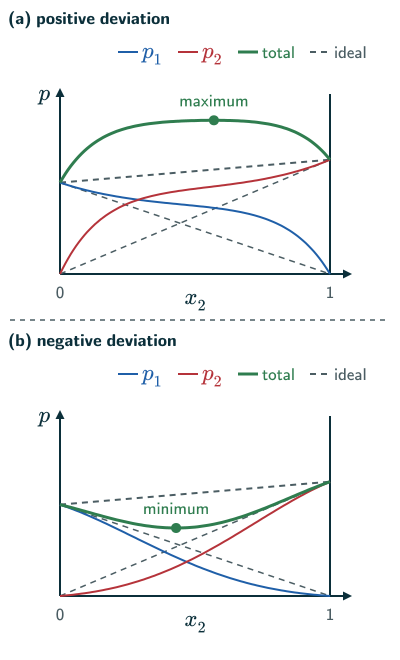
Minimum and maximum boiling azeotropes
- Some liquids form azeotropes: binary mixtures that have the same composition in the liquid and the vapour and boil at a constant temperature at a specified pressure. Ordinary fractional distillation at that pressure cannot separate the azeotropic mixture (NCERT page 14).
- Solutions that show a large positive deviation from Raoult’s law form a minimum boiling azeotrope at a specific composition. Ethanol and water, as obtained by fermenting sugars, give on fractional distillation a solution containing approximately 95% by volume of ethanol; once this composition is reached, the liquid and vapour have the same composition and no further separation occurs (NCERT pages 14–15). Strictly, the azeotrope is where the total vapour pressure passes through a maximum at a fixed temperature, or the boiling point through a minimum at a fixed pressure; its composition shifts with pressure (reasoned).
- NCERT slip (page 15): the composition basis. Beyond the NCERT text: near atmospheric pressure the ethanol–water azeotrope is about 95.6% ethanol by mass, not by volume (NIST SRM 1828 certificate reports 95.629 weight percent). It is roughly 97% by volume and boils near 78.2 °C (Wikipedia, “Ethanol”); volume percentage also needs a reference temperature, and the composition and boiling temperature change with pressure. In an NCERT-based question, give NCERT’s figure, “approximately 95% by volume of ethanol”; elsewhere state the basis.
- Solutions that show a large negative deviation form a maximum boiling azeotrope at a specific composition (NCERT page 15); there the total vapour pressure passes through a minimum (reasoned). Nitric acid and water is an example: about 68% nitric acid and 32% water by mass, boiling at 393.5 K near atmospheric pressure (NCERT page 15).
- Why the names (reasoned): a maximum in vapour pressure means the mixture boils at a lower temperature than either liquid; a minimum means it boils at a higher temperature.
Solved examples
Example 1: Liquid and vapour compositions (NCERT Intext Question 1.8)
The vapour pressures of pure liquids A and B at 350 K are 450 mm Hg and 700 mm Hg. Assuming an ideal solution, find the liquid composition if the total vapour pressure is 600 mm Hg, and the composition of the vapour.
Answer: 600 = 450 + (700 − 450)xB, so xB = 0.60 and xA = 0.40. Then pA = 0.40 × 450 = 180 and pB = 0.60 × 700 = 420 mm Hg, so yA = 180/600 = 0.30 and yB = 0.70 (NCERT Intext Question 1.8, page 15; worked here with NCERT Eq. (1.16)).
Example 2: Which deviation?
Say whether each mixture shows positive or negative deviation: (a) ethanol and acetone; (b) chloroform and acetone; (c) phenol and aniline; (d) carbon disulphide and acetone.
Answer: (a) Positive; (b) negative; (c) negative; (d) positive (NCERT page 14).
Example 3: Ideal or not?
50 mL of liquid A and 50 mL of liquid B are mixed, and the mixture warms up and has a volume of 97 mL. Is the solution ideal, and which way does it deviate?
Answer: Not ideal: an ideal solution would give 100 mL and no heat (NCERT Eq. (1.21), page 13), but here ΔmixV = −3 mL and ΔmixH < 0. By the usual rule this points to stronger A–B attractions and a possible negative deviation, but the sign cannot be determined from these observations alone. The rule is only a tendency: ethanol and water also warm up and shrink on mixing, yet deviate positively (Wikipedia, “Ethanol”). Only the vapour pressure decides.
Example 4: Why can’t distillation give pure ethanol?
Why does fractional distillation of a fermented ethanol–water mixture stop at about 95% ethanol?
Answer: Ethanol and water form a minimum boiling azeotrope. At that composition the vapour has the same composition as the liquid, so distilling it gives no further separation (NCERT pages 14–15).
Common mistakes to avoid
Common mistake
Mixing up the signs
Weaker A–B attractions mean higher vapour pressure, a positive deviation; stronger A–B attractions mean a negative deviation (NCERT pages 13–14).
Common mistake
Pairing the azeotropes the wrong way round
When an azeotrope forms, positive deviation gives a minimum-boiling type and negative deviation a maximum-boiling type; nonideality alone does not guarantee an azeotrope (NCERT pages 14–15).
Common mistake
Thinking an azeotrope is a compound
It is a mixture whose liquid and vapour have the same composition; ordinary fractional distillation at that fixed pressure cannot separate the azeotropic mixture (NCERT page 14).
Quick revision summary
- Ideal: obeys Raoult’s law at all compositions; ΔmixH = 0 and ΔmixV = 0; A–B attractions like A–A and B–B. Example: benzene and toluene.
- Positive deviation: A–B weaker; vapour pressure higher. Examples: ethanol and acetone; carbon disulphide and acetone.
- Negative deviation: A–B stronger; vapour pressure lower. Examples: phenol and aniline; chloroform and acetone.
- Azeotropes boil at constant composition: minimum boiling when positive deviation creates the required extremum (ethanol and water); maximum boiling for the corresponding negative-deviation extremum (nitric acid and water, 68%, 393.5 K).
Formula sheet
- Ideal: Δmix H = 0, Δmix V = 0, Δmix S > 0, Δmix G < 0
- Positive deviation: p > p(Raoult); usually Δmix H > 0, Δmix V > 0
- Negative deviation: p < p(Raoult); usually Δmix H < 0, Δmix V < 0
Questions students ask
Why can’t an ideal solution form an azeotrope?
An ideal solution cannot form an azeotrope because its total vapour pressure is a straight line between the pure vapour pressures, with no maximum or minimum (NCERT Eq. (1.16), page 10), and its vapour is always richer than the liquid in the more volatile component (NCERT page 11). So, unless the two vapour pressures are equal, every step of fractional distillation changes the composition, and repeated ideal equilibrium stages can approach separation (reasoned). A non-ideal solution forms an azeotrope only when its deviation is large enough to give the vapour pressure a maximum or minimum (reasoned from NCERT page 14).
How are azeotropes separated?
Ordinary fractional distillation at one fixed pressure cannot separate a mixture at its azeotropic composition (NCERT page 14). Other processes change the separation conditions: an entrainer can alter relative volatility, a selective adsorbent can remove water, or pressure-swing distillation can use two pressures when the azeotropic composition shifts enough. These methods require the actual phase-equilibrium data; changing pressure is not automatically effective for every azeotrope.
What is the difference between azeotropic and zeotropic mixtures?
An azeotropic mixture boils at a constant temperature with its liquid and vapour of the same composition, so fractional distillation cannot take it further (NCERT page 14). Beyond the NCERT text, a zeotropic mixture has no such composition, so fractional distillation can separate it, and refrigerant blends are numbered this way, zeotropic in the 400 series (now also the 4000 series) and azeotropic in the 500 series (ASHRAE Standard 34, including Addendum u, 2024). Nearly ideal solutions such as benzene and toluene are zeotropic, and so is a non-ideal solution whose deviation is too small to give a maximum or minimum in vapour pressure: not every non-ideal solution forms an azeotrope (reasoned from NCERT page 14).
What is the difference between an ideal solution and an ideal gas?
An ideal gas is a model in which the molecules exert no forces on each other except in collisions (kinetic theory), while in an ideal solution the molecules do attract each other, but the A–B attractions nearly equal the A–A and B–B ones, so mixing leaves each molecule’s pull unchanged (NCERT page 13). So an ideal solution forms with ΔmixH = 0 and ΔmixV = 0, yet stays a liquid, held by the forces an ideal gas lacks. Both are limits that real systems approach: gases at low pressure and high temperature, and mixtures of similar liquids such as n-hexane and n-heptane.
Are ideal and non-ideal solutions and azeotropes in the JEE Main and NEET syllabus?
Ideal and non-ideal solutions are in Unit 5, Solutions, of both the JEE Main 2027 and the NEET (UG) 2026 syllabuses, which list “Ideal and non-ideal solutions” after Raoult’s law, with vapour pressure–composition plots for both; azeotropes are not named in either. NCERT still teaches minimum and maximum boiling azeotropes (NCERT pages 14–15), and its Summary says that azeotropes arise from very large deviations from Raoult’s law (NCERT page 27), so school examinations can set them.
Practice questions
Try each question first, then open the answer to check your working.
-
Q1. What two conditions besides obeying Raoult’s law does an ideal solution satisfy?
Show answerHide answer
ΔmixH = 0 and ΔmixV = 0: no heat change and no volume change on mixing (NCERT Eq. (1.21), page 13).
-
Q2. Why does a mixture of chloroform and acetone show negative deviation?
Show answerHide answer
A chloroform molecule forms a hydrogen bond with an acetone molecule, so each is held more tightly than in its pure liquid and escapes less (NCERT page 14).
-
Q3. Name the type of azeotrope formed by nitric acid and water and give its approximate composition and boiling point.
Show answerHide answer
A maximum boiling azeotrope: about 68% nitric acid by mass, boiling at 393.5 K (NCERT page 15).