Hydrogen bonding: cause, types and effects
NCERT Class 11 Chemistry Chapter 4 Section 4.9
Quick answer
Hydrogen bonding is a directional attraction involving a bonded hydrogen and an electron-rich acceptor, within or between molecules; the common school examples use F, O and N. It helps explain water’s high boiling point, ice’s open structure and many solubility trends. Its strength and extent depend on the partners and conditions, so simple strength rankings are only guides.
With your textbook
NCERT Chemistry Part I (Class 11), Chapter 4 “Chemical Bonding and Molecular Structure”, Section 4.9 “Hydrogen Bonding”, pages 131–132.
Open the official NCERT chapter (PDF, 4.5 MB, ncert.nic.in) (opens in a new tab)
Checked against the 2026-27 reprint on .
What is a hydrogen bond?
Hydrogen bond
A hydrogen bond is the attractive force which binds the hydrogen atom of one molecule, covalently bonded to F, O or N, with the electronegative atom (F, O or N) of another molecule; it can also form within one molecule (NCERT Section 4.9, pages 131–132):
- the electronegative atom pulls the shared pair away, leaving the hydrogen with a partial positive charge (δ+) and itself with a partial negative charge (δ−);
- the δ+ hydrogen of one bond is attracted to the δ− atom of another, acting as a bridge; the bond is drawn as a dotted line;
- it is weaker than the covalent bond (NCERT page 131) and, beyond the NCERT text, generally stronger than van der Waals interactions, though the strength ranges overlap at the edges (Wikipedia, “Hydrogen bond”); it is of two types: intermolecular (between molecules, as in HF and water) and intramolecular (within one molecule, as in o‑nitrophenol).
In plain words: hydrogen is tiny and has only one electron. When it is bonded to F, O or N, the bond becomes polar and hydrogen has a partial positive charge; it does not become a bare proton. A nearby F, O or N, with its lone pairs, is then attracted to it. That extra attraction is the hydrogen bond, and it is why water is a liquid at room temperature.
How a hydrogen bond forms
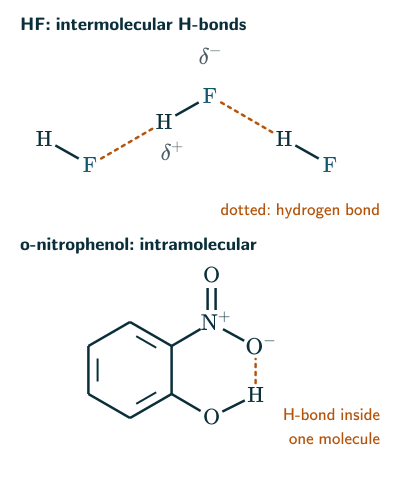
Nitrogen, oxygen and fluorine are highly electronegative. When one is attached to hydrogen by a covalent bond, the electrons of that bond shift towards it, and the partly positive hydrogen forms a bond with another electronegative atom: a hydrogen bond, weaker than the covalent bond (NCERT Section 4.9, page 131). In HF the hydrogen bond links the H of one molecule to the F of the next:
Hδ+–Fδ−···Hδ+–Fδ−···Hδ+–Fδ− (NCERT draws the hydrogen bond as – – –)
Here the hydrogen acts as a bridge, held to one atom by a covalent bond and to the other by a hydrogen bond. A dotted line shows the hydrogen bond and a solid line the covalent bond.
NCERT slip (page 131): NCERT says the hydrogen bond acts as a bridge between two atoms; the bridge is the hydrogen atom, held to one atom by a covalent bond and to the other by the hydrogen bond. In an exam, say the hydrogen atom acts as a bridge.
Thus, hydrogen bond can be defined as the attractive force which binds hydrogen atom of one molecule with the electronegative atom (F, O or N) of another molecule.
NCERT Chemistry Part I (Class 11), Section 4.9, page 131
Beyond the NCERT text: the IUPAC definition of 2011 is broader than an F/O/N-only rule and includes other donors or acceptors when evidence supports hydrogen bonding; weak C–H···O interactions are an example (Wikipedia, “Hydrogen bond”). The conventional F/O/N examples remain the main focus here. This quoted definition describes the intermolecular kind; the intramolecular kind, inside one molecule, is described in NCERT Section 4.9.2 below.
Cause of formation (NCERT Section 4.9.1, pages 131–132): when hydrogen is bonded to a strongly electronegative atom X, the shared pair moves far from the hydrogen, which becomes highly electropositive with respect to X. The hydrogen acquires a fractional positive charge (δ+) and X a fractional negative charge (δ−), giving a polar bond with an electrostatic attraction between molecules:
Hδ+–Xδ−···Hδ+–Xδ−···Hδ+–Xδ−
The magnitude of hydrogen bonding depends on the physical state of the compound: it is maximum in the solid state and minimum in the gaseous state, so hydrogen bonds strongly influence the structure and properties of compounds (NCERT page 132). Strictly, this is a broad comparison for a given substance, not a rule for intramolecular bonds or every crystal form (reasoned). Beyond the NCERT text: common hydrogen bonds between neutral molecules in the vapour are worth about 8 to 29 kJ mol−1, about 21 kJ mol−1 for O–H···O between water molecules (Wikipedia, “Hydrogen bond”), against 464.5 kJ mol−1 for the O–H bond in water (NCERT Section 4.3.3, page 109). The F, O and N examples are effective because these atoms are small, so their lone pairs can come close to the hydrogen; chlorine is about as electronegative as nitrogen but much larger, and HCl forms no HF-like network (reasoned). That is why the electronegativity scale on periodic trends is only part of the story.
Types of hydrogen bonds
There are two types (NCERT Section 4.9.2, page 132):
- Intermolecular hydrogen bond: formed between two different molecules of the same or different compounds, for example in HF, in alcohols and in water.
- Intramolecular hydrogen bond: formed when a hydrogen atom lies between two highly electronegative atoms (F, O, N) within the same molecule. In o‑nitrophenol the hydrogen of the OH group lies between two oxygen atoms, the second belonging to the neighbouring NO2 group (NCERT Fig. 4.22, page 132).
Effects of hydrogen bonding
Beyond the NCERT text, these are its main effects on physical properties: hydrogen bonding explains raised melting points, boiling points and solubilities, and ice floats on water (Wikipedia, “Hydrogen bond”; the boiling points, densities and melting point below are standard data):
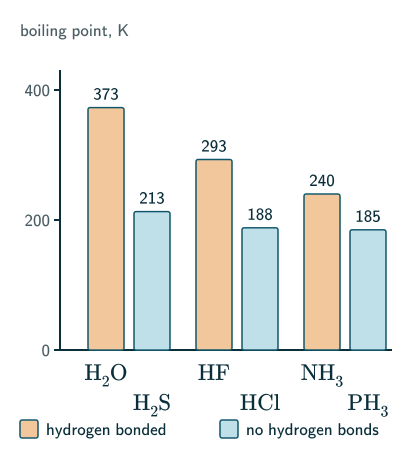
- High boiling points: H2O, HF and NH3 boil far higher than H2S, HCl and PH3, although the latter are heavier; extra energy is needed to break the hydrogen bonds between molecules.
- Water against HF: individual bond strengths depend on their environment, yet water boils higher (373 K against 293 K). Each water molecule has two hydrogens and two lone pairs, so it can form up to four hydrogen bonds; each HF has only one hydrogen, so it forms chains.
- Ice floats: in ice each water molecule is hydrogen bonded to four others in a tetrahedral, open cage structure, so ice (about 0.92 g cm−3) is less dense than liquid water (about 1.00 g cm−3).
- Solubility: ethanol, ammonia and sugars dissolve well in water because they form hydrogen bonds with it.
- Intramolecular bonding can reduce intermolecular association: o‑nitrophenol’s hydrogen bond is used up inside the molecule, which reduces their ability to link through that donor; it melts at about 45 °C and is volatile in steam, so steam distillation separates it from p‑nitrophenol. Melting also depends strongly on crystal packing, so this is not a universal melting-point rule. p‑nitrophenol cannot form this internal bond, so its molecules are linked by intermolecular bonds; it melts at about 114 °C.
Solved examples
Example 1: Hydrogen bonds and van der Waals forces (NCERT Exercise 4.39, page 135)
Define hydrogen bond. Is it weaker or stronger than the van der Waals forces?
A hydrogen bond is the attractive force binding a hydrogen atom, covalently bonded to F, O or N, to another highly electronegative atom of another molecule (or of the same molecule). It arises from the strong partial positive charge left on the hydrogen.
Answer: It is stronger than van der Waals forces, and weaker than a covalent bond (weaker than covalent: NCERT page 131). Beyond the NCERT text: hydrogen bonds are generally stronger than van der Waals interactions, though the ranges overlap at the edges, so compare like with like (Wikipedia, “Hydrogen bond”).
Example 2: Why water boils higher than hydrogen fluoride
F is more electronegative than O. Why does water (373 K) boil higher than HF (293 K)?
Count the hydrogen bonds per molecule. H2O has two H atoms (donors) and two lone pairs on O (acceptors), so each molecule can take part in up to four hydrogen bonds (four in ice). HF has three lone pairs but only one H, so each molecule forms on average only two (one as donor, one as acceptor), giving chains.
Answer: water supports a more extensively connected network than HF chains, contributing to its higher boiling point. The ideal counts help explain the trend; actual liquid populations and boiling points also depend on temperature, entropy and other interactions.
Example 3: o‑ and p‑nitrophenol
Which is more volatile, o‑nitrophenol or p‑nitrophenol? Explain.
In o‑nitrophenol the OH and NO2 groups are next to each other, so the hydrogen bond forms inside the molecule (intramolecular, NCERT Fig. 4.22). In p‑nitrophenol they are on opposite sides of the ring, so the bond can only form between molecules (intermolecular), which associates the molecules.
Answer: o‑nitrophenol is more volatile (lower boiling and melting points); this is why it can be separated from the para isomer by steam distillation.
Example 4: Can it hydrogen bond?
Which of these can form hydrogen bonds between their own molecules: CH4, CH3OH, (CH3)2O, CH3NH2?
A molecule must have H on F, O or N (a donor) and an F, O or N with a lone pair (an acceptor). CH4 has neither. CH3OH has O–H and O. (CH3)2O has an O acceptor but no O–H. CH3NH2 has N–H and N.
Answer: CH3OH and CH3NH2. (CH3)2O can still accept hydrogen bonds from water, so it is fairly soluble.
Common mistakes to avoid
Common mistake
Calling any bond to hydrogen a hydrogen bond
The O–H bond inside a water molecule is a covalent bond. The hydrogen bond is the weaker attraction between that H and an O of another molecule (or another part of the same molecule).
Common mistake
Expecting hydrogen bonds with C–H
Simple hydrocarbons such as methane do not form the strong conventional hydrogen-bond networks taught here. Some sufficiently polarised C–H groups do form weaker C–H···acceptor interactions under the broader modern definition.
Common mistake
Thinking intramolecular bonding raises the boiling point
Intramolecular hydrogen bonds do not hold molecules together; they use up the hydrogen that could have bonded to a neighbour. o‑Nitrophenol therefore boils lower than p‑nitrophenol.
Quick revision summary
- Hydrogen bond: attraction between H bonded to F, O or N and another F, O or N, drawn as a dotted line.
- Cause: the electronegative atom leaves the hydrogen strongly δ+; the δ+ H is attracted to a δ− atom.
- Most hydrogen bonding in solids, least in gases; weaker than covalent bonds, stronger than van der Waals forces (ranges overlap at the edges).
- Intermolecular: HF chains, water, alcohols. Intramolecular: o‑nitrophenol.
- Effects: high boiling points of H2O, HF, NH3; ice less dense than water; solubility of alcohols; o‑nitrophenol more volatile than p‑nitrophenol.
Formula sheet
- Common strong hydrogen bonds: X–H···Y, usually X/Y = F, O or N; broader cases exist
- Strength: covalent bond > hydrogen bond > van der Waals interaction (typical; ranges overlap)
- Extent of hydrogen bonding: solid > liquid > gas
- Hydrogen-bond strength depends on donor, acceptor, charge, distance and geometry
Questions students ask
Why is hydrogen bonding the strongest intermolecular force?
Hydrogen bonding is often a strong intermolecular interaction between comparable small neutral molecules. Hydrogen’s small size and the polarity of its bond allow a close, directional interaction with an electron-rich acceptor; electrostatics and electronic redistribution both contribute. The attraction is therefore much stronger than ordinary dipole–dipole or London (dispersion) forces between molecules of similar size, though still far weaker than a covalent bond. Between large molecules, though, dispersion forces can add up to more: octane, C8H18, which cannot hydrogen bond, boils at 126 °C, above water.
Why is hydrogen bonding important in DNA and proteins?
Hydrogen bonds help give DNA base pairs their specificity, while base stacking and solvent effects also contribute strongly to double-helix stability: adenine pairs with thymine through two hydrogen bonds and guanine with cytosine through three, and because each bond is weak, the strands can separate when DNA is copied and then pair again. In proteins, N–H···O=C hydrogen bonds between the peptide groups hold the chain in its α-helix and β-pleated sheet shapes, on which the protein’s function depends.
Can intramolecular hydrogen bonding change the acidity of a compound?
Yes, intramolecular hydrogen bonding can make a compound more or less acidic, depending on whether it stabilises the anion or the acid. In salicylic acid (2-hydroxybenzoic acid) the neighbouring OH group hydrogen bonds to the carboxylate ion left after the proton goes, stabilising it. Together with other ortho-substituent effects, this helps explain why salicylic acid (pKa about 3.0) is much stronger than benzoic acid (4.2) and its para isomer, 4-hydroxybenzoic acid (4.5). In o‑nitrophenol the bond instead holds the OH hydrogen inside the molecule, so it is a slightly weaker acid than p‑nitrophenol.
Why does ethanoic acid exist as a dimer?
Ethanoic (acetic) acid can associate into dimers in the vapour and in non-polar solvents such as benzene because two molecules join through two O–H···O=C hydrogen bonds, the O–H of each bonding to the C=O oxygen of the other to close a ring. So a molar mass measured in benzene, for example from the depression of its freezing point, approaches 120 g mol instead of 60 g mol if dimerisation is nearly complete; the apparent value depends on concentration and temperature. In water the acid forms hydrogen bonds with water molecules instead, so it hardly dimerises.
Is hydrogen bonding in the JEE Main 2027 and NEET (UG) 2026 syllabuses?
Yes, hydrogen bonding is in both syllabuses: JEE Main 2027 and NEET (UG) 2026 list ‘hydrogen bonding and its applications’ under Unit 3, Chemical Bonding and Molecular Structure. NCERT Class 11 covers its cause in Section 4.9 (page 131) and its two types on page 132, and its effects on boiling points and solubility come back in the Class 12 chapters on alcohols, phenols and ethers, carboxylic acids and amines.
Practice questions
Try each question first, then open the answer to check your working.
-
Q1. Arrange NH3, PH3, AsH3 and SbH3 in order of boiling point. Why is NH3 not the highest?
Show answerHide answer
PH3 (185 K) < AsH3 (211 K) < NH3 (240 K) < SbH3 (256 K). Down the group the molecules get larger, so van der Waals forces grow. N–H···N hydrogen bonds lift NH3 above PH3 and AsH3, but they are weaker than O–H···O or F–H···F bonds, and the much larger SbH3 molecules attract each other more strongly still. In groups 16 and 17, H2O and HF do boil highest.
-
Q2. Give one example each of intermolecular and intramolecular hydrogen bonding.
Show answerHide answer
Intermolecular: between HF molecules (or water, or alcohol molecules). Intramolecular: in o‑nitrophenol, between the H of the OH group and an O of the neighbouring NO2 group.
-
Q3. Salicylaldehyde (o-hydroxybenzaldehyde) has its OH and CHO groups next to each other on the ring; in p-hydroxybenzaldehyde they are opposite. Which is expected to be more volatile, and why?
Show answerHide answer
Salicylaldehyde. Its O–H hydrogen bonds to the C=O oxygen of the neighbouring CHO group inside the molecule (intramolecular), which reduces intermolecular association through that OH group. In p-hydroxybenzaldehyde the groups are too far apart, so the hydrogen bonds form between molecules (intermolecular), and more energy is needed to separate them.