Valence bond theory: orbital overlap, sigma and pi bonds
NCERT Class 11 Chemistry Chapter 4 Section 4.5
Quick answer
Elementary valence bond theory describes covalent bonding through overlapping orbitals and paired electrons of opposite spin. Head-on overlap gives σ bonding and sideways overlap of suitable parallel orbitals gives π bonding; for comparable orbitals, σ contributions are generally stronger. Modern VB theory extends beyond this simple localised pair picture.
With your textbook
NCERT Chemistry Part I (Class 11), Chapter 4 “Chemical Bonding and Molecular Structure”, Section 4.5 “Valence Bond Theory”, pages 117–120.
Open the official NCERT chapter (PDF, 4.5 MB, ncert.nic.in) (opens in a new tab)
Checked against the 2026-27 reprint on .
What is valence bond theory?
Valence bond (VB) theory
The elementary electron-pair version of valence bond theory explains a covalent bond as the overlap of half-filled atomic orbitals of two atoms, in which two electrons of opposite spin pair up (NCERT Section 4.5, pages 117–120):
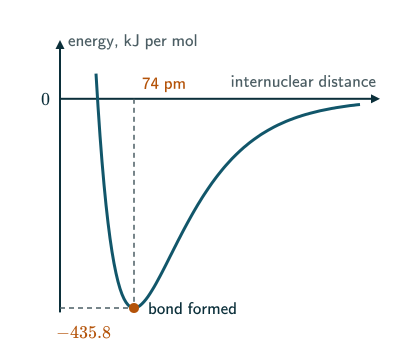
- as two atoms approach, the attraction between each nucleus and both electrons outweighs the repulsions, so the energy falls to a minimum at the bond length;
- for comparable orbitals and bonds, greater effective overlap generally strengthens bonding;
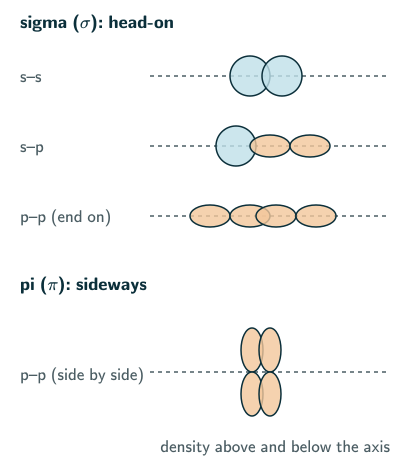
- head-on overlap along the internuclear axis gives a sigma (σ) bond; sideways overlap of parallel p orbitals gives a pi (π) bond, which is weaker.
Introduced by Heitler and London (1927) and developed by Pauling, it explains bond energies and, with hybridisation, molecular shapes.
In plain words: Lewis said bonds are shared pairs but not why sharing lowers the energy. VB theory pictures each atom’s half-filled orbital as a cloud. As the atoms come together the clouds overlap, the two electrons pair up with opposite spins, and the electron density between the nuclei pulls both nuclei together. Overlap end to end gives a strong σ bond; overlap side by side gives a weaker π bond.
Why another theory?
The Lewis approach helps to write structures but does not explain how a bond forms, or why H2 (435.8 kJ mol−1, 74 pm) and F2 (155 kJ mol−1, 144 pm in NCERT; the measured bond length is 141 pm) differ so much though both have one shared pair. VSEPR gives shapes but does not explain them (NCERT Section 4.5, page 117). Two theories based on quantum mechanics fill the gap: valence bond (VB) theory and molecular orbital (MO) theory. VB theory, introduced by Heitler and London in 1927 and developed by Pauling and others, is treated here qualitatively (page 117).
Forming the hydrogen molecule
Take two hydrogen atoms, A and B, with nuclei NA, NB and electrons eA, eB.
When the two atoms are at large distance from each other, there is no interaction between them.
NCERT Chemistry Part I (Class 11), Section 4.5, page 117
As they approach, new forces begin to act (NCERT pages 117–118, Fig. 4.7):
- attractions between each nucleus and its own electron (NA–eA, NB–eB) and between each nucleus and the other atom’s electron (NA–eB, NB–eA);
- repulsions between the two electrons (eA–eB) and between the two nuclei (NA–NB).
The new attractive forces are larger than the new repulsive ones, so the atoms move closer and the potential energy falls.
Ultimately a stage is reached where the net force of attraction balances the force of repulsion and system acquires minimum energy.
NCERT Chemistry Part I (Class 11), Section 4.5, page 118
At that point the atoms are bonded, with a bond length of 74 pm. Energy is released as the bond forms, so H2 is more stable than two separate H atoms; NCERT calls this energy the bond enthalpy, and uses it to label the schematic curve (page 118). The exact well depth is different from the room-temperature dissociation enthalpy. Conversely, 435.8 kJ is needed to dissociate one mole of H2:
H2(g) + 435.8 kJ mol−1 → H(g) + H(g)
Pushing the nuclei closer than 74 pm makes the energy rise steeply.
Orbital overlap
At the energy minimum, the atomic orbitals of the two atoms partly interpenetrate. This partial merging is the overlapping of atomic orbitals, and it pairs the two electrons (NCERT Section 4.5.1, page 118). The extent of overlap decides the strength of the bond: in general, the greater the overlap, the stronger the bond. So, in the orbital overlap concept, a covalent bond forms by the pairing of valence electrons of opposite spin.
Sign and direction matter (NCERT Section 4.5.3, page 119, Fig. 4.9). The + and − signs on orbital diagrams show the phase of the wave function, not charge (see shapes of atomic orbitals). Overlap is:
- positive (bonding) when the overlapping lobes have the same sign and suitable orientation;
- negative for the depicted opposite-phase overlap; adding those wave functions gives destructive rather than bonding interference;
- zero when the orbitals’ orientation makes the positive and negative parts cancel, as for a px and a py orbital, or an s and a px approaching along z.
The problem of directions
VB theory must also explain why CH4 is tetrahedral (109.5°), NH3 pyramidal and H2O bent (NCERT Sections 4.5.2–4.5.3, pages 119–120). Try simple overlap for methane. Ground-state carbon, [He] 2s2 2p2, has only two half-filled orbitals. In the excited state, [He] 2s1 2px1 2py1 2pz1, it has four to overlap with four H 1s orbitals; the energy needed for this excitation is compensated by the energy released when the bonds form (page 119). But the three 2p orbitals are at 90° to one another, so three H–C–H angles would be 90°, and the spherical 2s orbital would give a fourth bond in no particular direction. That does not match 109.5°. In the same way, pure p orbitals would give 90° in NH3 and H2O, not the observed 107° and 104.5° (page 120). Simple overlap of pure atomic orbitals cannot explain the directions of bonds; hybridisation (NCERT Section 4.6) solves this.
Sigma and pi bonds
Covalent bonds are of two types, by the way the orbitals overlap (NCERT Section 4.5.4, page 120):
- Sigma (σ) bond: end-to-end (head-on, axial) overlap along the internuclear axis. It can form from s–s overlap (H2), s–p overlap (a half-filled s with a half-filled p) or p–p overlap (two half-filled p orbitals end on).
- Pi (π) bond: sideways overlap of p orbitals whose axes stay parallel to each other and perpendicular to the internuclear axis. The electron cloud forms two saucer-shaped regions above and below the plane of the bonded atoms.
A σ bond is cylindrically symmetric about the internuclear axis, so rotation does not inherently destroy its overlap. Rotation about a single bond can still have an energy barrier from other interactions, conjugation or ring constraints. A π bond has no electron density in the plane containing the axis (its nodal plane); twisting would pull the p orbitals out of line, so rotation about a double bond is restricted, which makes cis–trans isomers possible.
Strength of sigma and pi bonds
A bond’s strength depends on the extent of overlap. Head-on overlap in a σ bond is greater, so a σ contribution is generally stronger than a π contribution for comparable orbitals between the same atoms, in which the sideways overlap is smaller (NCERT Section 4.5.5, page 120). In a multiple bond, π bonds form in addition to one σ bond: a double bond is one σ and one π, a triple bond one σ and two π.
Solved examples
Example 1: Counting σ and π bonds (NCERT Exercise 4.28, page 135)
Find the total number of σ and π bonds in (a) C2H2 and (b) C2H4.
(a) Ethyne, H–C≡C–H: two C–H σ bonds and a C≡C triple bond (1σ + 2π): 3σ, 2π. (b) Ethene, H2C=CH2: four C–H σ bonds and a C=C double bond (1σ + 1π): 5σ, 1π.
Answer: C2H2: 3σ, 2π; C2H4: 5σ, 1π.
Example 2: Which pair cannot form a σ bond? (NCERT Exercise 4.29, page 135)
Taking the x-axis as the internuclear axis, which pair will not form a σ bond: (a) 1s and 1s; (b) 1s and 2px; (c) 2py and 2py; (d) 1s and 2s?
A σ bond needs overlap along the axis. 1s–1s, 1s–2px and 1s–2s all overlap head-on along x. Two 2py orbitals are perpendicular to the x-axis; they can only overlap sideways.
Answer: (c); two 2py orbitals form a π bond, not a σ bond.
Example 3: Bonds in more molecules
Count the σ and π bonds in N2, CO2 and HCN.
N≡N: 1σ, 2π. O=C=O: two double bonds, 2σ, 2π. H–C≡N: C–H σ plus C≡N (1σ + 2π): 2σ, 2π.
Answer: N2 1σ 2π; CO2 2σ 2π; HCN 2σ 2π.
Example 4: What simple overlap predicts for ammonia
Using pure 2p orbitals on nitrogen, what H–N–H angle would VB theory predict, and what is observed?
Nitrogen’s three half-filled 2p orbitals are mutually perpendicular, so three N–H bonds from them would be at 90°. The observed angle is 107° (NCERT page 120).
Answer: 90° predicted against 107° observed; the gap shows that pure orbitals cannot explain bond directions, which leads to hybridisation.
Common mistakes to avoid
Common mistake
Reading orbital signs as charges
The + and − on orbital lobes are the phase of the wave function. Same-sign lobes overlap positively; the signs say nothing about electric charge.
Common mistake
Counting a double bond as two σ bonds
Between two atoms there is only ever one σ bond. A double bond is 1σ + 1π and a triple bond 1σ + 2π.
Common mistake
Thinking a π bond can exist alone
In VB theory, and in almost every molecule you will meet, a π bond forms only in addition to a σ bond between the same two atoms (NCERT Section 4.5.5, page 120). The exception NCERT itself gives is C2: molecular orbital theory makes its double bond two π bonds and no σ bond (NCERT Section 4.8, page 130).
Common mistake
Expecting any two orbitals to overlap
With the nuclei on the z-axis, px on one centre and py on the other have zero net overlap by symmetry. Always specify the internuclear axis before comparing orientations.
Quick revision summary
- VB theory (Heitler and London, 1927; Pauling): a covalent bond forms when half-filled atomic orbitals overlap and their electrons pair with opposite spins.
- H2: attractions outweigh repulsions until a minimum of energy at 74 pm; 435.8 kJ mol−1 is needed to break one mole of H–H bonds.
- More overlap, stronger bond; overlap can be positive, negative or zero depending on sign and orientation.
- Pure s and p orbitals cannot give 109.5°, 107° or 104.5°: hybridisation is needed.
- σ bond: head-on overlap (s–s, s–p, p–p), stronger. π bond: sideways overlap of parallel p orbitals, weaker, formed alongside a σ bond (C2, from MO theory, is the exception).
Formula sheet
- Single bond = 1σ; double = 1σ + 1π; triple = 1σ + 2π
- Comparable σ contributions are generally stronger than π contributions between the same atoms
- H: bond length 74 pm, bond enthalpy 435.8 kJ mol
Questions students ask
What are the limitations of valence bond theory?
The simplest localised two-electron-bond picture used here pairs all electrons, so it does not explain why O2 is paramagnetic: it pairs all of oxygen’s electrons, whereas O2 has two unpaired electrons. That restricted model also cannot describe a bond held by a single electron, as in H2+, or electrons spread over many atoms, as in benzene, without the extra idea of resonance, and it needs hybridisation to explain bond angles such as 109.5° in CH4. Molecular orbital theory handles these examples conveniently by using orbitals belonging to the whole molecule. These are limitations of the elementary model, not of modern VB theory, which can also describe open-shell and delocalised bonding.
How do you count sigma and pi bonds in a molecule?
To count sigma and pi bonds, draw the full structure and remember that every single, double or triple bond in an ordinary molecule contains exactly one σ bond: a single bond is 1σ, a double bond 1σ + 1π and a triple bond 1σ + 2π. Tetracyanoethylene, (NC)2C=C(CN)2, has one C=C bond (1σ + 1π), four C–C single bonds (4σ) and four C≡N bonds (4σ + 8π), so it has 9σ and 9π bonds in all. Lone pairs are not bonds and are not counted.
Can an s orbital form a pi bond?
No, an s orbital cannot form a π bond: it is spherical, so its nonzero bonding interaction has σ symmetry about the internuclear axis; some orientations, such as s with a perpendicular p orbital, give zero overlap. A π bond needs two orbitals with lobes perpendicular to the axis that overlap side by side, such as two parallel p orbitals (or, beyond Class 11, a p and a d orbital). Likewise, hybrid orbitals, whose large lobes point along the bonds, form only σ bonds, and the π bonds of ethene and ethyne come from unhybridised p orbitals.
How is valence bond theory used for coordination compounds?
In Class 12, valence bond theory explains coordination compounds by letting the central metal ion form a set of empty hybrid orbitals that accept lone pairs from the ligands as coordinate bonds; the hybridisation gives the shape, and the number of unpaired electrons gives the magnetism. For example, [Co(NH3)6]3+ uses d2sp3 orbitals, is octahedral and is diamagnetic, while [CoF6]3− uses sp3d2 orbitals and has four unpaired electrons. The theory cannot explain the colours of complexes or predict which ligands force the d electrons to pair, which crystal field theory does.
Practice questions
Try each question first, then open the answer to check your working.
-
Q1. Explain the formation of the H2 molecule on the basis of valence bond theory (NCERT Exercise 4.33, page 135).
Show answerHide answer
As two H atoms approach, each electron is attracted by both nuclei, while the electrons repel each other and so do the nuclei. The attractions win, so the energy falls until, at 74 pm, attraction and repulsion balance and the energy is at a minimum. There the 1s orbitals overlap and the two electrons, of opposite spin, pair to form the H–H σ bond; 435.8 kJ mol−1 is released.
-
Q2. Distinguish between a sigma and a pi bond (NCERT Exercise 4.32, page 135).
Show answerHide answer
σ bond: head-on overlap along the internuclear axis; can form from s–s, s–p or p–p orbitals; stronger; rotation preserves σ overlap but may face barriers from other interactions; one between any two bonded atoms. π bond: sideways overlap of parallel p orbitals, with density above and below the axis; weaker; rotation about it is restricted; forms only in addition to a σ bond (C2, from MO theory, is the exception).
-
Q3. What is the significance of the plus and minus signs shown on orbitals (NCERT Exercise 4.37, page 135)?
Show answerHide answer
They show the sign (phase) of the orbital wave function in each region, not charge. Lobes of the same sign overlap positively and can form a bond; lobes of opposite sign overlap negatively.