VSEPR theory and the shapes of molecules
NCERT Class 11 Chemistry Chapter 4 Section 4.4
Quick answer
VSEPR predicts shapes by arranging electron domains around a central atom to reduce repulsion: 2, 3, 4, 5 and 6 domains give linear, trigonal planar, tetrahedral, trigonal bipyramidal and octahedral arrangements. A multiple bond counts as one domain, and a lone pair also counts as one. Lone pairs often distort bond angles; molecular shape names the positions of atoms only.
With your textbook
NCERT Chemistry Part I (Class 11), Chapter 4 “Chemical Bonding and Molecular Structure”, Section 4.4 “The Valence Shell Electron Pair Repulsion (VSEPR) Theory”, pages 112–117.
Open the official NCERT chapter (PDF, 4.5 MB, ncert.nic.in) (opens in a new tab)
Checked against the 2026-27 reprint on .
What is VSEPR theory?
Valence shell electron pair repulsion (VSEPR) theory
VSEPR theory predicts the shapes of covalent molecules from the electron pairs round the central atom (NCERT Section 4.4, pages 112–117):
- the shape depends on the number of valence-shell electron pairs, bonded and non-bonded (lone pairs), round the central atom;
- the pairs repel one another and take up positions as far apart as possible;
- lone pairs repel more than bond pairs: lp–lp > lp–bp > bp–bp, so lone pairs often distort bond angles. Symmetry can preserve some ideal angles, as in square-planar XeF4.
Count a multiple bond as one electron domain, not as two or three separate pairs. Two domains give a linear arrangement, three trigonal planar, four tetrahedral, five trigonal bipyramidal and six octahedral.
In plain words: electron pairs are all negatively charged, so they push each other as far apart as they can round the central atom, like balloons tied together at their knots. Count the pairs and you know the arrangement. Then remember that only the atoms are “seen” in the shape, and that a lone pair, held by one nucleus only, spreads out more and pushes harder than a bond pair.
The postulates
Lewis structures cannot explain molecular shapes. Sidgwick and Powell proposed VSEPR theory in 1940, and Nyholm and Gillespie developed and refined it in 1957 (NCERT Section 4.4, pages 112–113). Its main postulates (page 113):
- The shape of a molecule depends on the number of valence-shell electron pairs (bonded or non-bonded) round the central atom.
- Electron pairs repel one another, since their clouds are negatively charged.
- They take up positions that minimise repulsion and so maximise the distance between them.
- The valence shell is treated as a sphere, with the pairs on its surface as far from one another as possible.
- A multiple bond is treated as one electron pair, a “super pair”.
- Where a molecule has resonance structures, VSEPR can be applied to any one of them.
The repulsions decrease in the order lone pair–lone pair > lone pair–bond pair > bond pair–bond pair. Nyholm and Gillespie explained why:
While the lone pairs are localised on the central atom, each bonded pair is shared between two atoms.
NCERT Chemistry Part I (Class 11), Section 4.4, page 113
So a lone pair occupies more space round the central atom and repels more strongly (page 113).
Molecules with no lone pair on the central atom
For isolated molecules with no central lone pairs, the shape follows the electron-domain arrangement (NCERT Table 4.6, page 114; ball-and-stick models in NCERT Fig. 4.6, page 113):
| Pairs | Geometry (angle) | Examples |
|---|---|---|
| 2 | linear (180°) | BeCl2, HgCl2 |
| 3 | trigonal planar (120°) | BF3 |
| 4 | tetrahedral (109.5°) | CH4, NH4+ |
| 5 | trigonal bipyramidal (120°, 90°) | PCl5 |
| 6 | octahedral (90°) | SF6 |
VSEPR predicts the shapes of a great many molecules accurately, especially compounds of the p-block elements, even where the energy difference between possible structures is very small. NCERT adds that its theoretical basis is still a matter of discussion (page 113).
Molecules with lone pairs
With lone pairs, the arrangement of electron pairs still follows the table above, but the shape describes only the positions of the atoms. Writing A for the central atom, B for a bonded atom and E for a lone pair (NCERT Table 4.7, page 115; the AB2E3 row is beyond the NCERT table):
| Type | Shape | Example |
|---|---|---|
| AB2E | bent | SO2, O3 |
| AB3E | trigonal pyramidal | NH3 |
| AB2E2 | bent | H2O |
| AB4E | see-saw | SF4 |
| AB3E2 | T-shaped | ClF3 |
| AB5E | square pyramidal | BrF5 |
| AB4E2 | square planar | XeF4 |
| AB2E3 | linear | XeF2, I3− |
NCERT’s Table 4.7 labels the water row “AB3E2”, though it lists two bonding pairs; water is AB2E2, as Table 4.8 has it. Table 4.8 in turn gives SO2 (AB2E) “4” bonding pairs; it has 2 (counting each double bond as one super pair).
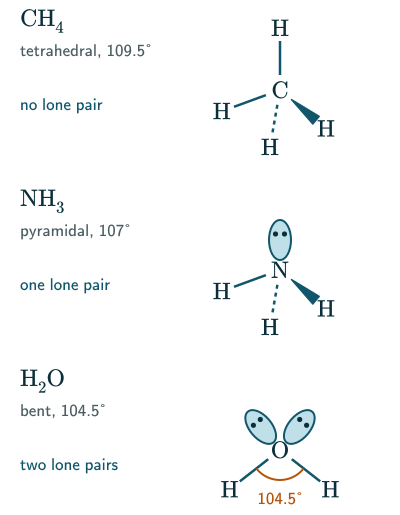
How lone pairs distort the angles (NCERT Table 4.8, pages 116–117):
- SO2 (AB2E): three pairs would give 120°, but lp–bp repulsion is greater than bp–bp, so the O–S–O angle closes slightly to 119.5°; the molecule is bent.
- NH3 (AB3E): four pairs would give a tetrahedron, but the lone pair pushes the N–H bonds together, to 107°.
- H2O (AB2E2): two lone pairs push harder still (lp–lp > lp–bp > bp–bp), to 104.5°.
- SF4 (AB4E): in a trigonal bipyramid the lone pair goes equatorial: there it has two lp–bp repulsions at 90°, against three if it were axial. The shape is a see-saw (a distorted tetrahedron).
- ClF3 (AB3E2): both lone pairs go equatorial. They are then 120° apart, with no lp–lp repulsion at 90° and four lp–bp repulsions at 90° (one lone pair axial and one equatorial would give an lp–lp repulsion at 90°; both axial would give six lp–bp repulsions at 90°). The shape is a T.
- XeF2 (AB2E3): ½(8 + 2) = 5 pairs; the three lone pairs take all three equatorial positions, so F–Xe–F is 180°: linear.
NCERT’s reason for the T shape of ClF3 (Table 4.8, page 117), that the equatorial structure has fewer lp–bp repulsions than the others, is not right as stated: it has four lp–bp repulsions at 90°, while the structure with one lone pair axial has only three. What makes it the most stable is that it avoids the strongest repulsion, lp–lp at 90°.
Using VSEPR step by step
- Draw the Lewis structure, or count the electron pairs on the central atom.
- Count bond pairs (a multiple bond counts once) and lone pairs.
- Their total fixes the arrangement (2 linear, 3 trigonal planar, 4 tetrahedral, 5 trigonal bipyramidal, 6 octahedral).
- Name the shape from the atoms only; lone pairs often compress some angles, but symmetry and other factors also matter.
A common shortcut for the number of pairs round the central atom (beyond the NCERT text):
Electron pairs round the central atom
Pairs = ½(V + M − c + a)
where V is the number of valence electrons of the central atom, M the number of monovalent atoms bonded to it (H, halogens), c the charge of a cation and a the charge of an anion. This shortcut works for the simple hydrides, halides and oxides illustrated here; it is not universal. Confirm the count from a complete Lewis structure, especially for charged, delocalised or unusual species. Each bonded atom gives one bonding domain, and each lone pair one additional domain. For NO2 the unpaired electron is treated as a weaker extra domain, not literally an electron pair.
Solved examples
Example 1: Shapes from NCERT Exercise 4.7 (page 134)
Predict the shapes of BeCl2, BCl3, SiCl4, AsF5, H2S and PH3.
Pairs = ½(V + M): BeCl2 ½(2 + 2) = 2, both bonding: linear. BCl3 ½(3 + 3) = 3: trigonal planar. SiCl4 ½(4 + 4) = 4: tetrahedral. AsF5 ½(5 + 5) = 5: trigonal bipyramidal. H2S ½(6 + 2) = 4, with 2 bonds and 2 lone pairs: bent. PH3 ½(5 + 3) = 4, with 3 bonds and 1 lone pair: trigonal pyramidal.
VSEPR gives the shape, not the exact angle: PH3 is about 93.5° and H2S about 92°, not 107° and 104.5°. A more detailed orbital description gives their bonds substantial p character, whose directions are near 90°; electron-pair repulsion alone does not calculate these angles.
Answer: linear, trigonal planar, tetrahedral, trigonal bipyramidal, bent, trigonal pyramidal.
Example 2: Water and ammonia (NCERT Exercise 4.8, page 134)
Both NH3 and H2O are distorted tetrahedra, but the bond angle in water is smaller. Why?
Both have four electron pairs round the central atom. NH3 has one lone pair, H2O two. Lone pair–lone pair repulsion is the strongest, so the two lone pairs in water push the O–H bonds closer than the single lone pair in ammonia pushes the N–H bonds.
Answer: H–O–H is 104.5°, H–N–H 107°, because water has two lone pairs.
Example 3: Xenon tetrafluoride
Predict the shape of XeF4.
Xe has V = 8 and four F atoms: pairs = ½(8 + 4) = 6, with 4 bond pairs and 2 lone pairs (AB4E2). Six pairs are octahedral; the two lone pairs go opposite each other (trans) to keep apart, leaving the four F atoms in a square.
Answer: square planar.
Example 4: Ions
Predict the shapes of NH4+ and NO2−, and compare the angle in NO2− with NO2+ and NO2.
NH4+: ½(5 + 4 − 1) = 4 pairs, all bonding: tetrahedral. NO2−: O atoms count 0 in M, so ½(5 + 0 + 1) = 3 pairs, with 2 bonded atoms and 1 lone pair: bent (about 115°). NO2+: ½(5 − 1) = 2 pairs, linear, 180°. NO2: ½(5) = 2.5, rounded up to 3, but the third “pair” is a single electron, which repels less than a lone pair, so the angle is about 134°.
Answer: NH4+ tetrahedral; NO2− bent; angles NO2+ 180° > NO2 about 134° > NO2− about 115°.
Example 5: Why CH<sub>4</sub> is not square planar (NCERT Exercise 4.21, page 134)
A square planar CH4, with C at the centre of a square of H atoms, is another possible geometry. Why is CH4 tetrahedral instead?
Four bond pairs round carbon repel one another. In a square they would be 90° apart; in a tetrahedron, 109.5°. The tetrahedron keeps them farther apart, so it has lower repulsion and lower energy. The observed shape is conveniently described by sp hybrid orbitals. Hybridisation is a model of bonding; absence of valence d orbitals alone is not a general proof that a square-planar geometry is impossible.
Answer: the tetrahedral arrangement minimises electron-pair repulsion.
Common mistakes to avoid
Common mistake
Naming the shape after the electron-pair arrangement
NH3 has a tetrahedral arrangement of pairs but a trigonal pyramidal shape; H2O’s arrangement is tetrahedral but its shape is bent. The shape describes only where the atoms are.
Common mistake
Counting a double bond as two pairs
For VSEPR a multiple bond is one “super pair”. SO2 has 2 bonding super pairs and 1 lone pair: AB2E, bent.
Common mistake
Putting lone pairs axial in a trigonal bipyramid
Lone pairs go equatorial, where they have more room: SF4 is a see-saw (not a trigonal pyramid) and ClF3 T-shaped (not trigonal planar).
Common mistake
Ignoring the ion’s charge
Add the anion’s charge, or subtract the cation’s, before halving: NH4+ has ½(5 + 4 − 1) = 4 pairs.
Quick revision summary
- VSEPR (Sidgwick and Powell 1940; Nyholm and Gillespie 1957): electron pairs round the central atom repel and keep as far apart as possible.
- Repulsion: lp–lp > lp–bp > bp–bp; a multiple bond counts as one super pair.
- Pairs 2, 3, 4, 5, 6: linear, trigonal planar, tetrahedral, trigonal bipyramidal, octahedral.
- With lone pairs: AB2E bent (SO2), AB3E pyramidal (NH3, 107°), AB2E2 bent (H2O, 104.5°), AB4E see-saw (SF4), AB3E2 T-shape (ClF3), AB5E square pyramidal (BrF5), AB4E2 square planar (XeF4), AB2E3 linear (XeF2).
- In a trigonal bipyramid, lone pairs take equatorial positions.
Formula sheet
- Repulsion order: lp–lp > lp–bp > bp–bp
- Shortcut domains = ½(V + M − c + a), for the simple cases discussed; verify with a Lewis structure
- 2, 3, 4, 5, 6 pairs: linear 180°, trigonal planar 120°, tetrahedral 109.5°, trigonal bipyramidal 120°/90°, octahedral 90°
- CH 109.5° > NH 107° > HO 104.5°
Questions students ask
What is the full form of VSEPR?
VSEPR stands for valence shell electron pair repulsion, and the name, usually pronounced ‘vesper’, sums up the theory: the electron pairs in the valence shell of the central atom repel one another, so the molecule takes the shape that keeps them as far apart as possible. It was proposed by Sidgwick and Powell in 1940 and developed by Nyholm and Gillespie in 1957.
What is the difference between VSEPR theory and hybridisation?
VSEPR theory predicts the shape of a molecule by counting the electron pairs round the central atom and letting them repel, while hybridisation, part of valence bond theory, explains that shape through the orbitals the atom uses to form its bonds. In the traditional school mapping, two to six electron pairs correspond to sp, sp2, sp3, sp3d and sp3d2, so four pairs mean a tetrahedral arrangement in VSEPR and sp3 orbitals in valence bond theory. The d-containing labels for hypervalent main-group molecules are textbook models, not evidence that d orbitals must participate substantially. Use VSEPR to find the shape and the steric number to name the hybridisation.
Why is the bond angle in NH3 larger than in NF3?
The H–N–H angle in NH3 (107°) is larger than the F–N–F angle in NF3 (about 102°) because fluorine, being far more electronegative than nitrogen, pulls the bonding pairs of NF3 away from the nitrogen atom. With the bond pairs farther from the central atom and from one another, bond pair–bond pair repulsion is weaker, and the lone pair on nitrogen squeezes the bonds closer together. In NH3 nitrogen is the more electronegative atom, so the bond pairs stay close to it, repel more strongly and keep the angle nearer the tetrahedral 109.5°.
What are the limitations of VSEPR theory?
VSEPR theory predicts the shapes of most p-block molecules well, but it has limits: it does not explain how bonds form or how strong they are, it tells only whether bond angles open or close, not their exact values, and it works poorly for transition-metal compounds, whose shapes depend on their d electrons. Some species also break its rules: the [TeCl6]2− ion has seven electron pairs round tellurium, one of them a lone pair, yet it is nearly regular octahedral in many salts; the precise distortion depends on the crystal environment. NCERT itself notes that the theoretical basis of VSEPR is still a matter of discussion.
Practice questions
Try each question first, then open the answer to check your working.
-
Q1. Predict the shape of SF6 and of PCl5, and give their bond angles.
Show answerHide answer
SF6: ½(6 + 6) = 6 bond pairs: octahedral, 90° between neighbouring bonds (180° between opposite bonds). PCl5: ½(5 + 5) = 5 bond pairs: trigonal bipyramidal, 120° in the equatorial plane, 90° between axial and equatorial bonds and 180° between the two axial bonds; the axial bonds are slightly longer than the equatorial ones (NCERT Section 4.6.3, page 125).
-
Q2. Why is ClF3 T-shaped and not trigonal planar?
Show answerHide answer
Cl has ½(7 + 3) = 5 pairs: 3 bond pairs and 2 lone pairs, a trigonal bipyramidal arrangement. The two lone pairs go equatorial, an arrangement with no lp–lp repulsion at 90° and fewer 90° lp–bp contacts than the both-axial option (one axial and one equatorial would put them 90° apart; both axial would give six lp–bp repulsions at 90° and a trigonal planar shape). This leaves the three F atoms in a T.
-
Q3. Arrange CH4, NH3 and H2O in order of decreasing bond angle and explain.
Show answerHide answer
CH4 (109.5°) > NH3 (107°) > H2O (104.5°). All have four pairs; the number of lone pairs rises from 0 to 1 to 2, and lone pairs repel more strongly than bond pairs, so the bond angle shrinks.