Ionic or electrovalent bond
NCERT Class 11 Chemistry Chapter 4 Section 4.2
Quick answer
An ionic bond is the electrostatic attraction between oppositely charged ions. Forming gaseous Na and Cl from atoms costs energy, but lattice formation releases enough to stabilise solid NaCl; its lattice formation enthalpy is about −788 kJ mol. Stability requires the full energy balance, and spontaneity at a given temperature also depends on entropy.
With your textbook
NCERT Chemistry Part I (Class 11), Chapter 4 “Chemical Bonding and Molecular Structure”, Section 4.2 “Ionic or Electrovalent Bond”, pages 106–107.
Open the official NCERT chapter (PDF, 4.5 MB, ncert.nic.in) (opens in a new tab)
Checked against the 2026-27 reprint on .
What is an ionic bond?
Ionic (electrovalent) bond
An ionic bond is the electrostatic attraction between positive and negative ions, often modelled as forming by the transfer of electrons from one atom to another (NCERT Section 4.1.1, pages 101–102; factors from Section 4.2, pages 106–107). Its formation depends on:
- how easily the metal atom loses electrons (low ionisation enthalpy);
- how readily the non-metal atom gains them (a large negative electron gain enthalpy);
- the energy released when the ions pack into a crystal (a large lattice enthalpy).
Lattice formation is a major contribution to stability, but the complete energy balance matters; an octet alone is insufficient. At specified temperature and pressure, spontaneity depends on Gibbs energy, including entropy.
In plain words: pulling an electron off sodium costs energy, and chlorine gives back less than that when it takes the electron, so making the two gaseous ions is uphill. What makes salt form anyway is the huge amount of energy released when vast numbers of Na+ and Cl− ions pull together into a crystal. That final step pays for everything else.
Factors favouring an ionic bond
From the Kössel and Lewis treatment, forming an ionic compound depends on (NCERT Section 4.2, page 106):
- how easily the positive and negative ions form from the neutral atoms;
- how the ions arrange themselves in the solid, the lattice of the crystal.
Forming a positive ion means ionisation, removing electrons; forming a negative ion means adding electrons:
The three steps
M(g) → M+(g) + e− (ionisation enthalpy)
X(g) + e− → X−(g) (electron gain enthalpy)
M+(g) + X−(g) → MX(s) (lattice formation)
The ionisation enthalpy is always positive (endothermic). The electron gain enthalpy, ΔegH, may be negative or positive; electron affinity uses the opposite sign for energy release, with thermal-convention differences usually neglected here (page 106).
Obviously ionic bonds will be formed more easily between elements with comparatively low ionization enthalpies and elements with comparatively high negative value of electron gain enthalpy.
NCERT Chemistry Part I (Class 11), Section 4.2, page 106
So most ionic compounds have cations from metals (low ionisation enthalpy, on the left of the table) and anions from non-metals (very negative electron gain enthalpy, on the right). The ammonium ion, NH4+, made only of non-metals, is an exception: it is the cation of many ionic compounds, such as NH4Cl (page 106).
The ionic crystal
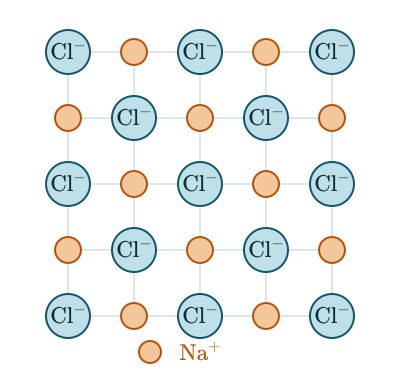
In the solid, cations and anions form an orderly three-dimensional arrangement held together by coulombic attraction. The crystal structure depends on the sizes of the ions, how they pack and other factors (NCERT page 106). In sodium chloride (rock salt), each Na+ is surrounded by Cl− ions and each Cl− by Na+ ions.
The energy balance and lattice enthalpy
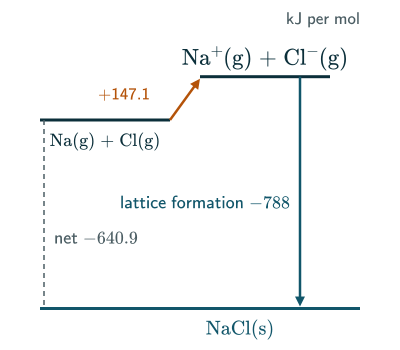
For sodium chloride (NCERT page 106):
- ionising Na(g) to Na+(g) costs 495.8 kJ mol−1;
- adding an electron to Cl(g) releases 348.7 kJ mol−1 (ΔegH = −348.7 kJ mol−1);
- so making the gaseous ions costs 495.8 − 348.7 = 147.1 kJ mol−1 overall;
- but forming the crystal lattice releases 788 kJ mol−1, which more than pays for it.
Thus a qualitative measure of the stability of an ionic compound is provided by its enthalpy of lattice formation and not simply by achieving octet of electrons around the ionic species in gaseous state.
NCERT Chemistry Part I (Class 11), Section 4.2, page 107
Lattice enthalpy is defined as the energy needed to separate one mole of a solid ionic compound completely into its gaseous ions (NCERT Section 4.2.1, page 107):
The Lattice Enthalpy of an ionic solid is defined as the energy required to completely separate one mole of a solid ionic compound into gaseous constituent ions.
NCERT Chemistry Part I (Class 11), Section 4.2.1, page 107
For NaCl it is 788 kJ mol−1: 788 kJ is needed to separate one mole of solid NaCl into one mole of Na+(g) and one mole of Cl−(g) at infinite distance. Lattice enthalpy is positive (energy is absorbed); the enthalpy of lattice formation, the reverse change, is −788 kJ mol−1 (pages 106–107).
The process involves both attraction between oppositely charged ions and repulsion between like ions. Because the crystal is three-dimensional, the lattice enthalpy cannot be calculated from these forces alone; factors that depend on the crystal geometry must be included (page 107). In practice it is found from measured enthalpy changes with a Born–Haber cycle, as in Example 5.
What makes a lattice enthalpy large (beyond the NCERT text, by Coulomb’s law): higher charges on the ions and smaller ions, which can come closer together. So MgO (2+ and 2− ions) has a much larger lattice enthalpy than NaCl (1+ and 1−), and among sodium halides it falls from NaF to NaI as the anion grows. A larger lattice enthalpy usually means a higher melting point: MgO melts near 2850 °C, NaCl at 801 °C.
Solved examples
Example 1: Is forming the ions alone favourable? (NCERT page 106)
Using NCERT’s values, find the energy needed to turn Na(g) and Cl(g) into Na+(g) and Cl−(g).
Ionisation of Na: +495.8 kJ mol−1. Electron gain by Cl: −348.7 kJ mol−1. Sum: 495.8 − 348.7 = +147.1 kJ mol−1.
Answer: +147.1 kJ mol−1: forming the gaseous ions alone is uphill.
Example 2: Including the lattice
The enthalpy of lattice formation of NaCl is −788 kJ mol−1. What is the overall enthalpy change from Na(g) + Cl(g) to NaCl(s)?
147.1 + (−788) = −640.9 kJ mol−1.
Answer: −640.9 kJ mol−1: lattice formation makes the whole process strongly downhill.
Example 3: Favourable factors (NCERT Exercise 4.6, page 134)
Write the factors favouring the formation of an ionic bond.
Answer: (1) a low ionisation enthalpy of the metal atom, so that it loses electrons easily; (2) a large negative electron gain enthalpy of the non-metal atom, so that it gains electrons readily; (3) a large lattice enthalpy, favoured by small ions with high charges, which releases enough energy to stabilise the solid.
Example 4: Comparing lattice enthalpies
Which has the larger lattice enthalpy: (a) NaCl or MgO; (b) NaF or NaI?
(a) MgO: its ions carry charges of 2+ and 2−, against 1+ and 1−, and they are also smaller. (b) NaF: the F− ion is much smaller than I−, so the ions are closer.
Answer: (a) MgO; (b) NaF.
Example 5: Calculating lattice enthalpy with a Born–Haber cycle (NCERT Section 5.5, pages 155–156)
Find the lattice enthalpy of NaCl from: enthalpy of formation of NaCl(s) −411.2; sublimation of Na +108.4; half the Cl–Cl bond enthalpy +121; ionisation enthalpy of Na +496; electron gain enthalpy of Cl −348.6 (all kJ mol−1).
Going round the cycle (Hess’s law), the enthalpy changes sum to zero. Breaking NaCl(s) into ions equals reversing its formation and then building the gaseous ions from the elements:
ΔlatticeH = 411.2 + 108.4 + 121 + 496 − 348.6 = +788 kJ mol−1.
Answer: +788 kJ mol−1. Use half the Cl–Cl bond enthalpy, since one mole of NaCl needs only ½Cl2. Chapter 5 rounds the Chapter 4 values to 496 and −348.6.
Common mistakes to avoid
Common mistake
Thinking the octet alone explains ionic compounds
Forming Na+ and Cl− from gaseous atoms costs energy. The compound is stable because of the lattice enthalpy (NCERT page 107).
Common mistake
Mixing up lattice enthalpy and the enthalpy of lattice formation
NCERT defines lattice enthalpy as the energy to separate the solid into gaseous ions: +788 kJ mol−1 for NaCl. Forming the lattice from the ions releases the same amount: −788 kJ mol−1.
Common mistake
Expecting every ionic compound to contain a metal
Ammonium salts such as NH4Cl are ionic, with the non-metal cation NH4+.
Quick revision summary
- Ionic bond: electron transfer, then electrostatic attraction between ions in a crystal lattice.
- Favoured by a low ionisation enthalpy (metal), a large negative electron gain enthalpy (non-metal) and a large lattice enthalpy.
- NaCl: 495.8 − 348.7 = +147.1 kJ mol−1 to form the gaseous ions, more than repaid by the lattice (788 kJ mol−1).
- Lattice enthalpy: energy to separate one mole of an ionic solid into gaseous ions (NaCl 788 kJ mol−1); larger for higher ionic charges and smaller ions.
- Lattice enthalpy contributes to stability; assess the full energy balance, not just octets or lattice enthalpy alone.
Formula sheet
- M(g) → M(g) + e: ionisation enthalpy (positive)
- X(g) + e → X(g): electron gain enthalpy
- NaCl: 495.8 − 348.7 = 147.1 kJ mol; lattice enthalpy +788 kJ mol (lattice formation −788)
- Born–Haber: ΔlatticeH = −ΔfH + ΔsubH + ½ΔbondH + ΔiH + ΔegH
- Lattice enthalpy rises with ionic charge and falls with ionic size
Questions students ask
What is the difference between an ionic bond and a covalent bond?
An ionic bond forms when electrons are transferred from one atom to another and is the non-directional electrostatic attraction between the resulting ions, while a covalent bond forms when two atoms share a pair of electrons and points in a definite direction. Ionic bonds usually join a metal to a non-metal, as in KBr, giving hard, high-melting crystals such as NaCl that conduct well when molten or dissolved because ions can move; covalent bonds usually join non-metals, giving separate molecules such as CH4 or giant networks such as diamond. Real bonds lie between the two: polar covalent bonds are partly ionic and ionic bonds partly covalent (Fajans’ rules).
Why is an ionic bond non-directional?
An ionic bond is non-directional because an ideal spherical ion has a radial electric field, so each ion attracts every oppositely charged ion around it rather than one particular partner. That is why ionic compounds form three-dimensional crystal lattices instead of separate molecules: in rock salt each Na+ has six Cl− nearest neighbours and each Cl− six Na+, and the formula NaCl gives only the ratio of the ions. A covalent bond is directional because it depends on the overlap of orbitals that point in particular directions.
What is the difference between lattice enthalpy and lattice energy?
Lattice enthalpy is the enthalpy change, at constant pressure, for separating one mole of an ionic solid into its gaseous ions, while lattice energy, strictly, is the internal energy change for the same process; for ideal gaseous ions and negligible solid volume, the two differ by ΔngRT. For NaCl(s) → Na+(g) + Cl−(g), Δng = 2, so at 298 K the lattice energy is smaller by 2RT ≈ 5 kJ mol: about 783 kJ mol against 788 kJ mol. The gap is under 1%, so many books use the two names interchangeably.
Is an electrovalent bond the same as an ionic bond?
Yes, an electrovalent bond is another name for an ionic bond, the electrostatic attraction between ions formed by the transfer of electrons. The name comes from electrovalence, the number of electrons an atom loses or gains, which equals the charge on its ion: in Al2O3 aluminium has an electrovalence of +3 and oxygen of −2. NCERT uses both names, while most modern books simply say ionic bond.
In which chapter of Class 11 is the Born–Haber cycle?
The Born–Haber cycle is in NCERT Class 11 Chemistry Part I, Unit 5 (Thermodynamics), Section 5.5, where it is used to find the lattice enthalpy of NaCl; Unit 4, Chemical Bonding and Molecular Structure, only defines lattice enthalpy (Section 4.2.1). Neither the JEE Main 2027 nor the NEET (UG) 2026 syllabus names the cycle, but both list the ‘calculation of lattice enthalpy’, which uses it, under Unit 3, Chemical Bonding and Molecular Structure. The cycle for NaCl is worked as Example 5 on this page.
Practice questions
Try each question first, then open the answer to check your working.
-
Q1. Define lattice enthalpy, and explain what “the lattice enthalpy of NaCl is 788 kJ mol−1” means.
Show answerHide answer
Lattice enthalpy is the energy needed to separate one mole of a solid ionic compound completely into its gaseous ions. For NaCl, 788 kJ must be supplied to turn one mole of solid NaCl into one mole of Na+(g) and one mole of Cl−(g) far apart.
-
Q2. The sum of the ionisation enthalpy of Na and the electron gain enthalpy of Cl is positive. Why does NaCl form at all?
Show answerHide answer
Because forming the crystal lattice from the gaseous ions releases 788 kJ mol−1, much more than the 147.1 kJ mol−1 needed to form the ions. The overall change is strongly negative.
-
Q3. Arrange KCl, NaCl and MgO in order of increasing lattice enthalpy.
Show answerHide answer
KCl < NaCl < MgO. K+ is larger than Na+, so KCl’s ions are farther apart; MgO has doubly charged ions.