Bonding in homonuclear diatomic molecules: H₂ to Ne₂
NCERT Class 11 Chemistry Chapter 4 Section 4.8
Quick answer
Elementary MO diagrams give H bond order 1, N 3 and O 2; O is paramagnetic because two π* electrons remain unpaired. He and Be have zero bond order in this simple model, yet weak bound dimers are experimentally known. Use the model for its stated predictions and distinguish them from exact molecular behaviour.
With your textbook
NCERT Chemistry Part I (Class 11), Chapter 4 “Chemical Bonding and Molecular Structure”, Section 4.8 “Bonding in Some Homonuclear Diatomic Molecules”, pages 129–131.
Open the official NCERT chapter (PDF, 4.5 MB, ncert.nic.in) (opens in a new tab)
Checked against the 2026-27 reprint on .
Bonding in homonuclear diatomic molecules
Homonuclear diatomic molecules in MO theory
A homonuclear diatomic molecule is made of two identical atoms (H2, He2, Li2, C2, N2, O2…). Molecular orbital theory describes each one by filling its electrons into molecular orbitals in order of energy (NCERT Section 4.8, pages 129–130, with Fig. 4.21 on page 131):
- count all the electrons of both atoms and fill σ1s, σ*1s, σ2s, σ*2s and then the 2p-based orbitals, using the order with π2p below σ2pz up to N2 and the order with σ2pz below π2p for O2 and F2;
- bond order = ½(Nb − Na): zero means no net covalent bond in the elementary model (He2, Be2, Ne2); it does not exclude weak binding beyond that model. For comparable species, higher order usually means a stronger, shorter bond;
- unpaired electrons make the molecule paramagnetic: MO theory correctly predicts that O2 is paramagnetic.
In plain words: take the orbital ladder (summarised below), pour in the electrons two at a time from the bottom, and then read off three things: the bond order, whether any electrons are left unpaired, and the model’s prediction of net covalent bonding. Five worked molecules from NCERT, and the full row from B2 to Ne2, follow.
The rules in brief
From molecular orbital theory (NCERT Section 4.7, pages 128–129):
- Order up to N2: σ1s < σ*1s < σ2s < σ*2s < (π2px = π2py) < σ2pz < (π*2px = π*2py) < σ*2pz.
- Order for O2 and F2: σ2pz moves below the π2p pair.
- Degenerate orbitals (the π pairs) each take one electron, with parallel spins, before either takes two (Hund’s rule), exactly as in filling atomic orbitals.
- Nb = electrons in bonding orbitals, Na = electrons in antibonding (starred) orbitals; bond order = ½(Nb − Na).
- The filled inner pair (σ1s)2 (σ*1s)2 is often written KK (the closed K shells of both atoms).
Hydrogen, H2
Each H atom has one 1s electron, so H2 has 2, both in σ1s (NCERT page 129):
H2: (σ1s)2 bond order ½(2 − 0) = 1
The two atoms are held by a single covalent bond. No electron is unpaired, so H2 is diamagnetic. Its bond length is 74 pm. NCERT gives its bond dissociation energy here as 438 kJ mol−1, but as 435.8 kJ mol−1 on pages 108 and 117. Use about 436 kJ mol−1 (the bond enthalpy at 298 K; the dissociation energy at 0 K is 432): 438 matches neither, so it is a slip.
Helium, He2, and beryllium, Be2
Each He atom is 1s2, so He2 would have 4 electrons, in σ1s and σ*1s (NCERT page 130):
He2: (σ1s)2 (σ*1s)2 bond order ½(2 − 2) = 0
This predicts no net covalent bond for He2. In the same way Be2, (σ1s)2 (σ*1s)2 (σ2s)2 (σ*2s)2, has elementary bond order 0. Both dimers have nevertheless been observed: He2 is extremely weakly dispersion-bound, and Be2 requires electron correlation/configuration mixing beyond this simple diagram. NCERT’s nonexistence statement is a limitation of the elementary model.
Lithium, Li2
Lithium is 1s2 2s1, so Li2 has 6 electrons (NCERT page 130):
Li2: (σ1s)2 (σ*1s)2 (σ2s)2, or KK (σ2s)2
There are 4 bonding and 2 antibonding electrons, so the bond order is ½(4 − 2) = 1. Li2 is stable, and with no unpaired electron it should be diamagnetic; diamagnetic Li2 molecules are indeed known in the vapour phase.
Carbon, C2
Carbon is 1s2 2s2 2p2, so C2 has 12 electrons. With the order for molecules up to N2 (NCERT page 130):
C2: KK (σ2s)2 (σ*2s)2 (π2px2 = π2py2)
Bond order ½(8 − 4) = 2, and every electron is paired, so C2 should be diamagnetic; diamagnetic C2 molecules have been detected in the vapour phase. Its double bond is unusual: all four bonding electrons above σ*2s occupy the two π orbitals, so the elementary NCERT diagram assigns net bond order 2 to π bonding after cancellation of the filled σ/σ* contributions. Detailed C2 bonding is more subtle than this model.
In most of the other molecules a double bond is made up of a sigma bond and a pi bond.
NCERT Chemistry Part I (Class 11), Section 4.8, page 130
NCERT’s first, long form of the C2 configuration, (σ1s)2 (σ*1s)2 (σ*2s)2 (π2px2 = π2py2), leaves out (σ2s)2 and accounts for only 10 electrons; the KK form printed next to it, with (σ2s)2, is the right one.
Nitrogen, N2
NCERT says only that N2 can be treated in a similar fashion (page 130). It has 14 electrons:
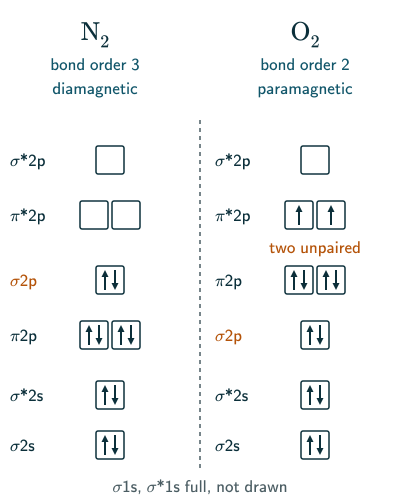
N2: KK (σ2s)2 (σ*2s)2 (π2px2 = π2py2) (σ2pz)2
Nb = 10 and Na = 4, so the bond order is 3: a triple bond (one σ, two π). All electrons are paired, so N2 is diamagnetic. This is the strongest bond in the row: 945 kJ mol−1, 110 pm (NCERT Fig. 4.21, page 131).
Oxygen, O2
Oxygen is 1s2 2s2 2p4, so O2 has 16 electrons, filled with σ2pz below π2p (NCERT page 130):
O2: KK (σ2s)2 (σ*2s)2 (σ2pz)2 (π2px2 = π2py2) (π*2px1 = π*2py1)
Ten electrons are in bonding orbitals and six in antibonding ones, so the bond order is ½(10 − 6) = 2: a double bond. The last two electrons go one each into π*2px and π*2py, with parallel spins. With two unpaired electrons:
O molecule should be paramagnetic, a prediction that corresponds to experimental observation.
NCERT Chemistry Part I (Class 11), Section 4.8, page 130
This is a famous success of MO theory: the Lewis structure of O2, with every electron paired, cannot explain why liquid oxygen is attracted to a magnet.
NCERT’s second, KK form of the O2 configuration on page 130 is misprinted: it is labelled “O2”, has “(σ2pS)2” where (σ*2s)2 belongs, and “π*21y” for π*2py1. The form above is the correct one.
From B2 to Ne2
NCERT Fig. 4.21 (page 131) collects the second-row molecules. B2, C2 and N2 use the order with π2p below σ2p (labelled “with 2s–2p mixing”); O2, F2 and Ne2 use the other (“without 2s–2p mixing”):
| Molecule | Bond order | Magnetism |
|---|---|---|
| B2 | 1 | paramagnetic |
| C2 | 2 | diamagnetic |
| N2 | 3 | diamagnetic |
| O2 | 2 | paramagnetic |
| F2 | 1 | diamagnetic |
| Ne2 | 0 | no net covalent bond in this model |
B2 (10 electrons) is KK (σ2s)2 (σ*2s)2 (π2px1 = π2py1): its last two electrons sit singly in the two π2p orbitals, so it has bond order ½(6 − 4) = 1 and two unpaired electrons.
| Molecule | Bond enthalpy (kJ mol−1) | Bond length (pm) |
|---|---|---|
| B2 | 290 | 159 |
| C2 | 620 | 131 (measured: 124) |
| N2 | 945 | 110 |
| O2 | 498 | 121 |
| F2 | 159 | 143 (measured: 141) |
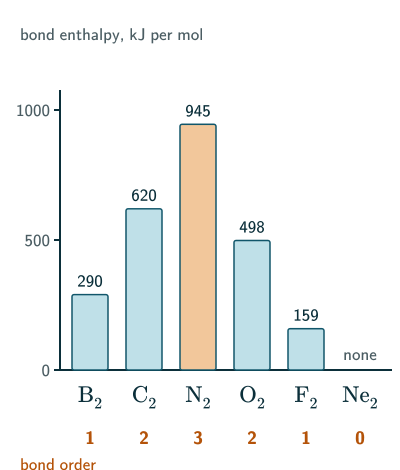
The pattern: as bond order rises from B2 to N2, the bond gets stronger and shorter; from N2 to Ne2, electrons enter antibonding orbitals, the bond order falls and the bond weakens and lengthens, until Ne2 has zero elementary covalent bond order; weak van der Waals dimers lie outside that model.
Two of NCERT’s bond lengths in Fig. 4.21 differ from the measured equilibrium values: C2 is 124 pm, not 131 pm (131 pm is its bond length in a low-lying excited state), and F2 is 141 pm (NCERT has 143 pm here and 144 pm on pages 108 and 117). For F2, NCERT uses 155 kJ mol−1 on page 117 and 159 kJ mol−1 here; both appear in data tables (the first is the dissociation energy at 0 K, the second the bond enthalpy at 298 K).
Solved examples
Example 1: Oxygen and its ions (NCERT Exercise 4.36, page 135)
Compare the relative stability of O2, O2+, O2− (superoxide) and O22− (peroxide), and give their magnetic properties.
Start from O2 (Nb = 10, Na = 6, two unpaired π* electrons). O2+ removes one π* electron: Na = 5, one unpaired. O2− adds one: Na = 7, one unpaired. O22− adds two: Na = 8, the π* orbitals are full, none unpaired.
Answer: bond orders 2.5 (O2+) > 2 (O2) > 1.5 (O2−) > 1 (O22−), so the elementary O–O bond-strength trend falls in that order. This is not a general ranking of chemical stability; free gaseous peroxide requires additional stabilisation to retain two excess electrons. O2, O2+ and O2− are paramagnetic; O22− is diamagnetic.
Example 2: Fluorine and neon
Write the configurations of F2 and Ne2 and find their bond orders.
F2 (18 electrons): KK (σ2s)2 (σ*2s)2 (σ2pz)2 (π2p)4 (π*2p)4; Nb = 10, Na = 8. Ne2 (20 electrons) adds (σ*2pz)2: Nb = 10, Na = 10.
Answer: F2 bond order 1, diamagnetic; Ne2 elementary bond order 0, predicting no net covalent bond; weak dispersion binding is outside this diagram.
Example 3: Bond order and bond length
Without looking at data, put N2, O2 and F2 in order of bond length.
Bond orders are 3, 2 and 1. The bond length decreases as bond order increases.
Answer: N2 < O2 < F2; NCERT’s data (110, 121 and 143 pm) agree.
Example 4: The C<sub>2</sub><sup>2−</sup> ion
Calcium carbide contains the C22− ion. Find its bond order and magnetic nature.
C22− has 12 + 2 = 14 electrons, as many as N2: KK (σ2s)2 (σ*2s)2 (π2p)4 (σ2pz)2; Nb = 10, Na = 4.
Answer: bond order 3 (a triple bond, as in N2), all electrons paired, diamagnetic.
Common mistakes to avoid
Common mistake
Calling C<sub>2</sub>’s double bond σ + π
In C2 both bonding pairs above σ*2s are π electrons; σ2pz is empty. Its double bond is two π bonds.
Common mistake
Pairing the π* electrons of O<sub>2</sub>
π*2px and π*2py have equal energy, so O2’s last two electrons go one in each with parallel spins. Pairing them would wrongly make O2 diamagnetic.
Common mistake
Expecting bond order to rise steadily across the row
Bond order climbs from B2 (1) to N2 (3) and then falls to Ne2 (0), because the extra electrons after N2 go into antibonding orbitals.
Quick revision summary
- H2 (σ1s)2: bond order 1, diamagnetic. He2 and Be2: elementary bond order 0, although weak bound dimers exist beyond the model.
- Li2 KK (σ2s)2: bond order 1, diamagnetic, found in the vapour phase.
- C2: bond order 2, diamagnetic, a double bond made of two π bonds.
- N2: bond order 3, diamagnetic, the strongest bond (945 kJ mol−1).
- O2: bond order 2, two unpaired π* electrons, paramagnetic, as observed.
- Across B2 to Ne2, bond order goes 1, 2, 3, 2, 1, 0; higher bond order means a stronger, shorter bond.
Formula sheet
- Bond order = ½ × (bonding electrons − antibonding electrons)
- Bond orders: H 1, He 0, Li 1, Be 0, B 1, C 2, N 3, O 2, F 1, Ne 0
- Paramagnetic: B, O (two unpaired electrons each)
Questions students ask
Why is O2 paramagnetic while N2 is diamagnetic?
O2 is paramagnetic because its last two electrons go into the two antibonding π*2p orbitals, which have equal energy, one in each with parallel spins (Hund’s rule), leaving two unpaired electrons; N2 has two electrons fewer, so its π*2p orbitals are empty and all 14 of its electrons are paired, which makes it diamagnetic. The Lewis structure O=O pairs every electron and cannot explain why liquid oxygen is held between the poles of a strong magnet while liquid nitrogen is not; molecular orbital theory explains it.
What is the difference between homonuclear and heteronuclear diatomic molecules?
A homonuclear diatomic molecule contains two atoms of the same element, such as H2, N2, O2, F2, Cl2, Br2 and I2, the seven elements that are diatomic at room temperature, while a heteronuclear diatomic molecule joins two different elements, such as HCl, CO or NO. Two identical atoms share their bonding electrons equally, so a homonuclear molecule has a non-polar bond and no dipole moment; heteronuclear bonds are often polar, but the detailed charge distribution is not fixed by electronegativity alone (CO is a notable exception to the simple direction rule). Noble gases such as helium stay monatomic: He2 would have a bond order of zero.
Is there a shortcut to find the bond order from the number of electrons?
Yes, for homonuclear diatomic molecules and ions with 10 to 20 electrons, and for species isoelectronic with them such as CO and NO+, the bond order follows from the total number of electrons: it is (electrons − 8)/2 from 10 to 14 electrons and (20 − electrons)/2 from 14 to 20. So O2, with 16 electrons, has bond order (20 − 16)/2 = 2, and C2, with 12, has (12 − 8)/2 = 2, just as their full configurations give. The shortcut says nothing about unpaired electrons, so write the configuration whenever magnetism is asked.
Is S2 paramagnetic like O2?
Yes, S2, the molecule that makes up sulphur vapour at high temperatures, is paramagnetic like O2: sulphur has the same valence configuration as oxygen, 3s2 3p4 against 2s2 2p4, so its 12 valence electrons fill the molecular orbitals in the same order and leave one unpaired electron in each of the two π*3p orbitals. Its bond order is also 2. At room temperature, though, sulphur exists as S8 molecules, rings of eight atoms joined by S–S single bonds, in which every electron is paired, so solid sulphur is diamagnetic.
Practice questions
Try each question first, then open the answer to check your working.
-
Q1. Using the fixed elementary C2 orbital ladder, find the predicted bond orders and unpaired-electron counts for C2+ and C2−. State why these need not be exact ground-state predictions.
Show answerHide answer
C2+ (11 electrons): KK (σ2s)2 (σ*2s)2 (π2p)3; Nb = 7, Na = 4, bond order 1.5. C2− (13 electrons): KK (σ2s)2 (σ*2s)2 (π2p)4 (σ2pz)1; Nb = 9, Na = 4, bond order 2.5. This fixed-ladder model predicts a longer bond for the cation and one unpaired electron in each. However, detailed calculations give C2+ a quartet ground state with three unpaired electrons: the neutral-molecule orbital order and configuration cannot simply be assumed unchanged after ionisation.
-
Q2. Find the bond orders of Li2+ and Li2−. Can each exist?
Show answerHide answer
Li2+ (5 electrons): KK (σ2s)1, bond order ½(3 − 2) = 0.5. Li2− (7 electrons): KK (σ2s)2 (σ*2s)1, bond order ½(4 − 3) = 0.5. Both bond orders are positive, so both can exist; each has one unpaired electron. Equal bond orders do not let us rank their stability merely by counting antibonding electrons; that comparison needs actual dissociation or electron-detachment energies.
-
Q3. The bond enthalpy of N2 (945 kJ mol−1) is nearly twice that of O2 (498 kJ mol−1). Explain using MO theory.
Show answerHide answer
N2 has bond order 3 (Nb = 10, Na = 4); O2 has bond order 2, because its two extra electrons go into antibonding π* orbitals (Na = 6). The higher bond order gives N2 a stronger and shorter bond.