Metallic bonding: the electron sea model
Beyond NCERT In the JEE Main and NEET syllabus; the Class 11 book has no section for it.
Quick answer
The electron-sea model describes metallic bonding as attraction between positive ion cores and delocalised valence electrons shared through the metal. It helps explain conductivity, lustre, malleability and ductility. Bond strength and conductivity also depend on electronic structure, atomic spacing and scattering, so electron count alone is not enough.
What is a metallic bond?
Metallic bond
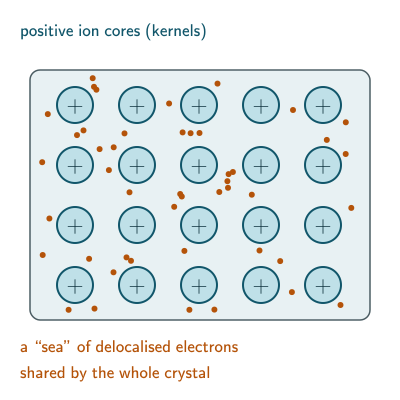
A metallic bond is the attraction between the positive ion cores of a metal and the valence electrons that have left them and move freely through the whole crystal:
- each metal atom gives up its valence electrons, which become delocalised, a “sea” of electrons shared by all the atoms;
- what remains of each atom, its nucleus and inner electrons, is a positive ion core (kernel), fixed in a regular lattice;
- the bond is non-directional and holds the whole crystal together; it explains why metals conduct, shine, and can be hammered and drawn into wires.
In plain words: the delocalised valence electrons in a metal are not assigned to one atom; core electrons remain localised. The outer electrons drift through the whole piece of metal like a glue, holding together a tidy stack of positive ions. Because the glue is everywhere and points nowhere in particular, the ions can be pushed around without the metal falling apart.
The NCERT Class 11 book (2026–27) has no section on metallic bonding, but the JEE Main and NEET syllabuses (Unit 3) ask for an elementary idea of it, so this page gives that idea. It builds on the metals, non-metals and metalloids of the periodic table.
The electron sea model
The simplest picture, the free-electron or electron sea model, was first proposed by Paul Drude in 1900:
- Metal atoms have few valence electrons and low ionisation enthalpies, so they give up those electrons easily.
- The released electrons are not transferred to another atom, as in an ionic bond, or shared between two atoms, as in a covalent bond. They spread over the whole crystal.
- The attraction between the positive ion cores and the negative electron sea holds the metal together. It acts equally in all directions.
| Bond | What is held together | Directional? |
|---|---|---|
| ionic | cations and anions, by attraction | no |
| covalent | two atoms, by a shared pair | yes |
| metallic | ion cores, by an electron sea | no |
Strength of metallic bonding
Within a comparable series, the elementary model often predicts stronger cohesion with more participating valence electrons and smaller ion cores, so the attraction is greater. Melting points are a rough guide:
- Across a period: Na (98 °C, one valence electron) < Mg (650 °C, two) < Al (660 °C, three).
- Melting points are only a rough guide: they depend on more than bond strength, and some pairs break the pattern: magnesium (650 °C) melts below calcium (842 °C). The enthalpy of atomisation, the energy to turn the metal into free gaseous atoms, shows the period trend more clearly: about 110, 150 and 330 kJ mol−1 for Na, Mg and Al.
- Down a group: in Group 1 the ion cores grow larger while each atom still gives one electron, so melting points fall: Li 181 °C, Na 98 °C, K 64 °C, Rb 39 °C, Cs 28 °C.
- Transition metals: d electrons also take part, so bonding is often strong and melting points are often high; tungsten melts at about 3422 °C.
Properties explained by metallic bonding
- Electrical conductivity: the delocalised electrons move when a voltage is applied, so metals conduct in the solid state as well as when molten. For ordinary metals over a typical temperature range, heating increases lattice vibrations and electron scattering, so conductivity usually falls.
- Thermal conductivity: the mobile electrons carry kinetic energy quickly from the hot end to the cold end.
- Lustre: light falling on the surface sets the free electrons oscillating, and they at once send it back out, so most visible light is reflected and polished metals shine.
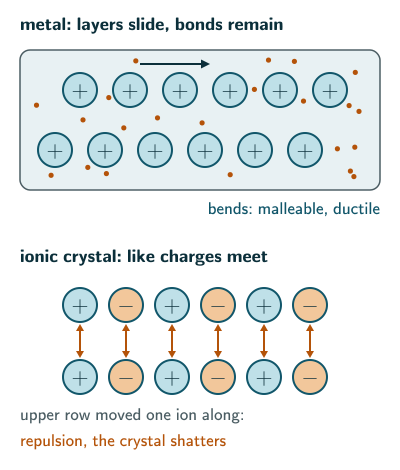
- Malleability and ductility: layers of ion cores can slide over one another while the electron sea still surrounds them, so metals can be beaten into sheets and drawn into wires without breaking. In an ionic solid the same slide brings ions of like charge face to face, and the crystal shatters.
Beyond this elementary model, band theory describes the delocalised electrons as filling energy bands spread over the whole crystal; it also explains semiconductors and insulators, but it goes beyond the elementary idea of metallic bonding that the chemistry syllabuses ask for.
Solved examples
Example 1: Sodium against magnesium
Magnesium melts at 650 °C and sodium at 98 °C. Explain using metallic bonding.
Each Na atom gives one electron to the sea and leaves a Na+ core; each Mg atom gives two and leaves a smaller Mg2+ core. More electrons per atom and a smaller, more highly charged core mean a stronger attraction between the cores and the electron sea.
Answer: metallic bonding is stronger in magnesium (two delocalised electrons per atom, smaller ion), so more energy is needed to melt it.
Example 2: Down Group 1
Why do the melting points of the alkali metals fall from lithium (181 °C) to caesium (28 °C)?
Each alkali metal gives one electron per atom. Down the group the ion cores become larger, so the electron sea is farther from the positive nuclei and the attraction weakens.
Answer: larger ion cores with the same single electron give weaker metallic bonding, so less energy is needed to melt the metal.
Example 3: Conduction by metals and by ionic compounds
Solid copper conducts electricity; solid sodium chloride does not, but molten sodium chloride does. Explain.
In copper the delocalised electrons can move through the solid. In solid NaCl the ions are fixed in the lattice and there are no free electrons. On melting, the ions become free to move and carry the current.
Answer: metals conduct by mobile electrons in both solid and liquid states; ionic conduction requires mobile ions: in ordinary NaCl this occurs readily when molten or dissolved, though some solid electrolytes also conduct.
Example 4: Hammering a metal and a salt
A copper sheet can be hammered thin, but a crystal of rock salt shatters. Why?
In copper, sliding one layer of ion cores over another leaves each core still surrounded by the electron sea, while overall cohesion remains; ion-core repulsions still exist. In NaCl, a slide of one ion spacing brings Na+ next to Na+ and Cl− next to Cl−; the like charges repel and the crystal splits.
Answer: in a metal every core is alike and the electron sea is everywhere, so after the slide each core is held as before; in an ionic crystal the slide puts like charges side by side, and their repulsion splits the crystal.
Common mistakes to avoid
Common mistake
Calling a metal a collection of neutral atoms
In the electron sea model the valence electrons have left their atoms: the lattice is made of positive ion cores, held by the shared electrons.
Common mistake
Thinking the electrons are transferred, as in an ionic bond
No anion forms. The released electrons belong to the whole crystal, not to any particular atom.
Common mistake
Confusing metallic character with metallic bond strength
Metallic character (how easily atoms lose electrons) increases down Group 1, but metallic bonding gets weaker: caesium is the most metallic alkali metal yet melts at 28 °C.
Common mistake
Expecting metals to conduct better when hot
Conductivity of an ordinary metal usually falls as the temperature rises, because the vibrating ion cores scatter the moving electrons more.
Quick revision summary
- Metallic bond: attraction between positive ion cores and a sea of delocalised valence electrons; non-directional.
- Stronger with more delocalised electrons per atom and smaller ion cores: Na < Mg < Al; weaker down Group 1.
- Explains electrical and thermal conductivity, lustre, malleability and ductility.
- Metals conduct as solids and liquids; ordinary ionic salts such as NaCl conduct well when molten or dissolved; solid electrolytes are exceptions.
- Not in the NCERT Class 11 book; asked as an elementary idea in JEE Main and NEET Unit 3.
Formula sheet
- Elementary trend for comparable metals: more participating electrons and smaller cores often strengthen cohesion
- Melting points: Na 98 °C < Mg 650 °C < Al 660 °C
- Group 1 melting points fall: Li 181 °C, Na 98 °C, K 64 °C, Rb 39 °C, Cs 28 °C
Questions students ask
Is metallic bonding in the JEE Main 2027 and NEET (UG) 2026 syllabuses?
Yes, metallic bonding is in both syllabuses, but only as an ‘elementary idea of metallic bonding’, listed under Unit 3, Chemical Bonding and Molecular Structure, in JEE Main 2027 and NEET (UG) 2026. The NCERT Class 11 book (2026–27) has no section on it, so expect questions at the level of the electron sea model: what holds a metal together, what makes the bonding stronger, and why metals conduct, shine and can be hammered into sheets. Band theory is not listed in either syllabus.
What is the difference between a metallic bond and an ionic bond?
In a metallic bond the valence electrons leave their atoms and move freely through the whole crystal, holding together a lattice of positive ion cores, while in an ionic bond the electrons are transferred to particular atoms, which become negative ions held in fixed places by their attraction to the positive ions. Metallic bonds form between atoms of metals, which lose electrons easily; ionic bonds form between a metal and a non-metal, which gains electrons readily. Both bonds are non-directional, but only a metal keeps mobile electrons in the solid, and that one difference explains most of the contrast in their properties.
Is a metallic bond weaker than a covalent bond?
A metallic bond is not always weaker than a covalent bond: depending on the metal it can be weak or very strong. Atomisation enthalpies, the energy to turn one mole of an element into free gaseous atoms, show the range: about 110 kJ mol for sodium, 715 kJ mol for diamond, held by covalent bonds, and 850 kJ mol for tungsten, which melts at 3422 °C. So the metallic bonding of the alkali metals is far weaker than the covalent bonding in diamond, while tungsten has greater cohesive energy per mole of atoms. These are not individual bond energies: coordination and the number of bonds per atom differ.
Does metallic bonding occur only between atoms of the same metal?
No, metallic bonding also holds together atoms of different metals: alloys such as brass (copper and zinc) and bronze (copper and tin) are held by the same sea of delocalised electrons round a lattice of mixed ion cores. It is also not a bond between two particular atoms, as a covalent bond is, but the attraction between all the ion cores of a crystal and all its delocalised electrons. Metal–non-metal compounds can be ionic or have mixed bonding, while small amounts of non-metals can also enter metallic alloys, as carbon does in steel.
Practice questions
Try each question first, then open the answer to check your working.
-
Q1. Silver and copper are the best electrical conductors and also among the best conductors of heat. Why do the two go together in metals?
Show answerHide answer
Both are carried by the same delocalised electrons: they drift under a voltage to carry charge, and at a hot end they gain kinetic energy and carry it quickly to colder parts. In many non-metallic solids lattice vibrations dominate heat transport; this need not be slow, as diamond’s very high thermal conductivity shows.
-
Q2. Compare the metallic bond with the covalent bond in terms of the electrons involved and direction.
Show answerHide answer
A covalent bond is a pair of electrons shared between two particular atoms and has a definite direction. In a metallic bond the valence electrons are shared by all the atoms of the crystal, and the attraction acts equally in all directions.
-
Q3. Aluminium gives three valence electrons per atom to the electron sea and sodium gives one. Which would you expect to conduct electricity better, and why?
Show answerHide answer
The electron count alone is insufficient to predict conductivity: the number of atoms per unit volume and electron mobility/scattering also matter. Aluminium does conduct better than sodium under ordinary conditions, but that observation is not proved by “three versus one” alone; which is why copper and silver, with one valence electron each, conduct better than aluminium.