General properties of the transition elements
NCERT Class 12 Chemistry Chapter 4 Section 4.3
Quick answer
Transition elements commonly show variable oxidation states, coloured ions, catalytic activity, alloy formation and magnetism associated with incomplete d subshells. The details depend on the metal, ligands, geometry and reaction conditions. Electron configurations explain useful trends, while measured electrode potentials, magnetic moments and compound stability require more than electron counting alone.
With your textbook
NCERT Chemistry Part I (Class 12), Chapter 4 “The d- and f-Block Elements”, Section 4.3 “General Properties of the Transition Elements (d-Block)”, pages 92–105.
Open the official NCERT chapter (PDF, 4.2 MB, ncert.nic.in) (opens in a new tab)
Checked against the 2026-27 reprint on .
What are the general properties of the transition elements?
General properties of the transition elements
The transition elements share a set of properties that come from their partly filled d orbitals. They are hard metals with high melting points, they show several oxidation states, many of their ions are coloured and paramagnetic, and they form complexes, interstitial compounds and alloys and act as catalysts. NCERT opens the list with their metallic character:
Nearly all the transition elements display typical metallic properties such as high tensile strength, ductility, malleability, high thermal and electrical conductivity and metallic lustre.
NCERT Chemistry Part I (Class 12), Section 4.3.1, page 92
NCERT discusses these properties for the first transition series, scandium to zinc (NCERT page 92).
In plain words: a transition metal has d electrons that can take part in bonding and can be lost a few at a time. That one fact explains why the metals are so strong, why iron can be Fe2+ or Fe3+, why copper sulphate is blue and why iron and nickel speed up industrial reactions.
The d-block sits between the s- and p-blocks. The numbers on this page are NCERT’s, from its Tables 4.2, 4.4 and 4.7 (NCERT pages 94, 99 and 102), unless another source is named.
Physical properties
- Metallic structures. Except Zn, Cd, Hg and Mn, the transition metals have one or more typical metallic structures (hcp, ccp or bcc) at normal temperatures (NCERT Section 4.3.1, page 92).
- NCERT slip (page 92): the key under the lattice-structure table reads “X = a typical metal structure”, but X marks Mn, Zn, Cd and Hg, the exceptions named just above it. Read it as “atypical”.
- Hard, with high melting points. Apart from zinc, cadmium and mercury they are very hard and have low volatility and high melting and boiling points. The reason is that electrons from the (n − 1)d orbitals join the ns electrons in the metallic bonding (NCERT page 92).
- The melting-point trend. Across each series the melting point rises to a maximum at about d, apart from the anomalous Mn and Tc, and then falls as the atomic number increases (NCERT page 92, Fig. 4.1).
- High enthalpies of atomisation. They peak near the middle of each series, where there is about one unpaired electron per d orbital, which favours strong interatomic interaction; in general, the more valence electrons, the stronger the bonding (NCERT pages 92–93). Metals with very high enthalpies of atomisation tend to be noble in their reactions (NCERT page 93).
- Heavier series. The 4d and 5d metals have higher enthalpies of atomisation than the 3d metals, which helps explain why metal–metal bonds are much more common in compounds of the heavy transition metals (NCERT page 93).
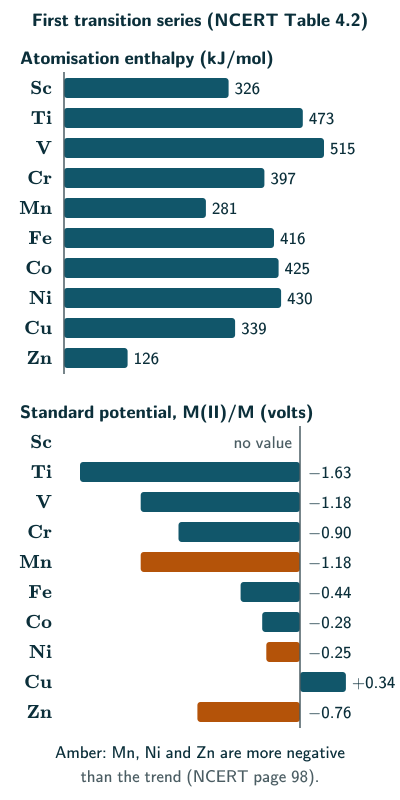
NCERT’s Table 4.4 (page 99) repeats these enthalpies of atomisation with slightly different values for seven of its nine metals (Ti 469, Cr 398, Mn 279, Fe 418, Co 427, Ni 431, Zn 130 kJ mol−1; V 515 and Cu 339 agree). The figure uses Table 4.2’s values, Example 3 Table 4.4’s.
Variation in atomic and ionic sizes of transition metals
Radii in pm and densities in g cm−3 for the first series (NCERT Table 4.2, page 94):
| Metal | M | M2+ | M3+ | Density |
|---|---|---|---|---|
| Sc | 164 | – | 73 | 3.43 |
| Ti | 147 | – | 67 | 4.1 |
| V | 135 | 79 | 64 | 6.07 |
| Cr | 129 | 82 | 62 | 7.19 |
| Mn | 137 | 82 | 65 | 7.21 |
| Fe | 126 | 77 | 65 | 7.8 |
| Co | 125 | 74 | 61 | 8.7 |
| Ni | 125 | 70 | 60 | 8.9 |
| Cu | 128 | 73 | – | 8.9 |
| Zn | 137 | 75 | – | 7.1 |
- Across a series ions of the same charge get smaller as the atomic number rises. Each new electron enters a d orbital, and a d electron shields the outer electrons poorly, so the net attraction of the nucleus grows. Atomic radii follow the same trend, but the change within a series is small (NCERT Section 4.3.2, page 93). NCERT’s Table 4.2 gives manganese 137 pm, above both its neighbours, yet its own Fig. 4.3 plots Mn on the smooth curve near 129 pm; the Wikipedia “Atomic radii of the elements (data page)” gives 127 pm.
- Down a group the radius rises from the 3d to the 4d series, but the 5d radii are almost the same as the 4d ones, for example Zr 160 pm and Hf 159 pm (NCERT pages 93–94).
- Lanthanoid contraction. Before the 5d series begins, the 4f orbitals fill. One 4f electron shields another even less well than one d electron shields another, so the 4fn orbitals shrink steadily as the nuclear charge rises. This lanthanoid contraction cancels the expected increase in size, so the 4d and 5d elements have similar radii and very similar properties (NCERT pages 93–94).
- Density rises across the series, from titanium to copper, because the metallic radius falls while the atomic mass rises (NCERT page 94).
- NCERT slip (Table 4.2, page 94): the densities printed for scandium (3.43), titanium (4.1) and cobalt (8.7 g cm−3) are out of line with measured values: scandium’s is about 15% high and titanium’s 9% low; cobalt’s is 2% low. Beyond the NCERT text, the Wikipedia “Densities of the elements (data page)” gives Sc 2.985, Ti 4.506 and Co 8.90 g cm−3. The trend NCERT describes still holds. In an exam, use the values a question gives.
- NCERT slip (Fig. 4.3, page 94): the radius axis is labelled “Radius/nm”, but its numbers, 12 to 19, are tens of picometres: Co and Ni, 125 pm in Table 4.2, sit at about 12.5. In an exam, give radii in pm.
Ionisation enthalpies
Ionisation enthalpy in kJ mol−1 for the first series (NCERT Table 4.2, page 94):
| Element | First | Second | Third |
|---|---|---|---|
| Sc | 631 | 1235 | 2393 |
| Ti | 656 | 1309 | 2657 |
| V | 650 | 1414 | 2833 |
| Cr | 653 | 1592 | 2990 |
| Mn | 717 | 1509 | 3260 |
| Fe | 762 | 1561 | 2962 |
| Co | 758 | 1644 | 3243 |
| Ni | 736 | 1752 | 3402 |
| Cu | 745 | 1958 | 3556 |
| Zn | 906 | 1734 | 3837 |
- The trend. Ionisation enthalpy rises along each series as the nuclear charge rises with the filling of the inner d orbitals. The rise is much smaller than along a period of non-transition elements. The first ionisation enthalpy rises gently; the second and third rise much more from one element to the next (NCERT Section 4.3.3, page 95).
- Why the first rises so little. The added 3d electrons shield the 4s electrons from the growing nuclear charge better than outer electrons shield one another, so the atoms shrink slowly and the first ionisation enthalpy creeps up. Its irregularities come from the way removing one electron changes the relative energies of the 4s and 3d orbitals (NCERT page 95).
- Breaks at d. M2+ and M3+ ions have dn configurations with no 4s electrons. The steady rise in second ionisation enthalpy breaks at Mn (1509, below Cr’s 1592), and the rise in third ionisation enthalpy breaks at Fe (2962, below Mn’s 3260). In both cases the ion formed is d (NCERT page 95).
- Exchange energy. Three terms set an ionisation enthalpy: the attraction of each electron to the nucleus, the repulsion between electrons and the exchange energy. Exchange energy stabilises a configuration and is roughly proportional to the number of pairs of electrons with parallel spins in the degenerate orbitals; by Hund’s rule the lowest state has the most singly filled orbitals with parallel spins (NCERT pages 95–96). Removing an electron that costs exchange energy is harder. So Mn+ (3d4s) ionises more easily than Cr+ (d), and Fe2+ (d) more easily than Mn2+ (d) (NCERT page 96).
- NCERT slip (page 96): NCERT writes “The loss of exchange energy increases the stability.” As written this is the wrong way round: exchange energy stabilises, so losing it makes a configuration less stable, and an ionisation that would lose exchange energy is difficult. NCERT’s conclusions in the same paragraph, about Mn+ against Cr+ and Fe2+ against Mn2+, are right. NCERT’s point is that ionising a d set would lose exchange energy, so it is difficult; write it that way.
- The +2 state. Forming M2+ from the solid needs the enthalpy of atomisation plus the first two ionisation enthalpies. The second is the big term: it is unusually high for Cr and Cu, whose M+ ions are d and d, and low for Zn, which loses its second 4s electron to become d (NCERT page 96).
- The third ionisation enthalpy is high for Mn2+ (d) and Zn2+ (d), and high values for copper, nickel and zinc explain why they rarely go beyond +2 (NCERT page 96).
Oxidation states
The common oxidation states of the first series (NCERT Table 4.3, page 96; the ones NCERT prints in bold are marked bold):
| Element | Oxidation states |
|---|---|
| Sc | +3 |
| Ti | +2, +3, +4 |
| V | +2, +3, +4, +5 |
| Cr | +2, +3, +4, +5, +6 |
| Mn | +2, +3, +4, +5, +6, +7 |
| Fe | +2, +3, +4, +6 |
| Co | +2, +3, +4 |
| Ni | +2, +3, +4 |
| Cu | +1, +2 |
| Zn | +2 |
- Most states in the middle. Manganese shows every state from +2 to +7. At the ends there are fewer: Sc and Ti have too few electrons to lose or share, and Cu and Zn have so many d electrons that few orbitals are left for sharing. Thus scandium(II) is virtually unknown, Ti(IV) is more stable than Ti(III) or Ti(II), and the only oxidation state of zinc is +2 (NCERT Section 4.3.4, page 97). Beyond the NCERT text: rare exceptions exist, such as the zinc(I) compound decamethyldizincocene, reported in 2004 (Wikipedia, “Decamethyldizincocene”).
- The highest stable state equals the sum of the s and d electrons up to manganese: Ti(IV) in TiO2, V(V) in VO2+, Cr(VI) in CrO42−, Mn(VII) in MnO4−. After that higher states quickly lose stability: Fe(II, III), Co(II, III), Ni(II), Cu(I, II), Zn(II) (NCERT page 97).
- Steps of one. Transition-metal oxidation states differ by one, as in V(II), V(III), V(IV) and V(V); those of non-transition elements usually differ by two (NCERT page 97).
- Opposite to the p-block. In the p-block the heavier members favour lower states (the inert pair effect). In groups 4 to 10 of the d-block the heavier members favour higher ones: Mo(VI) and W(VI) are more stable than Cr(VI), so dichromate in acid is a strong oxidising agent but MoO3 and WO3 are not (NCERT page 97).
- Low states. Ligands that accept π electrons as well as forming σ bonds stabilise low states: nickel in Ni(CO)4 and iron in Fe(CO)5 are 0 (NCERT page 97).
- No variable states: scandium (Z = 21) does not exhibit variable oxidation states (NCERT Example 4.3, page 97); give scandium in an exam.
Trends in the M/M standard electrode potentials
- The numbers. E⊖(M2+/M) is −1.63 V for Ti, −1.18 for V, −0.90 for Cr, −1.18 for Mn, −0.44 for Fe, −0.28 for Co, −0.25 for Ni, +0.34 for Cu and −0.76 V for Zn (NCERT Table 4.2, page 94; see the figure above). The more negative this standard reduction potential, the stronger the corresponding metal’s thermodynamic tendency to reduce a common comparison oxidant. It is not a reaction-rate prediction; actual potentials depend on activities.
- The trend is towards less negative values across the series, because the sum of the first and second ionisation enthalpies generally rises (NCERT Section 4.3.5, page 98).
- Copper is the only positive one. This accounts for its inability to liberate H2 from acids; only oxidising acids, nitric and hot concentrated sulphuric, react with copper, the acids being reduced (NCERT page 98). The large energy needed to turn Cu(s) into Cu2+(aq) is not repaid by its hydration enthalpy (NCERT page 98). Strictly, dissolved oxygen can also let copper dissolve slowly in a non-oxidising acid (reasoned from the E⊖ values).
- Mn, Ni and Zn are more negative than the trend: Mn2+ has a stable half-filled d set and Zn2+ a full d set, while nickel’s value goes with its most negative hydration enthalpy (NCERT pages 98–99). Nickel’s −0.25 V is barely above cobalt’s −0.28 V, though the series then climbs steeply to copper’s +0.34 V. In Table 4.4 nickel and copper share that value, −2121 kJ mol−1 (NCERT page 99).
Trends in the M/M standard electrode potentials
E⊖(M3+/M2+) is −0.37 V for Ti, −0.26 for V, −0.41 for Cr, +1.57 for Mn, +0.77 for Fe and +1.97 V for Co (NCERT Table 4.2, page 94).
- High for Mn: Mn2+ (d) is particularly stable, and removing a third electron from Mn (Mn2+ → Mn3+, d to d) takes a much larger third ionisation enthalpy (NCERT Section 4.3.6, page 99). NCERT adds that this “also explains why the +3 state of Mn is of little importance” (Example 4.7, page 101); give that in an exam. Strictly, the large value makes simple aqueous Mn(III) strongly oxidising, while Mn(III) is still found in solids such as MnF3 and Mn2O3 (reasoned from NCERT Tables 4.5 and 4.6, pages 99–100).
- Low for Fe: Fe3+ is d, so it is extra stable (NCERT page 99).
- Higher than its neighbours for V: −0.26 V is less negative than Ti’s −0.37 and Cr’s −0.41 V, because V2+ has a half-filled t2g level and resists oxidation (NCERT page 99).
- NCERT slip (page 99): NCERT calls vanadium’s value “comparatively low” yet relates it to the stability of V2+. A stable M2+ makes E⊖(M3+/M2+) higher, and Table 4.2’s −0.26 V is indeed above its neighbours’. In an answer, give NCERT’s reason, the half-filled t2g level of V2+.
- Sc and Zn. NCERT explains a low value for Sc by the noble gas configuration of Sc3+, and the highest value for Zn by the loss of an electron from Zn2+’s stable d set (NCERT page 99). Table 4.2 itself prints no value for either.
- Same d, opposite behaviour. Cr2+ is reducing, because going to Cr3+ takes d to d with a half-filled t2g level; Mn3+ is oxidising, because going to Mn2+ takes d to the half-filled d (NCERT Example 4.4, page 98).
Trends in stability of higher oxidation states
- Halides. The highest states appear in the tetrahalides TiX4, in VF5 and, in NCERT’s list, CrF6. Manganese’s +7 has no simple halide, but MnO3F is known. Among the ordinary compounds in NCERT’s restricted list, the trihalides beyond Mn are FeX3 and CoF3 (NCERT Section 4.3.7 and Table 4.5, page 99).
- NCERT slip (page 99), CrF6: beyond the NCERT text, a 2014 matrix-isolation reinvestigation assigned earlier purported CrF6 spectra to CrF5, so CrF6 should not be presented as a securely established ordinary compound (Schlöder and colleagues, Inorganic Chemistry, 2014); in an exam, give NCERT’s CrF6.
- Fluorine stabilises high states through a higher lattice energy (CoF3) or higher bond enthalpies in covalent compounds (VF5). V(V) forms only VF5; its other halides hydrolyse to the oxohalides VOX3. NCERT notes the “instability” of fluorides “in the low oxidation states e.g., VX2” (X = Cl, Br or I; page 99). Beyond the NCERT text: this is not a universal exclusion, since VF2 has been prepared and characterised (Shafer, Materials Research Bulletin, 1969).
- NCERT slip (Table 4.5 against the text, pages 99–100): the table’s key gives VX2 for all four halogens and CuX2 for F and Cl only. The text names VX2 only for Cl, Br and I (page 99), and says all copper(II) halides are known except the iodide (page 100). On copper the text is right (CuBr2 is known); on vanadium the table is borne out by VF2 (beyond the NCERT text, above). In an exam, answer from NCERT’s text.
- Copper(II) halides are all known except the iodide, because Cu2+ oxidises I−: 2Cu2+ + 4I− → Cu2I2 + I2 (NCERT page 100).
- Copper(I) in water disproportionates, 2Cu+ → Cu2+ + Cu. Cu2+(aq) is more stable than Cu+(aq) because its far more negative hydration enthalpy more than pays for copper’s second ionisation enthalpy (NCERT page 100).
- Oxides. The highest oxidation number in the oxides equals the group number from Sc2O3 to Mn2O7. In the ordinary textbook oxide series, iron ends at Fe2O3; ferrates(VI), FeO42−, form in alkali but decompose to Fe2O3 and O2. Oxocations stabilise V(V) as VO2+, V(IV) as VO2+ and Ti(IV) as TiO2+ (NCERT Table 4.6, page 100).
- Oxygen beats fluorine. The highest manganese fluoride is MnF4, but the highest oxide is Mn2O7, because oxygen can form multiple bonds to the metal. In Mn2O7 each Mn is surrounded tetrahedrally by oxygens, with an Mn–O–Mn bridge; tetrahedral [MO4]n− ions are known for V(V), Cr(VI), Mn(V), Mn(VI) and Mn(VII) (NCERT page 100).
- Standard oxidising power in acidic aqueous conditions rises VO2+ < Cr2O72− < MnO4−, because the lower species they are reduced to grow more stable in that order (NCERT Example 4.5, page 100).
- Disproportionation happens when a state becomes less stable than one higher and one lower state. Manganese(VI) does this in acid: 3MnO42− + 4H+ → 2MnO4− + MnO2 + 2H2O (NCERT Example 4.9, page 105).
Chemical reactivity and E⊖ values
- Reactivity varies widely. Many transition metals dissolve in mineral acids; a few are noble and are unaffected by single acids (NCERT Section 4.3.8, page 101).
- The usual first-series metals, except copper, have a thermodynamic tendency to reduce acid under the stated standard-like conditions, though sometimes slowly: titanium and vanadium are in practice passive to dilute non-oxidising acids at room temperature (NCERT page 101).
- M/M values become less negative across the series, so the tendency to form M2+ falls (NCERT page 101). They are irregular because the sum of the first two ionisation enthalpies varies irregularly, and so do the sublimation enthalpies, which for a metal are its enthalpies of atomisation (NCERT Example 4.6, page 101).
- NCERT slip (Example 4.6, page 101): the solution says the sublimation enthalpies are “relatively much less for manganese and vanadium”. Manganese fits (281 kJ mol−1), but NCERT’s own Table 4.2 gives vanadium the highest enthalpy of atomisation in the series, 515 kJ mol−1. In an answer, name manganese only. The same list also prints Cr as −0.91 V; Tables 4.2 and 4.4 give −0.90 V.
- M/M values show that Mn3+ and Co3+ are the strongest oxidising agents in water, while Ti2+, V2+ and Cr2+ are strong reducing agents that liberate hydrogen from dilute acid: 2Cr2+ + 2H+ → 2Cr3+ + H2 (NCERT page 101).
Magnetic properties
- Kinds of magnetism. Diamagnetic substances are repelled by a magnetic field and paramagnetic ones attracted; substances attracted very strongly are ferromagnetic, and NCERT calls ferromagnetism “an extreme form of paramagnetism” (NCERT Section 4.3.9, pages 101–102); give that in an exam. Beyond the NCERT text: in a ferromagnet the moments align with each other spontaneously in domains, which lets it form a permanent magnet (Wikipedia, “Ferromagnetism”), so it is more than strong paramagnetism. Many transition-metal ions are paramagnetic (NCERT page 102).
- Unpaired electrons cause paramagnetism. For the compounds of the first series, NCERT says, the orbital contribution is effectively quenched and hence of no significance (page 102), so the moment is found from the number of unpaired electrons, n, by the spin-only formula, in Bohr magnetons (BM). Strictly, the quenching is only partial for some ions, as the observed values below show (reasoned):
Spin-only magnetic moment
One unpaired electron gives 1.73 BM, and the moment rises with n, so the observed magnetic moment gives a useful indication of the number of unpaired electrons (NCERT page 102).
| Ion | dn | n | Calc. | Obs. |
|---|---|---|---|---|
| Sc3+ | 3d | 0 | 0 | 0 |
| Ti3+ | 3d | 1 | 1.73 | 1.75 |
| Ti2+ | 3d | 2 | 2.83 | 2.76 |
| V2+ | 3d | 3 | 3.87 | 3.86 |
| Cr2+ | 3d | 4 | 4.90 | 4.80 |
| Mn2+ | 3d | 5 | 5.92 | 5.96 |
| Fe2+ | 3d | 4 | 4.90 | 5.3–5.5 |
| Co2+ | 3d | 3 | 3.87 | 4.4–5.2 |
| Ni2+ | 3d | 2 | 2.83 | 2.9–3.4 |
| Cu2+ | 3d | 1 | 1.73 | 1.8–2.2 |
| Zn2+ | 3d | 0 | 0 | – |
Calc.: the spin-only value from the formula. Obs.: the observed value from NCERT Table 4.7 (page 102), mostly for hydrated ions.
From Fe2+ to Cu2+ the observed moments exceed the spin-only ones: the orbital contribution is not wholly quenched (reasoned from NCERT Table 4.7, page 102). Even so, when a problem asks for the magnetic moment of a first-series ion, give the spin-only value, as NCERT Example 4.8 (page 102) does for the divalent ion of Z = 25, Mn2+: √35 = 5.92 BM; a measured moment can differ from it (reasoned).
- NCERT slips (Table 4.7, page 102): the third ion is printed “Tl2+”, a misprint for Ti2+ (3d); the spin-only value for two unpaired electrons is printed 2.84 BM, but √8 = 2.83; and the observed range for Ni2+ is printed “2.9 – 3, 4”, meaning 2.9–3.4. In an exam, choose the option closest to 2.83 BM.
Formation of coloured ions
- d–d transitions. When an electron is excited from a lower-energy d orbital to a higher-energy one, the energy absorbed corresponds to light, usually in the visible region. We see the complementary colour of the light absorbed, and the ligand decides which frequency is absorbed (NCERT Section 4.3.10, page 103).
- Textbook colours in aqueous media (NCERT Table 4.8, page 103). Strictly, these colours depend on ligands, acidity and speciation (reasoned): the blue V(IV) species, for example, is the oxocation VO2+, not a bare V4+ ion (reasoned from NCERT page 100, where oxocations stabilise V(IV) as VO2+):
| Ion | Config. | Colour |
|---|---|---|
| Sc3+, Ti4+ | 3d | colourless |
| Ti3+ | 3d | purple |
| V4+ | 3d | blue |
| V3+ | 3d | green |
| V2+, Cr3+ | 3d | violet |
| Mn3+ | 3d | violet |
| Cr2+ | 3d | blue |
| Mn2+ | 3d | pink |
| Fe3+ | 3d | yellow |
| Fe2+ | 3d | green |
| Co3+ | 3d | blue |
| Co2+ | 3d | pink |
| Ni2+ | 3d | green |
| Cu2+ | 3d | blue |
| Zn2+ | 3d | colourless |
- d and d ions cannot show ordinary d–d transitions: with an empty or a full d set no d–d transition is possible (reasoned from NCERT page 103). This rules out only d–d colour: permanganate is Mn(VII), d, yet intensely purple, a colour NCERT says needs molecular orbital theory (page 107).
- NCERT slip (Table 4.8, page 103): the cobalt row is run together as “3d3d, Co3+Co2+, bluepink”. Read it as two rows: Co3+, 3d, blue; Co2+, 3d, pink, as above.
Formation of complex compounds
- Complexes are species in which a metal ion binds a number of anions or neutral molecules, such as [Fe(CN)6]3−, [Fe(CN)6]4−, [Cu(NH3)4]2+ and [PtCl4]2− (NCERT Section 4.3.11, page 103).
- Why so many: transition-metal ions are comparatively small, carry high charges and have d orbitals available for bonding (NCERT page 104). NCERT’s Unit 5, on coordination compounds, treats them in detail.
Catalytic properties
- Why they catalyse: they can adopt several oxidation states and form complexes. Examples are vanadium(V) oxide in the Contact Process, finely divided iron in Haber’s Process and nickel in catalytic hydrogenation (NCERT Section 4.3.12, page 104).
- At a surface, reactant molecules bond to the metal atoms (the first series uses 3d and 4s electrons), which concentrates the reactants at the surface and weakens their bonds, lowering the activation energy (NCERT page 104).
- By changing oxidation state. Iron(III) catalyses the reaction of iodide with persulphate, 2I− + S2O82− → I2 + 2SO42−, in two steps (NCERT page 104):
- 2Fe3+ + 2I− → 2Fe2+ + I2
- 2Fe2+ + S2O82− → 2Fe3+ + 2SO42−
Formation of interstitial compounds
- What they are: compounds formed when small atoms such as H, C or N are trapped inside the crystal lattice of a metal. They are usually non-stoichiometric and neither typically ionic nor covalent: TiC, Mn4N, Fe3H, VH0.56, TiH1.7. Their formulas do not correspond to any normal oxidation state of the metal (NCERT Section 4.3.13, page 104). Their bonding has mixed metallic, covalent and ionic character, so integer ionic valences describe it poorly (reasoned from NCERT page 104: neither typically ionic nor covalent, yet they retain metallic conductivity).
- Properties (NCERT page 104): (i) high melting points, higher than those of the pure metals; (ii) very hard, some borides approaching diamond in hardness; (iii) they retain metallic conductivity; (iv) they are chemically inert. Give these in an exam. Strictly, melting behaviour and chemical resistance depend on the compound; these are trends, not guarantees for every metal hydride or interstitial phase (reasoned).
Alloy formation
- An alloy is “a blend of metals prepared by mixing the components” (NCERT Section 4.3.14, page 104). In a homogeneous solid solution the atoms of one metal are spread at random among those of the other; such alloys form between atoms whose metallic radii are within about 15 percent of each other (NCERT page 104). Strictly, an alloy can contain a non-metal, as carbon in steel shows, and the 15 percent rule favours a substitutional solid solution without guaranteeing one; crystal structure, bonding and composition also matter (reasoned).
- Transition metals alloy readily because their radii and other properties are similar, and their alloys are hard and often have high melting points. Chromium, vanadium, tungsten, molybdenum and manganese are used to make steels and stainless steel; brass (copper–zinc) and bronze (copper–tin) join a transition metal to a non-transition metal (NCERT page 104).
Solved examples
Example 1: Two ions, one moment
Find the spin-only magnetic moments of the usual octahedral aqueous V3+ (Z = 23) and Ni2+ (Z = 28) ions.
Answer: V is [Ar] 3d4s; losing the two 4s electrons and one 3d electron leaves V3+ as 3d, with 2 unpaired electrons. Ni is [Ar] 3d4s, so Ni2+ is 3d: five d orbitals hold 8 electrons, three pairs and 2 unpaired. For both, μ = √(2 × 4) = √8 = 2.83 BM (spin-only formula, NCERT page 102).
Example 2: From the moment back to the ion
A high-spin divalent ion of the first transition series has a spin-only moment of 4.90 BM. How many unpaired electrons does it have, and which ions could it be?
Answer: n(n + 2) = 4.90 = 24.0, so n + 2n − 24 = 0, and (n + 6)(n − 4) = 0 gives n = 4. A d ion (Cr2+, four electrons in four orbitals) or a d ion (Fe2+, five up and one paired) has four unpaired electrons, so the ion is Cr2+ or Fe2+ (both listed at 4.90 BM in NCERT Table 4.7, page 102).
Example 3: Why copper’s E⊖ is positive
Using NCERT Table 4.4 (page 99), add the enthalpy of atomisation, the first two ionisation enthalpies and the hydration enthalpy of M2+ for nickel and for copper. Which costs more energy to turn into M2+(aq)?
Answer: Ni: 431 + 736 + 1752 − 2121 = 798 kJ mol−1. Cu: 339 + 745 + 1958 − 2121 = 921 kJ mol−1. Copper costs 123 kJ mol−1 more, mainly because its second ionisation enthalpy is 206 kJ mol−1 larger, and its hydration enthalpy is no more negative than nickel’s to pay for it. Over all of NCERT Table 4.4 this sum runs from 568 (Ti) to 798 (Ni), so copper’s 921 is the largest, consistent with the especially unfavourable oxidation of copper. The measured standard reduction potential is +0.34 V, but its sign relative to the hydrogen electrode cannot be derived from this enthalpy sum alone: entropy and the reference half-reaction also enter the Gibbs energy (reasoned from NCERT page 98). This answers NCERT Intext Question 4.4, whose hint is copper’s high enthalpy of atomisation and low hydration enthalpy: taking Cu(s) to Cu2+(g) costs 339 + 745 + 1958 = 3042 kJ mol−1, the most in the table, and hydration cannot repay it.
Example 4: Counting exchange pairs
Count the pairs of parallel spins in d, d and d (high spin). Use them to explain why the third ionisation enthalpy of Fe (2962 kJ mol−1) is lower than that of Mn (3260).
Answer: The counts for d and d are worked in Example 6 of the Class 11 configurations page. d: four parallel spins give 4 × 3/2 = 6 pairs. d: five give 5 × 4/2 = 10. d: five up give 10, and the one paired electron is opposite, so still 10. Mn2+ → Mn3+ is d → d and loses 4 same-spin pairs in this counting model; Fe2+ → Fe3+ is d → d and loses none. This supports the observed lower third ionisation enthalpy of Fe; pair counting is a qualitative model, not the complete energy calculation (reasoned from NCERT pages 95–96).
Example 5: Will they alloy?
Using the metallic radii in NCERT Table 4.2 (page 94), check that copper and zinc (brass) and iron and chromium (steels) meet the 15 percent rule.
Answer: Cu 128 and Zn 137 pm differ by 9 pm, 9/128 × 100 = 7.0%. Fe 126 and Cr 129 pm differ by 3 pm, 3/126 × 100 = 2.4%. Both pairs pass this size criterion; that supports their known alloy formation but does not prove unlimited solid solubility at every composition (reasoned from NCERT page 104).
Common mistakes to avoid
Common mistake
Calling manganese’s third ionisation enthalpy the highest
Mn’s 3260 kJ mol−1 breaks the trend, above iron’s 2962, but nickel (3402), copper (3556) and zinc (3837) are higher still (NCERT Table 4.2, page 94). The d effect is a break, not a maximum.
Common mistake
Reading a low E⊖(M/M) as a stable M
The more negative the value, the more easily M2+ is oxidised: Cr2+ (−0.41 V) is a reducing agent. A high value means a stable M2+ and an oxidising M3+, as for Mn3+ (+1.57 V) and Co3+ (+1.97 V) (NCERT pages 99 and 101).
Common mistake
Carrying the inert pair effect into the d-block
In the p-block the heavier members prefer lower states, but in groups 4 to 10 the heavier members prefer higher ones: W(VI) is more stable than Cr(VI).
Common mistake
Calling Cu stable in water
Cu+(aq) disproportionates to Cu2+ and Cu, because Cu2+’s hydration enthalpy is far more negative.
Common mistake
Expecting every transition-metal ion to be coloured
Ions with d (Sc3+, Ti4+) or d (Zn2+) have no d–d transition and are colourless in water. Do not turn it round: d MnO4− is deep purple (NCERT page 107).
Quick revision summary
- Transition metals are hard, with high melting points and enthalpies of atomisation, because (n − 1)d electrons join the metallic bonding; Zn, Cd and Hg are the soft exceptions.
- Radii fall slightly across a series; 4d and 5d radii are almost equal because of the lanthanoid contraction; density rises from Ti to Cu.
- Ionisation enthalpies rise slowly across; breaks at d (Mn for the second, Fe for the third) come from exchange energy.
- Oxidation states differ in steps of one; Mn shows +2 to +7; heavier members favour higher states.
- E⊖(M/M) grows less negative across; only Cu is positive; Mn and Co oxidise, Ti, V and Cr reduce.
- Oxygen stabilises higher states than fluorine (MnO against MnF); Cu disproportionates in water.
- Paramagnetism from unpaired electrons, spin-only μ = √(n(n + 2)) BM; colour from d–d transitions; complexes, catalysis, interstitial compounds and alloys.
Formula sheet
- Spin-only magnetic moment: μ = √(n(n + 2)) BM
- One unpaired electron: μ = 1.73 BM
- Highest stable state up to Mn = number of 4s + 3d electrons
- Standard oxidising power in acid: VO < CrO < MnO
- 2Cu → Cu + Cu
- 3MnO + 4H → 2MnO + MnO + 2HO
Questions students ask
Why is mercury a liquid at room temperature?
Mercury is a liquid at room temperature because its metallic bonding is unusually weak: it melts at −38.83 °C (234.32 K), the lowest melting point of any stable metal, and is the only metal known to be liquid under standard conditions (beyond the NCERT text; Wikipedia, “Mercury (element)”). Wikipedia puts this down to the lanthanoid contraction and relativistic effects, which draw its outer 6s electrons in towards the nucleus and weaken the bonding. NCERT names zinc, cadmium and mercury as the exceptions to the hardness and high melting points of the transition metals (NCERT page 92), and mercury is the extreme one.
What is a Bohr magneton (BM), the unit of the spin-only magnetic moment?
A Bohr magneton (BM, μB) is the natural unit of an electron’s magnetic moment, eh/(4πme) = 9.274 × 10 J T (beyond the NCERT text; Wikipedia, “Bohr magneton”; NIST CODATA 2022), and NCERT gives spin-only moments in it (NCERT page 102). An unpaired electron’s spin moment along a field is about 1 BM, but the effective moment that magnetic measurements give is √3 = 1.73 BM, because it grows with the total spin as √(S(S + 1)), not as S (Wikipedia, “Magnetochemistry”). Neither the JEE Main 2027 nor the NEET (UG) 2026 syllabus names the Bohr magneton, but Unit 11 of both lists the “magnetic properties” of the first-row transition elements.
What is the difference between the spin-only and the observed magnetic moment?
The spin-only magnetic moment, μ = √(n(n + 2)) BM, counts only the spin of the unpaired electrons, while the observed moment also includes their orbital motion; in first-series compounds the orbital part is effectively quenched, so the two are close (NCERT page 102). Close is not equal: Cu2+, one unpaired electron and 1.73 BM spin-only, is observed at 1.8–2.2 BM (NCERT Table 4.7, page 102). Beyond the NCERT text, when spin–orbit coupling is negligible the moment is √(4S(S + 1) + L(L + 1)) BM, the spin-only formula when L = 0; for the heavier transition metals, the lanthanoids and the actinoids that coupling cannot be ignored (Wikipedia, “Magnetochemistry”).
What is the difference between homogeneous and heterogeneous catalysis?
In homogeneous catalysis the catalyst is in the same phase as the reactants, usually dissolved with them; in heterogeneous catalysis it is in a different phase, usually a solid on whose surface gases or liquids react (beyond the NCERT text; Wikipedia, “Catalysis”). NCERT’s transition-metal catalysts show both kinds (reasoned): iron(III) ions catalysing the reaction of iodide with persulphate in solution act homogeneously, while vanadium(V) oxide in the Contact Process, finely divided iron in Haber’s Process and nickel in catalytic hydrogenation are solid, heterogeneous catalysts (NCERT page 104).
How are transition metals different from the alkali metals of group 1?
Transition metals differ from the alkali metals in most properties: the alkali metals are very reactive, have low ionisation enthalpies, form only 1+ ions, in mostly ionic compounds, and do not occur free in nature (NCERT Class 11 Chemistry, Unit 3, page 84). The transition metals are mostly hard, with high melting points (NCERT page 92), much less reactive, and show variable oxidation states, coloured ions, paramagnetism and catalytic activity (NCERT Class 11 Chemistry, Unit 3, page 84). Electrode potentials show the gap: E⊖(Na+/Na) is −2.71 V, against −0.44 V for Fe2+/Fe and +0.34 V for Cu2+/Cu (NCERT Unit 2, Table 2.1, page 37).
Practice questions
Try each question first, then open the answer to check your working.
-
Q1. In the series Sc to Zn, the enthalpy of atomisation of zinc is the lowest, 126 kJ mol−1. Why? (NCERT Intext Question 4.2.)
Show answerHide answer
High enthalpies of atomisation come from (n − 1)d electrons joining the ns electrons in metallic bonding, the more unpaired electrons the stronger the bonding (NCERT pages 92 and 95). Zinc is 3d4s: its d set is full, so only the two 4s electrons bond the atoms together, and the bonding is weakest of the series (reasoned).
-
Q2. Calculate the spin-only magnetic moment of the M2+(aq) ion of the element with Z = 27. (NCERT Intext Question 4.8.)
Show answerHide answer
Z = 27 is cobalt, [Ar] 3d4s, so Co2+ is 3d, with 3 unpaired electrons. μ = √(3 × 5) = √15 = 3.87 BM.
-
Q3. Which metal of the 3d series shows the largest number of oxidation states, and why? (NCERT Intext Question 4.3.)
Show answerHide answer
Manganese, from +2 to +7 (NCERT page 97). It has 3d4s, seven electrons that can be lost or shared, and it is in the middle of the series, where there are enough electrons and enough d orbitals for bonding.