Important compounds of transition elements
NCERT Class 12 Chemistry Chapter 4 Section 4.4
Quick answer
Potassium dichromate and potassium permanganate are important oxidising agents whose reactions depend on the solution conditions. Acidic dichromate accepts six electrons per ion, while permanganate accepts five when reduced to manganese in the plus-two state. Chromate and dichromate interconvert through an acid–base equilibrium; this change leaves chromium in the plus-six state.
With your textbook
NCERT Chemistry Part I (Class 12), Chapter 4 “The d- and f-Block Elements”, Section 4.4 “Some Important Compounds of Transition Elements”, pages 105–108.
Open the official NCERT chapter (PDF, 4.2 MB, ncert.nic.in) (opens in a new tab)
Checked against the 2026-27 reprint on .
What are the important compounds of the transition elements?
Important compounds of the transition elements
NCERT picks out the oxides and oxoanions of the transition metals, and two widely taught salts of oxoanions: potassium dichromate, K2Cr2O7, and potassium permanganate, KMnO4, both strong oxidising agents. One rule runs through the oxides:
As the oxidation number of a metal increases, ionic character decreases.
NCERT Chemistry Part I (Class 12), Section 4.4.1, page 105
As an introductory trend, a metal’s lower oxides tend to be more ionic and basic, and its higher oxides more covalent and acidic (NCERT page 105).
In plain words: the higher the metal’s formal oxidation state, the more it holds on to its oxygens with shared, covalent bonds, and the more its oxide behaves like a non-metal oxide, an acid. Chromium(VI) and manganese(VII) sit at that top end. A metal in so high a state readily takes electrons back, which is why dichromate and permanganate are strong oxidising agents (reasoned).
The oxidation numbers on this page follow the Class 11 rules.
Oxides and oxoanions of metals
- Formation. The oxides are usually made by heating the metal with oxygen. Every metal of the first series except scandium forms an ionic oxide MO (NCERT Section 4.4.1, page 105, repeating page 100).
- Highest oxides. The highest oxidation number in the oxides equals the group number from Sc2O3 to Mn2O7; beyond group 7, the ordinary textbook series ends with Fe2O3 for iron; this is not a catalogue of phases under extreme pressure. Oxocations also stabilise high states: V(V) as VO2+, V(IV) as VO2+ and Ti(IV) as TiO2+ (NCERT page 105).
- From ionic to covalent, basic to acidic. Mn2O7 is a covalent green oil, and even CrO3 and V2O5 have low melting points. In these higher oxides the acidic character dominates: Mn2O7 gives HMnO4, and CrO3 gives H2CrO4 and H2Cr2O7 (NCERT page 105).
| Oxide | Metal | Character |
|---|---|---|
| V2O3 | +3 | basic |
| V2O4 | +4 | less basic |
| V2O5 | +5 | amphoteric, mainly acidic |
| CrO | +2 | basic |
| Cr2O3 | +3 | amphoteric |
| CrO3 | +6 | acidic |
| Mn2O7 | +7 | acidic (covalent oil) |
Character as NCERT gives it (page 105); oxidation states from the formulas.
- Vanadium’s oxides show the change step by step. V2O4 dissolves in acids to give VO2+ salts, and V2O5, amphoteric though mainly acidic, gives vanadates VO43− with alkalis and VO2+ salts with acids (NCERT page 105).
- NCERT slip (page 105): the last vanadium sentence prints “VO43− and VO4+”. VO4+ would need vanadium at +9 (x − 8 = +1), more than its five valence electrons allow. The cation is VO2+ (x − 4 = +1, so +5), as NCERT itself writes three sentences earlier (“it gives VO43− as well as VO2+ salts”), at the start of the section (VV as VO2+) and on page 100. In an exam, write VO2+.
Potassium dichromate: preparation, properties and uses
Uses. Potassium dichromate is used in the leather industry and as an oxidant for making many azo compounds. It is a primary standard in volumetric analysis; sodium dichromate, which is more soluble in water, is the one used widely as an oxidising agent in organic chemistry (NCERT pages 105–106).
Preparation from chromite ore, FeCr2O4 (NCERT pages 105–106):
- Fuse the ore with sodium (or potassium) carbonate in free access of air, giving yellow sodium chromate: 4FeCr2O4 + 8Na2CO3 + 7O2 → 8Na2CrO4 + 2Fe2O3 + 8CO2
- Filter, and acidify the yellow solution with sulphuric acid; orange sodium dichromate, Na2Cr2O7·2H2O, crystallises: 2Na2CrO4 + 2H+ → Na2Cr2O7 + 2Na+ + H2O
- Add potassium chloride; the less soluble potassium dichromate crystallises out as orange crystals: Na2Cr2O7 + 2KCl → K2Cr2O7 + 2NaCl
Chromate and dichromate interconvert with pH. Acid turns yellow chromate into orange dichromate, and alkali turns dichromate back into chromate; chromium is +6 in both, so this is not a redox change (NCERT page 106). A useful overall equilibrium is 2CrO42− + 2H+ ⇌ Cr2O72− + H2O: added H+ shifts it right, and OH− removes H+ and shifts it left (reasoned from Le Chatelier’s principle). Actual speciation also depends on total chromium concentration and includes hydrogen chromate, HCrO; the two-ion picture is a school simplification. NCERT writes the two directions as:
- 2CrO42− + 2H+ → Cr2O72− + H2O
- Cr2O72− + 2OH− → 2CrO42− + H2O
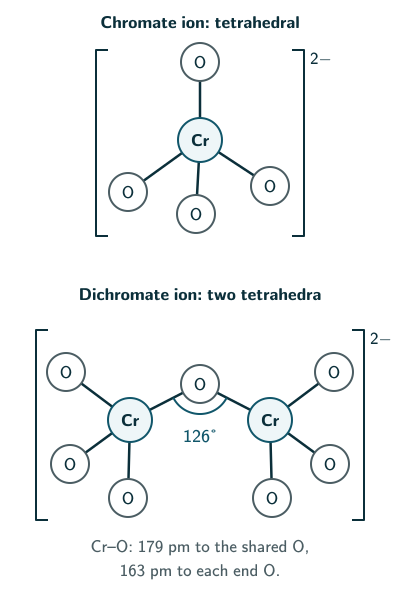
Structures. The chromate ion is tetrahedral; the dichromate ion is two tetrahedra sharing one corner, with a Cr–O–Cr angle of 126° (NCERT page 106).
Oxidising action. In acid, dichromate is a strong oxidising agent (NCERT page 106):
Dichromate in acid
Cr2O72− + 14H+ + 6e− → 2Cr3+ + 7H2O, E⊖ = 1.33 V
It oxidises iodide to iodine, sulphides to sulphur, tin(II) to tin(IV) and iron(II) to iron(III). In each, one dichromate ion takes six electrons (NCERT page 106):
- 6I− → 3I2 + 6e−
- 3H2S → 6H+ + 3S + 6e−
- 3Sn2+ → 3Sn4+ + 6e−
- 6Fe2+ → 6Fe3+ + 6e−
Adding a half-reaction to the dichromate one gives the full equation, for iron(II): Cr2O72− + 14H+ + 6Fe2+ → 2Cr3+ + 6Fe3+ + 7H2O (NCERT page 106). The Class 11 page shows this half-reaction method step by step.
Potassium permanganate: preparation, properties and uses
Preparation (NCERT pages 106–107):
- From MnO2. Fuse MnO2 with an alkali metal hydroxide and an oxidising agent such as KNO3, or air. This gives dark green potassium manganate, which disproportionates in neutral or acid solution to permanganate:
- 2MnO2 + 4KOH + O2 → 2K2MnO4 + 2H2O
- 3MnO42− + 4H+ → 2MnO4− + MnO2 + 2H2O
- Commercially, the alkaline oxidative fusion of MnO2 gives manganate (MnO42−), which is then oxidised to permanganate (MnO4−) electrolytically in alkaline solution.
- In the laboratory, a manganese(II) salt is oxidised by peroxodisulphate: 2Mn2+ + 5S2O82− + 8H2O → 2MnO4− + 10SO42− + 16H+.
Properties (NCERT page 107):
- Dark purple, almost black crystals, isostructural with KClO4. Not very soluble: 6.4 g per 100 g of water at 293 K.
- On heating it decomposes at 513 K: 2KMnO4 → K2MnO4 + MnO2 + O2.
- Its intense colour, and its diamagnetism with a weak temperature-dependent paramagnetism, need molecular orbital theory, beyond NCERT’s scope.
- Manganate and permanganate ions are both tetrahedral, with π bonding from the overlap of oxygen p orbitals with manganese d orbitals. Green manganate is paramagnetic, with one unpaired electron; permanganate has none and is diamagnetic.
Oxidising action. How far permanganate is reduced depends on the hydrogen ion concentration (NCERT page 107):
| Half-reaction | E⊖ |
|---|---|
| MnO4− + e− → MnO42− | +0.56 V |
| MnO4− + 4H+ + 3e− → MnO2 + 2H2O | +1.69 V |
| MnO4− + 8H+ + 5e− → Mn2+ + 4H2O | +1.52 V |
NCERT’s Table 2.1 (Electrochemistry) lists the last couple as 1.51 V; use the value specified in the question or chosen data table consistently.
- Electrons per MnO4−, by medium. In acid it takes 5, giving Mn2+; in neutral or faintly alkaline solution it takes 3, giving MnO2 (NCERT pages 107–108). The first couple in the table, to green manganate, takes 1. These electron counts are what titration problems use.
Kinetics matters too: at [H+] = 1 permanganate should oxidise water, but in practice the reaction is extremely slow unless Mn(II) ions are present or the temperature is raised (NCERT page 107).
In acid solution permanganate is reduced to Mn2+ (NCERT pages 107–108):
- iodide to iodine: 10I− + 2MnO4− + 16H+ → 2Mn2+ + 8H2O + 5I2
- green Fe2+ to yellow Fe3+: 5Fe2+ + MnO4− + 8H+ → Mn2+ + 4H2O + 5Fe3+
- oxalate or oxalic acid, at 333 K: 5C2O42− + 2MnO4− + 16H+ → 2Mn2+ + 8H2O + 10CO2
- hydrogen sulphide, precipitating sulphur: 5S2− + 2MnO4− + 16H+ → 2Mn2+ + 8H2O + 5S (NCERT first writes H2S → 2H+ + S2−; with the H2S molecule itself, 5H2S + 2MnO4− + 6H+ → 2Mn2+ + 5S + 8H2O, reasoned)
- sulphite to sulphate: 5SO32− + 2MnO4− + 6H+ → 2Mn2+ + 3H2O + 5SO42−
- nitrite to nitrate: 5NO2− + 2MnO4− + 6H+ → 2Mn2+ + 5NO3− + 3H2O
In the standard neutral or faintly alkaline reactions listed here it is reduced to MnO2 (NCERT page 108):
- iodide to iodate: 2MnO4− + H2O + I− → 2MnO2 + 2OH− + IO3−
- thiosulphate almost quantitatively to sulphate: 8MnO4− + 3S2O32− + H2O → 8MnO2 + 6SO42− + 2OH−
- manganese(II) to MnO2, catalysed by zinc sulphate or zinc oxide: 2MnO4− + 3Mn2+ + 2H2O → 5MnO2 + 4H+
Titrations. Permanganate titrations in these school experiments avoid hydrochloric acid, because chloride can be oxidised to chlorine (NCERT page 108).
Uses. Besides analytical chemistry, KMnO4 is a favourite oxidant in preparative organic chemistry, and its oxidising power is used to bleach wool, cotton, silk and other textile fibres and to decolourise oils (NCERT page 108).
Solved examples
Example 1: A dichromate titration
What volume of 0.0200 M K2Cr2O7 oxidises the iron(II) in 20.0 mL of 0.150 M FeSO4 in acid?
Answer: Fe2+: 0.0200 L × 0.150 mol L−1 = 3.00 × 10⁻³ mol. One Cr2O72− takes six Fe2+ (NCERT page 106), so 5.00 × 10⁻⁴ mol is needed, in 5.00 × 10⁻⁴ ÷ 0.0200 = 0.0250 L = 25.0 mL.
Example 2: Heating potassium permanganate
How much oxygen, by mass and by volume at 273.15 K and 1 bar, does 3.16 g of KMnO4 give when it decomposes? (K = 39.10, Mn = 54.94, O = 16.00 g mol−1; molar volume 22.7 L mol−1.)
Answer: M(KMnO4) = 39.10 + 54.94 + 64.00 = 158.04 g mol−1, so 3.16 g is 0.0200 mol. From 2KMnO4 → K2MnO4 + MnO2 + O2 (NCERT page 107), 0.0100 mol O2 forms: 0.320 g, or 0.0100 × 22.7 = 0.227 L.
Example 3: Green manganate, purple permanganate
Find the oxidation state and d-electron count of manganese in MnO42− and MnO4−, and explain their magnetic behaviour.
Answer: MnO42−: x − 8 = −2, so Mn is +6; formal electron bookkeeping for manganese (3d4s) assigns six electrons away, leaving d, one unpaired electron, so manganate is paramagnetic. MnO4−: x − 8 = −1, Mn +7, d, no unpaired electron, so permanganate is diamagnetic (NCERT page 107). By the spin-only formula, manganate’s moment would be √3 = 1.73 BM (reasoned).
Example 4: Oxalic acid and permanganate
What mass of oxalic acid dihydrate, H2C2O4·2H2O (126.07 g mol−1), reacts with 15.0 mL of 0.0400 M KMnO4 in hot acid?
Answer: MnO4−: 0.0150 L × 0.0400 mol L−1 = 6.00 × 10⁻⁴ mol. From 5C2O42− + 2MnO4− + 16H+ → … (NCERT page 108), oxalate is 5/2 × 6.00 × 10−4 = 1.50 × 10⁻³ mol, so the mass is 1.50 × 10−3 × 126.07 = 0.189 g.
Common mistakes to avoid
Common mistake
Calling the chromate–dichromate change a redox reaction
Chromium is +6 in both CrO42− and Cr2O72−. Acid or alkali only shifts the balance between them.
Common mistake
Confusing VO with VO
VO2+ (x − 2 = +2) holds vanadium(IV) and comes from V2O4 in acid. VO2+ (x − 4 = +1) holds vanadium(V) and comes from V2O5 in acid (NCERT page 105). Where the 2 sits decides the oxidation state.
Common mistake
Writing Mn as the product in every solution
Mn2+ forms in acid. In neutral or faintly alkaline solution permanganate stops at MnO2.
Common mistake
Mixing up manganate and permanganate
Manganate, MnO42−, is green, Mn(VI), paramagnetic. Permanganate, MnO4−, is purple, Mn(VII), diamagnetic.
Quick revision summary
- Oxides grow less ionic and more acidic as the oxidation state rises: CrO basic, CrO amphoteric, CrO acidic; MnO is a covalent green oil.
- KCrO: chromite → sodium chromate (fusion with NaCO in air) → sodium dichromate (HSO) → potassium dichromate (KCl). It is a primary standard.
- Chromate (yellow) and dichromate (orange) interconvert with pH; chromium stays +6. Dichromate in acid: E⊖ = 1.33 V.
- KMnO: MnO fused with KOH and an oxidant → green manganate → permanganate (disproportionation, or electrolytic oxidation).
- Permanganate goes to Mn in acid (E⊖ = 1.52 V) and to MnO in neutral or faintly alkaline solution; it decomposes at 513 K.
Formula sheet
- 4FeCrO + 8NaCO + 7O → 8NaCrO + 2FeO + 8CO
- 2CrO + 2H ⇌ CrO + HO
- CrO + 14H + 6e → 2Cr + 7HO (E⊖ = 1.33 V)
- 2MnO + 4KOH + O → 2KMnO + 2HO
- 3MnO + 4H → 2MnO + MnO + 2HO
- MnO + 8H + 5e → Mn + 4HO (E⊖ = 1.52 V)
- MnO + 4H + 3e → MnO + 2HO (E⊖ = 1.69 V)
- 2KMnO → KMnO + MnO + O (at 513 K)
Questions students ask
Why are KMnO4 and K2Cr2O7 coloured though Mn(VII) and Cr(VI) are d?
KMnO4 and K2Cr2O7 owe their colour to charge transfer, not to d–d transitions: Mn(VII) and Cr(VI) are d, so no d–d transition is possible (reasoned from NCERT pages 103 and 107), but visible light can move an electron from the oxygens into the metal’s empty d orbitals (beyond the NCERT text; Wikipedia, “Charge-transfer band” and “Potassium permanganate”). Such bands absorb far more strongly than d–d bands, so permanganate is intensely purple even when dilute, while molybdate and tungstate, also d, absorb only in the ultraviolet and are colourless (Wikipedia, “Charge-transfer band”).
Why does acidified potassium dichromate turn green when it oxidises something?
Acidified potassium dichromate turns from orange to green because its chromium is reduced from +6 in Cr2O72− to Cr3+ (NCERT page 106), and chromium(III) in the spent solution is green (beyond the NCERT text; Wikipedia, “Potassium dichromate”). The hexaaqua complex [Cr(H2O)6]3+ is violet, the colour NCERT Table 4.8 gives Cr3+ (page 103), but chromium(III) complexes in which anions such as sulphate or chloride replace some water are green (Wikipedia, “Chromium”, “Chromium(III) sulfate”). The colour change tells aldehydes, which it oxidises, from ordinary ketones under mild test conditions; vigorous oxidation can also break down ketones (Wikipedia, “Potassium dichromate”).
Why is potassium dichromate acidified in the usual oxidation reactions?
Potassium dichromate is a strong oxidising agent in acid because its reduction uses up 14 H+ ions per Cr2O72−, giving 2Cr3+ and 7H2O, with E⊖ = 1.33 V for standard activities (NCERT page 106). By the Nernst equation, at 298 K the potential falls by 14 × 0.059/6 = 0.138 V for each unit rise in pH, so formally at pH 3 with the other activities held at unity, it is about 0.92 V (reasoned). This illustrates the pH dependence, not the full speciation of a real solution. Alkali shifts the equilibrium towards yellow chromate, which can still oxidise suitable substrates; acid strengthens the usual dichromate oxidising action.
What is the difference between KMnO4 and K2Cr2O7 as oxidising agents?
KMnO4 is the stronger oxidant in acid, E⊖ = 1.52 V against 1.33 V (NCERT pages 106–107), but only K2Cr2O7 is a primary standard (NCERT page 106). MnO4− takes 5 electrons and Cr2O72− 6, so the equivalent mass of K2Cr2O7 in acid is 294.2/6 = 49.0 g per equivalent, against 31.6 g per equivalent for KMnO4 (reasoned). Permanganate is its own indicator, while dichromate needs diphenylamine, which it turns blue (NCERT Class 11 Chemistry, page 249).
Why is K2Cr2O7, not the sodium salt, used as a primary standard?
K2Cr2O7 is the primary standard because a weighed sample has a fixed composition: it has no water of crystallisation and, beyond the NCERT text, is not deliquescent, unlike sodium dichromate, Na2Cr2O7·2H2O (NCERT page 105; Wikipedia, “Potassium dichromate”). Water of crystallisation alone is no bar: the NCERT Laboratory Manual (Chemistry, Class 11) rules out unstable hydrated salts but accepts stable ones such as oxalic acid (page 67). The US National Bureau of Standards recrystallised K2Cr2O7, fused it at 400 °C and weighed it for standard solutions (Fowler and Bright, 1935).
Are K2Cr2O7 and KMnO4 in the JEE Main and NEET syllabus?
Yes, Unit 11 of both the JEE Main 2027 and the NEET (UG) 2026 syllabus ends its list for the transition elements with the preparation, properties and uses of K2Cr2O7 and KMnO4, so the preparations, reactions and uses on this page all come under it. The oxides and oxoanions of the 3d metals, NCERT’s Section 4.4.1, are not named as such, though the same unit lists the oxidation states of the first-row transition elements. The CBSE Class XII syllabus for 2026–27 lists the whole section, “Some Important Compounds of Transition Elements”, in Unit 4.
Practice questions
Try each question first, then open the answer to check your working.
-
Q1. Describe the preparation of potassium dichromate from iron chromite ore. What is the effect of increasing the pH of a solution of potassium dichromate? (NCERT Exercise 4.14.)
Show answerHide answer
Chromite is fused with sodium carbonate in air, giving sodium chromate; the yellow solution is acidified with sulphuric acid to sodium dichromate; potassium chloride then precipitates the less soluble potassium dichromate (equations as above, NCERT pages 105–106). Raising the pH adds OH−, which turns orange dichromate into yellow chromate: Cr2O72− + 2OH− → 2CrO42− + H2O (NCERT page 106).
-
Q2. Write the ionic equation for the reaction of acidified potassium dichromate with iodide. (NCERT Exercise 4.15 (i).)
Show answerHide answer
Add the dichromate half-reaction to 6I− → 3I2 + 6e−: Cr2O72− + 14H+ + 6I− → 2Cr3+ + 3I2 + 7H2O (reasoned from NCERT page 106). Check: charge −2 + 14 − 6 = +6 on the left and 2 × 3 = +6 on the right.
-
Q3. Why is V2O5 called amphoteric, and what does it give with alkalis and with acids?
Show answerHide answer
It reacts with both. With alkalis it gives vanadates, VO43−; with acids it gives VO2+ salts, vanadium staying +5 in both. It is mainly acidic, like the other high oxides (NCERT page 105).