The actinoids
NCERT Class 12 Chemistry Chapter 4 Section 4.6
Quick answer
NCERT treats the actinoids as thorium through lawrencium, while IUPAC’s family name also includes actinium. These radioactive elements fill the 5f region and show a wider range of oxidation states than the lanthanoids, including important nobelium in the plus-two state. Modern evidence supports a 7p electron in neutral lawrencium; NCERT gives the older 6d configuration.
With your textbook
NCERT Chemistry Part I (Class 12), Chapter 4 “The d- and f-Block Elements”, Section 4.6 “The Actinoids”, pages 111–113.
Open the official NCERT chapter (PDF, 4.2 MB, ncert.nic.in) (opens in a new tab)
Checked against the 2026-27 reprint on .
What are the actinoids?
The actinoids
The actinoids are the fourteen elements from thorium (Z = 90) to lawrencium (Z = 103), in which the 5f orbitals fill; actinium is usually discussed with them (NCERT pages 108 and 111). All are radioactive: the earlier members have relatively long half-lives, the later ones half-lives from a day down to 3 minutes for lawrencium, and the later members could be prepared only in nanogram quantities, which makes their study difficult (NCERT page 112). Strictly, a half-life belongs to a particular isotope, and the amount that can be made depends on the isotope and its production route, so these figures are not universal limits (reasoned). Their chemistry is more varied than the lanthanoids’:
There is a greater range of oxidation states, which is in part attributed to the fact that the 5f, 6d and 7s levels are of comparable energies.
NCERT Chemistry Part I (Class 12), Section 4.6.3, page 112
Naming convention: NCERT uses Th–Lr here and discusses Ac alongside them; IUPAC’s family name actinoids includes Ac–Lr. Formal oxidation states do not mean that highly charged free metal ions exist in all those compounds.
In plain words: the actinoids are the second row of the f-block. Their 5f electrons sit less deep than the lanthanoids’ 4f electrons and are close in energy to the 6d and 7s electrons, so early actinoids such as uranium can use many electrons in bonding and show states up to +6 or +7. Later in the series +3 becomes prominent, but nobelium is an important exception: No(II), with a filled 5f shell, is especially stable in ordinary aqueous chemistry.
They are the second row of the f-block, below the lanthanoids.
Electronic configurations
- The pattern. All the actinoids are believed to have 7s with a varying number of 5f and 6d electrons. The fourteen electrons are formally added to 5f, though not in thorium; from protactinium on, 5f fills (NCERT Section 4.6.1, page 112), and is already full in neutral nobelium, element 102 (NCERT Table 4.10, page 111), as well as lawrencium; NCERT’s text says the 5f orbitals “are complete at element 103” (page 112).
- Irregularities, as in the lanthanoids, come from the stability of f0, f7 and f14: americium is [Rn] 5f7 7s2 and curium [Rn] 5f7 6d1 7s2 (NCERT page 112).
- 5f against 4f. The 5f orbitals resemble the 4f in the angular part of their wave function but are not as buried, so 5f electrons take part in bonding far more (NCERT page 112).
Outside the [Rn] core (NCERT Table 4.10, page 111):
| M | Z | Atom | M3+ | M4+ |
|---|---|---|---|---|
| Ac | 89 | 6d1 7s2 | 5f0 | – |
| Th | 90 | 6d2 7s2 | 5f1 | 5f0 |
| Pa | 91 | 5f2 6d1 7s2 | 5f2 | 5f1 |
| U | 92 | 5f3 6d1 7s2 | 5f3 | 5f2 |
| Np | 93 | 5f4 6d1 7s2 | 5f4 | 5f3 |
| Pu | 94 | 5f6 7s2 | 5f5 | 5f4 |
| Am | 95 | 5f7 7s2 | 5f6 | 5f5 |
| Cm | 96 | 5f7 6d1 7s2 | 5f7 | 5f6 |
| Bk | 97 | 5f9 7s2 | 5f8 | 5f7 |
| Cf | 98 | 5f10 7s2 | 5f9 | 5f8 |
| Es | 99 | 5f11 7s2 | 5f10 | 5f9 |
| Fm | 100 | 5f12 7s2 | 5f11 | 5f10 |
| Md | 101 | 5f13 7s2 | 5f12 | 5f11 |
| No | 102 | 5f14 7s2 | 5f13 | 5f12 |
| Lr | 103 | 5f14 6d1 7s2 | 5f14 | 5f13 |
- Lawrencium. NCERT gives 5f14 6d1 7s2. Beyond the NCERT text, the Wikipedia “Electron configurations of the elements” lists [Rn] 5f14 7s2 7p1; every other actinoid there agrees with Table 4.10. Sato and colleagues’ ionisation-energy measurement supports the modern relativistic picture (Nature, 2015). In an exam, write NCERT’s 5f14 6d1 7s2 (Table 4.10, page 111), and know the modern 7p1 assignment.
- NCERT slip (Table 4.10, page 111): element 99 is spelt “Einstenium”; the name is einsteinium.
Ionic sizes
- The trend. As in the lanthanoids, the atoms and the M3+ ions grow gradually smaller across the series (NCERT Section 4.6.2, page 112).
- The numbers in NCERT Table 4.10 (page 111): M3+ falls from 111 pm (Ac3+) to 98 pm (Cf3+), and M4+ from 99 pm (Th4+) to 86 pm (Cf4+). NCERT gives no radii from einsteinium on.
Actinoid contraction
- What it is. The gradual decrease in the size of the atoms or M3+ ions across the series, by analogy with the lanthanoid contraction, is the actinoid contraction (NCERT page 112).
- Why it is larger. The contraction is greater from element to element than in the lanthanoids, because 5f electrons shield one another poorly (NCERT page 112; Intext Question 4.10, page 113).
- The tables are not a clean test of this. In NCERT Table 4.10 the M3+ radii fall 13 pm over the nine steps from Ac3+ to Cf3+ (about 1.4 pm per element), and the M4+ radii 13 pm over eight steps (about 1.6 pm); Table 4.9’s Ln3+ radii fall about 1.5 pm per element. Thus these particular tables do not establish a larger step at every atomic number. Compare like oxidation states, coordination numbers and radius conventions; NCERT’s claim is a qualitative trend, not a universal per-element inequality (reasoned from NCERT Tables 4.9 and 4.10).
- Which matters more. Both contractions affect the sizes, and so the properties, of the elements that follow them in their periods. The lanthanoid contraction is the more important, because the chemistry of the elements after the actinoids is still little known (NCERT page 113).
Oxidation states
- A wider range than in the lanthanoids, partly because the 5f, 6d and 7s levels are of comparable energies (NCERT Section 4.6.3, page 112).
- +3 in general (NCERT page 112), but the first half of the series often shows higher states: the highest state rises from +4 in thorium to +5 in protactinium, +6 in uranium and +7 in neptunium (NCERT page 112). NCERT’s text says the maximum then decreases, but its Table 4.11 gives plutonium +7 too; the fall starts at americium (+6). Beyond the NCERT text: nobelium is an important exception, since No(II), with a full 5f shell, is more stable than No(III) in water (Wikipedia, “Nobelium”), though Table 4.11 lists only +3 for it.
- Like the lanthanoids, the actinoids have more compounds in the +3 state than in the +4 state, but their +3 and +4 ions tend to hydrolyse. Because the states are spread so unevenly, it is unsatisfactory to review actinoid chemistry by oxidation state (NCERT page 112).
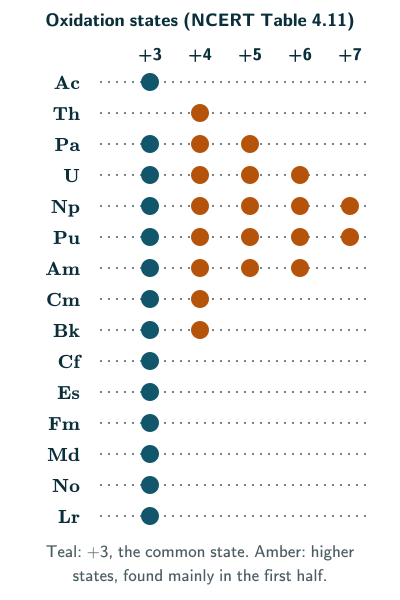
General characteristics and comparison with lanthanoids
- The metals all look silvery but have a variety of structures, because their metallic radii vary far more irregularly than the lanthanoids’ (NCERT Section 4.6.4, page 112).
- Reactivity. The actinoids are highly reactive metals, especially when finely divided: boiling water gives a mixture of oxide and hydride, they combine with most non-metals at moderate temperatures, hydrochloric acid attacks all of them, but most are only slightly affected by nitric acid, owing to protective oxide layers, and alkalies have no action (NCERT page 113). Beyond the NCERT text: these are introductory trends, since acid attack and passivation depend on the metal, acid concentration and temperature; uranium can dissolve in nitric acid, for example (Argonne National Laboratory dissolution studies).
- Magnetism is more complex than in the lanthanoids. The magnetic susceptibility varies with the number of unpaired 5f electrons roughly as the lanthanoids’ does, but the lanthanoids have the higher values (NCERT page 113). Strictly, no single inequality holds for every pair of ions, ligand environment and temperature (reasoned).
- Ionisation enthalpies. NCERT says “the ionisation enthalpies of the early actinoids, though not accurately known, but are lower than for the early lanthanoids”, because the 5f electrons are more effectively shielded from the nuclear charge than the 4f, so the outer electrons are less firmly held and available for bonding (page 113).
- NCERT slip (page 113), first ionisation energies: NCERT does not say which ionisation enthalpy it compares, but the measured first ionisation energies do not bear its statement out: thorium (6.3067 eV, about 608.5 kJ mol−1) and uranium (6.19405 eV, about 597.6 kJ mol−1) lie above cerium (5.5386 eV, about 534.4 kJ mol−1) and neodymium (5.52475 eV, about 533.1 kJ mol−1) (NIST Atomic Spectra Database). NCERT’s reason concerns the 5f and 6d electrons used in bonding, which are removed after the first; orbital occupation and relativistic effects also matter (reasoned). In an exam that asks NCERT’s comparison, give NCERT’s statement and its reason.
- The comparison. Lanthanoid-like behaviour appears only in the second half of the actinoid series, though even the early actinoids are closely similar to one another (NCERT page 113).
Lanthanoids against actinoids (drawn from NCERT pages 108–113):
- Filling: 4f with 6s (5d in La, Ce, Gd and Lu), against 5f with 7s (6d in several early atoms and Cm; modern Lr has 7p rather than NCERT’s 6d).
- f electrons in bonding: 4f orbitals are buried; 5f are less so, and 5f electrons take part in bonding far more (NCERT page 112).
- Oxidation states: mainly +3 with a few +2 and +4, against +3 to +7 (U +6, Np +7).
- Contraction: the actinoid contraction is larger from element to element.
- Magnetism: more complex in the actinoids, and the lanthanoids have the higher values (NCERT page 113); spin–orbit coupling and electronic states matter in both series, so no single unpaired-electron rule compares all their moments (reasoned).
- Ionisation enthalpies: NCERT puts the early actinoids lower than the early lanthanoids (page 113); measured first ionisation energies of thorium and uranium are higher than those of cerium and neodymium (NIST; see the slip above).
- Radioactivity: no actinoid has a stable isotope. Available quantities vary greatly: some of the latest elements are studied atom by atom, whereas californium-252 is produced for practical applications (Oak Ridge National Laboratory).
Solved examples
Example 1: Why the highest state rises, then falls
Count the electrons outside the [Rn] core in Th, Pa, U, Np and Pu, and compare with their highest oxidation states in NCERT Table 4.11.
Answer: Th 6d2 7s2 = 4, highest +4. Pa 5f2 6d1 7s2 = 5, highest +5. U 5f3 6d1 7s2 = 6, highest +6. Np 5f4 6d1 7s2 = 7, highest +7. Up to neptunium every outer electron can be used. Pu 5f6 7s2 has 8 but goes only to +7, and later elements fall back towards +3 (reasoned from NCERT pages 111–112).
Example 2: Configurations of Z = 91 and Z = 101
Write the electronic configurations of the elements with Z = 91 and Z = 101 (part of NCERT Exercise 4.34).
Answer: Z = 91 is protactinium, [Rn] 5f2 6d1 7s2; Z = 101 is mendelevium, [Rn] 5f13 7s2 (NCERT Table 4.10, page 111). Both are actinoids.
Example 3: The last actinoid
Which is the last element of the actinoid series? Write its configuration and comment on its oxidation state (NCERT Exercise 4.30).
Answer: Lawrencium, Z = 103: [Rn] 5f14 6d1 7s2 by NCERT Table 4.10. NCERT Table 4.11 lists only +3 for it, which leaves Lr3+ as 5f14, a full and stable f set (NCERT pages 111–112).
Common mistakes to avoid
Common mistake
Giving the actinoids only +3, like the lanthanoids
+3 is common, but the early actinoids reach much higher: uranium +6, neptunium and plutonium +7.
Common mistake
Starting the 5f filling at thorium
Thorium is [Rn] 6d2 7s2, with no 5f electron; 5f filling begins with protactinium. Th4+ is 5f0.
Common mistake
Calling the actinoid contraction smaller
NCERT describes a greater contraction owing to poor 5f shielding. This is a qualitative trend; individual comparisons require the same oxidation state and radius convention.
Quick revision summary
- Actinoids: Th to Lr (Z = 90–103), 5f filling with 7s and sometimes 6d; Lr is 5f 6d 7s in NCERT (modern 7p); all radioactive; accessible amounts depend strongly on element and isotope.
- 5f orbitals are less buried than 4f, so 5f electrons join in bonding; 5f, 6d and 7s are close in energy.
- Oxidation states: +3 common, with No(II) an important exception; highest +4 (Th), +5 (Pa), +6 (U), +7 (Np, Pu), then falling.
- Actinoid contraction: larger per element than the lanthanoid contraction, from poor 5f shielding.
- Highly reactive metals; acid attack and passivation depend on element and conditions; magnetism more complex than the lanthanoids’.
Formula sheet
- Actinoids: Th (Z = 90) to Lr (Z = 103)
- Typical configurations: [Rn] 5f 6d 7s; Th 6d 7s; Lr 5f 6d 7s (NCERT; modern 7p)
- Highest states: Th +4, Pa +5, U +6, Np +7
- Am: [Rn] 5f 7s; Cm: [Rn] 5f 6d 7s
Questions students ask
What is the difference between the actinoids and the transuranium elements?
The actinoids are the fourteen elements from thorium, Z = 90, to lawrencium, Z = 103 (NCERT page 111), while the transuranium elements are all those after uranium, Z = 93 to 118 so far (beyond the NCERT text; Wikipedia, “Transuranium element”). So thorium, protactinium and uranium are actinoids only, neptunium to lawrencium are both, and rutherfordium onwards are transuranium elements only. Thorium and uranium occur on Earth in quantity, with traces of protactinium, neptunium and plutonium, and the rest are man-made (Wikipedia, “Actinide”); why all are radioactive is on the Class 11 page.
How are the actinoids after uranium made?
The actinoids after uranium are made in nuclear reactions: in a reactor, uranium-238 captures a neutron, and the uranium-239 formed decays by two beta emissions, through neptunium-239, to plutonium-239 (beyond the NCERT text; Wikipedia, “Actinide”). Heavier ones come from repeated neutron capture or from bombarding targets with light ions in accelerators: lawrencium was first made in 1961 by firing boron ions at californium, and einsteinium and fermium were first found in the debris of the “Ivy Mike” hydrogen-bomb test of 1952 (same source). NCERT’s nanogram statement is historical (page 112); current accessible quantities depend strongly on the element and isotope.
Why is thorium an f-block element though its atom has no 5f electron?
Thorium is an f-block element because the actinoids are defined as a series, the fourteen elements after actinium in which 5f fills, not atom by atom: NCERT says the fourteen electrons are formally added to 5f, though not in thorium (NCERT page 112). Thorium’s 5f and 6d levels are so close in energy that its free atom happens to be [Rn] 6d2 7s2, yet its Th3+ ion is 5f1 (NCERT Table 4.10, page 111), much as gadolinium, 4f7 5d1 6s2, keeps an electron in 5d and is still a lanthanoid (NCERT Table 4.9, page 110). A configuration that breaks the filling order does not move an element out of its block (reasoned).
Practice questions
Try each question first, then open the answer to check your working.
-
Q1. Actinoid contraction is greater from element to element than lanthanoid contraction. Why? (NCERT Intext Question 4.10.)
Show answerHide answer
Each added electron goes into 5f, and 5f electrons shield one another from the nuclear charge even more poorly than 4f electrons do, so the effective nuclear charge, and the shrinking, rise faster from one element to the next (NCERT page 112).
-
Q2. The chemistry of the actinoids is not as smooth as that of the lanthanoids. Justify this with examples from their oxidation states. (NCERT Exercise 4.29.)
Show answerHide answer
The lanthanoids are almost all +3, with a few +2 and +4 ions. The textbook higher states range from +3 to +7, unevenly: thorium is +4, uranium reaches +6, neptunium and plutonium +7, while +3 predominates for many later members (NCERT Table 4.11, page 112). Beyond the NCERT text: +2 is also important for some late members, notably No(II) (Wikipedia, “Nobelium”). Because 5f, 6d and 7s are so close in energy, the number of electrons used varies from element to element (NCERT page 112).
-
Q3. Write the electronic configuration of Th4+. (NCERT Exercise 4.1 (viii).)
Show answerHide answer
Thorium is [Rn] 6d2 7s2; losing all four outer electrons gives Th4+ [Rn], 5f0 (NCERT Table 4.10, page 111).